
In This Article
What is finch food under $15 CAD? It’s a packaged seed blend (sometimes with fortified pellets or extruded morsels) made for small seed-eating birds like zebra finches, society finches and canaries. It’s sold in bag sizes that typically land under C$15 on Amazon.ca. The best ones balance canary grass seed, millet and a few oilier seeds with added vitamins.
Here’s the honest wrinkle. In my research window, many popular 2 lb (907 g) bags hovered right around that C$15 line, some under it, some a few dollars over. So this guide doesn’t just list bags. It teaches you to read a price like a grocer: per gram, per bird, per week.
Why does a Canadian pet owner care about canary seed in particular? Because Canada practically owns the crop. Saskatchewan’s government notes that Canada is the world’s largest producer and exporter of canary seed, with over half of annual world production and trade. Your finches are eating a hometown product, which is oddly satisfying.
Finches are small, fast and fussy. They burn through energy and make a glorious mess of hulls. So the cheapest bag is not automatically the cheapest bird. A C$9 mix that your flock flings onto the floor can cost more than a C$14 blend they actually eat.
Below, you’ll find seven real products, honest analysis (not hype), a cost-per-bag breakdown, refill routines for seed cups, and tips for feeding small flocks without wasting a single scoop.
Quick Comparison: 7 Budget Finch Foods at a Glance
| Product | Bag Size | Standout Trait | Typical Price Range (CAD)* | Best For |
|---|---|---|---|---|
| Kaytee Forti-Diet Pro Health Canary & Finch Food | 2 lb (907 g) | Probiotics + omega-3 | C$13-C$18 | Health-focused owners |
| Kaytee Supreme Canary & Finch Food | 2 lb (907 g) | No artificial colours/flavours | C$12-C$20 | Everyday simple feeding |
| Kaytee Fiesta Canary & Finch Food | 2 lb (907 g) | Fruit, veggie and grain pieces | C$13-C$20 | Picky eaters |
| Higgins Vita Seed Finch | 2 lb (907 g) | Extruded morsels in the mix | C$14-C$22 | Breeders and variety seekers |
| Wild Harvest Advanced Nutrition Canary & Finch | 2 lb (907 g) | Lowest likely entry price | C$7-C$12 | Tight budgets |
| Vitakraft Menu Premium Canary and Finch Food | 2.5 lb (1.1 kg) | Extra volume per bag | C$12-C$20 | Small flocks |
| Wild Harvest Universal Blend Small Bird Food | 3 lb (1.4 kg) | Best per-gram value | C$9-C$16 | Mixed small-bird homes |
*Ranges are informal estimates from the research period. Prices vary by seller and week, so check current price on Amazon.ca.
Look at the table through a value lens. The Wild Harvest Advanced Nutrition Canary & Finch is the likeliest to land comfortably under C$15, while the Wild Harvest Universal Blend Small Bird Food gives you the most grams for your dollar. Premium-leaning bags like the Kaytee Forti-Diet Pro Health and Higgins Vita Seed Finch often hover at or above the line, so patience and price-watching matter more with those.
💬 Just one click helps others make better buying decisions too!😊
Top 7 Finch Food Options Under $15 CAD: Expert Analysis
A note on method. I’m describing specs from manufacturer and retailer listings, in my own words, and framing opinions as analysis. I haven’t fed these to my own birds, and I won’t pretend otherwise. On reviews: I couldn’t verify a reliable pool of Amazon.ca reviews for each product, so I tell you what to scan for instead of inventing sentiment.
1. Kaytee Forti-Diet Pro Health Canary & Finch Food — probiotics and omega-3 in a seed bag
The headline feature is gut support. This blend adds probiotics and prebiotics to a seed-and-extruded base, plus omega-3 sources like flax and, in some versions, algae-derived DHA. Retailer listings show crude protein around 17% minimum and crude fat around 9.5% minimum. That’s a respectable profile for maintenance, though finches in breeding season need extra protein from other sources.
What does that mean in practice? Probiotics are most useful when birds are stressed, newly moved or recovering from antibiotics. Healthy adult finches on a clean diet may not “feel” the difference, so you’re paying partly for insurance.
For reviews, scan for comments on seed freshness and how much of the mix gets left behind. Those two themes decide value in any fortified blend.
Pros:
- ✅ Probiotics and prebiotics for digestion
- ✅ Omega-3 sources for feather and heart health
- ✅ Veterinarian-recommended brand positioning
Cons:
- ❌ Often sits right at or above C$15
- ❌ Fortified pieces may get picked out and ignored
Price range: roughly C$13-C$18. It’s worth it only if you catch a dip near C$15 or below.
2. Kaytee Supreme Canary & Finch Food — plain, honest everyday seed
This is the no-drama option. Its listing emphasizes a natural blend of seeds, grains and pellets, with added vitamins and minerals and no artificial colours or flavours. Simple blends like this encourage natural foraging, since birds sift through the dish to find their favourites.
Here’s the analytical catch. When birds pick favourites, the leftovers pile up, and a bag’s true cost rises. The fix is to feed small portions and top up only when the cup is nearly empty (more on that in the seed cup section).
For a first-time owner, this is a sensible baseline to compare everything else against. If your birds clear the dish evenly, you’ve found a low-waste winner.
For reviews, look for mentions of seed quality, dust and whether finches ate it evenly. Also note that one reviewer category on other retail sites complains the mix contains more than plain canary grass seed. That’s by design: it’s a mix, not a single seed.
Pros:
- ✅ No artificial colours or flavours
- ✅ Simple, familiar seed-and-grain profile
- ✅ Wide wholesale and multi-pound availability
Cons:
- ❌ Selective eating can leave piles of leftovers
- ❌ Price swings noticeably between sellers
Price range: around C$12-C$20. It’s a strong value when it’s near the low end.
3. Kaytee Fiesta Canary & Finch Food — colourful bits for fussy flocks
If your finches treat a standard seed dish like a salad bar they refuse, this is the ploy. The Fiesta line mixes fruit, vegetable and grain pieces with prebiotics and probiotics, so the dish looks more varied.
Variety is useful. Finches are seed specialists, yet captive birds benefit from some plant diversity. The caution is that colourful dried bits can be eaten first, leaving plainer seed behind. If that happens, you’re feeding a “treat-heavy” diet by accident.
My take: use it as a rotating blend rather than the sole daily food, or monitor closely for the dish being picked clean of the colourful pieces only.
Check reviews for notes on whether birds finish the whole mix or only the novelty bits, and for how fresh the seed arrives.
Pros:
- ✅ Fruit and vegetable pieces add variety
- ✅ Includes prebiotics and probiotics
- ✅ Helpful for birds bored with plain seed
Cons:
- ❌ Birds may pick out the sweet bits first
- ❌ Usually costs more per gram than plain blends
Price range: about C$13-C$20. Good as an occasional rotation, not the cheapest staple.
4. Higgins Vita Seed Finch — extruded morsels in a natural-colour blend
Higgins describes this as a natural seed blend with vitamins, minerals and trace nutrients, coloured with ingredients from seeds, spices and vegetables rather than dyes. It also includes Higgins inTune extruded morsels, which add nutrition beyond raw seed.
For you, that means a blend that behaves more like a hybrid diet. Extruded pieces are an easy way to sneak balanced nutrition into a seed-obsessed bird. The trade-off is that finches, as high-metabolism seed specialists, are known to reject pellets, so some morsels may be left uneaten.
The reputation here leans toward breeders and hobbyists who want a more complete mix, and the pricing reflects that. It frequently floats above C$15.
For reviews, scan for comments on how much of the morsel component gets eaten.
Pros:
- ✅ Colours sourced from natural ingredients
- ✅ Extruded morsels boost nutrition
- ✅ Well regarded among hobbyist breeders
Cons:
- ❌ Morsels may be ignored by some finches
- ❌ Often priced above C$15 for 2 lb
Price range: roughly C$14-C$22. It’s a deal only on a promotion you can verify.
5. Wild Harvest Advanced Nutrition Canary & Finch — the budget floor with vitamin support
This is the likeliest candidate for genuine finch food under $15 CAD. The listing promotes a daily seed-and-grain blend with vitamin A, a wide variety to encourage foraging, and support for skin and feathers.
Cheaper doesn’t mean careless here. Vitamin A matters for seed-only diets, which can run low in it. Still, a lower price usually means fewer premium inclusions, so expect a plainer, seed-forward profile.
My recommendation is to pair it with fresh greens a few times per week. A low-cost seed base plus fresh produce beats an expensive seed bag served alone.
For reviews, look for patterns around dustiness, husk-to-seed ratio and consistency from bag to bag.
Pros:
- ✅ Lowest likely cost per bag
- ✅ Vitamin A included in the formula
- ✅ Wide seed variety for foraging
Cons:
- ❌ Fewer premium extras than fortified rivals
- ❌ Quality may vary between batches
Price range: around C$7-C$12. Clear value verdict: the best “safe under C$15” starting point.
6. Vitakraft Menu Premium Canary and Finch Food — extra volume in a vitamin-fortified daily mix
Vitakraft sells this as a vitamin-fortified daily food for small pet birds, in a 2.5 lb (1.1 kg) bag. That extra half pound is a quiet advantage when you’re doing per-gram math.
What does “Premium” mean here? Mostly a seed-led blend with added vitamins rather than a radically different recipe. Think of it as the dependable middle child: not flashy, not stingy.
For a household with a small flock, the larger bag size reduces reorder frequency. That matters because every Amazon.ca order tempts you to add things you don’t need.
For reviews, check whether buyers mention freshness dates and how well the bag reseals. Seed that goes stale in a loose bag costs more than any sticker price.
Pros:
- ✅ Larger 2.5 lb bag for the money
- ✅ Vitamin-fortified daily formula
- ✅ Established small-bird brand
Cons:
- ❌ Price can drift above C$15 at some sellers
- ❌ Less distinctive than fortified Kaytee options
Price range: about C$12-C$20. A solid value if it’s under C$15 at checkout.
7. Wild Harvest Universal Blend Small Bird Food — the cost-per-gram champion
At 3 lb (1.4 kg), this blend is designed for parakeets, canaries, finches and other small birds, with seeds, veggie pieces and added vitamins and minerals. Its major selling point is sheer volume per dollar.
The catch is “universal.” A blend that serves several species is a compromise. Finches will happily pick the small seeds and may skip bigger pieces meant for parakeets. If you keep finches alone, check the bowl for rejected bulky seeds.
Where it shines is a mixed household, say finches plus a budgie, or a bird room where one big bag covers everyone.
For reviews, look for complaints about oversized seeds that finches can’t crack, and for notes on how long the bag stays fresh.
Pros:
- ✅ Most grams per dollar on this list
- ✅ Works for several small bird species
- ✅ Vitamins and minerals added
Cons:
- ❌ Some pieces too large for tiny finch beaks
- ❌ Less finch-specific than dedicated blends
Price range: around C$9-C$16. Excellent value for mixed flocks, slightly less ideal for finch-only homes.
How to Choose Finch Food Under $15 CAD
Choosing a bag is less about the label and more about your birds. Finches are part of a huge family; Wikipedia’s overview of the Estrildidae family describes these as small seed-eating passerines with short, thick, pointed bills. In other words, their beaks are built for tiny seeds, and your food should respect that.
Use these steps in order:
- Confirm the bird type. Zebra and society finches do fine on canary-and-millet blends. Larger-beaked species may handle bigger pieces. Species-specific labels beat “universal” blends for finch-only homes.
- Check the first ingredients. Canary grass seed and millets should lead the list. If fillers like corn gluten meal dominate, you’re paying for bulk, not appeal.
- Do the per-gram math. Divide bag price by grams, not pounds. A 3 lb bag at C$12 beats a 2 lb bag at C$11, even though the sticker looks higher.
- Look for fortification that fits your diet plan. Vitamins matter more if you can’t add fresh greens. Probiotics help in stressful periods, not necessarily every month.
- Assess waste potential. Blends with big colourful pieces tend to produce more leftovers. If your flock picks favourites, simpler is cheaper.
- Check freshness cues. Look for packaging dates and resealable bags. Old seed loses nutrition and attracts pantry pests.
- Compare at least three bags. A thirty-second price check across Amazon.ca listings can save more than any clever feeding trick.

Cost Per Bag: Doing the Real Math
Let’s be blunt. The sticker price is a distraction. What matters is cost per bird-day, and you can estimate it with kitchen-table arithmetic.
Veterinary guidance commonly cited for pet finches suggests most birds do well on no more than about one level teaspoon of varied seed per bird per day, served in a shallow dish. For a zebra finch weighing 10-15 g, another widely cited rule of thumb says a bird eats roughly a quarter to half its body weight daily, which is around 3-6 g. A level teaspoon of small seed weighs in the neighbourhood of 3-5 g, so the two guides agree.
Now apply it to a 2 lb (907 g) bag. At about 4 g per bird per day, that’s roughly 225 bird-days in theory. Real life brings hull waste and spills, so I’d plan on 60-70% of that, or about 135-155 bird-days.
| Bag Price (benchmark) | Approx. Cost per 100 g | Approx. Cost per Bird-Day (4 g, with waste) | Best For |
|---|---|---|---|
| C$10 | C$1.10 | about 6-7 cents | Tight budgets |
| C$12.50 | C$1.38 | about 8-9 cents | Everyday value |
| C$15 | C$1.65 | about 10-11 cents | Premium-leaning blends |
*These are illustrative benchmarks, not product prices.
Read the table like this. Even at C$15, a single finch costs around 10 cents a day, so a pair runs about C$6 per month. The difference between a C$10 bag and a C$15 bag is small per bird but adds up across a flock. The takeaway: spend extra only for features you’ll actually use, and always compare per 100 g.
Cheap Finch Seed: What You’re Really Paying For
“Cheap finch seed” is a double-edged phrase. Done well, it means smart shopping. Done poorly, it means dusty, stale or filler-heavy bags that your birds reject.
Here’s what separates a bargain from a bad buy.
Seed quality. Canary seed, millet and small oilseeds like niger and flax are the backbone of good finch blends. Beware of oversized grains and heavy filler; those are bulk, not nutrition.
Added pieces. Dried fruit and veggie bits add variety but also add cost. If your flock ignores them, you’ve paid for décor.
Oil content. Some seeds are rich in fat. A well-known avian author warns that niger, rape and linseed are mineral-rich but high in fat, and excess can cause liver problems, so they belong in small amounts. That’s a reason to avoid cheap mixes dominated by oily seeds.
Freshness. A cheaper bag that’s stale is no bargain. Old seed loses vitamins and may smell musty.
My approach: pick one or two trusted budget bags, rotate occasionally, and watch the dish. If your birds eat evenly and look bright, the cheap seed is doing its job.
Affordable Canary Seed: When It’s Worth Adding
Many finch owners wonder about affordable canary seed as a supplement or base. It’s a reasonable question, since canary grass seed is the backbone of nearly every finch blend.
Canary seed (Phalaris canariensis) is a grass seed, small and glossy, and valued for its balanced profile. The Canary Seed Development Commission of Saskatchewan notes that the crop is gluten-free but may trigger reactions in people with wheat allergy, which is a handy fact if you’re handling large amounts. Canada also supplies well over 80% of world canary seed exports, so supply here tends to be steady, though market prices can swing.
When does a plain canary seed bag make sense?
- As a base for mixing your own blend. Combine canary seed with a small share of millet and a pinch of niger for variety.
- When your finches are picky about extras. A plain base removes the temptation to pick out treats.
- When per-gram price matters most. A single-ingredient bag can beat a fortified mix on cost.
The trade-off is nutrition. Plain canary seed doesn’t carry added vitamins, so you’ll need to supply those through fresh greens, a supplement or a fortified blend used part of the time. I’d treat plain canary seed as an ingredient, not a complete diet.
Finch Food Deals on Amazon.ca: How to Spot Real Value
Finch food deals on Amazon.ca can be real, but they can also be mirages. Prices shift daily, and a “deal” on a bag that’s normally cheap isn’t much of one.
Here’s a practical checklist.
- Compare per 100 g, not per bag. Multi-packs and larger sizes often hide the best unit price.
- Watch bundle logic. A “2-pack” can be cheaper per bag or can simply bundle two small bags at a normal rate. Do the math.
- Check the seller. Items sold and shipped by Amazon or established pet brands generally have clearer freshness expectations than unfamiliar third-party listings.
- Look at date cues in reviews. Recent comments mentioning fresh seed are more useful than old praise.
- Don’t chase a “sale” label. Verify the price against what you’ve seen over several weeks. Only treat something as a deal if the current price is genuinely low.
- Consider Subscribe & Save carefully. If it’s offered, it can trim your cost, but only commit if the seed will be used before it goes stale.
💰 Pro tip: Open the listing in two tabs, one for your target bag and one for its nearest competitor, and compare grams and price side by side. It takes two minutes and works every time.
✨ Don’t Miss These Value Picks!
🔍 Ready to feed your flock without overspending? Click any highlighted product above to check current pricing and availability on Amazon.ca. A few minutes of comparison now means months of happy, well-fed birds!
Seed Cup Refills: A Schedule That Saves Money
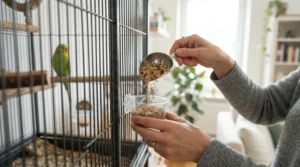
Seed cup refills are where most of your seed budget quietly disappears. Finches are messy: they dehull seeds and drop husks back into the dish, which makes a cup look full when it’s mostly empty shells.
Try this routine.
Morning check (30 seconds). Gently blow or tap off the husks so you can see the true seed level. Don’t just top up the surface.
Refill rule. Add fresh seed only when the cup is nearly empty of real seed. Leaving a small amount encourages birds to finish what’s there.
Evening glance. If the cup is empty by evening, increase the morning amount slightly. If lots of seed remains, reduce it.
Weekly deep clean. Wash and fully dry seed cups once a week. Stainless steel is hygienic and lasts longer than scratched plastic, which can harbour bacteria.
Water first. Fresh water should be changed daily. Birds that can’t drink well eat less and waste more.
Consider using two cups: one for the main blend and one for treats or grit. That way a favourite food doesn’t get buried or ignored.
The savings are real. Cutting seed waste by a quarter has the same effect as getting a quarter off the price, and no coupon is required.
Feeding Small Flocks: A Practical Daily Routine
Feeding small flocks is different from feeding one bird. Finches are social and, as Omlet’s finch feeding guide notes, a bird typically eats between a quarter and half its body weight, with no magic one-size amount. The practical goal is to leave a little seed in the dish at the end of the day, which signals you’ve got the portion about right.
For a flock of four to six finches, this routine works well:
- Offer base seed daily. Use a shallow dish or several small cups so birds don’t compete.
- Spread feeding stations. Dominant birds can guard a single cup. Two or three stations reduce squabbles.
- Add fresh foods. Finely chopped greens or vegetables a few times per week round out nutrition. Remove uneaten fresh items after a few hours.
- Watch each bird. Look for fluffed feathers, reduced activity or empty-crop behaviour. Because finches have fast metabolisms, a bird that stops eating for more than a day deserves a call to an avian vet.
- Rotate treats sparingly. Millet sprays are a classic favourite. Use them as enrichment, not a main course.
Remember too that seed should not be the entire diet. Veterinary sources suggest dry seed make up no more than about half of a pet finch’s intake, with the rest coming from greens, vegetables and suitable supplements. A cheap seed bag plus fresh produce is a smarter diet than an expensive seed bag served alone.
Real-World Scenarios: Matching Food to Your Situation
Case studies help more than abstract advice. Here are three profiles.
Scenario 1: The student with one pair of zebra finches. Budget is tight, and storage space is a shelf. A single 2 lb bag lasts a pair roughly four to five months at modest waste. The Wild Harvest Advanced Nutrition Canary & Finch is a sensible choice, topped with occasional fresh greens.
Scenario 2: The family with a six-finch aviary. Six birds at about 4 g each is 24 g daily, meaning a 2 lb bag lasts roughly five to six weeks in practice. A larger-format option like the Wild Wild Harvest Universal Blend Small Bird Food or the Vitakraft Menu Premium Canary and Finch Food lowers reorder frequency and cost per gram.
Scenario 3: The owner with a picky or recovering bird. Digestive stress calls for gentler, more fortified food. The Kaytee Forti-Diet Pro Health Canary & Finch Food is the logical pick, even if you wait for a price near C$15.
Notice the pattern. The cheapest bag isn’t always the best match, but the best match is rarely more than a few dollars above the cheapest. That’s why per-gram comparisons and a watch on your birds’ behaviour matter so much.
Finch Seed Mix vs Pellets vs Bulk Plain Seed
Which format wins on value? It depends on your birds.
| Option | Typical Cost per 100 g | Waste Level | Nutrition Completeness | Best For |
|---|---|---|---|---|
| Fortified seed mix (e.g. Kaytee Supreme Canary & Finch Food) | Mid | Medium | Good with fresh foods | Most finch owners |
| Pellets | Often higher | Low | High | Birds already weaned onto pellets |
| Plain bulk seed (canary, millet) | Low | Low-medium | Low alone | Experienced owners mixing their own |
Here’s the interpretation. Pellets look cost-heavy but waste less, yet finches are notoriously hard to convert from seed, and store-bought finches often refuse pellets entirely. That makes them a poor fit for most budget buyers. Fortified seed mixes win on practicality, and plain bulk seed wins on price only if you’re willing to supplement carefully.
Practically, I’d stick with a good mix and treat plain bulk seed as an advanced tweak.
Common Mistakes When Buying Cheap Finch Seed
Even savvy shoppers trip over the same few hazards.
Mistake 1: Buying by bag price alone. A bigger or heavier bag can be cheaper per gram. Always compare unit cost.
Mistake 2: Confusing wild bird seed with pet finch food. Outdoor wild finch blends, like nyjer or thistle mixes, are formulated for backyard feeders. The Canadian Encyclopedia notes that about 16 finch species occur in Canada and that seeds are their main food, but wild-bird bags aren’t designed as complete diets for caged birds. Choose a product labelled for canaries and finches.
Mistake 3: Ignoring freshness. A stale bag is no bargain. Check dates, sniff for mustiness and store seed airtight.
Mistake 4: Overbuying. A 20 lb bag only saves money if it’s used before it degrades. For a small flock, big bags often end up partially wasted.
Mistake 5: Over-relying on seed. Seed lacks several vitamins and minerals, so long-term seed-only feeding can cause health problems. Plan for greens and supplements.
Mistake 6: Chasing treats. Sugary or oily extras can crowd out balanced food. Offer them sparingly.
Problem → Solution: Fixing Waste, Mess and Picky Eaters
Problem: Husks everywhere. Finches fling hulls. Use a tray under the cage and a seed guard on the cup, and sweep daily.
Problem: Picky eating. If birds leave certain seeds untouched, switch to a simpler blend such as the Kaytee Supreme Canary & Finch Food, or rotate in the Kaytee Fiesta Canary & Finch Food for variety.
Problem: Seed going stale. Buy only what you’ll use in a few months, keep seed airtight, and store it somewhere cool and dry. In Canadian winters, avoid cold garages where condensation can form when bags warm up.
Problem: Costs creeping up. Track bag usage on a calendar. If a 2 lb bag stops lasting as long, check for waste before blaming the brand.
Problem: Dull feathers or low energy. Review the diet. Add fresh greens, consider a vitamin-fortified blend and, if symptoms persist, consult an avian vet.
FAQ
❓ How much does it cost to feed a finch each month?
❓ What is the best cheap finch seed for beginners?
❓ Can finches live on canary seed alone?
❓ How often should I refill my finch's seed cup?
❓ Is it cheaper to buy finch food in bulk?
Conclusion
Finding good finch food under $15 CAD is mostly a game of smart comparison. The best deal is rarely the lowest sticker; it’s the bag your birds eat evenly, at a per-gram price that fits your budget, with minimal waste.
If you want the safest budget choice, start with the Wild Harvest Advanced Nutrition Canary & Finch. If you keep several small birds, the Wild Harvest Universal Blend Small Bird Food gives the best cost per gram. If your finches are fussy, the Kaytee Fiesta Canary & Finch Food adds variety, and if digestive support matters, the Kaytee Forti-Diet Pro Health Canary & Finch Food is worth waiting on for a price near C$15. The Kaytee Supreme Canary & Finch Food, Higgins Vita Seed Finch and Vitakraft Menu Premium Canary and Finch Food round out the field for owners with specific preferences.
Whatever you pick, keep seed fresh, clean the cups weekly, add greens and watch your birds. Healthy, active finches are the best review any bag can get.
✨ Ready to stock the pantry?
🐤 Check current prices on Amazon.ca, compare per 100 g, and pick the blend that keeps your flock singing without emptying your wallet!
Recommended for You
- Finch Food Under $15 CAD: 7 Best Budget Picks In 2026
- Natural Small Bird Seed Mix Review: 7 Honest Picks (2026)
- Best Small Bird Food For Breeding Hens: 7 Proven Picks 2026
Disclaimer: This article contains affiliate links. As an Amazon Associate, I earn from qualifying purchases. If you purchase products through these links, we may earn a small commission at no additional cost to you.
✨ Found this helpful? Share it with your friends! 💬🤗
