
In This Article
Picture it: a Saturday morning in November, coffee in hand, a fresh fill of seed in the feeder. By the time the mug is empty, a grey squirrel is hanging upside down off the perch like a furry trapeze artist, and your chickadees are watching from the cedar hedge, unimpressed. Sound familiar? You are not alone, and you are not powerless either.
A well-chosen squirrel-resistant wild bird seed blend is the cheapest, quietest upgrade you can make to a backyard feeding station. It works on taste, not force. No springs, no cages, no arms race. With winter closing in across Canada and natural food getting scarce, now is exactly the moment to sort out what goes in the feeder.
Here is the honest caveat up front. Audubon’s rundown of common birdseed blends makes the point that the main reason to buy any blend is to match the birds you want to attract, and that anything beyond that is “buyer beware.” Fair. So this guide does not just rank bags. It explains how hot pepper bird seed, safflower seed for squirrel control, and pepper-free recipes actually work, where each one fails, and how squirrel behaviour and feeder placement can make or break the whole plan.
Every product below was researched from real manufacturer descriptions and published customer feedback. Where reviews were thin, I say so. Prices are ranges in Canadian dollars, so check current listings on amazon.ca before you buy.
Quick Comparison: 7 Squirrel-Resistant Bird Seed Options at a Glance
Before the deep dive, here is the lay of the land. Notice that the deterrent method matters more than the brand name. Heat, bitterness and “unspecified” each behave differently in your yard.
| Product | Deterrent Method | Seed Base | Best For |
|---|---|---|---|
| Cole’s Hot Meats | Habanero chili oil | Sunflower meats | Mixed feeders, no-mess zones |
| Wild Delight Sizzle N’ Heat | Hot pepper formula | Bird-friendly blend | Heat-first buyers |
| Birdzy Spicy No-Mess | Spicy coating | Shelled seeds | Balconies, patios, decks |
| Armstrong 100% Safflower No-Shell | Natural bitterness | Safflower | Cardinal fans, pet owners |
| West Coast Seeds Squirrel Free | Seed selection only | Mixed, no pepper | Pepper-averse households |
| Red Ribbon Squirrel-Proof Wild Bird Seed | Undisclosed deterrent | Mixed blend | Budget-conscious buyers |
| Cole’s Flaming Squirrel Seed Sauce | Capsaicin seed coating (DIY) | Your own seed | Upgrading seed you already own |
Looking at the table, the three pepper-based bags trade a little cost for the strongest taste signal, while Armstrong 100% Safflower No-Shell and West Coast Seeds Squirrel Free avoid capsaicin entirely. Budget shoppers should note that Red Ribbon Squirrel-Proof Wild Bird Seed keeps the price low but does not tell you what the deterrent is. The Cole’s Flaming Squirrel Seed Sauce is the wildcard: it is not seed at all, and it can turn the bag you already own into a squirrel-deterrent seed blend.
💬 Just one click — help others make better buying decisions too!😊
Top 7 Squirrel-Resistant Wild Bird Seed Blend Picks: Expert Analysis
1. Cole’s Hot Meats — habanero-coated sunflower meats
Start here if you want the benchmark. The recipe is sunflower hearts coated in safflower oil and liquid habanero chili, which means no shells to sweep up and a heat level squirrels notice immediately.
The spec that matters is the hulled sunflower base. Sunflower meats are what most songbirds want anyway, so you are not asking birds to accept a compromise recipe. Because there are no shells, nothing sprouts under the feeder, and every scoop is edible. On paper, that is real cost efficiency.
Birds lack the heat sensation that makes capsaicin painful to mammals, so the bag works as a one-way filter. Reviewers consistently report that birds empty the feeder quickly while squirrels sample once and leave. One reviewer described squirrels hopping off and wiping their faces on the ground. A minority report squirrels ignoring hot seed altogether, so expect good odds rather than a guarantee.
Pros:
- ✅ Habanero formula delivers a strong deterrent
- ✅ Shell-free seed means no mess
- ✅ Works in any standard feeder
Cons:
- ❌ Wear gloves when handling; wash hands afterward
- ❌ Costs more than plain sunflower seed
Expect the premium tier of the category, so check the current price. The value verdict: worth it for stubborn squirrel yards.

2. Wild Delight Sizzle N’ Heat — a premium hot blend with no fillers
This is the spicy blend for buyers who hate paying for seed that birds leave behind. The manufacturer describes it as a hot formula without filler ingredients, built to deter squirrels while keeping birds happy.
Filler-free matters because cheap blends often pad bags with milo or oats that songbirds flick onto the ground. When every kernel is something birds want, the heat has a better chance to do its job: squirrels get no consolation prize of cast-off grain.
On review evidence, one US retail listing showed a rating of about 4.1 out of 5 across 54 ratings. That is a solid but modest sample, and I could not verify detailed reviews, so treat it as a decent signal rather than proof. Compared with Cole’s Hot Meats, the case for this bag is mainly availability and brand preference rather than a different mechanism.
Pros:
- ✅ Filler-free recipe means less waste
- ✅ Hot formula aimed squarely at squirrels
- ✅ Comes in a manageable 5 lb (2.3 kg) bag
Cons:
- ❌ Limited verifiable review detail
- ❌ Small bag size raises cost per kilogram
Pricing sits in the premium tier, roughly the C$30s to C$40s for the small bag at the time of research. Value verdict: fair, especially if it is easy for you to find.
3. Birdzy Spicy No-Mess — made for balconies and tidy decks
If you feed birds from a condo balcony or a deck you actually sit on, this one is for you. The listing describes shelled, high-quality ingredients that birds eat completely, and a spicy formula that doubles as a squirrel-resistant option.
The practical translation: no husks hitting your neighbour’s patio table. That matters in dense Canadian neighbourhoods where feeding birds can strain relationships, and squirrels clearing leftovers is often what draws them in. Removing both attractions with one bag is smart design.
The product comes in an 8 lb (3.6 kg) bag through a Canadian seller, Ritchie Feed & Seed. I could not verify a meaningful pool of customer reviews, so there is no review verdict to offer. What I can say from the description is that the strategy matches how the best sealed-tidy blends work: heat plus zero shells.
Pros:
- ✅ Shell-free means cleaner balconies
- ✅ Spicy formula targets squirrels directly
- ✅ Larger bag than most premium rivals
Cons:
- ❌ Reviews are hard to verify
- ❌ Heat still demands careful handling
Look for a mid-to-premium range and check current price. Value verdict: promising for small spaces, pending more public feedback.
4. Armstrong 100% Safflower No-Shell — the cardinal magnet squirrels shrug off
No chili, no coating, no drama. This is straight safflower, and its appeal is simplicity. Safflower has a bitter taste that most squirrels dislike, while cardinals, chickadees, nuthatches and grosbeaks happily crack it.
The 9 kg (20 lb) bag makes sense if you commit. Safflower works best as a full switch, because sprinkling a little into sunflower gives squirrels an easy alternative. Several reviewers of this listing reported that cardinals and songbirds loved it and squirrels did not. One reported the opposite problem: squirrels stopped, but three weeks passed without birds noticing it.
That anecdote is useful. Birds sometimes need time to adjust, and the best fix is mixing it with your old seed and gradually shifting the ratio. Starlings and grackles generally skip it too, which is a bonus.
Pros:
- ✅ No capsaicin, so safe to handle
- ✅ Cardinals and chickadees love it
- ✅ Bitter taste deters squirrels and grackles
Cons:
- ❌ Birds may need a few weeks to adjust
- ❌ Expensive upfront in the 9 kg size
At a major Canadian retailer the big bag sat in the mid-C$50s to C$60 range. Value verdict: excellent per-use if you have cardinals nearby.
5. West Coast Seeds Squirrel Free — the pepper-free blend for juncos
Not everyone wants chili anywhere near their yard, especially with dogs around. This blend relies purely on seed selection, with no pepper or chemicals added, and it is marketed as all-natural.
The detail worth noting is that it contains some fine seeds. That makes it well suited to tube, tray or covered-dish feeders, but not most mesh feeders. Mismatch the feeder and you will have seed spilling out of the bottom. Juncos reportedly love it, which suits ground-feeding species through our long winters.
The product has a 4.3-star rating from only four reviews. That is far too small a sample to call proof, so do not buy it purely on stars. It works as a taste-and-texture bet. The seller notes the product cannot be shipped to the USA, a reminder that it is aimed squarely at the Canadian market.
Pros:
- ✅ No pepper, no chemicals added
- ✅ Attractive to juncos and other small birds
- ✅ Canadian company with multiple bag sizes
Cons:
- ❌ Not suited to most mesh feeders
- ❌ Very small review pool
Pricing varies by bag size, so check current price. Value verdict: a gentle choice, but expect weaker squirrel deterrence than pepper blends.
6. Red Ribbon Squirrel-Proof Wild Bird Seed — the budget Canadian shelf staple
This is the bargain bag. A 4.5 kg (10 lb) size is advertised to attract a variety of wild birds while deterring squirrels, and it came in under C$25 at the time of research.
The catch is transparency. The product description says it uses a “clever deterrent” without naming it. For most buyers that is fine, but if you own dogs or cats, read the label carefully for capsaicin before you scatter it around the yard. Honest advice: unclear ingredients mean unclear results, so run a small trial before committing to multiple bags.
I could not verify detailed customer review themes for this item. That is the trade-off with budget brands: less public chatter, more guessing. Compared with Cole’s Hot Meats, you are giving up proven heat and no-mess meats for lower cost.
Pros:
- ✅ Lowest price of the seven
- ✅ Easy to find at a mainstream Canadian retailer
- ✅ Decent bag size for trial runs
Cons:
- ❌ Deterrent ingredient not disclosed
- ❌ Limited review evidence
Expect a budget price, under C$25 for the 4.5 kg bag. Value verdict: low risk, moderate reward.
7. Cole’s Flaming Squirrel Seed Sauce — a DIY capsaicin seed coating
This one is the outlier. Instead of selling you seed, it sells you heat. The sauce is habanero chili in soybean oil, designed to mix into your favourite blend, creating a capsaicin seed coating you control.
The advantage is flexibility. If your birds love a particular mix, you keep it and add heat. Retailer guidance suggests about 3 tablespoons for every 5 lb (2.3 kg) of seed, though cautious users start with less and increase if squirrels persist. The coating is applied directly, so it clings better to hulled seed than to thick shells.
Handling is the trade-off. Clemson’s extension team recommends gloves with hot seed and warns about pets. Reviewers of Cole’s products tend to be positive overall on squirrel resistance, though a few found squirrels unbothered, which is true of any hot formulation.
Pros:
- ✅ Upgrades seed you already own
- ✅ Adjustable heat level
- ✅ Small bottle treats a lot of seed
Cons:
- ❌ Messy to mix; gloves essential
- ❌ Extra step every refill
Roughly C$25 to C$35 for the smaller bottle at time of research. Value verdict: great if you buy seed in bulk.
✨ Don’t Miss These Exclusive Deals!
🔍 Take your backyard feeding station to the next level with these carefully selected products. Click on any highlighted item to check current pricing and availability. These picks will help you create a calmer, birdier yard your whole family will love!
Your First 30 Days: A Practical Guide to Switching Seed
Transformation is the key word here. Nobody tells you that switching to a squirrel-deterrent seed blend is a process, not a purchase. Here is a simple schedule.
Days 1-3: clean up. Empty old seed, scrub the feeder with a diluted soap solution, and rinse thoroughly. Dry it completely. Damp feeders breed mould, and safflower in particular can spoil when wet.
Days 4-10: the gradual swap. Birds are creatures of habit. Mix your new blend with the old one at roughly one-third new to start, then increase every few days. If you are switching to straight safflower, that means slowly reducing the sunflower share until none remains.
Days 11-20: observe. Note how fast seed disappears and who is visiting. If squirrels are still hammering the feeder, check placement before blaming the seed.
Days 21-30: fine-tune. Adjust portions. Seed still lying around at dusk means you overfilled, and squirrels will happily clean it up.
For hot products, wear gloves, avoid touching your face, and wash hands afterward. Clemson University’s extension review of spicy bird seed explains that capsaicin arrives in powder or oil form and notes that pets roaming near feeders may feel a burning sensation. If a curious dog is part of your household, consider a pepper-free option such as safflower.
Problem and Solution: Fixing the Five Most Common Squirrel Headaches
Problem 1: Squirrels ignore the hot seed. Some do, and some reviewers confirm it. Solution: switch to straight safflower, which relies on bitterness rather than heat, and double-check that the feeder is not within easy jumping range.
Problem 2: Birds ignore the new seed. Birds can be conservative. Solution: blend gradually and be patient for a couple of weeks, especially when starting with Armstrong 100% Safflower No-Shell.
Problem 3: Squirrels move to the ground. Spilled seed is the usual culprit. Solution: choose no-mess formulas such as Birdzy Spicy No-Mess or Cole’s Hot Meats, which leave nothing behind but happy birds.
Problem 4: Starlings and grackles take over. Safflower helps here, since grackles and starlings usually reject it. Solution: fill feeders with safflower only for a few weeks to break the crowd.
Problem 5: Squirrels still raid anyway. Try diversion feeding. Offer corn cobs in a separate spot away from your feeders, and your squirrels may leave the bird buffet alone.
Think of seed as a pillar, not a miracle. A good blend plus careful placement solves most of these headaches.
Real-World Scenarios: Which Blend Fits Your Yard?
Scenario 1: The balcony birder. You live on the fourth floor and feed birds on a balcony railing. Budget is moderate, and shell mess would irritate your neighbours. Birdzy Spicy No-Mess or Cole’s Hot Meats fit best, because shell-free seed removes the clean-up complaint.
Scenario 2: The dog household. You have a lively labrador and a fenced suburban yard with mature maples. Capsaicin is a nuisance for pets, so go pepper-free: Armstrong 100% Safflower No-Shell or West Coast Seeds Squirrel Free, paired with a baffle.
Scenario 3: The frugal veteran. You feed three feeders daily through winter, so cost per kilogram matters. Buy plain seed in bulk and add Cole’s Flaming Squirrel Seed Sauce, starting with a light coating and increasing if squirrels persist. If you want an off-the-shelf bargain to test, Red Ribbon Squirrel-Proof Wild Bird Seed is the lowest-risk trial.
The pattern: match the product to your household, not the hype.
What Is a Squirrel-Resistant Wild Bird Seed Blend?
A squirrel-resistant wild bird seed blend is a mix of seeds, or seeds with a coating, chosen or treated so squirrels dislike the taste while birds still eat it happily. Most rely on capsaicin from chili peppers or on bitter seeds like safflower, with some designed to leave no shell waste.
There are three main families. Hot pepper bird seed is coated with capsaicin, which mammals feel as burning heat and birds do not. Bitter-seed blends lean on safflower or similar seeds that squirrels reject. Selection-only blends, like West Coast Seeds Squirrel Free, omit anything squirrels love and add nothing artificial.
The important nuance: none of these make seed “squirrel-proof.” They make it less appealing. Think of it as a bad restaurant review rather than a locked door. Good enough to change habits, rarely enough on its own to end the conversation for determined animals.
How to Choose a Squirrel-Resistant Wild Bird Seed Blend
- Decide whether pets share your yard. If dogs roam near feeders, favour pepper-free seed. Capsaicin can sting noses and paws.
- Match the bird you want. Cardinals love safflower; juncos favour fine seed mixes; chickadees take almost anything hulled.
- Check the deterrent. A product that names the ingredient, such as habanero extract, is easier to evaluate than one with a vague claim.
- Look for no-mess seed. Shell-free blends prevent ground spillage, which is where squirrels cash in.
- Pick a bag size you can finish. Seed goes stale, and safflower can mould when damp. Buy what you will use within a few weeks.
- Check feeder compatibility. Fine-seed blends can pour through mesh feeders; hulled hot seed works in most standard designs.
- Plan the budget. Compare cost per kilogram, not bag price. A larger bag often saves more than coupons.
Follow this checklist and you avoid the most common buying mistake: choosing on marketing instead of fit.
Hot Pepper Bird Seed vs Safflower Seed for Squirrel Control
This is the central choice, so let us compare plainly.
| Option | How It Works | Handling Notes | Best For |
|---|---|---|---|
| Hot pepper bird seed (e.g., Cole’s Hot Meats) | Capsaicin burns mammal taste buds | Gloves; keep pets away | Heavy squirrel pressure |
| Safflower seed for squirrel control (e.g., Armstrong 100% Safflower No-Shell) | Bitter taste turns squirrels off | Safe to handle; keep dry | Cardinals, pet owners |
| Pepper-free blend (e.g., West Coast Seeds Squirrel Free) | Leaves out squirrel favourites | No special handling | Juncos, gentle approach |
| Traditional mixed seed | No deterrent | Standard | Not recommended for squirrel yards |
Reading the table, hot pepper bird seed offers the strongest immediate deterrent, but safflower wins on safety and simplicity. If you have pets or small children, safflower is the more comfortable choice. If squirrels are relentless, start with heat.
A detail worth knowing: birds like cardinals, chickadees and nuthatches eat safflower, while starlings and some blackbirds usually skip it. That is a free filter. And the capsaicin seed coating from Cole’s Flaming Squirrel Seed Sauce can sit on top of either strategy, letting you layer deterrents.
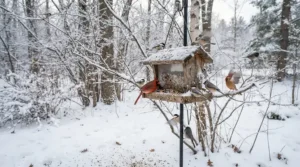
Understanding Squirrel Behaviour at Your Feeder
Squirrels are not stupid, which is exactly the problem. Cornell Lab ornithologist Kevin McGowan has noted that squirrels are very observant, and he has watched them solve baffle-equipped feeders at home. Understanding squirrel behaviour is half the battle.
First, they do not hibernate, so winter feeders are fair game all season. Second, they learn. A squirrel that finds one hot seed may sample again days later, so consistency matters. Third, they are athletes: published guidance suggests grey squirrels can jump roughly 1.2 m (4 ft) vertically and around 3 m (10 ft) horizontally. Fourth, they are opportunists, so spilled seed under the feeder is a standing invitation.
Emma Grieg of Project FeederWatch, a joint Cornell Lab and Birds Canada survey, points to launch points such as nearby trees as a key factor. That is why seed alone sometimes underperforms: if a squirrel can leap onto the feeder, it will test the menu eventually.
One more honest note. Some of the specific jump-distance numbers repeated online lack published research behind them. Treat them as starting guidelines, then watch your own squirrels and adjust.
Feeder Placement That Makes Seed Work Harder
Good feeder placement turns a decent seed blend into a reliable one. Think of seed as the bait and placement as the stage.
Keep it open. Retail guidance from Wild Birds Unlimited suggests the top of a pole baffle should sit about 1.2 to 1.5 m (4 to 5 ft) off the ground, with the pole roughly 3 m (10 ft) from anything squirrels can jump from. Fences, railings, trees and rooflines all count.
Choose the right baffle. A dome or cone placed below the feeder stops climbing; one placed above stops drops from branches. Make the baffle wide enough to prevent hugging.
Think about birds too. Nature Canada’s feeder-safety advice recommends keeping feeders outside pouncing distance of bushes where cats can hide. The Nature Conservancy of Canada also advises positioning feeders away from reflective glass to reduce window strikes.
Add a seed tray. Catching spillage prevents ground-level buffets that attract squirrels.
Combine these with a squirrel-deterrent seed blend and you have layered defences. Squirrels may still visit, but your birds eat first.
Safety and Canadian Considerations
Safety deserves its own moment, because chili peppers are not harmless to everyone.
Capsaicin and pets. Hot seed can cause a burning sensation if dogs or cats roam your feeders, according to Clemson’s guidance. If that concerns you, choose safflower or a pepper-free blend.
Handling. Wear gloves, wash your hands, and keep seed away from your eyes. Store hot seed where children cannot reach it.
Feeder hygiene. Clean feeders regularly, keep seed dry, and discard anything mouldy. Cardinals will not touch spoiled safflower.
Local rules. As far as I could find, there is no federal rule against feeding wild birds in Canada, but some municipalities have bylaws about feeding wildlife or attracting rodents. Check yours before setting up a large feeding station.
Be kind to squirrels. They have a role in nature, too. Offering a corn cob elsewhere keeps the peace without harm.
Cost, Value and Long-Term Savings
Squirrel-deterrent seed costs more per bag than plain seed, but wasted seed is the real expense. If a squirrel empties a feeder in an afternoon, cheap seed becomes the most expensive option.
| Product | Price Tier (CAD, check current) | Format | Value Verdict / Best For |
|---|---|---|---|
| Cole’s Hot Meats | Premium | Seed | Stubborn squirrel yards |
| Wild Delight Sizzle N’ Heat | Premium, roughly C$30s-C$40s | 5 lb bag | Filler-free heat |
| Birdzy Spicy No-Mess | Mid to premium | 8 lb bag | Balconies |
| Armstrong 100% Safflower No-Shell | Roughly C$50s-C$60 for 9 kg | Bulk | Cardinals, pet owners |
| West Coast Seeds Squirrel Free | Varies by size | Seed | Gentle approach |
| Red Ribbon Squirrel-Proof Wild Bird Seed | Under C$25 | 4.5 kg bag | Trial runs |
| Cole’s Flaming Squirrel Seed Sauce | Roughly C$25-C$35 | Additive | Bulk-seed buyers |
The analysis is simple. Bulk buyers get the best long-term return from Armstrong 100% Safflower No-Shell or from adding Cole’s Flaming Squirrel Seed Sauce to existing seed. Small feeders do fine with premium bags, since waste is tiny. Red Ribbon Squirrel-Proof Wild Bird Seed is your cheapest experiment. Prices change often, so check current listings.
Frequently Asked Questions
❓ Will squirrels get used to hot pepper bird seed over time?
❓ How long does safflower seed for squirrel control take to work?
❓ Can I make my own capsaicin seed coating?
❓ How much seed should I put out each day?
❓ Is a squirrel-resistant wild bird seed blend safe for dogs and cats?
Conclusion
Squirrels are not going away, and honestly, that is okay. The goal is not a squirrel-free yard; it is a yard where your birds eat first. A well-chosen squirrel-resistant wild bird seed blend gets you most of the way there.
Here is the short version. If squirrels are relentless and your pets stay indoors, start with Cole’s Hot Meats or Wild Delight Sizzle N’ Heat. If you live on a balcony, Birdzy Spicy No-Mess keeps things tidy. If you have dogs or love cardinals, Armstrong 100% Safflower No-Shell is the calmer, safer path. West Coast Seeds Squirrel Free suits pepper-averse households, Red Ribbon Squirrel-Proof Wild Bird Seed is the budget test, and Cole’s Flaming Squirrel Seed Sauce upgrades the seed you already have.
Pair your seed with sensible feeder placement, a good baffle, and respect for squirrel behaviour, and you will be set. For broader guidance on responsible feeding, the Canadian Wildlife Federation’s Hinterland Who’s Who bird feeding guide is a trustworthy next read.
✨ Ready to win the feeder wars this winter?
🔍 Pick the blend that fits your yard, check current pricing and availability, and give your birds the head start they deserve. Your chickadees will thank you!
Recommended for You
- Bulk Wild Bird Seed Value Pack: 7 Best Buys For 2026
- Wild Bird Seed: 7 Smart, Affordable Buys In Canada (2026)
- Natural Canary Food: 7 Best Picks For Canada In 2026
Disclaimer: This article contains affiliate links. As an Amazon Associate, I earn from qualifying purchases. If you purchase products through these links, we may earn a small commission at no additional cost to you.
✨ Found this helpful? Share it with your friends! 💬🤗
