
In This Article
Anyone who has ever watched a budgie demolish a bowl of seed in roughly the time it takes to make a cup of tea knows the real math of bird ownership: small birds, surprisingly large appetites. A bulk small bird food value pack is exactly what it sounds like — a larger-format bag of seed, pellets, or a seed-pellet blend sized for parakeets, budgies, cockatiels, canaries, and finches, sold at a lower per-kilogram cost than the little 500-gram pouches lining most pet store shelves. It’s the difference between refilling a dish every ten days and refilling it every ten weeks.
If you’ve got one budgie, the tiny bags are fine. If you’ve got three budgies, a cockatiel, and a finch colony that keeps multiplying (finches do that), the math changes fast, and buying small starts to feel like setting money on fire in small, adorable increments. This guide digs into the seven real, currently sold products worth considering, walks through what “bulk” actually means for a bird that eats a tablespoon a day, and tackles the practical stuff nobody puts on the packaging: how to store 25 pounds of seed without inviting pantry moths to the party, whether subscribe-and-save actually pencils out for something birds eat slowly, and where the real bulk buying thresholds sit before a “deal” quietly becomes wasted food.
Every product below is a genuine item you can research and purchase on amazon.ca — no invented brands, no made-up model numbers. Prices shift constantly, so treat every dollar figure here as a rough range rather than gospel, and always check current pricing before you click buy.
Quick Comparison Table
Before the deep dive, here’s the express version for anyone standing in the aisle (or squinting at their phone) trying to decide fast.
| Product | Best For | Format |
|---|---|---|
| Hagen Budgie Parakeet Bird Seed | Budget-conscious single-budgie homes | Seed |
| Volkman Avian Science Super Parakeet Food | Multi-bird households wanting real bulk | Seed blend |
| Lafeber’s Classic Nutri-Berries for Parakeets | Owners prioritizing complete nutrition | Pellet-seed hybrid |
Looking at this trio, the pattern that jumps out is the trade-off between upfront cost and nutritional completeness: Hagen Budgie Parakeet Bird Seed wins on price per bag but leans on seed alone, Volkman Avian Science Super Parakeet Food adds dried fruit and vegetable pieces for a broader nutrient spread at a similar per-kilogram cost once you buy the larger bag, and Lafeber’s Classic Nutri-Berries for Parakeets costs noticeably more per kilogram but is formulated to close the vitamin A and calcium gaps that plain seed mixes are notorious for. None of these three is objectively “best” — it depends whether you’re optimizing for grocery-bill relief or long-term vet-bill avoidance, and honestly, most flocks do best on a mix of the two philosophies rather than an all-or-nothing pick.
💬 Just one click — help others make better buying decisions too!😊
Top 7 Bulk Small Bird Food Value Packs: Expert Analysis
1. Hagen Budgie Parakeet Bird Seed — best large bag budgie seed on a budget
The obvious standout here is that this is a genuinely Canadian product — Hagen is manufactured by Rolf C. Hagen Inc., headquartered in Montreal, so if buying domestic matters to you, this is about as home-grown as budgie seed gets. Hagen Budgie Parakeet Bird Seed comes in a large bag format built specifically around the “large bag budgie seed” use case, with the blend air-cleaned and polished to cut down on the dust that settles at the bottom of cheaper bags and tends to trigger sneezing fits in both bird and owner. Based on the ingredient list, it’s a millet-and-grain-forward mix fortified with added vitamins and minerals rather than a plain, unfortified seed dump, which matters more than people expect since budgies can’t synthesize everything they need from raw millet alone.
Who this suits: single-budgie or two-budgie households where the bag needs to last a reasonable stretch without the owner committing to an aviary-scale purchase. Reviewers on major retail sites consistently describe budgies clearing the bag with minimal waste and note the seed arrives visibly clean and dust-free compared to bargain-bin alternatives — a common thread across multiple independent buyers rather than an isolated comment.
Pros:
- ✅ Genuinely Canadian-made, appealing for buy-local shoppers
- ✅ Air-cleaned, low-dust mix reduces mess around the cage
- ✅ Fortified with vitamins and minerals, not just raw seed
Cons:
- ❌ Seed-only formula still needs fresh produce to round out nutrition
- ❌ Largest bag size tops out smaller than some bulk-specific competitors
Price sits in the under-C$25 range for the standard large bag, climbing toward the mid-C$40s for the bigger bulk size — solid value for anyone with one or two birds who wants a trustworthy daily staple without pellet-level spending.
2. Kaytee Supreme Parakeet Food — best-known name for reliable everyday feeding
Kaytee Supreme Parakeet Food is the seed blend most Canadian bird owners have already seen on a shelf somewhere, and that ubiquity exists for a reason: Kaytee has been formulating budgie diets for decades, and the Supreme line sticks to a straightforward, no-frills seed mix without the exotic add-ins that drive up cost elsewhere. What the spec sheet won’t tell you outright is that this simplicity is actually the selling point for owners who’ve had picky eaters reject “fancier” blends loaded with unfamiliar dried fruit pieces — sometimes plain and familiar beats novel and nutrient-dense, at least until a bird is properly transitioned.
This is the pick for budget-first buyers who want a name-brand safety net rather than a boutique blend, and for anyone managing a mixed flock where a simple base seed gets supplemented with fresh vegetables and occasional pellets on the side. Aggregated review sentiment across pet retail sites points to consistent freshness and few complaints about mold or must, which for a seed product sitting in a warehouse for months is not a small thing.
Pros:
- ✅ Widely available with strong brand-recognition track record
- ✅ Simple formula suits picky or seed-set birds well
- ✅ Reliable freshness reported across most review sources
Cons:
- ❌ Fewer added extras (fruit, veg pieces) than pricier blends
- ❌ Not a nutritionally complete standalone diet
Expect to pay in the C$10-C$20 range for smaller bags, moving into the C$30-C$45 range for the bulk sizes — check current price, since Kaytee’s bulk-size availability shifts by retailer.
3. Volkman Avian Science Super Parakeet Food — best true bulk bag for multi-bird flocks
If the goal is genuinely stretching a purchase across a busy aviary rather than a single cage, Volkman Avian Science Super Parakeet Food is where the “value pack” idea stops being marketing language and starts being literal — it’s sold in bulk formats up to 20-pound bags, a size category most competitors don’t even offer. Based on the ingredient breakdown, this blend goes further than a basic seed mix, folding in flax seed, canola seed, nyjer, dehydrated carrot, dried papaya, coconut, and spinach flakes alongside the expected millet and oat groats, which gives foraging birds more textural and flavor variety to pick through — arguably closer to what a wild budgie would encounter than a monotone seed bowl.
Here’s what matters in practice: the feeding guidance calls for roughly 1.5 to 2 tablespoons per bird daily, so a 20-pound bag realistically stretches for months even with a small flock, which is exactly the math that makes bulk buying thresholds worth calculating before you buy the smaller bag out of habit. Reviewers repeatedly mention birds eating with minimal shell waste and describe the mix as noticeably fresher than what they’d sourced locally, a recurring theme rather than a one-off comment.
Pros:
- ✅ True bulk sizing (up to 20 lb) built for larger flocks
- ✅ Broader ingredient variety than basic seed-only mixes
- ✅ Repeatedly praised for freshness in aggregated reviews
Cons:
- ❌ Contains added colour and sugar per the ingredient list
- ❌ Smallest available bag (4 lb) is pricier per pound than rivals’ small bags
Pricing runs roughly C$15-C$20 for the 4-pound bag, dropping meaningfully on a per-kilogram basis once you commit to the 20-pound size — a textbook case of bulk buying only paying off past a certain flock-size threshold.
4. Wild Harvest Universal Blend Small Bird Food — best multi-species daily blend
Not every household has just budgies — plenty have a mixed cage of parakeets, canaries, and finches sharing the same feeding routine, and Wild Harvest Universal Blend Small Bird Food is built precisely for that scenario rather than forcing owners to buy three separate species-specific bags. The blend combines seed with dried vegetable pieces and is fortified with vitamins and minerals aimed at supporting skin and feather condition, which the spec sheet frames as a beauty claim but which, in practical terms, reflects the biotin and omega content birds need to avoid the dull, patchy plumage that shows up on nutrient-poor diets.
Who this fits: households with a mixed small-bird collection who’d rather manage one bag than juggle several, and owners newer to bird-keeping who appreciate a single trustworthy default rather than researching species-specific formulations from scratch. The 3-pound bag size sits smaller than some of the true bulk options on this list, so it suits moderate households more than large aviaries chasing maximum bulk buying thresholds.
Pros:
- ✅ One blend covers parakeets, canaries, and finches
- ✅ Vitamin and mineral fortification supports feather condition
- ✅ Accessible entry point for newer multi-bird households
Cons:
- ❌ 3 lb bag size caps out below true bulk competitors
- ❌ Less ingredient variety than Volkman’s more elaborate blend
At roughly C$8-C$15 per bag depending on retailer, this lands as a mid-range option — not the cheapest per kilogram, but a fair trade for the convenience of one bag serving several species.
5. ZuPreem Smart Selects Parakeet & Budgie Food — best hybrid seed-and-pellet blend
ZuPreem Smart Selects Parakeet & Budgie Food occupies the middle ground between plain seed and full pellet diets, blending Smart Pellets into the mix alongside conventional seed so birds get some of the nutritional completeness of pellets while still enjoying the shelling and foraging behavior that keeps seed-eating birds mentally engaged. Made in the USA and fortified with added vitamins and minerals, the “Smart” branding refers to the pellet component being designed to be more palatable to seed-loyal birds than a straight pellet-only diet, which — based on the formulation logic — is meant to ease the seed-to-pellet transition avian vets frequently recommend.
This is the pick for owners who’ve heard the “seeds alone aren’t a complete diet” warning from their vet but have a bird who turns its beak up at pure pellets. Reviewers commonly describe it as a reasonable middle step, with birds eating both the seed and pellet components rather than picking around the pellets entirely, which isn’t guaranteed with every hybrid blend on the market.
Pros:
- ✅ Bridges the seed-to-pellet nutritional gap gradually
- ✅ Made in the USA with added vitamin/mineral fortification
- ✅ Reasonable acceptance rate reported for the pellet portion
Cons:
- ❌ 2 lb bag size is the smallest on this list
- ❌ Costs more per pound than pure seed blends
Expect roughly C$8-C$14 for the 2-pound bag — a premium per kilogram compared to bulk seed, but a reasonable price for a transitional formula doing double nutritional duty.
6. ZuPreem Natural Pellets, Small Bird — best economy small bird pellets option
For owners specifically hunting economy small bird pellets rather than seed, ZuPreem Natural Pellets is the straightforward pick: a 100% pellet formula for budgies, parrotlets, and doves that skips the seed component entirely, meaning there’s no picking-and-choosing behavior for birds to exploit. Made in the USA, the “Natural” branding on this ZuPreem line typically signals a formula built without artificial dyes, which matters to owners uneasy about the bright, unnaturally colored pellets some competitors produce purely for shelf appeal.
Because every pellet is uniform, birds can’t selectively eat the tasty-but-nutritionally-thin bits and leave the rest, which is the core argument avian vets make for pellets over seed in the first place — you can’t have a picky eater problem if every bite is identical. This suits owners actively transitioning a bird off seed, or anyone who has already made that switch and simply wants an economical way to keep buying pellets without paying boutique prices. Aggregated reviews suggest acceptance varies noticeably by individual bird, which tracks with the well-documented reality that pellet conversion can take weeks of patient, gradual mixing rather than an overnight swap.
Pros:
- ✅ 100% pellet format eliminates selective-eating waste
- ✅ Reportedly free of artificial dyes per the “Natural” formulation
- ✅ Economical relative to boutique pellet brands
Cons:
- ❌ Some birds resist the transition from seed entirely
- ❌ Less foraging engagement than seed or hybrid formats
Pricing typically falls in the C$10-C$18 range depending on bag size — genuinely the more economical small bird pellets choice on this list for owners ready to commit to pellet feeding.
7. Lafeber’s Classic Nutri-Berries for Parakeets — best premium foraging-focused pick
At the top end sits Lafeber’s Classic Nutri-Berries for Parakeets, a pellet-and-seed hybrid pressed into bite-sized foraging shapes rather than loose mix, formulated with input from avian veterinarians and nutritionists specifically to be nutritionally complete rather than a supplement to something else. What the spec sheet won’t fully convey is the behavioral upside: because each berry is a compact, textured shape a bird has to work at rather than a pile of loose seed it can inhale in seconds, this formula is frequently recommended as enrichment for birds prone to boredom-driven feather plucking or excessive vocalizing, not purely as a nutrition product.
This is the premium pick for owners prioritizing complete, vet-informed nutrition and mental stimulation over the lowest possible per-kilogram cost, and for birds transitioning off seed who need something more engaging than plain pellet pieces to hold their interest. Reviewers across major retail platforms consistently praise the foraging value and note reduced pickiness compared to loose pellets, though several also flag the noticeably higher price point relative to seed-based options on this list.
Pros:
- ✅ Nutritionally complete formula developed with avian vets
- ✅ Foraging shape adds mental enrichment, not just calories
- ✅ Strong acceptance reported even among former seed-only birds
Cons:
- ❌ Most expensive per kilogram on this comparison
- ❌ Bag sizes run smaller than dedicated bulk seed options
Budget around C$18-C$28 for the 3.25-pound bag — genuinely premium pricing, but arguably the best value-for-nutrition ratio if you’re weighing long-term vet costs rather than just the grocery receipt.
Full Spec Comparison: Top 7 Bulk Small Bird Food Value Packs
| Product | Format | Bag Size Range | Best For |
|---|---|---|---|
| Hagen Budgie Parakeet Bird Seed | Seed | Up to ~11 lb | Budget single-bird homes |
| Kaytee Supreme Parakeet Food | Seed | Small to bulk | Name-brand reliability |
| Volkman Avian Science Super Parakeet Food | Seed blend | 4-20 lb | Multi-bird flocks |
| Wild Harvest Universal Blend | Seed + veg | ~3 lb | Mixed-species cages |
| ZuPreem Smart Selects | Seed-pellet hybrid | ~2 lb | Seed-to-pellet transition |
| ZuPreem Natural Pellets | Pellet | Varies | Economy pellet feeding |
| Lafeber’s Classic Nutri-Berries | Pellet-seed hybrid | ~3.25 lb | Premium nutrition + enrichment |
Reading across this table, the size column tells most of the story: Volkman Avian Science Super Parakeet Food is the only option genuinely built for aviary-scale bulk buying, while ZuPreem Smart Selects and Lafeber’s Classic Nutri-Berries cap out smaller because their formulas cost more to produce per unit. If your household has more than two or three birds, the math consistently favors starting your shortlist with the bulkiest available bag rather than the cheapest small one, since per-kilogram cost drops fastest in the jump from a 2-pound bag to anything in double digits.
✨ Don’t Miss These Exclusive Deals! 🐦
Take your flock’s feeding routine to the next level — click any highlighted product above to check today’s pricing before stock shifts.
Bulk Value Packs vs Small Bags: Benefits Compared
| Factor | Small Bags (Under 3 lb) | Bulk Value Packs (10+ lb) |
|---|---|---|
| Cost per kilogram | Highest | Lowest, once flock size justifies it |
| Freshness risk | Low (used quickly) | Higher without airtight storage |
| Shopping frequency | Frequent | Infrequent |
| Best For | Single bird, small budget | Multi-bird households, aviaries |
The trade-off in this table is really a freshness-versus-cost equation: small bags cost more per kilogram but get eaten before staleness becomes an issue, while bulk value packs save real money but only if you’re disciplined about storage — a 20-pound bag of Volkman Avian Science Super Parakeet Food sitting open in a humid kitchen for six months isn’t a deal, it’s a slow-motion mold experiment. According to CBC’s reporting on Canadian households fighting rising food costs, bulk buying is one of the most consistently recommended tactics for stretching a grocery budget, and the same logic scales down neatly to pet food — provided the storage side is handled properly, which the next section covers in detail.
Practical Usage Guide: Feeding & Transitioning Your Birds
Buying a bulk small bird food value pack is only half the equation — using it correctly is what actually delivers the savings. Start by measuring, not eyeballing: a single budgie eats roughly one to two tablespoons of seed or pellets daily, so scooping loosely from a 20-pound bag “until the dish looks full” is the single fastest way to blow through a bulk purchase faster than the smaller bags it was supposed to replace.
If you’re transitioning from a seed-only diet toward a pellet or hybrid product like ZuPreem Natural Pellets or ZuPreem Smart Selects, do it gradually over two to three weeks — mix a small amount of the new food into the familiar bowl and slowly increase the ratio, since birds can be stubborn enough to skip eating entirely rather than accept an abrupt swap. Keep a close eye on droppings and weight during any transition; a sudden drop in either is the signal to slow down and consult an avian vet rather than push through.
For first-30-days mistakes: don’t fill the food dish to the brim daily “just in case,” since uneaten seed sitting in a humid cage environment attracts mold faster than most owners expect, and don’t skip rotating fresh produce alongside seed or pellets just because the bag says “complete diet” — even the best-formulated products from Lafeber’s Classic Nutri-Berries to Wild Harvest Universal Blend benefit from the vitamin boost of the occasional leafy green.
Real-World Scenarios: Matching Bulk Bird Food to Your Flock
The single-budgie apartment owner: One bird, limited storage space, tight grocery budget. A large bag of Hagen Budgie Parakeet Bird Seed or Kaytee Supreme Parakeet Food hits the sweet spot — enough bulk to save money without the freshness risk of a 20-pound bag that a lone budgie will take a year to finish.
The multi-bird backyard aviary keeper: Five, ten, or more budgies and parakeets sharing an outdoor or garage aviary in, say, the Fraser Valley or southern Ontario. This household genuinely justifies Volkman Avian Science Super Parakeet Food in its 20-pound format, since the daily consumption volume clears the bag fast enough that freshness stays manageable even without refrigeration, provided airtight storage is in place.
The mixed-species household transitioning to pellets: A family with a canary, two finches, and a budgie whose vet has recommended moving toward pellets for long-term health. This is the profile that benefits most from starting with ZuPreem Smart Selects as a bridge product before eventually settling into ZuPreem Natural Pellets or Lafeber’s Classic Nutri-Berries once the birds have fully adjusted.
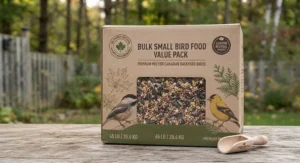
How to Choose a Bulk Small Bird Food Value Pack
- Count your actual daily consumption first. Multiply the number of birds by roughly 1-2 tablespoons daily before deciding how large a bag makes sense — buying bulk for a single bird often backfires.
- Decide seed, pellet, or hybrid based on vet guidance. If a vet has flagged nutritional concerns, lean toward pellet-inclusive options like ZuPreem Natural Pellets over pure seed.
- Check the ingredient list for added sugar and dye. Some bulk blends, including parts of the Volkman Avian Science Super Parakeet Food line, include cosmetic colouring that adds no nutritional value.
- Confirm your storage setup can handle the bag size. No airtight container big enough? Don’t buy the 20-pound bag yet.
- Compare price per kilogram, not per bag. A cheaper small bag can cost more per kilogram than a pricier bulk one.
- Factor in shelf life realistically. Multi-bird households clear bags faster and can safely buy bulkier; single-bird homes should stay moderate.
- Read aggregated review sentiment, not just star ratings. Look specifically for freshness complaints, which matter more for bulk bags sitting longer before the bottom is reached.
Common Mistakes When Buying Small Bird Food in Bulk
Buying the biggest bag simply because the per-kilogram price looks best is the single most common misstep — if a bag will sit open for eight months before a single bird finishes it, any savings evaporate the moment mold or rancid oils from sunflower seed content set in. A second frequent mistake is treating “bulk” and “cheap” as synonyms; some bulk-format products like Lafeber’s Classic Nutri-Berries cost more overall precisely because the formulation quality is higher, and choosing based on bag size alone misses that distinction entirely.
Owners also commonly skip checking whether a bulk blend is genuinely species-appropriate — a large bag of budgie-specific seed like Hagen Budgie Parakeet Bird Seed isn’t automatically suitable for a canary or finch sharing the same cage, since seed size and nutrient ratios vary by species. Finally, plenty of buyers forget to plan storage before the bag arrives, discovering only after the fact that they don’t own a container airtight or large enough to hold 20 pounds of seed safely.
Seeds vs Economy Small Bird Pellets: Which Wins on Value
The seed-versus-pellet debate isn’t purely nutritional — it’s also a genuine economy small bird pellets value question once you factor in waste. Seed mixes let birds selectively eat their favourite pieces (usually the fattiest, least nutritious ones) and discard the rest, meaning a portion of every bag’s weight never actually gets consumed as intended. Economy small bird pellets like ZuPreem Natural Pellets eliminate that selective waste since every piece is nutritionally identical, which can make a cheaper-looking pellet bag more economical in practice than a bigger seed bag once you account for what actually ends up eaten versus swept off the cage floor.
That said, seed retains real advantages: lower sticker price per bag, higher palatability for picky eaters, and genuine foraging engagement that pure pellets can’t replicate without the extra formulation cost seen in something like Lafeber’s Classic Nutri-Berries. The honest answer for most households is a blended approach — a seed-forward bulk bag like Volkman Avian Science Super Parakeet Food as the daily base, supplemented with a modest rotation of economy pellets to close nutritional gaps without committing fully to either extreme.
Bulk Buying Thresholds: When a Bigger Bag Actually Pays Off
Bulk buying thresholds are the specific point where a larger bag stops being a marketing upsell and starts genuinely saving money — and that point depends almost entirely on flock size and consumption speed, not on the sticker price alone. As a rough guide, a single budgie eating roughly one tablespoon daily gets through about 1.5 pounds of seed a month; at that rate, a 20-pound bag like Volkman Avian Science Super Parakeet Food would take well over a year to finish, long past the point where freshness and mold risk outweigh the per-kilogram savings.
The threshold shifts dramatically with three or more birds, where monthly consumption climbs into the 4-6 pound range and a 20-pound bulk bag clears in four to five months — comfortably inside most seed products’ realistic shelf life when stored properly. As a practical rule, single or double-bird households should generally cap purchases around the mid-size bags (roughly 6-11 pounds) offered by products like Hagen Budgie Parakeet Bird Seed, while genuine multi-bird flocks are where the true bulk formats justify themselves financially.
Subscribe & Save: Is It Worth It for Small Bird Food?
Small bird food subscribe and save programs, offered by most major Canadian pet retailers and Amazon itself, typically shave 5-15% off a recurring order in exchange for scheduled automatic deliveries — and whether that’s worth it comes down almost entirely to how predictably your flock eats. For a stable single-budgie household running through a bag of Kaytee Supreme Parakeet Food on a consistent monthly cycle, subscribe and save genuinely makes sense: the discount is real money saved on a purchase you’d make anyway, and the auto-delivery removes the “oh no, we’re out” scramble.
Where it gets riskier is bulk-format products bought for larger flocks; committing to recurring shipments of a 20-pound bag before you’ve confirmed your actual consumption rate can leave you buried in unopened bags of Volkman Avian Science Super Parakeet Food while the earlier bag is still barely touched, and stacked, unopened bulk bags don’t stay fresh indefinitely just because they’re sealed. The safest approach is running one manual bulk purchase first to establish your real consumption timeline, then converting to a subscribe and save schedule only once you know how many months a bag genuinely lasts your household.

Airtight Storage: Keeping Bulk Bird Food Fresh for Months
Airtight storage isn’t optional once you’ve committed to a bulk small bird food value pack — it’s the single factor separating genuine savings from a slow-motion waste of money. Stored grain products, seed included, are a known attractant for pantry pests; the Canadian Grain Commission’s guidance on managing stored grain quality notes that insect infestations thrive wherever grain products sit exposed to warmth and humidity, and the exact same risk applies at kitchen-counter scale to an open bag of Wild Harvest Universal Blend or Volkman Avian Science Super Parakeet Food left loosely resealed in a cupboard.
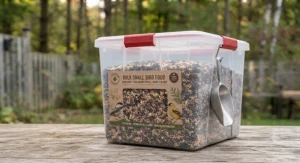
The fix is straightforward: transfer bulk seed or pellets into hard-sided, genuinely airtight containers — food-grade plastic bins or glass jars with sealed lids, not just the bag’s built-in zip closure, which loosens with repeated use and lets both moisture and pests in. Store containers in a cool, dry spot away from direct sunlight and stovetop humidity, and where possible, keep a portion refrigerated (a step several manufacturers, including Hagen’s product guidance, specifically recommend for opened seed) to extend freshness further during warmer months. Labelling containers with the purchase date and rotating older stock to the front prevents the classic bulk-buying trap of forgetting a container exists until it’s well past its best.
Safety, Regulations & Freshness in Canada
Unlike human food, pet food in Canada — including small bird food — isn’t comprehensively regulated the way most owners assume. According to the Canadian Food Inspection Agency, oversight is largely limited to import and export compliance for animal by-products rather than domestic manufacturing standards, which means the burden of checking ingredient quality, freshness, and appropriate fortification falls more heavily on the buyer than it would with, say, packaged human cereal.
Practically speaking, this means reading labels carefully matters more in Canada’s regulatory environment than some shoppers expect: look for a clear best-before date, a transparent ingredient list rather than vague “grain products” language, and manufacturer storage guidance (like refrigeration recommendations) that signals the company has actually thought through freshness rather than just packaging and shipping. None of the seven products featured here raised red flags in that regard, but it’s a habit worth building for any future bulk purchase.
Frequently Asked Questions
❓ Is buying bird seed in bulk cheaper?
❓ How long does bulk bird seed stay fresh once opened?
❓ Can budgies eat the same food as finches or canaries?
❓ Are pellets better than seed for small birds?
❓ Is subscribe and save worth it for pet bird food?
Conclusion
There’s no single “best” bulk small bird food value pack — there’s only the best one for your specific flock, budget, and storage setup. A single budgie in a downtown condo has completely different needs than a backyard aviary with a dozen parakeets, and the seven products covered here span that entire range, from the wallet-friendly, Canadian-made Hagen Budgie Parakeet Bird Seed through to the nutritionally rigorous Lafeber’s Classic Nutri-Berries for Parakeets.
What matters most is doing the math before you buy: count your birds, estimate real consumption, confirm you can store the bag airtight, and only then chase the biggest bag on the shelf. Get that sequence right and bulk buying genuinely saves meaningful money over months of small-bag purchases; get it backward and you’re just storing future mold in a bigger container.
✨ Ready to stock up smarter?
Click through to check today’s prices on any product above before restocking your birds’ pantry. 🐦
Recommended for You
- 7 Best Small Bird Food Picks For Canadian Flocks In 2026
- 7 Best Natural Parrot Food Picks For Canadian Birds
- Parrot Food For Feather Health: 7 Top Picks Ranked For 2026
Disclaimer: This article contains affiliate links. As an Amazon Associate, I earn from qualifying purchases. If you purchase products through these links, we may earn a small commission at no additional cost to you.
✨ Found this helpful? Share it with your fellow bird-loving friends! 💬🤗
