
In This Article
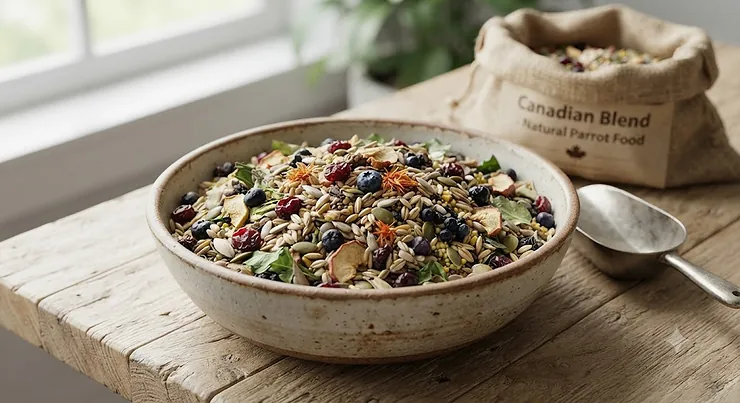
If you have ever stood in the bird aisle staring at a wall of bags that all claim to be “natural,” “premium,” or “veterinarian recommended,” you already know the problem: those words mean almost nothing on their own. natural parrot food is any diet formulated primarily from whole-food ingredients — grains, legumes, fruits, and vegetables — with vitamins and minerals added to meet a parrot’s nutritional needs, and without synthetic dyes or artificial flavourings. That is the textbook definition, but it does not tell you which bag on the shelf actually earns the label.
Here is what most bird owners eventually discover the hard way: the difference between a genuinely wholesome diet and clever marketing usually comes down to three things — what preserves the fat from going rancid, whether the “vegetables” are a garnish or a real ingredient, and how your individual bird’s body actually responds to it. Parrots belong to the order Psittaciformes, a group of birds whose wild diets are wildly varied and whose captive nutrition science is honestly still catching up — a fact that becomes obvious the moment you start comparing ingredient panels side by side (Wikipedia’s overview of parrot biology and diversity is a useful primer if you want the ecological backstory).
This guide walks through seven real, Canadian-available products spanning budget, mid-range, and premium tiers, with honest analysis of what each ingredient panel actually means for your bird’s health — not just a repeat of what’s printed on the bag. We will also dig into organic parrot pellets, preservative-free parrot food, and the surprisingly common issue of avian allergies, because these three topics come up in almost every conversation about switching a parrot’s diet. By the end, you should be able to walk into (or click through) a pet store with a shopping list that actually fits your bird, your budget, and your province’s climate for storage.
Quick Comparison Table
| Product | Best For | Price Range (CAD) |
|---|---|---|
| Harrison’s Bird Foods Adult Lifetime Organic Pellets | Allergy-prone or sensitive species (African Greys, Eclectus) | C$25–C$65 |
| TOP’s Parrot Food Organic Pellets | Owners who want zero corn, soy, or peanut fillers | C$25–C$45 |
| ZuPreem Natural Bird Food | Budget-conscious first-time pellet buyers | C$20–C$85 |
| Roudybush Daily Maintenance | Converting seed-addicted birds without breaking the bank | C$25–C$95 |
| Hagen Tropican Lifetime Formula | Canadian-made, low-dust granules | C$20–C$95 |
Looking at this snapshot, the split is fairly clean: Harrison’s Bird Foods and TOP’s Parrot Food sit at the organic, allergy-conscious end of the spectrum, while ZuPreem Natural anchors the budget tier without sliding into seed-mix territory. Roudybush Daily Maintenance and Hagen Tropican land in the middle, and both happen to be popular conversion diets among breeders precisely because birds tend to accept them readily. None of these five require you to guess at nutrient completeness — they are all formulated diets, not seed blends dressed up with a few dried fruit pieces.
💬 Just one click — help others make better buying decisions too!😊
Top 7 Natural Parrot Food Products: Expert Analysis
1. Harrison’s Bird Foods Adult Lifetime Fine Organic Pellets — the vet-trusted organic staple
The standout here is simple: this is one of the only pelleted diets that is fully USDA Organic certified, meaning every grain and legume in the bag was grown without synthetic pesticides. That single certification does more heavy lifting than most feature lists.
Harrison’s Bird Foods uses whole grains, seeds, and legumes as the base, with naturally occurring vitamins and minerals rather than a synthetic vitamin pre-mix sprayed on afterward — a distinction that matters because synthetic-coated pellets lose potency faster once the bag is opened. Because oxidation happens quickly once the bag is cracked, Harrison’s recommends refrigeration or freezing after opening, which is a genuine inconvenience worth knowing before you buy the largest bag available.
Based on the formulation, this is the pick most avian veterinarians default to when a client mentions feather plucking, chronic GI issues, or a suspected sensitivity, since it removes synthetic preservatives and colourants from the list of possible triggers entirely. Reviewers consistently report that fussy eaters — African Greys in particular — take longer to transition onto it than onto sweeter, fruit-flavoured pellets, but that once converted, birds rarely go back to seed.
Pros:
- ✅ USDA Organic certified with no synthetic pesticide residue
- ✅ No artificial colours, flavours, or chemical preservatives
- ✅ Frequently the default recommendation from avian veterinarians
Cons:
- ❌ Short shelf life once opened; needs refrigeration or freezing
- ❌ Higher price per kilogram than most competitors
Priced around C$25–C$65 depending on bag size, Harrison’s Bird Foods is not the cheapest option on this list, but for birds with a documented sensitivity or a vet-recommended elimination diet, the value case is straightforward.
2. TOP’s Parrot Food Organic Pellets — the cleanest ingredient list on the market
What sets this one apart is what is missing: no corn, no soy, no peanuts, and no wheat — a filler-free formulation that is genuinely rare among pelleted diets.
TOP’s Parrot Food is cold-pressed rather than extruded, a manufacturing choice that keeps processing temperatures lower and, according to the company, preserves more of the naturally occurring nutrient content in the raw organic ingredients. It is naturally preserved using rosemary, rose hips, and citrus peel instead of synthetic antioxidants like ethoxyquin or BHA/BHT, which is exactly the kind of preservative-free parrot food profile that owners chasing an allergen-light diet tend to search for.
What most buyers overlook about this brand is that the absence of corn and soy is not just a purity flex — for a bird with a suspected grain sensitivity, eliminating the two most common allergenic grains in one step can shortcut months of trial-and-error elimination dieting. Reviewers note mixed acceptance rates, with some birds converting easily and others holding out; this appears to track with how seed-dependent the bird was beforehand rather than any flaw in the food itself.
Pros:
- ✅ Zero corn, soy, peanut, or wheat fillers
- ✅ Naturally preserved with rosemary, rose hips, and citrus peel
- ✅ Cold-pressed processing retains more raw nutrient content
Cons:
- ❌ Some birds are slow to accept the unfamiliar pellet texture
- ❌ Limited availability compared to bigger-box brands
At roughly C$25–C$45 per bag depending on size, TOP’s Parrot Food sits in the same premium tier as Harrison’s Bird Foods, and the two are frequently recommended together as interchangeable organic options.
3. ZuPreem Natural Bird Food — the best budget-friendly natural pellet
The standout advantage is accessibility: this is a genuinely natural, additive-light formula sold at a price point and in a distribution network — big-box pet retailers across Canada — that most premium organic brands cannot match.
The formula blends five whole grains with real dried celery, carrots, parsley, beets, blueberries, cranberries, and ground flaxseed, and it skips artificial colours and flavours entirely. On paper this means a bird gets some of the antioxidant and fibre benefits of fresh produce baked directly into the daily staple, rather than relying solely on the owner remembering to chop vegetables every morning.
Here is what the spec sheet won’t tell you outright: ZuPreem Natural is not organic, and the corn-and-soybean-meal base is a step below the grain-forward profile of Harrison’s Bird Foods or TOP’s Parrot Food — so this is the food to reach for when budget matters more than certification, not when you are managing a diagnosed sensitivity. Reviewers consistently rate the consistent pellet shape and colour highly, since it stops birds from cherry-picking favourite pieces and leaving the rest.
Pros:
- ✅ Real dried fruits and vegetables baked into every pellet
- ✅ Widely available across Canadian pet retailers
- ✅ Consistent shape and colour prevents selective eating
Cons:
- ❌ Not certified organic; contains corn and soybean meal
- ❌ Contains a small amount of added sugar
Priced from roughly C$20 for small bags up to the C$80s for bulk sizes, ZuPreem Natural delivers strong value for owners converting a bird off seed for the first time on a tight budget.
4. Roudybush Daily Maintenance — the nutritionist-formulated value pick
The defining feature is the pedigree: this diet was developed by avian nutritionist Tom Roudybush specifically to balance nutrition without requiring supplementation, and it shows in the consistency of the formula across pellet sizes.
Roudybush Daily Maintenance relies on natural preservatives — mixed tocopherols, citric acid, and rosemary extract — rather than synthetic antioxidants, and it contains no added sugars or artificial colours. The company states it is not certified organic or human-grade, which is an honest distinction from Harrison’s Bird Foods, but the natural-preservative approach still qualifies it as a legitimate preservative-free parrot food option in the sense that matters most to owners: no ethoxyquin, no BHA, no BHT.
Based on the spec comparison, this is arguably the best “daily driver” on this list for multi-bird households, since it is formulated to work across an unusually wide range of species and life stages without the owner needing to buy different bags for different birds. Reviewers who keep large collections — breeders and rescues especially — repeatedly mention that Roudybush is what several respected aviaries default to, which says something about consistency at scale even if it is not a substitute for a formal clinical trial.
Pros:
- ✅ Formulated by a dedicated avian nutritionist since 1985
- ✅ All-natural preservatives, no added sugars or synthetic colours
- ✅ Trusted at scale by breeders and multi-bird households
Cons:
- ❌ Not certified organic or human-grade
- ❌ Pellet size selection can be confusing for first-time buyers
Expect to pay around C$25 for small bags up to the C$90s for bulk 4.5 kg (10 lb) bags, making Roudybush Daily Maintenance one of the better per-kilogram values in the natural category.
5. Higgins InTune Natural Parrot Food — naturally preserved with built-in probiotics
The standout feature is the probiotic delivery system: Higgins InTune uses microencapsulated probiotics, meaning the beneficial bacteria are protected through the manufacturing process rather than destroyed by heat before they ever reach the bird.
The formula draws its aroma from real banana, pineapple, and citrus rather than sprayed-on artificial flavouring, and its colour comes from annatto seed, turmeric root, and beet juice instead of synthetic dye. Paired with balanced omega-3 and omega-6 fatty acids and added vitamin C and E, the ingredient philosophy leans hard into “food as medicine” territory without straying into unsubstantiated health claims.
What most buyers overlook is that the probiotic angle makes this a particularly good option for a bird recovering from a course of antibiotics or transitioning off a poor diet, since gut flora support can smooth out some of the digestive upset that comes with a sudden dietary shift. A recurring theme in aggregated customer feedback is praise for the tropical scent and colour variety, though a subset of reviewers have flagged occasional quality-control concerns with specific batches — worth knowing if you buy in bulk and store long-term.
Pros:
- ✅ Microencapsulated probiotics support digestive health
- ✅ Naturally sourced colours and real fruit flavouring
- ✅ Balanced omega-3 and omega-6 fatty acid profile
Cons:
- ❌ Occasional batch quality-control complaints in aggregated reviews
- ❌ Pellet shapes vary, which can confuse picky eaters initially
At around C$18–C$35 depending on bag size, Higgins InTune Natural is competitively priced against ZuPreem Natural while offering a more elaborate ingredient story.
6. Lafeber Classic Nutri-Berries — the best foraging-friendly natural treat-food
The standout feature is texture and behaviour: unlike a uniform pellet, Nutri-Berries are irregularly shaped clusters designed to mimic the natural, varied food pieces a wild parrot would forage for — which turns feeding time into enrichment rather than a chore.
Lafeber Classic Nutri-Berries are built around whole ingredients like hulled canary seed, peanuts, and cracked corn, rolled together and naturally preserved and flavoured rather than treated with synthetic antioxidants. Each berry is formulated to deliver the 40 nutrients Lafeber’s founding veterinarian identified as essential, so despite looking like a treat, the company positions it as a complete diet option when fed as the primary food.
Here is the honest caveat the marketing glosses over: because Nutri-Berries retain more visible seed and nut pieces than a fully extruded pellet, they run higher in fat than something like Roudybush Daily Maintenance, so they suit active, foraging-driven birds better than a sedentary companion bird prone to weight gain. Reviewers frequently describe an “exceptionally high acceptance rate” compared to standard pellets — unsurprising, since the shape and crunch closely resemble what a seed-loving bird already enjoys, making it a smart bridge food during a pellet conversion.
Pros:
- ✅ Naturally preserved and flavoured, non-GMO formula
- ✅ Encourages natural foraging behaviour and beak exercise
- ✅ High acceptance rate among reluctant pellet converts
Cons:
- ❌ Higher fat content than fully extruded pellet diets
- ❌ Not ideal as a sole diet for low-activity or overweight birds
Priced roughly C$20–C$60 depending on bag size and flavour, Lafeber Classic Nutri-Berries earns its spot as a transition tool and enrichment staple rather than a strict weight-management diet.
7. Hagen Tropican Lifetime Formula — Canadian-made, low-dust granules
The standout feature for Canadian shoppers specifically: this is one of the few widely available options actually manufactured in Canada, developed at the Hagen Avicultural Research Institute (HARI) in Montreal and tested on HARI’s own resident flock before release.
Hagen Tropican uses an extruded granule rather than a compressed pellet, which the company says breaks cleanly instead of crumbling into powder — a meaningful practical difference if you have ever cleaned up after a pellet-dust explosion in a cage tray. The Lifetime formula skips artificial sweeteners and relies on natural fruit flavouring for palatability, and the CO2-flushed air-barrier bags are designed to extend freshness without needing chemical preservatives at the levels older formulas required.
Based on the spec comparison, the harder, denser granule texture also does double duty as informal beak conditioning, since birds have to work at breaking each piece down rather than swallowing loose powder. Reviewers frequently mention it as a successful “rescue diet” for birds transitioning off all-seed backgrounds, and more than one owner has reported calmer behaviour after a dietary switch — though, as with any anecdotal report, that should be read as encouraging rather than clinically proven.
Pros:
- ✅ Manufactured in Canada with in-house HARI research and testing
- ✅ Dense granules reduce powdery mess versus standard pellets
- ✅ No artificial sweeteners; naturally flavoured with real fruit
Cons:
- ❌ Granule hardness can be a slow adjustment for smaller-beaked birds
- ❌ Fewer third-party retailer reviews than the bigger US brands
Priced from about C$20 for small bags up to the C$90s for bulk sizes, Hagen Tropican Lifetime Formula is a strong pick for owners who want a domestically produced, low-mess staple.
Practical Usage Guide: Switching Your Parrot to a Natural Diet
Converting a seed-dependent bird onto any of the products above takes patience, not just a bag swap. Start by weighing your bird weekly — a kitchen scale that reads in grams works fine — since the biggest risk during conversion is a bird that refuses the new food long enough to lose a dangerous amount of body weight. Most avian vets recommend a gradual mix-in approach over 2 to 4 weeks rather than a cold swap: begin with roughly 80% familiar food and 20% new food, and shift the ratio by about 10% every few days as intake stabilizes.
A common mistake in the first 30 days is removing seed entirely on day one — birds can and do starve themselves rather than try an unfamiliar food, so a slower taper is safer. Warming pellets slightly or lightly misting them with water can also increase acceptance, since it releases more aroma, and rotating between two or three of the products above (say, alternating Roudybush Daily Maintenance with Lafeber Classic Nutri-Berries for variety and enrichment) often works better than rigid consistency. Once converted, store any organic or preservative-free parrot food in an airtight container in a cool, dark cupboard, and refrigerate or freeze anything explicitly labelled as needing cold storage after opening — humidity and heat are the two fastest ways to spoil a naturally preserved bag.
Real-World Feeding Scenarios: Matching Natural Parrot Food to Your Bird’s Life
If you are a new cockatiel owner on a student budget converting your first bird off an all-seed diet, ZuPreem Natural paired with fresh chopped vegetables gives you an affordable, additive-light base without the higher per-kilogram cost of certified organic pellets — a sensible starting point while you learn your bird’s preferences.
If you own a sensitive species like an African Grey or Eclectus with a history of feather plucking or digestive upset, Harrison’s Bird Foods or TOP’s Parrot Food are worth the premium, since removing synthetic preservatives and common allergenic grains is often the first, lowest-risk step an avian vet will suggest before more invasive diagnostics.
If you manage a multi-bird household or a small rescue with several species and life stages under one roof, Roudybush Daily Maintenance or Hagen Tropican Lifetime Formula offer the most practical middle ground — consistent formulation across pellet sizes, reasonable bulk pricing, and a track record with breeders who need predictable results across dozens of birds at once.
Problem → Solution: Fixing Common Diet-Related Issues in Parrots
Problem: Picky eater refuses to touch pellets. Solution: mix a small amount of Lafeber Classic Nutri-Berries into the food dish alongside your target pellet — the familiar seed-like texture often bridges the gap, and you can taper it out once pellet acceptance is established.
Problem: Feather plucking with no obvious medical cause. Solution: ask your avian vet about ruling out dietary sensitivity before assuming a purely behavioural cause; feather-destructive behaviour has documented medical roots including poor diet and food allergies, and a detailed clinical handout on the topic is available from UC Davis’s veterinary school if you want to read the full differential before your appointment.
Problem: Pellets going stale or losing potency quickly. Solution: buy smaller bags of naturally preserved diets like Harrison’s Bird Foods more frequently rather than bulk-buying, and always check the “best before” date at purchase, since naturally preserved food has a shorter effective shelf life than synthetically preserved alternatives.
Problem: Bird losing weight mid-conversion. Solution: slow the taper ratio, reintroduce a higher percentage of the familiar food temporarily, and consult your vet if weight loss exceeds roughly 5% of body weight during the switch — that threshold generally warrants a check-in rather than continued at-home troubleshooting.
Problem: Suspected grain or corn sensitivity. Solution: consider a filler-free formula like TOP’s Parrot Food, which excludes corn, soy, wheat, and peanuts entirely, making it easier to run an informal elimination trial before pursuing formal allergy testing.
How to Choose Natural Parrot Food: 7 Expert Criteria
- Check for a certified organic seal, not just the word “natural.” “Natural” is largely unregulated marketing language; USDA Organic certification, as seen on Harrison’s Bird Foods and TOP’s Parrot Food, is independently verified.
- Read the preservative line specifically. Look for mixed tocopherols, citric acid, or rosemary extract rather than ethoxyquin, BHA, or BHT if preservative-free parrot food is a priority for your bird.
- Match pellet size to your bird’s species. A macaw-sized pellet will frustrate a budgie, and a tiny crumble will be ignored by a large cockatoo — size mismatches are one of the most common reasons diet conversions fail.
- Consider fat content relative to your bird’s activity level. Active foraging birds tolerate higher-fat foods like Lafeber Classic Nutri-Berries better than a sedentary companion bird.
- Factor in shelf life and storage requirements. Organic, naturally preserved diets often need refrigeration after opening — a real cost if you cannot buy small bags locally.
- Weigh price per kilogram, not price per bag. Bulk sizes of Roudybush Daily Maintenance or Hagen Tropican often work out cheaper long-term than repeatedly buying small bags of pricier organic brands.
- Introduce gradually and monitor droppings and weight. The best food on paper is only as good as your bird’s actual acceptance and digestive response to it.
Common Mistakes When Buying Natural Parrot Food
The single most common mistake is trusting front-of-bag marketing language over the ingredient panel — “natural” and “premium” carry no regulatory weight in Canada the way “USDA Organic” does, so a bag can call itself natural while still containing synthetic dyes buried in the ingredient list. A second frequent error is buying the largest bag available to save money, only to have a naturally preserved diet go stale or lose potency before it’s finished, especially in humid summer storage conditions. Owners also commonly underestimate how long a full pellet conversion takes, giving up after a few days when most avian vets recommend budgeting two to four weeks. Finally, many buyers assume “organic” automatically means “hypoallergenic” — the two are related but not identical, since a bird can still react to an organic grain it happens to be sensitive to.
Organic Parrot Pellets vs Standard Commercial Pellets: What the Label Really Means
The core distinction comes down to how the ingredients were grown and how the finished pellet is preserved. organic parrot pellets like those from Harrison’s Bird Foods and TOP’s Parrot Food are made from crops grown without synthetic pesticides or fertilizers and are typically preserved with natural antioxidants rather than chemical ones. Standard commercial pellets, by contrast, may use conventionally grown grains and, depending on the brand, synthetic preservatives that extend shelf life significantly longer than natural alternatives can manage.
| Factor | Organic Parrot Pellets | Standard Commercial Pellets |
|---|---|---|
| Ingredient sourcing | Certified pesticide-free grains and legumes | Conventionally grown grains |
| Preservation method | Natural (tocopherols, rosemary extract) | Often synthetic (varies by brand) |
| Shelf life after opening | Shorter; refrigeration often recommended | Typically longer at room temperature |
| Best For | Harrison’s Bird Foods, sensitive species | ZuPreem Natural, budget-first buyers |
| Price per kilogram | Generally higher | Generally lower |
What the table doesn’t fully capture is that “standard” does not mean “bad” — brands like ZuPreem Natural and Higgins InTune Natural sit in a middle category, using natural flavouring and avoiding synthetic dyes without pursuing full organic certification. For most healthy birds without a diagnosed sensitivity, the jump from a seed diet to any well-formulated pellet matters far more than the jump from a standard natural pellet to a certified organic one.
Preservative-Free Parrot Food: Natural vs Synthetic Preservation Explained
preservative-free parrot food is something of a misnomer — every shelf-stable pellet needs some form of preservation to prevent fat oxidation and rancidity, so “preservative-free” in practice almost always means “naturally preserved” rather than literally free of any preserving agent. Brands like Roudybush Daily Maintenance and TOP’s Parrot Food rely on antioxidants such as mixed tocopherols (a form of vitamin E), rosemary extract, and citric acid instead of synthetic options like ethoxyquin, BHA, or BHT.
The practical trade-off is shelf life: naturally preserved food typically has a shorter window of peak freshness once the bag is opened, which is exactly why brands like Harrison’s Bird Foods recommend refrigeration or freezing. What most buyers overlook is that this shorter shelf life is not a flaw — it is a direct consequence of removing chemical preservatives, and it means buying smaller quantities more frequently is the correct trade-off, not a workaround to avoid.
Avian Allergies and Food Sensitivities: What Every Owner Should Know
avian allergies are a genuinely under-researched area of veterinary medicine, and unlike in humans, there is currently no reliable blood or skin test that definitively confirms a food allergy in a parrot — avian veterinarians typically rely on elimination diets and careful symptom tracking instead. Feather plucking, chronic itchiness, digestive upset, and skin irritation are the most commonly reported symptoms owners associate with a suspected sensitivity, though all of these can also stem from unrelated medical or behavioural causes, which is why a full veterinary work-up matters before assuming diet is the culprit.
Corn and soy are the two ingredients most frequently discussed in bird owner communities as suspected triggers, which is part of why filler-free formulas like TOP’s Parrot Food get recommended so often for elimination trials. Specialized avian veterinary services — such as the Avian and Exotic Medicine team at the Ontario Veterinary College, which sees well over a thousand bird appointments a year — are worth seeking out if your regular vet does not have dedicated avian training, since diagnosing the difference between an allergy and a behavioural or infectious cause genuinely requires specialized experience.
If you suspect a sensitivity, resist the urge to switch foods repeatedly in quick succession; a properly run elimination diet needs several weeks on a single, simplified formula before you can draw any real conclusion, and constant switching just muddies the data your vet needs to help you.
Natural Parrot Food vs Traditional Seed Diets: Benefits Compared
| Factor | Natural Formulated Diet | Traditional Seed-Only Diet |
|---|---|---|
| Nutrient completeness | Balanced vitamins, minerals, amino acids | Deficient in calcium, vitamin A, several B vitamins |
| Fat content | Moderate, species-appropriate | High-fat seeds (sunflower, safflower) promote obesity |
| Selective eating risk | Low (uniform pellet or granule shape) | High (birds cherry-pick favourite seeds) |
| Best For | Hagen Tropican, Roudybush Daily Maintenance | Occasional treats or foraging enrichment only |
Wild parrots forage constantly and burn far more energy than a caged companion bird ever will, which is exactly why a high-fat, seed-only diet that suits a wild bird’s activity level becomes a fast route to obesity and fatty liver disease in a pet setting. Reviewers and avian nutritionists alike consistently flag seed-only diets as the single most common nutritional mistake new bird owners make, largely because seed mixes look colourful and birds visibly enjoy them, masking the underlying deficiency. A formulated diet does not need to fully replace seed and fresh food — most vets recommend seed and treats remain under 10–20% of total intake, with a formulated pellet or granule as the nutritional backbone.
Long-Term Cost & Value: Is Natural Parrot Food Worth the Price?
| Product | Price Range (CAD) | Value Verdict |
|---|---|---|
| Harrison’s Bird Foods | C$25–C$65 | Premium; best value for sensitive/allergy-prone birds |
| TOP’s Parrot Food | C$25–C$45 | Premium; best value for filler-free elimination diets |
| ZuPreem Natural | C$20–C$85 | Best overall value for healthy budget-conscious owners |
| Roudybush Daily Maintenance | C$25–C$95 | Strong bulk value for multi-bird households |
| Higgins InTune Natural | C$18–C$35 | Good mid-range value with added probiotic support |
| Lafeber Classic Nutri-Berries | C$20–C$60 | Best value as a conversion and enrichment tool |
| Hagen Tropican Lifetime Formula | C$20–C$95 | Strong value for low-mess, Canadian-made bulk feeding |
Looking at the table, the real long-term cost driver is not the sticker price but bag size and feeding frequency — buying the largest bag your storage and freshness window allow, rather than repeatedly restocking small bags, cuts the effective price per kilogram substantially across every brand listed. For most households, a mid-range option like Roudybush Daily Maintenance or Higgins InTune Natural delivers the best balance of nutritional completeness and total cost of ownership, while the organic tier remains worth the premium specifically for birds with a documented dietary sensitivity.
Safety, Labelling & Regulations for Parrot Food in Canada
Unlike the United States, Canada does not have a single omnibus regulatory body dedicated to pet food; instead, pet food labelling falls under the Consumer Packaging and Labelling Act, administered by the Competition Bureau, while the Canadian Food Inspection Agency oversees the import and export of pet food products containing animal by-products specifically. Many Canadian manufacturers, including several brands featured above, voluntarily follow the nutritional adequacy standards set by the Association of American Feed Control Officials (AAFCO), even though Canada has no legal requirement to do so.
Practically, this means the burden of verification falls more heavily on the buyer in Canada than it might elsewhere — reading the ingredient panel and guaranteed analysis yourself remains the most reliable way to confirm a bag actually delivers what its front label promises. Bilingual labelling (English and French) is a legal requirement for products sold nationally, which is a quick, easy way to spot food packaged specifically for the Canadian market versus a cross-border import.
Frequently Asked Questions
❓ What is the best natural parrot food overall?
❓ Are organic parrot pellets worth the extra cost?
❓ Does preservative-free parrot food go bad faster?
❓ Can food allergies cause feather plucking in parrots?
❓ How much does natural parrot food cost per month in Canada?
Conclusion
Choosing natural parrot food ultimately comes down to matching the formulation to your specific bird rather than chasing the fanciest label on the shelf. Harrison’s Bird Foods and TOP’s Parrot Food earn their premium pricing for allergy-prone and sensitive species, ZuPreem Natural and Higgins InTune Natural deliver dependable everyday nutrition without straining a budget, and Roudybush Daily Maintenance, Lafeber Classic Nutri-Berries, and Hagen Tropican Lifetime Formula round out a toolkit for conversion, enrichment, and multi-bird households respectively.
Whatever you choose, the transition matters as much as the product itself — a gradual, monitored switch protects your bird from the single biggest real risk in any diet change: refusing to eat long enough to lose dangerous weight. Keep fresh vegetables in rotation, watch your bird’s weight and droppings during any transition, and loop in an avian-experienced vet any time you suspect a sensitivity rather than guessing your way through repeated food swaps.
🔍 Take your parrot’s daily diet to the next level with one of these seven researched picks. Click through to check current pricing and availability, and give your feathered companion the nutrition its wild ancestors would recognize — just without the corn husk mess on your carpet!
Recommended for You
- Parrot Food For Feather Health: 7 Top Picks Ranked For 2026
- 7 Best Amazon Parrot Food Picks For Weight Management (2026)
- 7 Best Conure Pellet Diet Picks for 2026 (Vet-Backed Guide)
Disclaimer: This article contains affiliate links. As an Amazon Associate, I earn from qualifying purchases. If you purchase products through these links, we may earn a small commission at no additional cost to you.
✨ Found this helpful? Share it with your friends! 💬🤗
