
In This Article
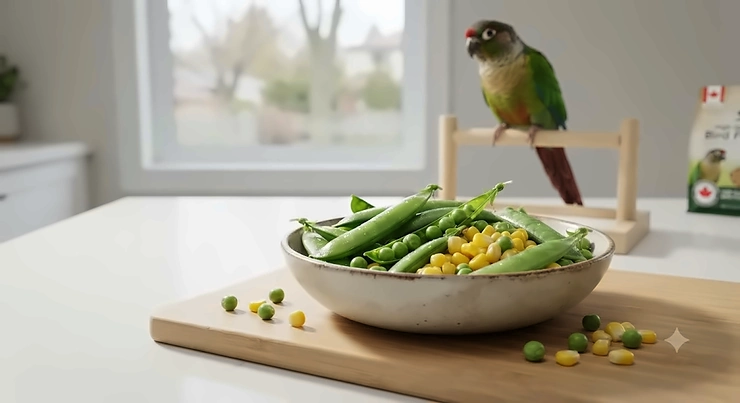
Vegetables safe for parrots are fresh, unseasoned produce items — like leafy greens, orange squash, and cruciferous veggies — that supply vitamin A, calcium, and fibre without the toxins found in avocado, onion, or raw rhubarb leaves. Get this part of the diet wrong and you’re not just dealing with a picky eater; you’re looking at years of slow, sneaky nutrient gaps that avian vets see constantly in seed-only birds.
Here’s the thing nobody tells new parrot owners: your bird’s ancestors spent their entire lives foraging across a rotating buffet of leaves, pods, shoots, and unripe fruit. A bowl of sunflower seeds is about as far from that as fast food is from a home-cooked meal. Fresh vegetables safe for parrots close that gap, and according to the Hagen Avicultural Research Institute in Montreal, enrichment foods like fresh vegetables should make up roughly 30% of a parrot’s daily intake alongside a quality pellet base, with the rest coming from formulated diets built for the job.
This guide is built for Canadian bird owners who want the real picture: which vegetables are genuinely safe, which tools and treats actually make the daily veggie grind easier, and how to build a routine your parrot won’t just tolerate but actively look forward to. We’ve dug through real product specs and aggregated reviewer feedback from amazon.ca listings to pull together seven genuinely useful picks — feeders, treats, and prep tools — spanning budget to premium. No fluff, no fabricated five-star raves, just what the research actually shows.
Quick Comparison Table
| Product | Type | Price Range (CAD) | Best For |
|---|---|---|---|
| Nogeqi 2PCS Bird Cage Food Holder | Vegetable skewer feeder | Under C$15 | Budget daily feeding setups |
| 6-Pack Bird Cage Food Holder Clips | Multi-species vegetable clips | C$15-C$20 range | Multi-cage or multi-bird households |
| Zoody Freeze Dried Vegetables & Fruit | Crunchy treat mix | Under C$15 | Fussy or converting eaters |
| Lafeber Garden Veggie Nutri-Berries | Foraging staple food | C$15-C$25 range | Everyday foraging nutrition |
| KATUMO Parrot Grass Mat Foraging Toy | Shredder/foraging wall toy | C$10-C$20 range | Boredom-busting veggie enrichment |
| La Reveuse Electric Mini Food Chopper | Prep appliance | C$25-C$40 range | Fast daily chop prep |
| NESCO FD-75A Snackmaster Pro Dehydrator | Dehydrating appliance | C$100-C$140 range | Batch-making shelf-stable veggie mixes |
Looking at the spread above, the cheap end of this list (the skewers and clips) solves the “how do I even present this vegetable” problem, while the pricier end (the chopper and dehydrator) solves the “I don’t have time to do this every single day” problem. If you’re just starting to introduce fresh produce, start with a feeder and the freeze-dried treats; if you’re already committed to daily chop and it’s eating your evenings, the appliances pay for themselves in saved time.
💬 Just one click — help others make better buying decisions too!😊
Top 7 Vegetables Safe for Parrots: Expert Product Picks
Coverage here spans budget, mid-range, and premium options, plus a mix of feeders, treats, staple foods, and prep tools — because “vegetables safe for parrots” isn’t just a list of produce, it’s a whole feeding system.
1. Nogeqi 2PCS Bird Cage Food Holder with Hook — rust-resistant skewer for daily veggies
The stainless steel construction on the Nogeqi 2PCS Bird Cage Food Holder is the standout here — it won’t corrode from daily contact with wet produce the way cheap coated wire eventually does. You get two sizes in the pack (roughly 17.5 cm and 22.5 cm), so a smaller conure and a larger amazon in the same household can each get an appropriately scaled skewer. The hook-and-clip design threads directly through carrots, bell pepper strips, or corn cobs and hangs off the cage bars, which keeps produce off the cage floor where it wilts, gets soiled, and gets ignored.
Based on the spec comparison against plastic clip-style holders, stainless steel skewers hold up better to birds with strong beaks — cockatoos and macaws can crack cheap plastic clips within weeks, while food-grade steel resists chewing damage. This makes the Nogeqi 2PCS Bird Cage Food Holder a smart first purchase for owners transitioning a seed-focused bird onto fresh veggies, since it turns produce into a foraging activity rather than a sad pile in the food bowl. Reviewers on amazon.ca consistently note the compact size fits standard cage bar spacing without extra tools, though a few mention the smaller size is genuinely built for parakeet-scale birds rather than large parrots.
Pros:
- ✅ Rust-resistant stainless steel handles daily wet produce
- ✅ Two size options fit small to mid-sized parrot species
- ✅ Turns feeding into a foraging activity, not just a bowl refill
Cons:
- ❌ Larger macaws and cockatoos may need a heavier-duty skewer
- ❌ Only two pieces per pack, so multi-cage households need more
At under C$15, the Nogeqi 2PCS Bird Cage Food Holder is one of the cheapest ways to meaningfully improve how you present vegetables safe for parrots, and the value here is hard to beat for a first-time buyer.
2. 6-Pack Bird Cage Food Holder Clips — best value multi-pack for busy households
The sheer quantity is the standout with this 6-Pack Bird Cage Food Holder Clips set — six clips means you can outfit multiple cages or place backup feeders at different heights so more dominant birds don’t monopolize the fresh food in a shared aviary. Each clip measures around 5.3 x 2.9 x 1.3 cm, small enough for parakeets and cockatiels but sturdy enough for conures and lovebirds too, according to the manufacturer’s stated compatibility list.
What most buyers overlook about clip-style holders versus skewers is the hand-safety angle: you clip the food in place first, then attach the holder to the cage, so you’re never reaching a bare hand full of veggies past an excited beak. That’s a genuinely underrated feature for anyone whose bird gets a little too enthusiastic at feeding time. The 6-Pack Bird Cage Food Holder Clips set works especially well for leafy greens and softer produce that would slide right off a skewer, filling a gap the Nogeqi option doesn’t fully cover. Aggregated buyer feedback frequently mentions the plastic construction as lightweight and easy to clean, though a handful of reviews flag that the clip tension loosens with heavy daily use over many months.
Pros:
- ✅ Six clips cover multi-cage or multi-bird setups
- ✅ Clip design protects hands from enthusiastic beaks
- ✅ Handles soft leafy greens that slide off skewers
Cons:
- ❌ Plastic clip tension can loosen after months of daily use
- ❌ Not rated for the bite force of large macaws or cockatoos
In the C$15-C$20 range for six pieces, this set delivers strong value per unit, and it pairs naturally with the leafy greens section further down this guide.
3. Zoody Freeze Dried Vegetables & Fruit Parakeet Treats — 90% nutrient retention, zero mess
The freeze-drying process is the standout feature on the Zoody Freeze Dried Vegetables & Fruit Parakeet Treats, and it matters more than it sounds. Unlike heat-dehydrated snacks, freeze-drying pulls moisture out at low temperatures, which the manufacturer states preserves around 90% of the original nutrients and natural colour compared to fresh produce. In practice, that means you’re not just handing your bird a crunchy version of a vegetable; you’re handing them something closer to the nutritional profile of the fresh item, minus the spoilage risk.
The ingredient list — pea, pumpkin, carrot, corn, hawthorn berry, and dragon fruit among others — leans toward fibre-dense, vitamin A-precursor-rich produce, which lines up with what avian nutrition sources flag as priority foods for preventing hypovitaminosis A, a common and entirely preventable vitamin A deficiency in pet birds fed seed-heavy diets. Reviewers consistently report that even picky or “converting” birds — meaning birds being weaned off an all-seed diet — take to the crunchy texture faster than they accept limp fresh vegetables, which makes this a practical bridge product rather than a replacement for fresh produce.
Pros:
- ✅ Freeze-drying locks in roughly 90% of natural nutrients
- ✅ Crunchy texture appeals to picky or converting eaters
- ✅ No prep, no spoilage, works great inside foraging toys
Cons:
- ❌ Not a substitute for the water content of fresh vegetables
- ❌ Smaller 2 oz size means frequent reordering for larger flocks
At under C$15 for a 2 oz bag, the Zoody Freeze Dried Vegetables & Fruit Parakeet Treats earns its spot as a genuinely useful transition tool, not just a treat.
4. Lafeber Garden Veggie Nutri-Berries for Parrots — real veggie pieces baked into a foraging staple
What stands out on the Lafeber Garden Veggie Nutri-Berries for Parrots is that it’s not marketed as a treat at all — it’s formulated by avian veterinarians and nutritionists as a complete-nutrition foraging food that happens to be packed with real pieces of carrot, pea, and broccoli. The round berry shape is deliberate: it encourages the same manipulation and beak-play behaviour a parrot would use cracking open a seed pod in the wild, which the manufacturer notes offers roughly twice the foraging engagement of flat pellets.
Here’s what the spec sheet won’t tell you outright, but nutrition-focused reviewers note: birds transitioned onto Nutri-Berries often show more interest in subsequent fresh vegetable offerings, likely because the shape and texture habituate them to associating “chewing through something” with food reward — a useful stepping stone if your parrot currently ignores the veggie bowl entirely. Non-GMO, human-grade ingredients with no artificial colours or preservatives round out why this shows up so often in avian vet recommendation lists. Aggregated review sentiment points to strong long-term acceptance, particularly among African greys and cockatiels who are notoriously selective eaters.
Pros:
- ✅ Formulated by avian vets, not just marketed as a snack
- ✅ Real vegetable pieces baked directly into the shape
- ✅ Encourages natural foraging and beak-play behaviour
Cons:
- ❌ Not a full replacement for fresh, whole vegetables
- ❌ Some seed-imprinted birds need a slow transition period
In the C$15-C$25 range for a 10 oz bag, the Lafeber Garden Veggie Nutri-Berries for Parrots delivers real value as a daily staple that quietly reinforces good vegetable-eating habits.
5. KATUMO Parrot Grass Mat Foraging Wall Toy — turns veggies into a shredding puzzle
The standout on the KATUMO Parrot Grass Mat Foraging Wall Toy is its material mix — natural seaweed, corn husk, wood chip, rattan, and walnut shell, dyed only with edible pigments — which means it’s genuinely safe for a bird to shred, chew, and occasionally swallow small fibres of. At 6.6 x 6.6 inches, it mounts flat against the cage wall like a climbing mat, and owners commonly tuck small pieces of leafy greens or shredded veggie strips into the woven gaps so the bird has to work for its food.
Based on the spec comparison with plain skewer feeders, this is less about presenting a whole vegetable and more about combining foraging enrichment with a fibre-rich snack — the psychological payoff of “finding” food tends to matter as much as the nutritional content for behaviourally frustrated or feather-plucking-prone birds. What most buyers overlook is that this toy does double duty: it’s marketed as a chewing and climbing toy first, but tucking produce into the weave transforms it into an active feeding tool rather than passive entertainment. Reviewers frequently mention smaller birds like budgies, cockatiels, and lovebirds engage with it immediately, while larger parrots may destroy it faster given their stronger beaks.
Pros:
- ✅ Edible, bird-safe natural materials throughout
- ✅ Doubles as chewing enrichment and a veggie-hiding puzzle
- ✅ Wall-mounted design saves cage floor space
Cons:
- ❌ Large, powerful-beaked parrots will shred it quickly
- ❌ Needs occasional replacement as a consumable toy
Priced in the C$10-C$20 range, the KATUMO Parrot Grass Mat Foraging Wall Toy is an inexpensive way to make vegetable time feel like enrichment time instead of a chore.
6. La Reveuse Electric Mini Food Chopper — cuts daily chop-prep time to seconds
The standout feature on the La Reveuse Electric Mini Food Chopper is speed — this compact appliance with a 1.3-cup prep bowl reduces what might be five or ten minutes of hand-chopping carrots, peppers, and greens into a few pulses of a button. For owners feeding multiple birds or a large parrot that goes through a full bowl of chopped vegetables daily, that time savings adds up fast over a year.
On paper, this means finer, more uniform pieces than most people achieve chopping by hand, which matters because smaller birds and picky eaters are often more willing to try new vegetables when they’re bite-sized and mixed in with familiar favourites rather than presented as a single intimidating chunk. What the spec sheet won’t tell you, but bird-owner community feedback consistently notes, is that a dedicated “bird-only” chopper prevents any cross-contamination concerns from garlic, onion, or seasoned foods prepared in a shared kitchen appliance — a real consideration since alliums are toxic to parrots in even small amounts. The compact size also means less counter space and easier cleanup than a full-size food processor.
Pros:
- ✅ Cuts hands-on chop prep time dramatically
- ✅ Produces uniform, bite-sized pieces picky eaters accept more readily
- ✅ Compact size keeps a dedicated bird-safe prep tool separate from cooking gear
Cons:
- ❌ 1.3-cup capacity means smaller batches for large flocks
- ❌ Manual food processors offer more control over chop size
Sitting in the C$25-C$40 range, the La Reveuse Electric Mini Food Chopper is a smart mid-tier upgrade once daily fresh-food prep becomes a real part of your routine.
7. NESCO FD-75A Snackmaster Pro Food Dehydrator — batch-dries a week of veggie chop at once
The NESCO FD-75A Snackmaster Pro Food Dehydrator stands out for its Converga-Flow drying system, which forces air down through a pressurized exterior chamber and horizontally across each tray so all five trays dry evenly without needing to rotate them mid-cycle — a real advantage over stackable dehydrators where the top and bottom trays finish at wildly different times. The adjustable thermostat runs from 35°C to 71°C (95°F to 160°F), giving enough range to gently dry delicate leafy greens on the low end and denser root vegetables on the high end.
Here’s what the spec sheet translates to in practice: batch-dehydrating a large tray of mixed vegetables once a week, then storing the finished chop in an airtight container, means you’re never scrambling to prep fresh produce on a busy weeknight. The unit expands from five trays up to twelve with additional tray purchases, so it scales with a growing flock. Its opaque exterior is designed to block light exposure during drying, which the manufacturer states helps retain more of the nutrients and vitamins that direct light would otherwise degrade — a meaningful detail since vitamin A and several B vitamins are light-sensitive. Reviewers on amazon.ca commonly cite it as a workhorse appliance that outlasts cheaper stackable dehydrators, though the compact footprint means large-batch processing still takes patience.
Pros:
- ✅ Even, tray-by-tray drying with no rotation needed
- ✅ Expandable from 5 to 12 trays as your needs grow
- ✅ Light-blocking design helps preserve light-sensitive vitamins
Cons:
- ❌ Higher upfront cost than any other item on this list
- ❌ Countertop footprint needs dedicated storage space
At around C$100-C$140 depending on current promotions, the NESCO FD-75A Snackmaster Pro Food Dehydrator is the investment pick for owners who’ve committed to fresh feeding long-term and want to stop fighting the clock every single day.
Full Comparison: All 7 Picks Side by Side
| Product | Category | Key Spec | Price Range (CAD) | Best For |
|---|---|---|---|---|
| Nogeqi 2PCS Bird Cage Food Holder | Feeder | Stainless steel, 2 sizes | Under C$15 | First-time fresh-food setups |
| 6-Pack Bird Cage Food Holder Clips | Feeder | 6-pack, hand-safe clip | C$15-C$20 | Multi-cage households |
| Zoody Freeze Dried Vegetables & Fruit | Treat | ~90% nutrient retention | Under C$15 | Picky or converting eaters |
| Lafeber Garden Veggie Nutri-Berries | Staple food | Vet-formulated, foraging shape | C$15-C$25 | Daily foraging nutrition |
| KATUMO Parrot Grass Mat Foraging Toy | Enrichment | Edible natural materials | C$10-C$20 | Behavioural enrichment |
| La Reveuse Electric Mini Food Chopper | Appliance | 1.3-cup bowl, electric | C$25-C$40 | Fast daily prep |
| NESCO FD-75A Snackmaster Pro Dehydrator | Appliance | 5-12 trays, 35-71°C range | C$100-C$140 | Weekly batch-drying |
Taken together, this table maps almost perfectly onto how most owners’ fresh-food routines evolve: you start with a feeder and a treat bag, graduate to a staple foraging food and enrichment toy once your bird is engaged, then eventually invest in prep appliances once daily fresh feeding becomes non-negotiable. Budget-conscious owners should note the first five items combined still cost less than the dehydrator alone, so there’s no need to buy everything at once.
✨ Don’t Miss These Exclusive Deals!
🔍 Take your bird’s fresh-food routine to the next level with these carefully selected picks. Click on any highlighted item to check current pricing and availability on amazon.ca. These tools help you build a genuinely healthier, more enriching diet your parrot will actually look forward to!
How to Choose Vegetables Safe for Parrots
Picking the right produce isn’t about memorizing a giant list — it’s about applying a handful of consistent filters every time you’re at the grocery store or your own garden.
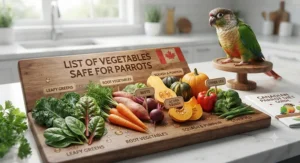
- Check for known toxins first. Avocado, raw beans, and any part of the onion or garlic family are hard no’s — these contain compounds that are genuinely dangerous to avian physiology, not just “not recommended.”
- Favour colour density. Deep orange, red, and dark leafy green vegetables carry the highest beta-carotene content, which your parrot converts into vitamin A — the single most commonly deficient nutrient in captive birds.
- Rotate, don’t repeat. No single vegetable provides a complete nutrient profile, so aim for at least 4-5 different vegetables across any given week rather than the same carrot and pea mix daily.
- Wash thoroughly, every time. A quick rinse under running water is enough to meaningfully reduce any surface residue, since Canada’s pesticide residue limits are set far below any level of health concern for the produce sold here.
- Match texture to species and size. Small parrots like budgies do better with finely chopped or shredded pieces, while larger parrots benefit from bigger chunks that support foraging and beak exercise.
- Introduce gradually. New vegetables should be offered in small amounts alongside familiar favourites, since sudden dietary shifts can cause digestive upset even with completely safe foods.
- Watch portion size relative to pellets. Fresh vegetables should typically make up a meaningful minority of the diet — most avian veterinary sources put fresh produce in the 20-40% range alongside a pellet-based foundation, not as the majority of calories.
Leafy Greens for Birds: The Calcium and Vitamin Powerhouses
Leafy greens for birds deserve their own spotlight because they punch well above their weight nutritionally. Kale, dandelion greens, Swiss chard, and romaine all supply meaningful calcium alongside vitamins A, C, and K — a combination that’s genuinely hard to replicate with any other food category.
Here’s what most owners overlook: calcium from leafy greens matters enormously for female parrots, since hypocalcemia (low blood calcium) is a well-documented issue in egg-laying hens and species prone to reproductive stress, including African greys. Spinach is the one leafy green that comes with a caveat worth understanding rather than avoiding outright — it’s high in oxalates, compounds that bind to calcium and can reduce its absorption, so it works best as an occasional addition rather than a daily staple, rotated alongside oxalate-lower greens like romaine or bok choy.
Practically speaking, leafy greens for birds work best chopped finely and mixed into a broader vegetable blend rather than offered as an isolated pile, since many parrots initially treat large leafy pieces as toys to shred rather than food to eat. Clipping a whole leaf into a feeder like the 6-Pack Bird Cage Food Holder Clips and letting your bird tear into it themselves often gets better engagement than a chopped pile in a bowl.
Best Veggies for Budgies and Other Small Parrots
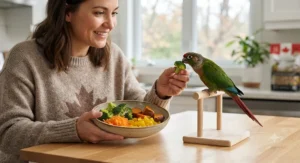
Best veggies for budgies looks a little different than the picture for a macaw or cockatoo, mostly because of scale and beak strength rather than dietary restriction. Budgies, cockatiels, lovebirds, and other small parrots do best with finely minced or shredded vegetables — grated carrot, finely chopped bell pepper, shredded dark leafy greens, and small peas are all easy for a tiny beak to manage without the bird abandoning the food out of frustration.
Based on the spec comparison across species-specific feeding guides, small parrots also benefit disproportionately from foraging-style presentation, since their wild counterparts spend enormous portions of the day searching for tiny seed heads and shoots. A tool like the KATUMO Parrot Grass Mat Foraging Wall Toy, sized appropriately for smaller birds, taps directly into that instinct by hiding shredded veggie pieces inside the woven material rather than presenting everything in an open bowl. What most owners overlook with budgies specifically is portion control in the other direction — because these birds are so small, even a modest pile of vegetables can represent a disproportionately large share of daily calories, so freshness and rotation matter more than sheer volume.
Corn kernels, cooked sweet potato cut into small cubes, and finely chopped broccoli florets round out a strong small-parrot vegetable rotation, all chosen for being easy to manage in size while still delivering the vitamin A and fibre density that matters most for this size class of bird.
Building a Fiber-Rich Bird Diet
A fiber-rich bird diet isn’t just about digestive regularity, though that matters too — fibre also plays a real role in weight management and can reduce the risk of certain crop and digestive issues that show up more often in birds fed a low-fibre, high-fat seed diet. Vegetables are one of the most efficient ways to add meaningful fibre without adding excess fat or sugar the way some fruits do.
Broccoli, Brussels sprouts, cauliflower, and other cruciferous vegetables sit near the top of the fibre-density list among parrot-safe produce, and reviewers consistently note that freeze-dried versions like those in the Zoody Freeze Dried Vegetables & Fruit Parakeet Treats blend retain much of that fibre content in a shelf-stable, no-mess format. On the spec sheet, that translates into an easy way to boost fibre intake on days when fresh prep isn’t realistic.
What the marketing on most fibre-focused pet products won’t tell you is that too much fibre, introduced too fast, can actually cause loose droppings in birds unaccustomed to it — the fix is the same gradual introduction principle that applies to any new food. A fiber-rich bird diet built primarily around vegetables rather than supplements or fillers tends to produce steadier, more predictable digestive outcomes, according to the pattern that emerges across avian nutrition guidance.
Vegetables vs Fruit: What Belongs on Your Parrot’s Plate
Vegetables and fruit both belong in a healthy parrot diet, but they’re not interchangeable, and treating them as such is one of the more common mistakes new owners make.
| Factor | Vegetables | Fruit |
|---|---|---|
| Sugar content | Generally low | Often high (natural sugars) |
| Recommended frequency | Daily | A few times per week |
| Vitamin A precursors | High in most orange/dark greens | Lower, except mango, papaya |
| Best For | Daily nutritional base | Occasional treat and training reward |
The core takeaway from this comparison is that vegetables should form the daily backbone of fresh feeding, while fruit works better as a smaller, more occasional addition — largely because of sugar content that, in excess, can contribute to the same kind of metabolic issues seen in birds fed too many sugary treats. Products like the Lafeber Garden Veggie Nutri-Berries for Parrots lean specifically into the vegetable side of that equation for exactly this reason, prioritizing daily-safe ingredients over fruit-forward formulas.
Common Mistakes When Buying Vegetables Safe for Parrots
Even well-intentioned owners trip over a handful of recurring mistakes, and most are easy to fix once you know what to look for.
The most common mistake is treating “vegetables safe for parrots” as a fixed, unchanging list rather than a starting framework — species differences, individual sensitivities, and even regional availability all shift what’s realistic for your specific bird. A second frequent misstep is buying pre-washed bagged produce and assuming it needs no further rinsing; a quick rinse under running water remains worthwhile regardless of packaging claims. Third, many owners default to the same two or three vegetables indefinitely because their bird “likes” them, missing the nutritional variety that comes from rotation. Fourth, some owners skip vegetables entirely once their bird accepts pellets, not realizing pellets are formulated as a foundation, not a complete replacement for fresh food variety. Finally, buying feeding tools sized for the wrong species — a feeder built for macaws on a budgie cage, for instance — leads to frustration and abandoned fresh-food routines that could have worked with the right-sized equipment, like the size-appropriate options in the Nogeqi 2PCS Bird Cage Food Holder lineup.
Safety, Regulations & Pesticide Residue: What Canadian Owners Should Know
Safety concerns around fresh produce for parrots in Canada mostly come down to two questions: is the vegetable itself toxic to birds, and is there anything on the surface of the vegetable worth worrying about?
On the toxicity side, the short, non-negotiable list includes avocado (all parts, all preparations), raw or dried beans, the leaves and stems of nightshade plants like tomato and pepper (the fruit itself is fine), and anything from the onion and garlic family. These aren’t “reduce consumption” items — they’re genuine no’s regardless of amount.
On the residue side, Canadian owners can take real comfort in the data. The Canadian Food Inspection Agency tests thousands of produce samples annually, and recent monitoring shows the vast majority of both domestically grown and imported fruits and vegetables fall well within established maximum residue limits set by Health Canada — limits calculated with significant safety margins that already account for smaller-bodied consumers. That said, a bird’s body mass is dramatically smaller than even an infant’s, so the practical, low-effort habit of rinsing produce under running water for 30 seconds before it goes anywhere near your parrot remains good practice regardless of how clean the regulatory data looks on paper.
How to Build a Fresh Vegetable Mix for Birds
Building a fresh vegetable mix for birds — commonly called “chop” in the parrot-owning community — doesn’t need to be complicated, but a few setup habits make the difference between a routine that sticks and one that quietly dies out after two weeks.
Start with a wide base: pick four to six different vegetables spanning leafy greens, orange/red vegetables, and a cruciferous option, then wash everything thoroughly under running water. Chop into pieces sized appropriately for your bird’s species — a tool like the La Reveuse Electric Mini Food Chopper turns what could be a tedious ten minutes of knife work into a thirty-second task, which matters enormously for whether this becomes a sustainable daily habit rather than something you do once and abandon.
Once chopped, mix everything together rather than serving vegetables separately, since most parrots are more likely to accept a new item when it’s surrounded by familiar favourites. Common mistakes in the first 30 days of building this habit include making batches too large to use before spoiling, forgetting to remove uneaten fresh food before it sits out too long in a warm room, and giving up too early when a bird initially ignores or flings the new mix — most parrots need repeated, low-pressure exposure to a new food before acceptance clicks. For maintenance, portion out and freeze extra chop in daily-sized containers, or invest in a dehydrator like the NESCO FD-75A Snackmaster Pro Food Dehydrator to batch-process a week’s worth at once and store it shelf-stable rather than relying entirely on freezer space.
Daily Vegetable Feeding Chart
A daily vegetable feeding chart takes the guesswork out of portioning, especially for new owners unsure how much is too much or too little.
| Bird Size | Example Species | Daily Fresh Veggie Portion | Feeding Frequency |
|---|---|---|---|
| Small | Budgie, lovebird | 1-2 tsp, finely chopped | Once daily |
| Medium | Cockatiel, conure | 1-2 tbsp, chopped | Once daily |
| Large | African grey, amazon | 2-4 tbsp, chopped or chunked | Once daily |
| Extra-large | Macaw, cockatoo | 1/4-1/2 cup, chunked | Once daily, split AM/PM optional |
This chart is a starting point, not a rigid prescription — appetite, activity level, and how much of the diet already comes from pellets versus seed all shift the right portion for an individual bird. The general pattern holds regardless of species: offer fresh vegetables once daily, remove anything uneaten within a few hours to prevent spoilage, and adjust portion size gradually based on what your bird actually finishes rather than what the chart says on paper.
Real-World Scenarios: Matching Veggies to Your Parrot’s Life
Consider a university student in Kitchener with a single budgie and a packed schedule. Fresh chop every day isn’t realistic, so leaning on the Zoody Freeze Dried Vegetables & Fruit Parakeet Treats for weekday convenience, then batch-prepping fresh vegetables once on a Sunday using the 6-Pack Bird Cage Food Holder Clips to portion out grab-and-go servings, closes the gap without demanding daily kitchen time.
Now picture a retired couple in Nova Scotia with a pair of cockatiels and genuine time on their hands. For them, the daily ritual of hand-chopping a rotating mix of vegetables becomes part of the routine itself, and a modest appliance like the La Reveuse Electric Mini Food Chopper simply speeds up a task they already enjoy doing.
Finally, think about a household in Calgary managing three parrots of different sizes, including a demanding macaw. Volume becomes the deciding factor here — hand-chopping enough fresh produce daily for three birds eats real time, and batch-drying a week’s supply at once with the NESCO FD-75A Snackmaster Pro Food Dehydrator turns what would be a daily chore into a weekly one, freeing up weeknights while still delivering fresh-adjacent nutrition every day.
Problem → Solution: Fixing Common Veggie-Feeding Struggles
Problem: My parrot flings every vegetable out of the bowl. Solution: switch presentation rather than giving up — a feeder like the Nogeqi 2PCS Bird Cage Food Holder that requires the bird to work for the food often gets better engagement than a passive bowl.
Problem: Fresh produce wilts and gets wasted before my bird touches it. Solution: offer smaller portions more frequently rather than one large daily serving, and consider freeze-dried options like the Zoody Freeze Dried Vegetables & Fruit Parakeet Treats for days when fresh prep isn’t realistic.
Problem: I don’t have time to chop vegetables every single day. Solution: batch-prep weekly using an appliance like the La Reveuse Electric Mini Food Chopper, then freeze or refrigerate daily portions in advance.
Problem: My bird only eats the same one or two vegetables. Solution: chop new vegetables finely and mix them into the accepted favourites rather than offering them alone, gradually shifting the ratio over several weeks.
Problem: I’m worried about pesticide residue on produce. Solution: rinse everything under running water for 30 seconds before serving, which meaningfully reduces surface residue regardless of how strict Canada’s existing safety limits already are.
Long-Term Cost & Maintenance of a Fresh-Food Routine
Long-term cost is where the math on fresh feeding actually works in your favour, even once you factor in equipment. A weekly grocery vegetable haul for even a large parrot typically runs a modest amount compared to the ongoing cost of premium pellets or specialty seed blends, and the return on investment shows up in fewer avoidable vet visits tied to nutritional deficiencies over the bird’s lifetime — a meaningful consideration given many parrot species live 20 to 60+ years.
On the equipment side, a budget feeder like the 6-Pack Bird Cage Food Holder Clips essentially never needs replacing beyond occasional wear, making it close to a one-time cost. Mid-tier tools like the La Reveuse Electric Mini Food Chopper typically hold up for years of regular use given how lightly a mini chopper gets worked compared to daily kitchen duty. The NESCO FD-75A Snackmaster Pro Food Dehydrator represents the largest upfront outlay on this list, but its expandable tray system means the same unit scales with a growing flock rather than needing an upgrade, which spreads that cost meaningfully over years of use rather than one season.
Frequently Asked Questions
❓ What vegetables are toxic to parrots?
❓ How many vegetables should a parrot eat per day?
❓ Can budgies eat the same vegetables as larger parrots?
❓ Do freeze-dried vegetables count as fresh food for parrots?
❓ How often should I wash vegetables before feeding my parrot?
Conclusion
Building a solid routine around vegetables safe for parrots isn’t about finding one perfect product or memorizing an exhaustive list — it’s about combining the right presentation tools, a rotating variety of genuinely safe produce, and a prep system that fits your actual schedule rather than an idealized one. Start small if you need to: a simple feeder like the Nogeqi 2PCS Bird Cage Food Holder and a bag of the Zoody Freeze Dried Vegetables & Fruit Parakeet Treats cost less than C$30 combined and immediately improve on a seed-only diet.
As that routine sticks, tools like the Lafeber Garden Veggie Nutri-Berries for Parrots and the KATUMO Parrot Grass Mat Foraging Wall Toy deepen the nutritional and behavioural payoff, while appliances like the La Reveuse Electric Mini Food Chopper and the NESCO FD-75A Snackmaster Pro Food Dehydrator exist for the moment fresh feeding graduates from occasional habit to daily non-negotiable. Whatever stage you’re starting from, the science is consistent: a varied, colourful, genuinely fresh vegetable rotation is one of the single highest-impact changes you can make for a parrot’s long-term health, and it’s one that pays off across every one of the many years your feathered companion is likely to be part of your household.
Recommended for You
- Safe Fruits for Parrots List: 7 Vet-Backed Picks for 2026
- Winter Bird Seed 2026: 7 Top Picks Canadian Birds Love
- Black Oil Sunflower Seeds Canada Bulk: 7 Top Picks for 2026
Disclaimer: This article contains affiliate links. As an Amazon Associate, I earn from qualifying purchases. If you purchase products through these links, we may earn a small commission at no additional cost to you.
✨ Found this helpful? Share it with your friends! 💬🤗
