
In This Article
A safe fruits for parrots list sounds like it should be simple. Apple, good. Avocado, bad. Done, right? Except then your cockatiel side-eyes a strawberry like it’s a personal insult, your neighbour swears her macaw eats grape seeds with zero issues, and somewhere online a very confident stranger tells you mango is “basically candy.” Suddenly you’re standing in your kitchen holding a knife, a napkin, and a great deal of uncertainty.
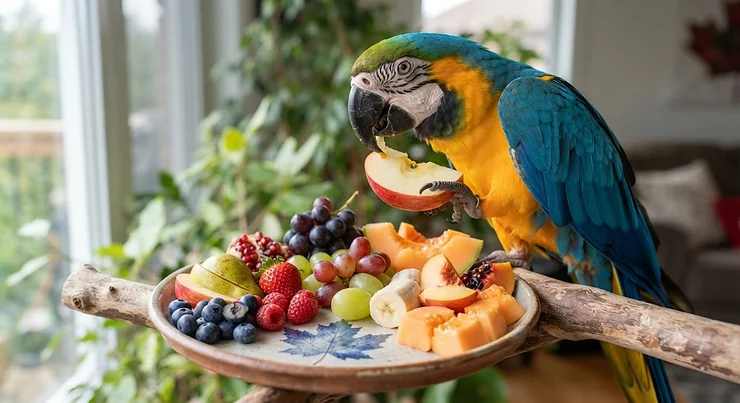
Here’s the good news: the science on this is more settled than the internet chatter suggests. Fruit should make up a modest slice of a parrot’s daily plate — most avian nutritionists land somewhere around 10 to 20 percent of the total diet — with the bulk coming from a quality pellet and a rotating cast of vegetables. Within that fruit allowance, though, there’s real room to spoil your bird with colour, texture, and genuine vitamin C, and beta-carotene wins. This guide walks through exactly which fruits belong on a parrot’s plate, which ones need prep work first, and which real Amazon.ca products can help you deliver that nutrition without turning your counter into a produce graveyard by Thursday. We’ll also cover a fresh fruit diet for cockatiels specifically, because a budgie-sized bird and a macaw do not eat the same way, and pretending otherwise is how good intentions go sideways.
What Is a Safe Fruits for Parrots List, Exactly?
A safe fruits for parrots list is a reference guide identifying which fruits (and which parts of those fruits — flesh, skin, seeds) can be fed to companion parrots without risk of toxicity, and in what quantity. It typically excludes avocado entirely and flags stone-fruit pits and apple seeds for removal, since crushed seeds release cyanogenic compounds. According to the Canadian Veterinary Medical Association, a well-rounded pet bird diet weaves fresh produce in alongside seed and pellet, precisely because malnutrition — not toxicity — is the more common threat companion birds actually face.
Quick Comparison Table: Fruits vs. Fortified Treats
Before we get into the weeds, here’s the shortcut. Fresh fruit and commercial fruit-based treats aren’t competitors — they’re teammates that cover different gaps.
| Option Type | Best For | Vitamin Density | Shelf Life | Prep Effort |
|---|---|---|---|---|
| Fresh whole fruit (mango, papaya, berries) | Daily variety, hydration, enrichment | High (raw, unprocessed) | 2-5 days refrigerated | Wash, chop, remove pits/seeds |
| Fortified pellet with real fruit (e.g. ZuPreem FruitBlend) | Consistent daily nutrition base | High (fortified) | Months, sealed | None — straight from bag |
| Foraging fruit treats (e.g. Lafeber’s Tropical Fruit Nutri-Berries) | Enrichment + behavioural stimulation | Moderate-high | Months, sealed | None |
| Dehydrated fruit-nut blends (e.g. Vitakraft Fresh Super Fruit Cocktail) | Occasional treat, training rewards | Moderate (some nutrients degrade in drying) | Months, sealed | None |
Looking at this table, no single column wins outright — a ZuPreem FruitBlend-style pellet gives you dependable daily nutrition, but it can’t replace the enrichment value of a bird ripping into a real chunk of papaya with its tongue and beak. Dehydrated treats like Vitakraft Fresh Super Fruit Cocktail are wonderful for convenience and long shelf life, but the drying process does reduce some heat-sensitive vitamin content, so they’re best treated as a bonus rather than a cornerstone. The smart approach, and the one most avian vets quietly recommend, blends all three columns rather than picking just one.
💬 Just one click — help others make better buying decisions too!😊
Top 7 Fruits and Fruit-Rich Foods for Parrots: Expert Analysis
Below are seven real, currently available options that cover the safe fruits for parrots list from a few different angles — pure fresh fruit knowledge, plus commercial products that deliver fruit-based nutrition in a form you can actually keep stocked. Prices shift constantly on Amazon, so treat every figure here as a rough Canadian-dollar ballpark rather than a quote — always check current price before buying.
1. ZuPreem FruitBlend Pellets — the everyday backbone with real fruit baked in
Let’s start with the product most likely to already be sitting in your pantry. ZuPreem FruitBlend is formulated as a nutritionally complete daily diet, and each pellet actually contains ground banana, orange, apple, and grape rather than fruit flavouring sprayed on top. That distinction matters more than it sounds — spray-on flavour washes off in a food dish, but baked-in fruit solids stay put through the whole bag. The formula is fortified with 21 vitamins and minerals, which is exactly the kind of consistent baseline nutrition that loose seed mixes can’t guarantee, since birds famously pick out their favourite seeds and leave the fortified husks behind. Based on the ingredient panel, this is best suited to owners who want a low-effort daily staple rather than a novelty treat — think busy households with African greys, amazons, or conures rather than folks chasing maximum enrichment value. Reviewers consistently report that FruitBlend is one of the more palatable pellet lines for previously seed-dependent birds transitioning to a balanced diet, though a subset of buyers note their birds initially pick around the pellet shapes before accepting them, which lines up with the slow-conversion advice most avian vets already give.
Pros:
- ✅ Real fruit (banana, orange, apple, grape) baked into every pellet
- ✅ Fortified with 21 vitamins and minerals for daily completeness
- ✅ Widely available in sizes for small through large parrots
Cons:
- ❌ Contains added colour and some birds initially reject new pellet shapes
- ❌ Not a substitute for fresh produce or foraging enrichment
At the time of research, small bags run in the C$15-C$25 range with large bags climbing toward C$60-C$90 depending on size — check current price on Amazon.ca. As a daily-diet anchor with genuine fruit content, ZuPreem FruitBlend earns its spot as strong everyday value.
2. Lafeber’s Tropical Fruit Nutri-Berries — best for foraging-driven enrichment
If ZuPreem FruitBlend is the reliable sedan, Lafeber’s Tropical Fruit Nutri-Berries is the bird equivalent of a scavenger hunt. Instead of grinding seeds and grains into a uniform pellet, Lafeber leaves them mostly whole and binds them with real pineapple, papaya, and mango pieces into a textured, berry-shaped clump your parrot has to work to pull apart. That “work” is the entire point — foraging behaviour is one of the biggest predictors of behavioural wellbeing in captive parrots, and a University of Utrecht study cited by the manufacturer found birds spent roughly twice as long in feeding-related activity on Nutri-Berries compared with standard pellets. What most buyers overlook about this format is that it’s nutritionally equivalent to a pelleted diet — not a treat layered on top of one — so it can rotate into daily feeding rather than sitting in the “occasional snack” category. This is the pick for owners of amazons, African greys, or conures who’ve noticed their bird finishing meals in ninety seconds flat and then turning to feather plucking or cage-bar chewing out of sheer boredom. Reviewers frequently mention birds becoming visibly more engaged at mealtimes, alongside a smaller number of notes that fussier eaters need a week or two of exposure before diving in.
Pros:
- ✅ Real mango, papaya, and pineapple pieces, not flavouring
- ✅ Nutritionally equivalent to pellets, backed by university research
- ✅ Textured shape doubles foraging and feeding time
Cons:
- ❌ Pickier birds may need a gradual introduction period
- ❌ Higher fat content than plain pellets due to whole seeds
Expect a mid-C$20s to mid-C$30s range for a standard bag at the time of research, with the value proposition resting on behavioural enrichment as much as raw nutrition — a fair trade for birds prone to boredom-driven habits.
3. HARI Tropimix Enrichment Food — the homegrown Canadian pick with real produce variety
Here’s one Canadian shoppers can feel genuinely good about supporting: HARI Tropimix is formulated and quality-tested by the Hagen Avicultural Research Institute in Montreal, Quebec, a facility that’s been studying companion bird husbandry since 1985. The blend layers seeds, nuts, legumes, dehydrated vegetables, and dried fruit pieces around Tropican extruded granules, and HARI’s own feeding guidance recommends it as the “30 percent enrichment” portion alongside a 70 percent extruded pellet base — a ratio that lines up closely with what most independent avian nutritionists suggest. On paper this means Tropimix isn’t trying to be a complete standalone diet; it’s explicitly designed as the flavourful, foraging-friendly complement to a pelleted foundation, which is an honest bit of positioning you don’t always get from bird food marketing. Reviewers frequently highlight that birds accustomed to seed mixes transition to Tropimix more willingly than to plain pellets, likely because the mixed textures feel closer to a natural foraging experience. Owners in Ontario, British Columbia, and the Maritimes alike note reliable availability and freshness, which tracks with a shorter domestic supply chain compared with US-manufactured competitors.
Pros:
- ✅ Manufactured and quality-tested in Canada (Montreal, QC)
- ✅ Blends dried fruit, veg, legumes, and nuts for real variety
- ✅ Manufacturer-published 70/30 feeding ratio removes guesswork
Cons:
- ❌ Best used alongside a pellet, not as a sole diet
- ❌ Larger bag sizes (20 lb) impractical for single-bird households
Bag pricing typically lands in the C$15-C$40 range depending on size, with the smaller 2-4 lb bags being the sweet spot for a one- or two-bird household — check current price before ordering.
4. Vitakraft Fresh Super Fruit Cocktail — best grab-and-go dehydrated treat blend
Some days you don’t have time to wash, peel, and dice fresh produce, and that’s precisely the gap Vitakraft Fresh Super Fruit Cocktail fills. This dehydrated blend mixes papaya, pineapple, banana, and coconut with whole peanuts, split peas, carrots, and a hit of dried chili pepper, all shelf-stable in a resealable bag. The spec sheet lists roughly 7.5-9 percent crude protein and 13-18 percent crude fat depending on the batch, numbers that translate in practice to a calorie-dense treat best measured out rather than left in a bowl all day. Here’s what the spec sheet won’t tell you, but user reports suggest: several reviewers note their birds sort through the mix and cherry-pick the fruit pieces first, leaving the vegetable bits behind — a pattern worth watching if you’re trying to encourage balanced eating rather than reinforce pickiness. This is best suited as a training reward, a topper sprinkled over regular food, or a “we’re out the door in five minutes” fallback, not a dietary cornerstone. Aggregated reviewer sentiment is largely positive on palatability, with a recurring minor complaint about sulfur dioxide used in the drying process, which some owners prefer to avoid for sensitive birds.
Pros:
- ✅ Long shelf life with zero prep required
- ✅ Genuine variety of fruit, veg, and nut pieces in one bag
- ✅ Doubles as a foraging topper or hand-training treat
Cons:
- ❌ Some birds selectively eat only the fruit, skipping veg pieces
- ❌ Contains sulfur dioxide preservative some owners prefer to avoid
Bag sizes commonly fall in the C$10-C$20 range for smaller pouches, climbing toward C$30-C$45 for the larger 40 oz bag — solid value as an occasional add-in rather than a daily staple.
5. Kaytee Fiesta Parrot Food — best variety-driven blend for skeptical eaters
Kaytee Fiesta takes a different approach than a uniform pellet: it leans into visual and textural variety on purpose, mixing sunflower and safflower seeds with dried banana, dried pineapple, dried papaya, raisins, and a handful of nuts, all bound together with prebiotics and probiotics for digestive support. Based on the ingredient panel, this formula reads more like a curated trail mix than a single-note diet, which explains why it tends to win over birds that have flatly refused plain pellets in the past. What most buyers overlook here is that variety cuts both ways — it’s genuinely more engaging at mealtime, but it also makes selective eating (a bird methodically picking out peanuts and ignoring everything else) more likely than with a uniform pellet, so portion awareness matters. The manufacturer states the blend was formulated by a pet bird nutritionist specifically to support skin, feather, digestive, brain, and heart health, and the inclusion of flaxseed as an omega-3 source backs that claim up nutritionally. Reviewers with a 30-year Kaytee history frequently describe it as a trusted “known quantity,” while a smaller group of buyers with strict no-fat-seed diets steer toward pellet-only alternatives instead.
Pros:
- ✅ Genuine fruit, nut, and seed variety birds find engaging
- ✅ Contains prebiotics and probiotics for digestive support
- ✅ Formulated by a bird nutritionist with omega-3 inclusion
Cons:
- ❌ Higher fat content than pellet-only diets due to seed and nut ratio
- ❌ Selective eating risk if not portion-controlled
At the time of research, expect roughly C$15-C$30 for a 4.5 lb bag, with larger 25 lb bags priced well below C$100 — genuinely solid value per pound for multi-bird households.
6. Higgins Sunburst Gourmet Blend — best premium pick for larger, discerning parrots
Stepping up a tier, Higgins Sunburst Gourmet Blend targets owners who want a noticeably higher ingredient standard and are willing to pay for it. The blend combines a wide range of seeds, grains, dried fruit pieces, and nuts, and aggregated reviewer sentiment (averaging in the mid-4-star range across major retailers) consistently praises ingredient freshness and the noticeably lower proportion of filler compared with bargain-tier mixes. Here’s what most buyers overlook about this category of “gourmet” blend: the premium pricing isn’t really about the fruit content specifically, it’s about sourcing consistency — fewer broken seeds, less dust, and a lower rejection rate at mealtime, which in practice means less wasted food and less mess on your floor. That said, this is still a seed-forward blend rather than a pellet, so it’s best positioned as the enrichment layer for macaws, cockatoos, and African greys who already have a fortified pellet as their nutritional base, not as a standalone diet for a bird with weight management concerns. Owners consistently mention that birds who’d previously turned their beaks up at cheaper blends readily accept Sunburst, which lines up with the ingredient-quality argument.
Pros:
- ✅ Noticeably fresher ingredient quality reviewers can taste and see
- ✅ Wide dried fruit and nut variety appeals to picky large parrots
- ✅ Lower filler and dust than budget-tier seed blends
Cons:
- ❌ Premium pricing reflects sourcing, not added nutritional completeness
- ❌ Seed-forward, so best paired with a fortified pellet base
Pricing typically sits in the C$20-C$35 range for a 3 lb bag, moving toward C$80-C$100+ for bulk 25 lb bags — a fair ask if ingredient sourcing is your priority, less so if you’re strictly budget-driven.
7. Volkman Avian Science Super Parrot & Hookbill Blend — best for large hookbills needing energy-dense variety
Rounding out the list, Volkman Avian Science Super Parrot Blend is built specifically for larger, more active hookbills — African greys, amazons, and similarly sized parrots that burn through calories with all that beak-powered chewing and flying. The safflower-based formula folds in banana chips, dehydrated carrot, dried apple, kiwi slices, and papaya alongside a mix of seeds, grains, and whole tree nuts, delivering a genuinely broad nutrient spread rather than a narrow one. Based on the spec comparison against competitors on this list, Volkman leans harder into whole-nut content than Kaytee or Higgins, which pushes fat and protein higher — appropriate for high-energy birds but worth moderating for a sedentary companion parrot prone to weight gain. Company-published guidance recommends roughly 2-4 tablespoons daily per bird as the main diet, supplemented with fresh produce for variety, a ratio that tracks sensibly with broader avian nutrition guidance. Reviewers with decades-long experience feeding Volkman blends describe consistent quality across bag purchases, with an occasional note about higher-than-expected whole corn content that some owners pick around.
Pros:
- ✅ Broad fruit and vegetable variety (papaya, kiwi, apple, carrot)
- ✅ Energy-dense profile suited to large, active hookbills
- ✅ Long-standing brand with consistent batch-to-batch quality
Cons:
- ❌ Higher fat content unsuitable for sedentary or overweight birds
- ❌ Whole corn kernels are picked around by some birds, adding waste
Expect roughly C$15-C$25 for a 4 lb bag, with 20 lb bags in the C$60-C$85 range at the time of research — strong value for large-bird households feeding multiple birds daily.
Top 7 Products: Specs & Value Comparison
| Product | Format | Best For | Price Range (CAD) |
|---|---|---|---|
| ZuPreem FruitBlend | Pellet | Daily nutritional base | C$15-C$90 (by size) |
| Lafeber’s Tropical Fruit Nutri-Berries | Foraging berry | Enrichment-driven feeding | C$20s-C$30s |
| HARI Tropimix | Enrichment mix | 30% enrichment portion | C$15-C$40 |
| Vitakraft Fresh Super Fruit Cocktail | Dehydrated treat | Grab-and-go treat/topper | C$10-C$45 |
| Kaytee Fiesta | Seed-fruit-nut blend | Skeptical/picky eaters | C$15-C$100 (by size) |
| Higgins Sunburst Gourmet Blend | Premium seed blend | Large discerning parrots | C$20-C$100+ |
| Volkman Avian Science Super Parrot | Energy-dense blend | Large, active hookbills | C$15-C$85 |
Scanning this table, the split is fairly clean: ZuPreem FruitBlend and HARI Tropimix anchor the “daily diet” end of the spectrum, Lafeber’s Tropical Fruit Nutri-Berries and Vitakraft Fresh Super Fruit Cocktail live in enrichment-and-treat territory, and Higgins Sunburst Gourmet Blend alongside Volkman Avian Science Super Parrot cater to larger, higher-energy birds willing to pay a premium for ingredient quality. None of these should be fed in isolation — pairing a pellet with a foraging treat and rotating fresh fruit on top is where the real nutritional and behavioural payoff shows up.
Introducing Fresh Fruit: A 30-Day Rollout Plan for Any Parrot or Cockatiel
Dumping a pile of unfamiliar produce into a food bowl rarely goes the way owners hope — most parrots are neophobic, meaning new foods get eyed with suspicion before they get eaten, sometimes for weeks. Here’s a practical rollout that respects that instinct instead of fighting it.
Days 1-7: Introduce one new fruit at a time, in tiny quantities, alongside familiar foods. Papaya and banana tend to have the highest early acceptance rates because of their soft texture and mild sweetness. Don’t remove existing food — layering new options on top of the familiar reduces stress.
Days 8-14: Rotate in a second and third fruit. Try offering fruit skewered on a foraging toy or wedged into cage bars rather than dropped in a bowl; the physical interaction mimics natural foraging and speeds acceptance considerably.
Days 15-21: Watch droppings and appetite closely as fruit intake increases — loose droppings usually mean you’ve overshot the 10-20 percent guideline and should scale back slightly.
Days 22-30: Settle into a rotating weekly rhythm: two to three fruit varieties in small daily portions, refreshed and removed within a few hours to avoid spoilage, especially in warmer months. A common first-30-days mistake is leaving cut fruit in the cage overnight — bacteria multiply fast on cut produce, and a bird nibbling spoiled fruit the next morning is a genuinely avoidable vet visit.
Real-World Scenarios: Matching Fruit to Your Bird’s Actual Life
The apartment-dwelling budgie/cockatiel owner. If you’re keeping a cockatiel or budgie in a smaller space with limited flight time, portion control matters more than variety. A teaspoon of finely diced apple (seeds removed) or a few blueberries, offered two to three times weekly, is plenty — these smaller birds have a proportionally higher risk of weight-related complications on a fruit-heavy diet.
The multi-parrot household with a working schedule. If mornings are chaos and you’re managing feeding for two or three birds before running out the door, lean on prep-ahead convenience: chop a batch of mixed fruit on Sunday, portion it into daily containers, and pair it with a fortified pellet like ZuPreem FruitBlend so nutrition doesn’t slip on the days fresh prep isn’t realistic.
The enrichment-focused owner with a bored, feather-plucking bird. If your parrot’s showing signs of boredom-driven behaviour, foraging-format foods do double duty. Lafeber’s Tropical Fruit Nutri-Berries or fruit threaded onto a foraging toy turns feeding time into a twenty-minute puzzle instead of a ninety-second snack, which measurably increases activity and can ease repetitive behaviours over time.
✨ Ready to build your bird’s fruit rotation? Check today’s pricing on the picks above before your next grocery run.
How to Choose Safe Fruits for Your Parrot
- Check for seeds and pits first. Apple, pear, cherry, apricot, peach, plum, and nectarine seeds contain amygdalin, which releases cyanide when crushed — remove them every time, no exceptions.
- Rule out avocado completely. Every part of the avocado plant contains persin, which is toxic to birds and has no safe serving size — this is the one fruit with zero grey area.
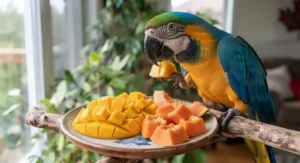
- Favour colour variety over volume. Orange and yellow fruits (mango, papaya) bring beta-carotene; red and purple fruits (berries) bring anthocyanins — rotating colours does more nutritional work than piling on one favourite.
- Wash and, where needed, peel. Waxed citrus skins and any produce you’re unsure was grown pesticide-free should be peeled; otherwise a thorough rinse is sufficient.
- Portion for your bird’s actual size. A budgie’s fruit portion should be a fraction of a large macaw’s — scale by body weight, not by what looks generous to your human eye.
- Watch fresh-vs-dried sugar concentration. Dried fruit concentrates natural sugars significantly; treat dried pieces as occasional rewards, not a daily base.
- Introduce gradually and observe droppings. A new fruit that causes loose stool within 24 hours should be paused and reintroduced later in a smaller amount.
Common Mistakes When Buying and Feeding Fruit to Parrots
The single most common error isn’t toxicity — it’s proportion. Owners who fall in love with how enthusiastically their bird eats fruit often let it creep past 20 percent of the diet, which crowds out the balanced nutrition a pellet or well-formulated seed blend provides. A close second is leaving cut fruit in the cage too long; produce left out for six-plus hours, particularly in a warm room, becomes a bacterial risk rather than a treat. Third, owners frequently assume “fresh is always better than processed,” but that’s not quite right either — a fortified pellet undergoes quality control that loose fresh produce simply doesn’t, so the two should complement rather than compete. Finally, there’s the seed-and-pit oversight: even experienced owners occasionally hand over a whole apple slice with seeds intact because it looks harmless, when in fact that’s exactly the scenario avian vets warn about most. Reviewers of fruit-based commercial treats also report a related mistake — assuming a “fruit cocktail” bag is nutritionally complete on its own, when most are explicitly formulated as a supplement rather than a full diet.
Fresh Fruit vs. Dried Fruit for Parrots
| Factor | Fresh Fruit | Dried Fruit |
|---|---|---|
| Vitamin C retention | High | Reduced by drying/heat exposure |
| Sugar concentration | Lower, more diluted by water content | Higher per gram (concentrated) |
| Shelf life | 2-5 days refrigerated | Months, sealed |
| Hydration value | High | Minimal |
| Best For | Daily rotation, enrichment | Occasional treats, training rewards |
The analysis here is straightforward once you see it laid out: fresh fruit wins decisively on hydration and vitamin retention, while dried fruit wins on convenience and shelf stability. Products like Vitakraft Fresh Super Fruit Cocktail aren’t trying to out-nutrition a fresh mango — they’re solving a different problem, namely “I need a bird treat that doesn’t spoil by Wednesday.” The smartest feeding approach treats these as complementary tools rather than picking a winner, leaning on fresh produce for the bulk of fruit intake and dried options for training rewards or travel convenience.
Fresh Fruit Diet for Cockatiels vs. Larger Parrots
A fresh fruit diet for cockatiels looks meaningfully different from what you’d build for a macaw, and the difference comes down to body size and metabolism, not preference. Cockatiels typically weigh 80-100 grams, meaning a “generous” fruit portion for them is genuinely tiny — a few blueberries or a teaspoon of finely diced melon two to three times a week covers it comfortably. Offer more than that regularly and you risk crowding out the seed-and-pellet nutrition that actually needs to dominate a bird this size. Larger parrots — African greys, amazons, macaws — have more metabolic room to work with, and a broader daily fruit rotation (a slice of mango, a few grapes, some papaya) fits more naturally into their feeding pattern without tipping the 10-20 percent guideline. What most owners overlook when moving from a cockatiel to a larger parrot household, or vice versa, is that portion habits don’t automatically scale — a fruit amount that’s perfectly reasonable for an amazon can genuinely overload a cockatiel’s daily intake. If you’re managing both bird sizes in one household, separate feeding dishes and portioned servings aren’t fussy, they’re necessary.
Vitamin-Rich Bird Treats: Which Nutrients Actually Matter
Not every nutrient marketed on a treat bag deserves equal attention. For parrots specifically, three stand out based on how directly they connect to observable health outcomes, a point echoed in pet nutrition research from the University of Guelph’s Ontario Veterinary College: vitamin A (found richly in mango, papaya, and orange-fleshed fruit), which supports mucous membrane and respiratory health and is one of the most common deficiencies in seed-heavy diets; vitamin C, abundant in citrus, berries, and kiwi, which supports immune function even though birds can synthesize some on their own; and calcium, less about fruit specifically and more about pairing fruit-forward diets with a mineral source, since a diet overly focused on sweet produce without calcium backup can create imbalances over time. The spec sheet won’t tell you this, but reviewers of vitamin-rich bird treats consistently note that visible improvements — glossier feathers, more consistent energy — tend to show up over weeks, not days, which tracks with how nutrient-driven physiological changes actually work rather than the overnight transformation some marketing implies. Ignore treats boasting long lists of synthetic additives with no whole-food source behind them; a fortified pellet or a genuinely fruit-based treat like Lafeber’s Tropical Fruit Nutri-Berries delivers those same nutrients through a form your bird’s body recognizes and processes more efficiently.
Safety, Toxicity & Regulations: What Every Canadian Parrot Owner Should Know
Beyond avocado and stone-fruit pits, a short list of other foods deserves a permanent spot on your “never” list: chocolate and caffeine (both metabolized dangerously slowly by birds), onion and garlic in large quantities, alcohol, and anything high in added salt. On the regulatory side, Canada doesn’t currently mandate species-specific nutritional standards for companion bird food the way it does for some livestock feeds, which means the burden of due diligence sits more heavily with owners and retailers reading ingredient panels carefully. That’s part of why sourcing from established, traceable brands — whether that’s a Canadian-manufactured option like HARI Tropimix or a long-standing US brand like ZuPreem FruitBlend — carries real weight; established manufacturers typically publish sourcing and quality-control information that smaller, unregulated treat sellers simply don’t. If you’re ever uncertain whether a specific fruit, seed, or additive is safe for your particular species, an avian veterinarian remains the most reliable resource, since toxicity thresholds can vary meaningfully by species, size, and individual sensitivity.
Problem → Solution: Fixing Common Fruit-Feeding Headaches
Problem: My bird only eats the fruit pieces and ignores everything else in a mixed blend. Solution: separate the fruit out and offer it as a distinct, portioned reward rather than letting your bird self-select from a mixed bowl — this restores control over overall balance.
Problem: Fresh fruit spoils before I can use the whole piece. Solution: pre-portion and freeze diced fruit in ice-cube-tray-sized amounts; thawed portions retain most nutritional value and cut prep time dramatically.
Problem: My cockatiel won’t touch any new fruit. Solution: pair the unfamiliar fruit with a favourite existing food on the same dish for several days running — proximity association speeds acceptance more reliably than swapping foods outright.
Problem: I’m not sure if a fruit I have at home is actually safe. Solution: default to caution and skip anything not confirmed safe rather than assuming “fruit is fruit” — when in doubt, stick to the well-established safe list rather than experimenting.
Building a Balanced Avian Diet Around Fresh Produce
A genuinely balanced avian diet treats fresh produce as one contributing layer among several, not the whole structure. The widely cited framework — roughly 60-80 percent fortified pellet, 10-20 percent fresh fruits and vegetables, and a small remaining allowance for seeds, nuts, and treats — gives fresh produce for parrots real room to matter without letting it dominate in ways that crowd out complete nutrition. In practice, that might look like a morning pellet serving from something like ZuPreem FruitBlend or HARI Tropimix, a midday rotation of two or three fresh fruits and vegetables, and an occasional foraging treat like Lafeber’s Tropical Fruit Nutri-Berries worked into an enrichment toy a few times weekly. The goal isn’t rigid measuring-cup precision — it’s consistency over time, since a single indulgent day rarely matters, but a pattern of imbalance compounds into real deficiency or excess over months.
Frequently Asked Questions
❓ What fruits should never be fed to a parrot?
❓ Can cockatiels eat grapes?
❓ How much fruit should a parrot eat daily?
❓ Is dried fruit safe for parrots?
❓ Where can I buy vitamin-rich fruit treats for my parrot in Canada?
Conclusion
A safe fruits for parrots list doesn’t need to be complicated once you strip away the noise: skip avocado entirely, remove seeds and pits from stone fruit, favour colour variety over volume, and keep the whole category to roughly 10-20 percent of your bird’s overall plate. From there, it’s really about building a rhythm — a fortified pellet doing the heavy nutritional lifting, fresh produce adding hydration and enrichment several times a week, and the occasional foraging treat or dehydrated blend rounding things out for convenience and behavioural stimulation. Whether you’re managing a fresh fruit diet for cockatiels in a small apartment or feeding a multi-parrot flock with bigger appetites and bigger personalities, the same core framework holds — after all, every companion parrot species, from the smallest budgie to the largest macaw, evolved eating exactly this kind of varied, plant-forward diet in the wild. Products like HARI Tropimix, ZuPreem FruitBlend, and Lafeber’s Tropical Fruit Nutri-Berries each solve a slightly different piece of that puzzle, and none of them need to be fed alone to do their job well. Start small, watch how your bird responds, and adjust — that’s genuinely most of the work.
✨ Don’t Miss These Exclusive Deals!
🔍 Take your parrot’s fruit rotation to the next level with these carefully selected products. Click on any highlighted item to check current pricing and availability on Amazon.ca. These picks will help you build a genuinely nutritious, vitamin-rich routine your feathered friend will love!
Recommended for You
- Winter Bird Seed 2026: 7 Top Picks Canadian Birds Love
- Black Oil Sunflower Seeds Canada Bulk: 7 Top Picks for 2026
- Safflower Seed Canada Squirrel Proof: 7 Top Picks for 2026
Disclaimer: This article contains affiliate links. As an Amazon Associate, I earn from qualifying purchases. If you purchase products through these links, we may earn a small commission at no additional cost to you.
✨ Found this helpful? Share it with your friends! 💬🤗
