
In This Article
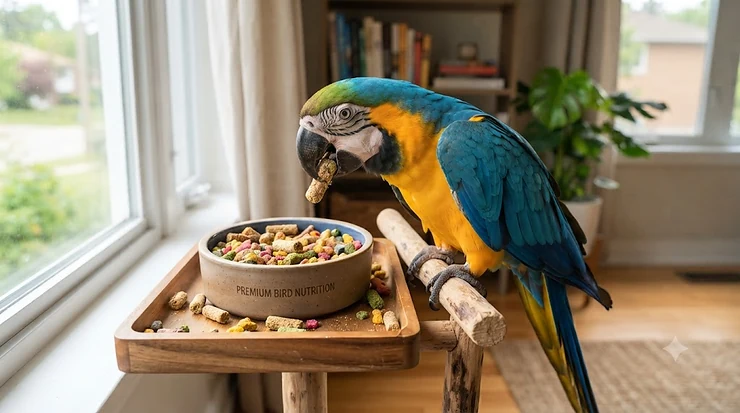
Here’s a blunt truth nobody prints on the packaging: your parrot did not evolve to eat out of a bowl, and every bag of pellets on the shelf is really just a best-effort translation of a rainforest buffet into something shelf-stable. So which translation is worth trusting? That’s the question behind every search for best parrot pellets, and it’s a genuinely tricky one, because “best” depends enormously on your bird’s species, age, and — let’s be honest — its opinions, which are often strong and rarely negotiable.
What is a parrot pellet, exactly? It’s a formulated, extruded or cold-pressed food that combines grains, legumes, vitamins, and minerals into a single uniform piece, engineered so your bird can’t pick out just the tasty bits and leave the nutrition behind. Unlike loose seed mixes, pellets aim to deliver complete nutrition in every bite.
We dug into the guaranteed analyses, ingredient panels, and aggregated owner feedback for seven genuinely different pellet lines, because a Congo African grey and a budgie have almost nothing in common nutritionally. Along the way we leaned on findings from the Hagen Avicultural Research Institute, a Canadian avicultural research body that has spent decades studying pelleted diet conversion. This article contains affiliate links, so keep reading for the honest comparisons, the price-range realities in CAD, and the buyer logic that actually holds up once you look past the marketing copy on the bag.
Quick Comparison Table: Best Parrot Pellets at a Glance
Before diving into all seven, here’s the shortlist for readers who just want the headline picks.
| Pellet Brand | Crude Protein | Best For | Price Range (CAD) |
|---|---|---|---|
| Harrison’s High Potency | 18-20% | Organic-focused owners, conversion diets | C$30-C$110 (1-25 lb) |
| ZuPreem Natural | 14% | Budget-friendly daily feeding | C$25-C$45 |
| Roudybush Daily Maintenance | 11% | Long-term low-fat maintenance | C$35-C$95 |
| Lafeber Premium Daily | 13-14% | Converting seed-only “junkies” | C$25-C$70 |
Looking at this shortlist, a pattern jumps out immediately: protein content varies almost twofold between brands, and that’s not an accident of formulation — it reflects genuinely different feeding philosophies. Harrison’s leans into a higher-protein, organic-first approach aimed at birds in transition or recovery, while Roudybush deliberately keeps protein lower for adult maintenance, on the theory that most companion parrots simply aren’t burning calories the way a wild forager does. Neither approach is “wrong”; they’re built for different life stages, which is exactly why picking a pellet brand isn’t a one-size-fits-all decision.
💬 Just one click — help others make better buying decisions too!😊
Top 7 Parrot Pellets: Expert Analysis
We selected these seven pellets to cover budget, mid-range, and premium price points, along with a genuinely allergen-conscious option most “top 10” roundups skip entirely.
1. Harrison’s High Potency Coarse — most vet-referenced organic pellet
If you’ve ever asked an avian vet what to feed a recovering, molting, or newly converted parrot, there’s a good chance Harrison’s High Potency Coarse came up in the answer. Founded by a double board-certified avian veterinarian, the brand built its reputation on formulating for actual companion-bird physiology rather than repurposing poultry-feed science, and that history shows up in the ingredient list.
The guaranteed analysis runs roughly 18% crude protein and 12-15% crude fat, sourced from certified organic hulled barley, sunflower kernels, peas, and lentils — no corn as a primary filler, and no artificial preservatives, colours, or flavours. Based on the spec comparison, that fat percentage is meaningfully higher than most maintenance-style pellets, which makes practical sense: Harrison’s is explicitly designed as a conversion and special-needs formula for molting, breeding, underweight, or recently-switched birds, not necessarily a forever-food for a sedentary adult.
Harrison’s is best suited to owners actively transitioning a seed-eating bird, supporting a breeding pair, or nursing a bird back from illness, where the extra caloric density earns its keep. Reviewers consistently report that the coarse texture holds together better than crumblier competitors, though a few owners note their pickier Amazons and cockatoos need real patience during the initial changeover, since Harrison’s doesn’t rely on flavouring or dye to win birds over.
Pros:
- ✅ Certified organic with no corn, soy fillers, or synthetic dyes
- ✅ Backed by decades of avian-specific formulation research
- ✅ Higher protein/fat supports molting, breeding, and recovery
Cons:
- ❌ Small bag sizes make per-pound cost noticeably higher
- ❌ Some picky eaters resist the plain, unflavoured taste at first
Expect to pay in the C$30-C$45 range for a 1-2 lb bag, climbing toward C$90-C$110 for bulk 25 lb sizes — always check current price, since availability fluctuates. For a bird actively converting or recovering, Harrison’s earns its premium price tag through ingredient transparency alone.
2. ZuPreem Natural — best everyday value for mixed flocks
ZuPreem Natural is the pellet you’ll spot in nearly every big-box pet store, and there’s a reason it’s become the default recommendation for owners who just need something reliable without a specialty order. The guaranteed analysis sits at 14% crude protein, 4% crude fat, and 5% max crude fiber, formulated with corn, oats, and wheat as a base, blended with dried vegetables like beets, carrots, and celery for natural colour rather than synthetic dye.
What most buyers overlook about ZuPreem Natural is that it comes in four distinct pellet sizes calibrated to species — parakeet, cockatiel/conure, parrot/conure, and large parrot — meaning a household mixing a budgie with an African grey doesn’t need two entirely different brands, just two bag sizes. The spec sheet won’t tell you this, but user reports across pet-store review sections suggest it’s genuinely one of the higher-acceptance pellets for finicky Amazons and cockatoos who’ve refused pricier organic options outright.
Pros:
- ✅ Four pellet sizes cover nearly every companion species
- ✅ Naturally coloured from real vegetables, no artificial dyes
- ✅ Widely stocked, so restocking is rarely a scramble
Cons:
- ❌ Lower protein than premium organic competitors
- ❌ A few caiques and cockatoos reportedly refuse the plain colour
Price sits comfortably in the C$25-C$40 range for a 3 lb bag, making it one of the more approachable everyday options — a solid value verdict for anyone feeding a mixed flock on a realistic budget.
3. Roudybush Daily Maintenance — best low-fat long-term staple
Roudybush occupies a curious niche: it’s the pellet most frequently recommended for birds that are done converting and simply need a sustainable, low-fat daily diet for the next couple of decades. Its guaranteed analysis of roughly 11% crude protein and 6-7% crude fat is deliberately conservative compared with every other brand on this list, and that’s the whole point — Tom Roudybush, the food’s namesake, built the formula around the idea that most companion parrots are sedentary compared with wild foragers and don’t need breeding-level calories every single day.
Here’s what most buyers overlook: lower fat doesn’t mean lower quality — it means a formula tuned specifically for maintenance rather than growth or recovery. Reviewers consistently report exceptional long-term acceptance, with numerous owners describing decades-long feeding relationships and steady body condition in African greys, Amazons, and macaws. The rice-based, corn-and-wheat formula is also relatively soy-forward, so owners managing suspected soy sensitivities should compare notes with TOP’s further down this list.
Pros:
- ✅ Lower fat profile suits sedentary adult companion birds
- ✅ Exceptionally strong long-term acceptance across large species
- ✅ Steam-pelleted process reduces harmful bacteria
Cons:
- ❌ Not ideal for breeding, molting, or underweight birds needing more calories
- ❌ Primarily direct-ship, so local availability can be inconsistent
Pricing runs from roughly C$35-C$50 for smaller bags up to C$85-C$95 for 25 lb sizes, positioning it as a mid-to-premium long-term investment rather than an impulse buy.
4. Lafeber Premium Daily Pellets — best for converting stubborn seed-eaters
Few pellets tackle the seed-to-pellet conversion problem as directly as Lafeber Premium Daily Pellets. The brand naturally flavours its pellets with molasses specifically because, as Lafeber puts it, birds like Amazons and African greys will happily choose high-fat seed over nutrient-dense pellets given the option — so they built in a flavour hook rather than fighting that instinct. The guaranteed analysis lands around 13-14% crude protein and 4.5-5% crude fat, built from non-GMO corn, soybean meal, oat groats, and whole egg as a highly digestible protein source.
Based on the spec comparison, the molasses flavouring is the standout feature that separates Lafeber from plainer pellets like Roudybush — it’s specifically engineered as a conversion bridge, not just a maintenance diet. Reviewers consistently mention success stories spanning 20, 30, even 40 years of continuous feeding, which speaks to sustained palatability rather than just initial novelty appeal. Each batch is also independently lab-tested, adding a layer of quality assurance beyond the guaranteed analysis on the label.
Pros:
- ✅ Molasses flavouring dramatically eases seed-to-pellet conversion
- ✅ Contains whole egg for highly digestible protein
- ✅ Independently lab-tested every batch
Cons:
- ❌ Higher natural sugar content than plain maintenance pellets
- ❌ Some owners report increased crumbling versus harder pellet brands
Expect C$25-C$35 for a 4-5 lb tub, scaling to roughly C$55-C$70 for 25 lb bulk bags — genuinely solid value for a brand this widely vet-referenced.
5. Kaytee Exact Rainbow — best budget multi-species option
Kaytee Exact Rainbow has been on pet-store shelves since 1989, and its longevity says something: this is the pellet most likely to be the first one a new bird owner encounters, precisely because of its price point and near-universal availability. The guaranteed analysis varies slightly by species-specific formula, but generally runs 14-15% crude protein and 5-6% crude fat, built on ground corn, wheat, and oat groats with dried whole egg and flax seed for omega-3s.
The spec sheet won’t tell you this, but the “rainbow” colouring is actually a functional design choice, not just a marketing gimmick — the varied shapes and colours are intended to keep visually-driven species like macaws and cockatoos engaged with their food bowl rather than ignoring a monotone pellet. On paper, this means a lower barrier to entry for owners nervous about pellet conversion, since the visual variety mimics some of the foraging stimulation seed mixes naturally provide. Reviewers consistently note strong acceptance among cockatiels and smaller conures, with more mixed results reported for larger, pickier macaws.
Pros:
- ✅ Extremely wide availability at big-box and grocery pet aisles
- ✅ Colourful, varied pellet shapes support visual engagement
- ✅ Contains DHA omega-3 for brain and vision support
Cons:
- ❌ Contains artificial colouring (titanium dioxide, canthaxanthin)
- ❌ Some large-parrot owners report lower long-term acceptance
Price typically falls in the C$20-C$35 range for a 2-4 lb bag, making it one of the most budget-accessible entries on this list, particularly for multi-bird households feeding several species at once.
6. Higgins InTune Natural — best for digestive and immune support
Higgins InTune takes a noticeably different formulation angle than its competitors: rather than leaning purely on grain-and-vitamin fortification, it builds in encapsulated probiotics, real dried fruits and vegetables, and stabilized Vitamin C alongside a 15% crude protein, 5% crude fat guaranteed analysis. The ingredient panel includes cranberries, blueberries, celery, spinach, and watercress, plus algae meal as a DHA source.
What most buyers overlook about InTune is the microencapsulation process used for its probiotic strains — Enterococcus faecium and two Lactobacillus species — which is specifically designed to survive the extrusion and digestive process rather than being destroyed before it can help. Based on the spec comparison, that’s a meaningfully different value proposition than a pellet that simply lists vitamins on the label; it’s targeting gut flora balance directly. Reviewers consistently describe strong acceptance in African greys and Amazons, with several owners specifically noting improved feather condition during molting season, though the natural (rather than artificial) colouring means some birds initially pick around the less colourful pieces.
Pros:
- ✅ Microencapsulated probiotics support digestive health directly
- ✅ Naturally coloured and flavoured with real fruit and vegetable content
- ✅ Includes stabilized Vitamin C and E for immune support
Cons:
- ❌ Some birds selectively avoid less vibrant pellet pieces
- ❌ Premium formulation carries a mid-to-upper price point
Pricing generally runs C$30-C$45 for a 3 lb bag, up to roughly C$65-C$80 for larger 18 lb bags — a fair trade for the added digestive-health engineering if your bird has a history of loose droppings or slow molts.
7. TOP’s Totally Organic Pellets — best allergen-conscious organic pick
TOP’s occupies a genuinely distinct lane among pellet brands: it’s the only major USDA Organic-certified pellet that deliberately excludes corn, soy, and peanuts entirely — three of the most common allergen and sensitivity concerns flagged by avian vets. The guaranteed analysis runs roughly 12-13.6% crude protein, 3.5-5% crude fat, and a notably higher 8-10.5% max crude fiber, built primarily from organic alfalfa, hulled millet, barley, and rice, with rosehips, kelp, and dandelion leaf powder rounding out the micronutrient profile.
Here’s what most buyers overlook: TOP’s pellets are cold-pressed rather than extruded or baked, a processing choice the company says preserves more natural enzyme activity than the high-heat extrusion used by most competitors on this list. On paper, that higher fiber content also supports birds prone to obesity or those needing more gut-fill volume without excess calories. Reviewers consistently note this as the go-to option for owners managing a bird with a confirmed or suspected soy or corn sensitivity, though the higher price and narrower retail footprint mean it’s rarely an impulse purchase.
Pros:
- ✅ Corn-, soy-, and peanut-free — rare among organic pellets
- ✅ Cold-pressed processing preserves more natural enzymes
- ✅ USDA Organic certified with no artificial preservatives
Cons:
- ❌ Higher price point than mainstream mid-range pellets
- ❌ Narrower retail availability compared to Kaytee or ZuPreem
Expect C$35-C$55 for a 4 lb bag, with 10 lb bags running toward C$80-C$100 — a premium worth paying specifically if allergen avoidance is a real, vet-flagged concern rather than a general preference.
Transitioning to a Pelleted Parrot Diet: A Practical Usage Guide
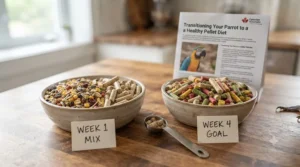
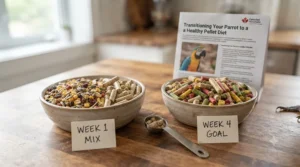
Switching a bird onto any pelleted parrot diet is less about the brand you pick and more about the process you follow — and this is where most conversions quietly fail. Start by resisting the urge to swap food cold turkey; instead, mix a small ratio of new pellets into the existing diet for one to two weeks, gradually shifting the balance every week or two while watching droppings closely for signs your bird isn’t actually eating.
A gram scale is your single best diagnostic tool during the first 30 days. Weigh your bird daily at the same time, and if body weight drops more than 5%, pause the transition and return to the previous ratio for a week before trying again — this single habit prevents the most dangerous mistake in pellet conversion, which is a bird quietly starving itself rather than accepting a new food.
Once your bird is reliably eating pellets, maintenance is straightforward: discard uneaten pellets daily rather than topping up a half-full bowl, since oxidation and bacterial growth degrade nutritional value within hours in a humid cage environment. Store unopened bags in a cool, dry location, and once opened, many owners freeze the remainder in an airtight container to preserve freshness — most manufacturers recommend using an opened bag within 30-60 days. A common first-month mistake is assuming a bird that’s simply crushing pellets into powder without swallowing is “eating” — check for actual pellet material in the crop or droppings, not just an empty-looking dish.
Real-World Scenarios: Matching Pellets to Your Flock
Consider Maria, a first-time cockatiel owner in a small Toronto apartment who’s converting her bird from an all-seed pet-store mix. Her budget is tight, her bird is young and adaptable, and she doesn’t need premium organic sourcing yet — Kaytee Exact Rainbow or ZuPreem Natural fit perfectly here, since both offer strong acceptance rates in smaller species and won’t strain a student budget.
Now picture Daniel, whose 22-year-old African grey has been seed-only its entire life and is showing early signs of calcium deficiency his avian vet flagged at a recent checkup. This is a conversion-and-recovery scenario, and it’s exactly the use case Harrison’s High Potency Coarse was formulated for — the higher protein and fat support the transition, while the organic, allergen-conscious ingredient list minimizes any additional digestive stress during an already stressful dietary shift.
Finally, there’s Priya, who keeps a mixed flock of macaws and Amazons in a rural Alberta aviary and has noticed one macaw with chronically loose, inconsistent droppings despite an otherwise reasonable diet. Rather than guessing, she works with her vet toward Higgins InTune, specifically for its probiotic and digestive-support formulation — a targeted fix rather than a brand swap for its own sake. Each of these owners needs a genuinely different pellet, which is the whole argument against blanket “best” rankings that ignore individual bird circumstances.
Problem → Solution: Fixing Common Pellet Feeding Mistakes
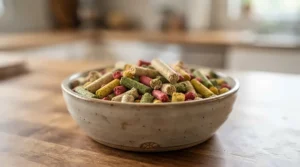
Problem: Your bird refuses pellets entirely. Rather than switching brands repeatedly, try offering pellets first thing in the morning when hunger is highest, and scatter a few on the cage floor or a mirror, since some birds respond to perceived “novelty” or social feeding cues before accepting a bowl offering.
Problem: Your bird eats pellets but is gaining excess weight. This usually means the fat content is mismatched to activity level — a sedentary indoor Amazon on a molasses-flavoured, higher-fat conversion pellet like Lafeber may do better long-term on a leaner maintenance formula like Roudybush once conversion is complete.
Problem: Feathers look dull or molting seems delayed. According to the Hagen Avicultural Research Institute, inadequate dietary variety and stress are common contributors here — consider a pellet with added omega-3s and real fruit/vegetable content, such as Higgins InTune or ZuPreem Natural, alongside a vet check to rule out underlying illness.
Problem: You suspect a soy or corn sensitivity. Don’t guess — but if a vet has flagged a suspected sensitivity, TOP’s Totally Organic Pellets is the only major brand on this list built entirely without those two ingredients, making elimination-diet trials considerably simpler.
Problem: Multiple species in one household need different nutrition. Rather than juggling three separate brands, look at pellet lines like ZuPreem or Kaytee that offer multiple size-specific formulas under one brand umbrella, simplifying storage and bulk ordering.
How to Choose the Best Parrot Pellets
- Identify your bird’s life stage first. A molting, breeding, or recently-converted bird needs a higher-calorie formula like Harrison’s; a stable adult usually does better on a leaner maintenance pellet.
- Check the protein-to-fat ratio against your bird’s activity level. Sedentary indoor birds rarely need breeding-level fat percentages.
- Scan the ingredient list for known sensitivities. Corn, soy, and peanuts are the three most commonly flagged allergens in companion parrots.
- Match pellet size to species. A pellet sized for a budgie will frustrate a macaw, and vice versa — most brands publish species-specific size charts.
- Weigh acceptance realism against nutritional ideals. The most “perfect” pellet on paper is worthless if your bird won’t eat it; sometimes a flavoured conversion pellet is the smarter first step.
- Factor in your actual budget and buying frequency. Premium organic pellets in small bags can cost significantly more per pound than bulk mid-range options.
- Confirm you’re buying from a source with fresh stock turnover. Pellets degrade in nutritional value over time, so checking manufacture dates matters more with niche or specialty brands.
ZuPreem vs Harrison’s Pellets: Which Should You Choose?
This is one of the most searched pellet comparisons for a reason — these two brands sit at genuinely opposite philosophical poles. ZuPreem Natural is a mainstream, widely available, moderately priced pellet built for everyday feeding across a broad range of species, with a 14% protein baseline and natural (not synthetic) vegetable-based colouring. Harrison’s, by contrast, is a certified organic, higher-protein formula built specifically around conversion, recovery, and special-needs feeding, developed under direct veterinary formulation rather than general pet-nutrition science.
The practical difference shows up fastest in price and purpose. ZuPreem costs meaningfully less per pound and is available at nearly every pet retailer, making it the sensible default for a healthy adult bird with no complicating factors. Harrison’s costs more, sells in smaller bag sizes, and requires more patience during acceptance — but it’s formulated for situations where that extra investment genuinely matters, like a bird recovering from illness or converting off seed for the first time. Neither brand is objectively “better”; the right choice depends entirely on whether your bird needs everyday maintenance or a more clinically-focused nutritional intervention.
African Grey Parrot Pellets: Tailored Advice for the Pickiest Eaters
African greys have an outsized reputation for pellet pickiness, and aggregated review sentiment across multiple brands backs that up — greys appear disproportionately often in “won’t eat this” complaints regardless of brand. Part of this comes down to their intelligence and neophobia; wild greys forage across dozens of food types and can be genuinely suspicious of a uniform, unfamiliar pellet shape.
For a grey specifically, reviewers consistently point toward Lafeber Premium Daily or Harrison’s High Potency as stronger long-term fits, likely because greys respond well to either the molasses flavour cue in Lafeber or the higher-calorie density Harrison’s provides during conversion. Greys are also more prone to calcium and Vitamin D deficiencies than some other species due to limited natural UV exposure indoors, so a pellet with a solid calcium-to-phosphorus ratio, paired with supervised outdoor time or a full-spectrum light, matters more here than with hardier species like Amazons. If your grey is an especially stubborn holdout, patience genuinely outperforms brand-switching — most conversion failures come from giving up after a week rather than the pellet itself being wrong.
Top Rated Parrot Pellet Brands: Features That Actually Matter (And Those That Don’t)
Marketing copy loves to highlight “vibrant colours” and “fun shapes,” but reviewers consistently note that colour variety matters far less to actual bird health than owners assume — it’s a visual-engagement feature, not a nutritional one, and several of the top rated parrot pellet brands, including ZuPreem and Kaytee, use it primarily to ease conversion for visually-motivated species.
What actually matters: the protein-to-fat ratio relative to your bird’s life stage, the presence (or deliberate absence) of common allergens like corn and soy, whether preservatives are natural (mixed tocopherols, rosemary extract) versus synthetic, and independent lab testing practices like those Lafeber publicizes. What matters less than owners think: pellet shape variety, added “flavours” beyond the functional molasses-style conversion aids, and marketing terms like “human-grade,” which sound reassuring but aren’t independently regulated claims in the same way “USDA Organic” is.
Avian Nutrition Requirements: The Science Behind the Bag
Avian nutrition requirements differ substantially from the poultry-feed science that historically informed early pet bird diets, and this gap is exactly why brands like Harrison’s and Roudybush market themselves around companion-parrot-specific formulation rather than repurposed livestock feed research. Companion parrots generally need higher fat-soluble vitamin support (particularly A, D3, and E) than production poultry, alongside calcium ratios tuned for a non-laying adult rather than an egg-producing hen.
In Canada, pet food — including parrot pellets — isn’t subject to the same pre-market approval regime as livestock feed. According to the Canadian Food Inspection Agency, CFIA oversight of pet food is largely limited to import, export, and animal-by-product compliance rather than nutritional adequacy testing, meaning claims like “complete and balanced” typically reference voluntary AAFCO nutrient profiles rather than a Canadian regulatory standard. That’s not necessarily a red flag — most major pellet brands do formulate against AAFCO benchmarks regardless — but it does mean the burden of comparing guaranteed analyses falls more on the buyer than it might with, say, human food labelling.
Parrot Food Comparison Chart: Long-Term Cost & Maintenance
| Pellet Brand | Approx. Cost per lb (CAD) | Bag Life (Opened) | Best Long-Term Use Case |
|---|---|---|---|
| Harrison’s High Potency | Higher | 6-8 weeks | Conversion, breeding, recovery |
| ZuPreem Natural | Low-Mid | 30-45 days | Everyday multi-species feeding |
| Roudybush Daily Maintenance | Mid | Varies by size | Long-term adult maintenance |
| Lafeber Premium Daily | Low-Mid | 8-10 weeks | Seed-conversion, general use |
| TOP’s Totally Organic | Higher | 8 weeks | Allergen-sensitive birds |
Looking at total cost of ownership rather than sticker price alone changes the calculus considerably: Harrison’s and TOP’s cost more per pound, but if a bird has a genuine health need — recovery, conversion, or allergen avoidance — that premium buys something a cheaper pellet simply doesn’t offer. For a healthy adult bird with no complicating factors, Roudybush or ZuPreem deliver comparable long-term value at a noticeably lower per-pound cost, which matters considerably more once you’re feeding a macaw eating a cup a day rather than a budgie eating a tablespoon.
✨ Ready to build your bird’s new feeding routine? Compare current pricing on today’s top picks before your next bag runs out!
Common Mistakes When Buying Parrot Pellets
The single most common mistake is buying based on bag size alone rather than checking the manufacture or “best before” date — pellets do lose nutritional potency over time, and a bargain 25 lb bag that’s been sitting in a warehouse for months isn’t actually a bargain. A close second is assuming pellets should make up 100% of a diet; most avian vets recommend pellets form roughly 70-80% of intake, with the remainder coming from fresh vegetables and limited fruit, not the other way around.
Owners also frequently switch brands too quickly when a bird resists a new pellet, when the real issue is usually technique — insufficient patience, wrong time of day, or too abrupt a transition ratio — rather than the brand itself being unsuitable. Finally, many buyers overlook species-specific pellet sizing entirely, offering a large-parrot pellet to a cockatiel or vice versa, which can suppress intake regardless of how nutritionally sound the formula is.
Frequently Asked Questions
❓ What is the healthiest pellet food for parrots?
❓ How much of a parrot's diet should be pellets?
❓ Can I mix different pellet brands together?
❓ Why won't my African grey eat pellets?
❓ Are colourful pellets bad for parrots?
Conclusion
There isn’t one universal “best” parrot pellet, and honestly, any guide claiming otherwise is oversimplifying a genuinely individual decision. What we found through comparing real guaranteed analyses, ingredient panels, and aggregated owner sentiment is that the right pellet depends heavily on your bird’s species, life stage, and any known sensitivities — a molting African grey and a stable adult budgie have almost nothing in common nutritionally, and their pellets shouldn’t either.
If you’re starting a conversion from seed, Lafeber or Harrison’s offer the strongest documented success rates. If you’re maintaining an already-converted adult bird, Roudybush or ZuPreem deliver reliable long-term value. And if allergen sensitivity is a genuine, vet-confirmed concern, TOP’s stands alone in the corn-and-soy-free category. Whichever bag you land on, remember that patience during transition matters more than brand loyalty — and always check current pricing before you buy, since availability and cost shift regularly across Canadian retailers.
Recommended for You
- 7 Best Replacement Bird Bath Bowl Picks for 2026 (Canada Guide)
- Bird Bath Heater Canada 2026: 7 Safe Picks That Actually Work
- Metal Bird Bath: 7 Rust-Resistant Picks for Canadian Yards (2026)
Disclaimer: This article contains affiliate links. As an Amazon Associate, I earn from qualifying purchases. If you purchase products through these links, we may earn a small commission at no additional cost to you.
✨ Found this helpful? Share it with your friends! 💬🤗
