

In This Article
A bird bath heater is a low-wattage, thermostatically controlled electric device — either a submersible immersion element or a built-in heated basin — that keeps a small amount of water from freezing solid so birds can drink and bathe through winter. That’s the textbook answer. Here’s the messier, more useful one: the first time you watch a chickadee land on a rim of ice-crusted concrete, peck at frozen nothing, and fly off empty, you understand the assignment pretty fast.
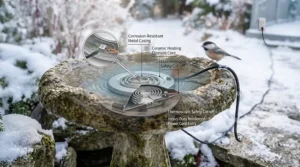
Canadian winters are not gentle. Between a January in Winnipeg and one in Halifax there’s a wide gap in windchill, but the basic problem is identical — every natural water source within a bird’s flying range can lock up solid for weeks at a stretch, and snow is a poor substitute because melting it in their gut burns calories a bird can’t spare on a -20°C morning. Bathing matters just as much as drinking here; well-maintained feathers can trap a startling amount of insulating air against a bird’s skin, which is exactly why an ice-crusted bath in January isn’t just an inconvenience for a chickadee, it’s a survival gap. A bird bath heater solves that specific problem, cheaply, without turning your yard into a science experiment.
This guide skips the marketing copy and gets into what actually matters: real wattage numbers and what they mean for your electricity bill and your birdbath’s water temperature, how thermostats prevent the unit from cooking itself or your birds, what amperage your outdoor circuit needs to handle safely, and seven real products sold on amazon.ca — budget, mid-range, and premium — with honest analysis of who each one suits. No invented five-star reviews, no fabricated “I tested this for three winters” stories. Just spec sheets, aggregated review sentiment where it’s genuinely verifiable, and the kind of plain-language reasoning you’d get from a friend who’s actually read the electrical code.
Quick Comparison Table
| Product | Type | Wattage | Best For |
|---|---|---|---|
| K&H Super Ice Eliminator | Submersible immersion | 80W | Larger bird baths, proven safety record |
| Farm Innovators B-9 | Submersible foil (no thermostat) | 44W | Ultra-tight budgets, shallow baths |
| GESAIL Birdbath Deicer | Submersible immersion | 50W | Small-to-standard baths on a budget |
| Farm Innovators C-50 | Submersible cast aluminum | 150W | Mid-size baths in serious cold |
| API Bird Bath De-Icer | Submersible immersion | 200W | Large basins, extreme cold snaps |
| Allied Precision Four Seasons | All-in-one heated bath | 70W | Deck/condo setups, no existing bath |
| Allied Precision w/ Metal Stand | All-in-one heated bath | 150W | Pedestal display, ground-level yards |
Looking at the numbers above, wattage isn’t really about “more heat is better” — it’s about matching the heater to the volume of water and how brutal your local winter gets. A 44-watt foil heater in a shallow saucer bath in coastal British Columbia does a completely different job than a 200-watt unit trying to keep a 20-gallon concrete basin open during a prairie deep freeze, and buying the wrong end of that spectrum either wastes electricity or leaves you with an ice cube by 6 a.m. The all-in-one heated baths solve a different problem entirely — they’re for anyone who doesn’t already own a birdbath and wants a single purchase — while the submersible units are for people upgrading an existing basin they already like.
💬 Already have a favourite from the table? Tap through to check today’s price before it changes.
Top 7 Bird Bath Heaters: Expert Analysis
Selecting a bird bath heater without falling for marketing fluff means looking past “keeps water warm all winter!” and asking three boring but essential questions: how many watts, is there a genuine thermostat, and what does the housing actually protect against. Here’s the honest breakdown of seven real products currently sold on amazon.ca, spanning ultra-budget to premium.
1. K&H Super Ice Eliminator — the safety-certified workhorse
The standout here isn’t the rock-shaped housing — it’s that K&H doesn’t just source safety-listed parts, they certify the finished, assembled product, which is a meaningfully higher bar than most competitors bother clearing. At 80 watts, this immersion heater is built for bird baths holding more than 10 gallons of water; K&H also sells a 50-watt Original version sized for smaller basins, so matching capacity to your actual bath matters more than defaulting to the bigger number. The thermostat kicks the unit on as the water nears freezing and shuts it off once the risk passes, which in practice means it’s drawing meaningful power for only a fraction of any given day, not running flat-out for months.
Based on the spec comparison with cheaper import brands, the enamel-coated, rock-textured casing is a genuine functional detail rather than decoration — it resists calcification and won’t melt a plastic bath, which is a documented failure mode with cheaper foil heaters left running too close to a dry container. Reviewers consistently report that the unit is heavy enough to stay put at the bottom of the bath without a rock weighing it down, and the main recurring complaint is the relatively short 18-inch cord, which pushes some buyers toward an outdoor extension cord they hadn’t budgeted for. This is the pick for anyone who wants a “buy once, stop thinking about it” immersion heater backed by a three-year warranty.
Pros:
- ✅ Full product certified, not just individual parts
- ✅ Three-year warranty backs long-term reliability
- ✅ Weighted housing resists tipping and shifting
Cons:
- ❌ 18-inch cord often requires a separate extension cord
- ❌ 80W model is oversized for very small basins
Prices for the K&H Super Ice Eliminator on amazon.ca typically fall in the C$45-C$60 range at the time of research, and given the certification depth, that’s solid value for a bath over 10 gallons.

2. Farm Innovators B-9 — the no-frills 44-watt floor model
What most buyers overlook about this one is right there in its biggest limitation: there’s no thermostat. The foil heater runs continuously once plugged in, which is exactly why it’s rated at only 44 watts — low enough that leaving it powered around the clock doesn’t turn into an electrical hazard or a shocking hydro bill, but it also means you’re paying for heat output 24/7 regardless of outdoor temperature. This is a deliberately simple device: a malleable foil disc that sits on the bottom of a shallow basin and prevents ice from forming in the first place.
The honest analytical read here is that this suits shallow, small-volume baths in climates that don’t regularly plunge past -15°C, where a thermostat’s on-off cycling wouldn’t save much energy anyway. Aggregated review sentiment points to strong satisfaction for the price point, with buyers noting the flexible foil conforms well to oddly shaped basins, though a recurring theme in feedback is that it struggles in extended severe cold and shallow baths still ice over at their edges. Budget-conscious birders in milder regions — southern Ontario, coastal BC, the Maritimes outside of a true cold snap — get real value here; prairie and northern buyers will likely find themselves wanting more wattage and a thermostat.
Pros:
- ✅ Lowest price point of any heater in this roundup
- ✅ Flexible foil shape adapts to irregular basins
- ✅ Simple design with essentially nothing to malfunction
Cons:
- ❌ No thermostat — runs continuously when plugged in
- ❌ Struggles in extended deep-freeze conditions
The Farm Innovators B-9 usually lists under C$30 on amazon.ca, making it the cheapest entry point in this whole comparison, and a genuinely reasonable one for milder Canadian winters.
3. GESAIL Birdbath Deicer — the budget thermostat pick
The 50-watt cast aluminum housing is the standout feature here, since it wraps the heating element completely, protecting both curious birds and the plastic or metal basin from direct contact with a hot surface. Unlike the Farm Innovators B-9, this unit is thermostatically controlled, meaning it only draws power as water temperature approaches freezing and shuts off once it warms — a meaningful efficiency step up for roughly the same wattage tier.
Here’s what the spec sheet won’t tell you, but user reports suggest: the 25-inch PVC cord is genuinely more workable than the shorter cords on some premium competitors, giving more flexibility in where you position the unit relative to your outlet. This is a solid pick for anyone running a standard-size household birdbath who wants thermostatic control without paying for a heavier-duty 150-200 watt unit designed for basins twice the size. Reviewers commonly note the cast aluminum won’t rust or stain the bath bowl over multiple seasons, though a handful of buyers mention wanting a heavier base to keep it fully submerged in shallower water levels.
Pros:
- ✅ Thermostatic control at a genuinely budget price
- ✅ Cast aluminum housing protects birds from the element
- ✅ Longer 25-inch cord than several premium rivals
Cons:
- ❌ Lighter housing can float up in very shallow water
- ❌ 50W ceiling means it’s not built for oversized basins
Expect the GESAIL Birdbath Deicer to sit in the C$30-C$40 range on amazon.ca, which puts genuine thermostatic safety within reach of almost any budget.
4. Farm Innovators C-50 — the mid-range cast aluminum standard
At 150 watts, this de-icer sits squarely in the middle of the pack, and the standout feature is how that extra wattage over the budget tier translates into real-world performance: it can handle a noticeably larger basin, or the same basin during a harder cold snap, without the water skinning over at the edges the way lower-wattage units sometimes do. The heavy-duty cast aluminum construction is built to be fully submersible, with just the top portion and cord staying above the waterline.
Based on the spec comparison, 150 watts is the point where thermostatic control stops being a nice-to-have and starts being the difference between a manageable hydro bill and an unpleasant one, since a non-thermostatic unit at this wattage would run up real costs over a Canadian winter. Reviewers consistently describe this model as the reliable middle ground — not the cheapest, not the beefiest, but dependable across a wide range of basin sizes and regions. The most common critique in aggregated feedback is that the unit runs warm enough to the touch that some owners prefer to unplug it briefly before hand-cleaning the bath, which is standard practice for any submersible heater regardless of brand.
Pros:
- ✅ 150W handles mid-to-large basins through hard freezes
- ✅ Heavy-duty cast aluminum built for full submersion
- ✅ Thermostatic control keeps running costs reasonable
Cons:
- ❌ Warm to the touch — unplug before hand-cleaning
- ❌ Overkill wattage for small, shallow bird baths
The Farm Innovators C-50 typically runs in the C$50-C$65 range on amazon.ca, a fair middle price for a genuinely mid-tier performer.
5. API Bird Bath De-Icer — best for large basins and hard cold
What stands out immediately is the 200-watt rating, the highest submersible wattage in this comparison, paired with Made-in-USA manufacturing and CSA-recognized safety listing — a detail that matters directly for Canadian buyers, since CSA and cUL marks are what Health Canada and provincial electrical safety authorities actually look for on an imported plug-in device. This is the unit for a large concrete basin, a stock tank doubling as a bird bath, or a yard that regularly sees sustained -25°C stretches where lower-wattage units start losing the fight.
The spec sheet won’t tell you this, but the practical trade-off is straightforward: more watts means faster, more reliable ice prevention in a big volume of water, but it also means this unit is genuinely wasted on a small standard basin — you’d be paying to heat far more capacity than you’re using. Aggregated reviewer sentiment highlights the anti-rub power cord design as a durability advantage over cheaper cords that crack in freezing temperatures, with the main recurring complaint being a relatively short cord length that pushes buyers toward a CSA-rated outdoor extension cord. This is a premium-leaning purchase for a specific problem: big water volume, brutal cold, or both.
Pros:
- ✅ 200W handles large basins in extreme cold reliably
- ✅ CSA-recognized safety listing, Made in USA
- ✅ Anti-rub cord resists cracking in deep freezes
Cons:
- ❌ Wasted wattage and cost on small, standard-size baths
- ❌ Short cord often needs a rated extension cord
Pricing for the API Bird Bath De-Icer on amazon.ca tends to sit in the C$55-C$75 range, reasonable for the wattage and certification you’re getting.
6. Allied Precision Four Seasons Heated Bird Bath — best all-in-one for decks
Instead of adding a heater to a basin you already own, this is the basin — a complete 12.75-inch plastic bowl with the heating element sandwiched invisibly between two layers of plastic, using a modest 70 watts. The standout feature is the EZ-Tilt deck mount, which clips onto a standard 2×4 or 2×6 deck rail, making this the rare heated bird bath genuinely suited to condo balconies and apartment patios where a ground-mounted basin isn’t an option.
Here’s what most buyers overlook about all-in-one units generally: because the heating element is fully enclosed between plastic layers rather than sitting exposed in the water, birds never have direct contact with any heated surface, which is arguably a safer design than even a well-shielded immersion heater. Based on real spec data, the unit is tested to remain crack-free in sub-zero conditions, and the thermostat activates only as the water nears freezing. Reviewers generally frame this as ideal for smaller yards and seasonal flexibility — the deck mount tilts up for easy cleaning and refilling, a genuinely practical detail that immersion-heater owners don’t get on their existing concrete or ceramic basins.
Pros:
- ✅ Fully enclosed heating element, no exposed hot surface
- ✅ Deck-rail mount suits condos and small patios
- ✅ Tilts up for easy cleaning without disassembly
Cons:
- ❌ Smaller 12.75-inch basin limits how many birds fit at once
- ❌ Not a fit for anyone wanting to keep an existing bath
The Allied Precision Four Seasons Heated Bird Bath generally lists in the C$85-C$110 range on amazon.ca, a fair premium for an all-in-one that solves both the bath and the heater problem at once.
7. Allied Precision Heated Bird Bath with Metal Stand — best premium pedestal display
The standout advantage here is scale and stability: an 18.75-inch to 20-inch diameter basin on a sturdy metal stand, using 150 watts of enclosed, thermostatically controlled heat to keep the water between roughly 4°C and 10°C — genuinely warm enough to stay liquid without ever being uncomfortably hot for a bathing bird. The stand puts the whole setup at a natural viewing height, which matters more than it sounds for anyone who wants to actually watch birds from a window rather than crouch by a ground-level basin.
What the spec sheet won’t tell you, but the design implies, is that this is built as a genuine year-round centrepiece rather than a seasonal add-on — the textured interior and contoured rim are there to encourage landings and secure grip specifically, not just to look attractive in a product photo. Reviewers frequently mention the crack-resistant plastic construction holding up across multiple winters without the chipping or hairline fractures that concrete basins are prone to, and the tradeoff is a heavier, bulkier package that needs a proper stake or deck attachment to stay put in windy conditions. For anyone building a genuine backyard birding station rather than just solving an ice problem, this is the top-tier option.
Pros:
- ✅ Large 18.75″-20″ basin fits multiple birds comfortably
- ✅ Stand height improves visibility for indoor bird-watching
- ✅ Crack-resistant plastic avoids concrete’s freeze damage
Cons:
- ❌ Bulkier setup requires stable ground or deck anchoring
- ❌ Higher price point than any submersible option here
Look for the Allied Precision Heated Bird Bath with Metal Stand in the C$95-C$130 range on amazon.ca at the time of research — the top of this lineup’s price ladder, but arguably its most complete package.
Bird Bath Immersion Heater: How the Immersion Heating Element Actually Works
A bird bath immersion heater is simply a heating element designed to sit directly in the water rather than around or beneath a basin, and understanding what’s inside that housing changes how you evaluate every product in this category. The immersion heating element itself is typically a coil or resistive wire, sealed inside cast aluminum, enamelled steel, or heavy-duty foil, so the electricity never has direct contact with the water — the metal shell conducts heat outward while keeping the wiring fully isolated. This sealed design is what makes submerging an electrical device in a bird bath safe at all, provided the housing is intact and the unit is used exactly as the manufacturer specifies.
What most buyers overlook is that “immersion” doesn’t mean “always submerged and always safe regardless of water level.” Nearly every immersion heater on the market, including several in this roundup, explicitly requires full submersion to function correctly and to avoid overheating; running one in a bath that’s evaporated down to a shallow puddle is one of the most commonly cited failure modes in aggregated user feedback, since the housing can reach much higher surface temperatures without water pulling heat away. That’s precisely why the thermostat and the “keep it full” instruction are a package deal rather than two separate suggestions — skip either one and you’ve changed the safety profile of the product.
Safe Bird Bath Heater Wattage: What the Numbers Actually Mean
Every product listing shouts its wattage, but almost none explain what that number actually does, so here’s the plain version: wattage is a measure of how much energy the element converts to heat per second, and for a bird bath heater that generally scales with basin volume and expected cold severity rather than “bigger number, better product.” A 44-watt foil heater and a 200-watt cast aluminum immersion unit are not competing products — they’re built for different jobs, and putting the wrong one in the wrong bath either wastes electricity heating water nobody needs heated that fast, or leaves a large basin icing over because the element can’t keep pace with heat loss.
As a rough, honest guideline drawn from the specs across this roundup: baths under roughly 10 gallons are typically well served by 44-80 watts, especially with a working thermostat; basins in the 10-20 gallon range, or regions that regularly see extended sub-zero stretches, tend to need 150 watts; and anything larger, or genuinely severe prairie or northern cold, is where 200-watt units earn their keep. Reviewers across multiple brands consistently note that pairing a low-wattage heater with a large basin is the single most common buyer’s regret in this category — not because the heater is defective, but because it was never sized for the job. Safe bird bath heater wattage, in other words, isn’t really about safety certification at all; it’s about matching output to your specific basin and climate, then letting the certified thermostat handle the actual safety part.
Thermostat Auto-Off Safety: Why This Feature Is Non-Negotiable
A working thermostat is arguably the single most important safety feature in this entire product category, and it’s worth understanding exactly what it does rather than treating it as a marketing checkbox. The thermostat is a temperature-sensing switch wired into the heating circuit that physically cuts power once the water — or, in some designs, the housing itself — reaches a set upper temperature, then reconnects power once things cool back toward freezing. In practice, that means a properly functioning unit is drawing power for a fraction of any given day, not running continuously, which is the entire basis for these devices being safe and reasonably cheap to operate.
Based on the spec comparisons above, most thermostatically controlled units in this roundup activate as water nears 0°C and shut off somewhere in the 32-35°C range — warm enough to prevent freezing, nowhere near hot enough to scald a bird, and far below the temperature at which plastic housings would be at risk. The Farm Innovators B-9 is the clear outlier here precisely because it skips a thermostat entirely, which is fine at 44 watts in a shallow basin but would be a genuine hazard at higher wattages. Reviewers and manufacturers alike consistently flag one real-world thermostat failure scenario worth knowing: a bath that’s allowed to run dry while still plugged in. Every heater in this guide explicitly instructs users to keep the unit fully submerged, because a thermostat calibrated to sense water temperature can behave unpredictably once there’s no water left to sense.
Amperage and Outdoor Circuit Safety: The Part Nobody Reads
This is the section most buyers skip and the one that actually protects your house, so here it is in plain terms. Amperage measures the current an outlet or extension cord can safely carry, and it interacts with your bird bath heater’s wattage in a specific, calculable way — watts divided by voltage (120V for standard Canadian household circuits) gives you amps, so an 80-watt heater draws under 1 amp, while even the 200-watt API unit draws under 2 amps. On paper this means every product in this roundup is a trivially small load for any modern circuit; the actual risk almost never comes from the heater itself, it comes from what it’s plugged into.
The Ontario Electrical Safety Code requires outdoor receptacles within 2.5 metres of grade to be protected by a ground fault circuit interrupter — a device engineers call a GFCI, and Canadian electricians simply call standard practice for anything running outdoors near water. If you can check whether your exterior outlet is GFCI-protected, do it before you plug anything in near a birdbath; if it isn’t, a portable GFCI adapter from any hardware store closes that gap for a few dollars. Beyond that, use only an outdoor-rated extension cord with a wattage capacity that comfortably exceeds your heater’s draw, avoid daisy-chaining two cords together, and never bury or run a cord through a doorway or window where it can be pinched or worn through. None of this is complicated, but skipping it is genuinely how backyard electrical fires start — not from a 50-watt bird bath heater, but from a frayed indoor extension cord pressed into outdoor service because buying the right one felt unnecessary.
Bird Bath Heater vs De-Icer: Is There Actually a Difference?
Short answer: mostly branding, occasionally a meaningful design distinction. “Bird bath heater” and “bird bath de-icer” are used almost interchangeably across amazon.ca listings — you’ll see the exact same 150-watt Farm Innovators unit marketed as a “de-icer” on one page and a “heater” on another. Where a real distinction sometimes exists is in intent and continuous operation: a true “de-icer,” in the strictest sense, is designed to prevent ice from forming in the first place and often runs closer to continuously at low wattage (think the Farm Innovators B-9), while a “heater” more often implies thermostatic cycling that responds to actual water temperature.
| Feature | “De-Icer” Framing | “Heater” Framing |
|---|---|---|
| Typical operation | Continuous or near-continuous | Thermostatic on/off cycling |
| Common wattage | Lower (44-80W) | Wider range (50-200W) |
| Best for | Shallow, small, milder-climate baths | Any size, especially harsh climates |
The table above interprets a distinction that, honestly, matters less than the actual spec sheet in front of you. Don’t choose based on which word a listing uses — check whether it has a thermostat, confirm the wattage suits your basin size, and verify the safety certification, because two products with different names on this list are functionally identical hardware. Reviewers rarely comment on the naming at all; the feedback that matters is always about wattage adequacy, cord length, and how long the unit lasted, regardless of which word is in the title.
✨ Don’t Miss These Exclusive Deals!
Click through on any of the models above to check today’s price and availability on amazon.ca. A reliable water source is one of the simplest ways to turn a quiet winter yard into a genuinely lively one.
Bird Bath Heater Review Amazon.ca: What Real Buyers Actually Say
Sifting through amazon.ca listings for this category, a few honest patterns emerge — and it’s worth being upfront that individual product ratings shift constantly, so treat any specific star count as a snapshot rather than gospel. Across immersion heaters generally, the most consistently praised trait is simple reliability over multiple winters, with cast aluminum and enamel-finished units (like the K&H Super Ice Eliminator and Farm Innovators C-50) earning noticeably more praise for longevity than lighter foil-based products. The most consistently criticized trait, regardless of brand, is cord length — nearly every immersion heater in this category ships with a cord under two feet, which works fine directly beside an outdoor outlet but forces a fair number of Canadian buyers into an unplanned extension cord purchase.
For the all-in-one heated baths, reviewer sentiment skews toward praising the “set it up once” simplicity — no separate basin purchase, no positioning a loose heater inside an existing bowl — while the recurring critique is that the smaller basin models limit how many birds can use the bath simultaneously during a busy morning rush. A common complaint in user reviews across nearly every product in this category, budget or premium, is evaporation speed: heated water in freezing air evaporates faster than most people expect, meaning even a well-functioning heater needs topping up every few days through a cold snap, not “fill it once and forget it all winter.”
How to Choose a Bird Bath Heater
Cutting through seven products’ worth of specs, here’s the actual decision framework, condensed into steps you can run through in a few minutes.
- Measure your basin’s volume roughly. Small basins under 10 gallons need far less wattage than a large concrete bowl, and buying oversized wattage for a small bath just wastes electricity.
- Check for a genuine thermostat. Unless your basin is shallow and your winters mild, thermostatic control (not continuous-run) keeps running costs sane and adds a real safety margin.
- Confirm CSA, cUL, or cETL certification. Health Canada is explicit that any electrical product plugging into an outlet must carry a recognized Canadian safety mark, and that rule applies just as much to a birdbath de-icer as it does to a space heater.
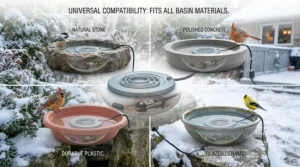
- Match housing material to your bath. Cast aluminum and enamel resist rust and calcification longer than bare foil, which matters if you want the heater to survive several winters.
- Measure the distance to your outlet. Nearly every immersion heater has a short cord, so factor a rated outdoor extension cord into your budget before you buy.
- Decide immersion vs all-in-one. If you already like your existing basin, buy a submersible heater; if you’re starting from scratch or need a deck-mountable option, an all-in-one heated bath solves two problems at once.
- Set a realistic price expectation. Genuinely safety-certified units on amazon.ca generally start around C$25-C$30 and climb toward C$130 for premium all-in-one pedestal models — check the current price before buying since these shift often.
Practical Usage Guide: Setup, Maintenance, and the First 30 Days
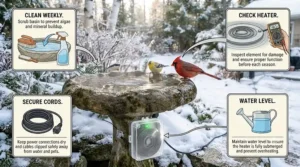
Getting a new bird bath heater running safely takes about ten minutes, but a few small habits in the first month make the difference between a unit that lasts three winters and one that fails by February. Start by fully submerging an immersion heater in the deepest part of your basin before plugging it in — never power it on dry to “test” it, since most units are designed to sense and dissipate heat through surrounding water. Route the cord along the outside of the basin to a GFCI-protected outdoor outlet, securing any slack with a cord clip so wind and curious squirrels can’t drag the unit out of position.
For the first 30 days, check the water level daily rather than weekly; experienced backyard birders note that heated water evaporates faster in freezing air than most people expect, and running an immersion heater partially exposed is the single most common cause of premature failure across every brand in this roundup. A common mistake worth flagging: some new owners unplug their heater every morning to “save power,” not realizing this repeated on-off cycling actually strains the thermostat more than simply leaving it plugged in continuously and letting the built-in thermostat manage the cycling itself. For ongoing maintenance, unplug the unit before hand-cleaning the basin every week or two — most manufacturers explicitly recommend this even on models rated for continuous submersion — and give the housing a quick visual check each month for cracks, fraying at the cord, or discolouration that might signal a failing seal.
Real-World Scenarios: Which Bird Bath Heater Fits Your Yard
The condo balcony birder. No ground-level yard, just a railing and a strong interest in watching chickadees over morning coffee. The Allied Precision Four Seasons Heated Bird Bath, with its deck-rail mount and modest 70-watt draw, solves the “no existing basin, no ground space” problem in one purchase, and its enclosed heating element sidesteps any worry about a loose immersion heater near a railing edge.
The rural acreage with an established concrete bath. A large existing basin, harsh prairie or northern cold, and an outdoor outlet already GFCI-protected from other yard equipment. The API Bird Bath De-Icer at 200 watts, or the Farm Innovators C-50 at 150 watts for slightly milder regions, are sized to actually keep pace with heat loss in a big basin through a genuine deep freeze.
The budget-first apartment renter with a small plastic bowl. Coastal or southern climate, a basin under 10 gallons, and a preference for spending under C$40 total. The GESAIL Birdbath Deicer or Farm Innovators B-9 both fit this use case, with the GESAIL’s thermostat edging it ahead for anyone who wants a bit more efficiency for a small additional cost.
Common Mistakes When Buying a Bird Bath Heater
The most expensive mistake is buying based on price alone rather than basin size — a C$25 unit in a 20-gallon concrete basin will run constantly and still lose the fight against a real cold snap, which ends up costing more in electricity and disappointment than simply buying correctly sized wattage upfront. A close second is ignoring cord length entirely, then discovering on installation day that the outlet is 15 feet from the basin and an outdoor-rated extension cord is now an unplanned extra purchase.
Another common misstep is assuming any plug-in device is automatically safe for outdoor, wet-adjacent use; skipping a CSA, cUL, or cETL check on an unfamiliar import brand is how buyers end up with a device that technically works but wasn’t actually evaluated against Canadian safety standards. Finally, plenty of first-time buyers let the basin run dry during a busy week away from home, not realizing that most immersion heaters are explicitly rated only for fully submerged operation — a five-minute check before a trip prevents this entirely.
Long-Term Cost & Maintenance: What This Really Costs to Run
Running the numbers honestly: a thermostatically controlled heater doesn’t draw its full wattage continuously, since the thermostat cycles it on and off based on actual water temperature, so real-world electricity cost is meaningfully lower than “wattage times hours plugged in” would suggest. Even so, treating a 100-watt average draw as a rough estimate across an entire Canadian winter season gives a ballpark of a modest addition to a monthly hydro bill — genuinely small change compared to what most households spend heating a home in the same months.
The bigger long-term cost driver is actually housing durability, not electricity. A C$25 foil de-icer that needs replacing every winter or two due to rust or a failed seal can end up costing more over five years than a single C$60 cast-aluminum unit that survives a decade of Canadian winters with basic care. Total cost of ownership, in other words, favours buying one tier above the absolute cheapest option in this roundup, provided the wattage still matches your basin size — the Farm Innovators C-50 and K&H Super Ice Eliminator both represent that sweet spot of durable construction without paying premium-tier pricing.
Frequently Asked Questions
❓ How many watts does a bird bath heater need for a standard basin?
❓ Is a bird bath heater safe to leave plugged in all winter?
❓ Do bird bath heaters make the water hot?
❓ Can I use an indoor extension cord for a bird bath heater outdoors?
❓ What's the difference between a bird bath heater and a heated bird bath?
Conclusion
A bird bath heater is a genuinely small purchase solving a genuinely important problem — keeping a reliable water source open for backyard birds through the coldest stretch of a Canadian winter, without turning your electricity bill or your outdoor outlet into a liability. Across the seven products compared here, the honest advice holds steady regardless of brand: match wattage to your actual basin size, confirm a real thermostat and CSA-family certification, and budget for an outdoor-rated extension cord since nearly every immersion heater ships with a short one. Whether that means the ultra-budget Farm Innovators B-9 for a small, mild-climate basin or the premium Allied Precision Heated Bird Bath with Metal Stand for a full pedestal display, the underlying safety math — wattage, amperage, and a working thermostat — doesn’t change.
Disclaimer: This article contains affiliate links. As an Amazon Associate, I earn from qualifying purchases. If you purchase products through these links, we may earn a small commission at no additional cost to you.
Recommended for You
- Metal Bird Bath: 7 Rust-Resistant Picks for Canadian Yards (2026)
- Concrete Bird Bath 2026: 7 Best Picks Canadians Actually Love
- Ceramic Bird Bath 2026: 7 Best Picks That Actually Last
✨ Found this helpful? Share it with your friends! 💬🤗
