
In This Article
The best lovebird food is a formulated, vet-endorsed pellet base, roughly 60–80% of daily intake depending on the brand’s own guidance. It is rounded out with fresh vegetables, a measured portion of quality seed and clean water. Seed-only bowls fall short on vitamin A, calcium and key amino acids, which is why pellet-forward feeding dominates avian-vet advice today.
Here’s the awkward part. Lovebirds are tiny, stubborn and gloriously opinionated. Walk down any Canadian pet aisle and you’ll find a wall of colourful seed bags decorated with photos of fruit that barely made it into the mix. Your bird will ignore the nutritious bits, pluck out the sunflower seeds like a toddler raiding a candy jar, and leave the rest. The Merck Veterinary Manual’s pet-owner guidance on nutritional disorders says as much. Birds tend to pick out the tastier seeds and nuts and skip the pellets, and obesity is common because seeds and nuts are so rich in fat.
So this guide does two jobs. First, it ranks seven real products by what their labels and aggregated owner reviews actually tell us. The lineup covers pellets, seed blends, a breeding-season formula and a foraging “berry”. Second, it tackles the questions that cost owners sleep: how to make a lovebird pellet diet stick, which lovebird seed mix brands deserve your money, and what lovebird food for breeding pairs looks like. We’ll also cover how pair bonding behaviour and aggression and diet are tangled together, and where breeding nutrition fits in. Canadian winters, dry indoor air and thin sunlight add their own twists, so we’ll cover those too.
One honest note: product details come from manufacturer labels and retailer listings checked at the time of research. Formulas and bag sizes change, so confirm everything on the current Amazon.ca listing and the bag itself.
Quick Comparison: Best Lovebird Food at a Glance
Short on time? Here’s the whole lineup. Prices are broad CAD ranges based on retailer listings at the time of research. Check the current price before buying, because bag sizes and costs shift.
| Product | Format | Best For | Price Range (CAD) |
|---|---|---|---|
| Harrison’s Adult Lifetime Fine | Certified organic pellets | Non-breeding adults, cleanest label | C$25–C$40 (small bags) |
| Roudybush Daily Maintenance Mini | Soft, steam-pelleted nuggets | Seed-to-pellet converts | C$20–C$30 |
| ZuPreem Natural Small Bird | Multigrain pellets | Budget pellet base | C$15–C$25 |
| Higgins Vita Seed Conure & Lovebird | Seed blend with extruded morsels | Variety and foraging | C$20–C$30 |
| Kaytee Forti-Diet Pro Health Conure & Lovebird | Seed and pellet blend | Budget mixed diet | C$15–C$25 |
| Kaytee Forti-Diet Pro Health Egg-Cite! | Blend with dried whole egg | Breeding and molting | C$20–C$30 |
| Lafeber Sunny Orchard Nutri-Berries | Berry-shaped whole-food nuggets | Picky eaters, foraging | C$15–C$25 |
Reading across the table, ZuPreem Natural Small Bird and Kaytee Forti-Diet Pro Health Conure & Lovebird keep entry cost lowest. Harrison’s Adult Lifetime Fine costs more per bag, but it’s the only certified-organic option here. Seed addicts will find the gentlest bridges in Roudybush Daily Maintenance Mini and Lafeber Sunny Orchard Nutri-Berries. Active breeders should look at Kaytee Forti-Diet Pro Health Egg-Cite! as a seasonal tool, not a year-round default.
💬 Just one click — help others make better buying decisions too!😊
Top 7 Best Lovebird Food Picks: Expert Analysis
1. Harrison’s Adult Lifetime Fine — organic whole-grain pellets, cleanest label here
This is the ingredient-list perfectionist’s pick. It is built from certified organic, non-GMO-verified whole grains and legumes, with no artificial preservatives.
The manufacturer positions it as a year-round maintenance formula for healthy, non-breeding, non-molting birds, ideally after a conversion stint on its higher-calorie High Potency line. Its feeding blueprint splits the day into roughly 75–80% nuggets, 15–20% vegetables and fruit, and about 5% omega-rich seeds or nuts. That’s a handy template even if you buy something else. Retail listings suggest around 1½–3 tsp per lovebird daily. That “non-breeding” wording matters: a pair with a nest box shouldn’t treat this as the whole answer to breeding nutrition.
Based on the label, this suits single pets and non-breeding pairs whose owners want a clean panel and don’t mind the learning curve. The maker also advises against combining it with other formulated diets, so it’s an all-in commitment. Nugget appearance varies batch to batch because whole ingredients replace dyes. That’s by design, not a defect.
Public review data is thin. One owner reports a bird still eating it three years on, alongside grapes, apples and carrots. Another noted a late-2025 bag with pieces about three times larger than the usual Fine, so check the size on arrival.
Pros:
- ✅ Certified organic whole grains and legumes
- ✅ No artificial preservatives
- ✅ Small pellet sizes suit lovebird beaks
Cons:
- ❌ Premium cost per bag
- ❌ Maintenance-only; not a breeding-season formula
Small bags landed around C$25–C$40 at the time of research (check current price). The verdict: you pay more for simplicity and purity.

2. Roudybush Daily Maintenance Mini — softer pellets that ease the seed switch
If your lovebird treats pellets like unwelcome vegetables, softness matters. Retail copy describes these pellets as softer and often more palatable for converting birds.
The Mini size is marked for budgie and lovebird beaks. The formula skips artificial colours, flavours and animal by-products, and it’s steam-pelleted. The maintenance line guarantees minimums of about 11% crude protein and 6% crude fat. That’s noticeably leaner than most seed blends, which helps weight control. Corn, wheat and soy meal lead the ingredient list, so it’s grain-forward rather than “garden-fresh”. The maker says no extra vitamin or mineral supplements are needed, and it’s suitable for off-season breeding birds too.
My read is that this is the pragmatic converter’s pick. It works for owners moving a seed-fed bird onto a lovebird pellet diet who want something gentle, plain and consistent. The same maker’s breeding formula makes seasonal switching straightforward, which we’ll unpack later.
Owners describe birds that adore it and say the transition from seed is slow but doable. One notes the pellets can crumble into powder when bitten. A conure keeper found that mixing seed in encouraged pellet-dumping to reach the good stuff.
Pros:
- ✅ Soft texture helps picky converts
- ✅ No artificial colours or flavours
- ✅ Pairs with a matching breeder formula
Cons:
- ❌ Crumbling can create dust
- ❌ Plain taste may bore fussy birds
Expect roughly C$20–C$30 for a 22 oz (about 620 g) bag (check current price). Good value for converting stubborn eaters.
3. ZuPreem Natural Small Bird — widely stocked budget pellet with uniform colour
Availability is half the battle, and this one is easy to find. It’s a multigrain pellet with celery, carrots, parsley, beets, blueberries, cranberries and ground flaxseed baked in.
Every nugget shares the same colour and shape. That discourages the “eat only the red ones” game that dyed pellets invite. The manufacturer says it should make up about 80% of the daily diet, and it carries no artificial colours or flavours. Sizing is slightly confusing. The small-bird version targets budgies, parrotlets and finches, and some listings add lovebirds. The medium version explicitly names lovebirds and small conures. Match pellet size to your bird’s beak.
For budget-conscious households, this is the lowest-risk way into a lovebird pellet diet. One reviewer noted corn and soy lead the ingredients and a little sugar aids palatability, so it’s solid rather than elite.
Reviewer sentiment is split. Some owners report successful switches from seed, while others say their birds flatly refuse it. Taste varies bird by bird.
Pros:
- ✅ Affordable and easy to find
- ✅ No artificial colours or flavours
- ✅ Uniform pellets discourage cherry-picking
Cons:
- ❌ Some birds refuse it outright
- ❌ Corn and soy lead the ingredients
Around C$15–C$25 for roughly 1 kg (2.25 lb), subject to current price. The verdict: best entry-level value.
4. Higgins Vita Seed Conure & Lovebird — seed blend with extruded morsels and probiotics
For owners not ready to abandon seed, this is the upgrade path from supermarket mixes.
The guaranteed analysis lists minimums of 13% protein and 12% fat, with maximums of 8.5% fibre and 10% moisture. It also lists at least 0.40% omega-3 and probiotic lactic-acid bacteria. Colour comes from annatto, turmeric and beet juice rather than synthetic dyes. Dried fruits, vegetables and extruded morsels share the bag with the seeds. That 12% fat minimum versus about 6% for a maintenance pellet is a minimum, not a ceiling. Still, the direction is clear: this is a richer food.
That’s why I’d use it as a supporting act or foraging component, not the sole bowl. Merck’s veterinary guidance warns that even half-seed, half-pellet feeding can leave vitamin A short if portions aren’t controlled. Remove uneaten food and hulls daily, per the maker’s instructions.
I couldn’t verify detailed owner review text for this product. It does appear on Chewy’s reviews-based best lovebird food list, which suggests solid popularity.
Pros:
- ✅ No artificial colours, flavours or preservatives
- ✅ Adds probiotics and omega-3
- ✅ Varied textures encourage foraging
Cons:
- ❌ Fat minimum is higher than pellets
- ❌ Selective eating still possible
Roughly C$20–C$30 for a 2.5 lb (1.1 kg) bag (check current price). A fair-value step up from basic seed.
5. Kaytee Forti-Diet Pro Health Conure & Lovebird — prebiotic-probiotic blend at a budget price
This is a mainstream, easy-to-find blend with a gut-health pitch: prebiotics, probiotics and psyllium fibre.
Labelled minimums are 15% protein and 10% fat, with a 12% fibre maximum and at least 0.5% omega-3. The label suggests about 1/8 cup (roughly 16 g) per lovebird and use within 30–45 days of opening. One retailer’s ingredient list includes FD&C colour additives, so synthetic-dye avoiders should read the bag. The protein is higher than the Higgins blend, while the fat minimum is slightly lower.
For households wanting an affordable mixed diet that clearly beats generic seed, this fits. It works best alongside vegetables and a gradual push toward pellets. Note the freshness window: a single bird at 16 g a day would take nearly four months to finish a 4 lb (1.8 kg) bag, far beyond 45 days. Smaller bags make more sense for singles.
Reviewers mostly speak from conure ownership, praising palatability. Lovebird-specific feedback is sparse, so treat this as tentative.
Pros:
- ✅ Prebiotics and probiotics for gut support
- ✅ Higher protein than comparable blends
- ✅ Budget-friendly and easy to source
Cons:
- ❌ Listing includes synthetic colour additives
- ❌ Short post-opening freshness window
Typically C$15–C$25 for 4 lb (1.8 kg) (check current price). Strong value for pairs; wasteful for one bird.
6. Kaytee Forti-Diet Pro Health Egg-Cite! — dried whole egg for breeding and molting
Most bags ignore breeding nutrition. This one aims straight at it, adding dried whole egg as a source of protein, vitamins, minerals and amino acids.
The maker positions it as especially useful for birds during breeding and molting. It also carries the prebiotic-probiotic package, and the transition guidance (blend old and new over 7–10 days) matches the sister blend. One caution: the listing emphasises protein, and I couldn’t verify calcium figures. Confirm the calcium numbers on the label before relying on it for laying hens.
Seasonal use is the smart play. Protein-rich, calorie-dense food in a non-breeding bird can nudge hormonal behaviour, a link we’ll revisit in the aggression section. For active pairs raising chicks, it’s a sensible short-term upgrade. For a single pet hen, I’d skip it.
Public review volume is limited, so I can’t responsibly summarise owner sentiment beyond noting that the formula is the same range as the more widely reviewed standard blend.
Pros:
- ✅ Purpose-built for breeding and molting
- ✅ Dried whole egg adds protein
- ✅ Probiotics included
Cons:
- ❌ Wrong choice for non-breeding birds year-round
- ❌ Little verifiable review data
Expect roughly C$20–C$30 (check current price). The verdict: worthwhile seasonally, not as a staple.
7. Lafeber Sunny Orchard Nutri-Berries — foraging-friendly berries that tempt picky birds
Think of these as pellets in costume. The manufacturer describes a berry-shaped mix of seeds, grains and real fruit with about 30% pellets, marketed as nutritionally complete.
They can be offered as a main diet or a treat. The berry shape encourages beak work and fits inside foraging toys, which matters for bored, bitey birds. The retail guaranteed analysis lists at least 10% protein. Ingredient lists vary by retailer. One US listing shows artificial colours and ethoxyquin, while other sellers advertise no dyes and non-GMO ingredients. That discrepancy suggests formulas changed over time, so read the bag you actually receive.
I’d recommend them for picky eaters and enrichment-hungry birds, ideally as part of a rotation with a true pellet base. Dried fruit adds sugar, so portion control matters.
Reviewers consistently describe picky birds taking to them and using them well in foraging toys. Crumbs are the usual complaint, and keepers recycle them into treat mixes.
Pros:
- ✅ Berry shape suits foraging toys
- ✅ Tempts picky birds
- ✅ Mixes whole fruit and seeds with pellets
Cons:
- ❌ Crumbly debris at the bottom of the bag
- ❌ Ingredient lists differ across retailers
Around C$15–C$25 for 10 oz (284 g) (check current price). A fun, useful supporting player.
Having compared the field, here’s the daily-feeding snapshot.
| Product | Label or Listing Guidance | Richness Note | Best For |
|---|---|---|---|
| Harrison’s Adult Lifetime Fine | About 1½–3 tsp per lovebird (retail listing) | Whole-grain, maintenance-level | Non-breeding adults |
| Roudybush Daily Maintenance Mini | Complete diet; no extra supplements advised | Min. 11% protein, 6% fat (maintenance line) | Seed-to-pellet converts |
| ZuPreem Natural Small Bird | About 80% of daily diet | Check label for fat | Budget pellet base |
| Higgins Vita Seed Conure & Lovebird | Remove uneaten food and hulls daily | Min. 13% protein, 12% fat | Variety and foraging |
| Kaytee Forti-Diet Pro Health Conure & Lovebird | 1/8 cup (≈16 g) per lovebird | Min. 15% protein, 10% fat | Budget mixed diet |
| Kaytee Forti-Diet Pro Health Egg-Cite! | Transition over 7–10 days | Egg-based protein boost | Active breeders |
| Lafeber Sunny Orchard Nutri-Berries | Main diet or treat | Min. 10% protein | Picky eaters, foraging |
The pattern is clear. Pellets cluster at the lean end, while blends climb to 10–12% fat or more. If weight or hormones are your worry, start with the pellets. If boredom is the issue, pair a pellet base with Lafeber Sunny Orchard Nutri-Berries in a foraging toy. For a budget pair, Kaytee Forti-Diet Pro Health Conure & Lovebird plus fresh greens is a decent compromise.
How to Switch to a Lovebird Pellet Diet: A Four-Week Plan
A lovebird pellet diet looks simple on paper and turns into a standoff in practice. These birds are small and can run into trouble quickly if they stop eating, so go slowly and never “starve them onto pellets”.
Week 1 — Introduce. Mix about a quarter pellets into the current seed. The Kaytee Forti-Diet Pro Health line advises blending old and new food over 7–10 days to avoid digestive upset. You can also scatter nuggets on white paper at the bottom of the cage to spark curiosity.
Weeks 2–3 — Shift the ratio. Raise pellets to half, then three-quarters. Remove seed hulls so you can see what’s actually eaten. A gram scale for weekly weigh-ins is the best early-warning tool you’ll own.
Week 4 — Settle. Aim for the pellet-forward base described earlier. Add vegetables as a separate, daily “chop” bowl.
Common first-month mistakes:
- Switching overnight
- Stacking three brands at once
- Ignoring weight and droppings
- Using seed as an emergency bribe every time the bird complains
If your bird stops eating or loses weight, pause the switch and call an avian vet. Soft pellets like Roudybush Daily Maintenance Mini and foraging berries like Lafeber Sunny Orchard Nutri-Berries make good bridge foods for stubborn birds.
Aggression and Diet: A Problem-and-Solution Guide
Aggression and diet are linked more tightly than most owners expect. Veterinary-reviewed behaviour resources describe captive birds as being kept in breeding readiness by constant daylight, abundant high-fat food and nest-like hideaways. That readiness can produce biting, territoriality and regurgitation. Food is one lever, not the only one, and medical causes should be ruled out first.
Problem 1: A hen who bites and keeps laying. Hormones are the usual suspect. Trim rich, fatty extras and avoid leaving protein-heavy foods in the cage year-round. Remove nest-like spots, and consider shortening daylight. Lafeber’s veterinary Q&A suggests 8–10 hours of daylight can help in some hormonal birds.
Problem 2: Guarding the food bowl. Provide several small cups instead of one prized dish. Remove any bowl she sits in.
Problem 3: Pellet-dumping to reach seed. Keep seed to a scheduled foraging portion, not mixed into the pellets.
Problem 4: Bickering pairs. Two feeding stations reduce competition, and a second chop dish helps.
Problem 5: Picky eating that breeds crankiness. A hungry, nutrient-short bird isn’t a happy one. Rotate bridge foods like ZuPreem Natural Small Bird and Roudybush Daily Maintenance Mini to find what sticks.
Punishing hormone-driven behaviour doesn’t work. Managing the environment and the bowl does.
Real-World Scenarios: Matching the Best Lovebird Food to Your Flock
Scenario 1: A single lovebird in a Toronto condo. The owner wants an easy routine and a modest monthly outlay. Based on the specs, ZuPreem Natural Small Bird or Harrison’s Adult Lifetime Fine fit, with a chop bowl each morning. A small bag of Lafeber Sunny Orchard Nutri-Berries is a good enrichment treat. Budget: roughly C$15–C$40 per bag, depending on the pellet choice.
Scenario 2: A bonded, non-breeding pair in Ottawa. Two birds eat twice as much and guard their dishes. Choose Roudybush Daily Maintenance Mini as the base, offer two separate bowls and add a measured Higgins Vita Seed Conure & Lovebird topper in a foraging toy.
Scenario 3: An active breeding pair in Calgary. During breeding, the pair needs more calcium and protein. The sensible path is a breeding formula blended with maintenance feed, plus fresh dark greens. Kaytee Forti-Diet Pro Health Egg-Cite! is the over-the-counter option I could verify, and Roudybush High Energy Breeder is the more structured one. Return to maintenance feed when chicks are weaned.
Whatever your profile, confirm availability and current prices on Amazon.ca, because stock varies.
✨ Ready to Upgrade Your Lovebird’s Bowl?
🔍 Take your flock’s nutrition to the next level with these carefully selected foods. Click on any highlighted product to check current pricing and availability. A better bowl can mean a healthier, happier, more balanced pair of feathered friends! 🦜
How to Choose the Best Lovebird Food: 6 Steps
Picking the best lovebird food comes down to a handful of decisions. Work through them in order.
- Start with the diet type. Choose a formulated pellet or pellet-heavy base, with seed as an accent. The Merck Veterinary Manual’s psittacine nutrition chapter notes that strictly seed diets are suboptimal, and that pelleted diets differ in quality and must be evaluated individually.
- Match pellet size to the beak. Mini, Super Fine or small sizes suit lovebirds. Oversized nuggets frustrate tiny beaks.
- Read the guaranteed analysis. Compare protein and fat minimums. Leaner pellets (about 6% fat) suit maintenance, while richer blends suit active breeders.
- Check the ingredient panel for dyes and preservatives. Ignore the pictures on the front and read the small print.
- Match the life stage. Maintenance, molting and breeding diets differ, so choose the one that fits the season.
- Mind freshness and bag size. Blends often carry a 30–45 day post-opening window. Buy a bag you’ll finish.
Lovebird Pellet Diet vs Seed-Based Feeding: The Real Trade-Offs
The debate between a lovebird pellet diet and a seed-based approach isn’t about purity. It’s about what ends up in the bird. Seed-heavy diets tend to be low in calcium and vitamin D and high in phosphorus. Merck’s veterinary guidance also flags vitamin A shortfalls, even with half-seed, half-pellet feeding when portions aren’t controlled.
| Feeding Style | Nutritional Balance | Waste and Picking | Best For |
|---|---|---|---|
| Pellet-forward base (Roudybush Daily Maintenance Mini) | Designed to be complete in each bite | Low selective feeding | Most healthy adults |
| Seed-heavy mix | Gaps in vitamin A, calcium, amino acids | High; birds pick favourites | Occasional foraging only |
| Seed-and-morsel blend (Higgins Vita Seed Conure & Lovebird) | Better than plain seed; still rich | Moderate | Owners mid-transition |
| Foraging berries (Lafeber Sunny Orchard Nutri-Berries) | Marketed as complete with 30% pellets | Low waste, some crumbs | Picky or bored birds |
The table shows why pellets win as a base: they remove the bird’s ability to cherry-pick. Seed blends still earn a place, but as a supporting act. For picky birds, Lafeber Sunny Orchard Nutri-Berries offers a middle path. For everyone else, the lovebird pellet diet remains the most reliable route to balanced nutrition.
Lovebird Seed Mix Brands: What to Look for on the Label
Not all lovebird seed mix brands are equal, and the front of the bag tells you little. Flip it over and check for these points.
Seed variety. A decent mix should offer more than millet and sunflower. Look for canary seed and safflower, and treat the sunflower content as a fat flag.
Colour and preservatives. Higgins Vita Seed Conure & Lovebird colours with annatto, turmeric and beet juice, while one retailer’s list for Kaytee Forti-Diet Pro Health Conure & Lovebird shows FD&C additives. Neither is a deal-breaker, but now you know where to look.
Added extras. Probiotics, omega-3 and extruded morsels add genuine value, as long as the base isn’t mostly high-fat seed.
Freshness and storage. Merck links liver damage in birds to aflatoxins from improperly stored seed and pet-grade peanuts. Buy fresh, store dry, and bin anything that smells off or looks mouldy.
Portion control. Harrison’s guidance caps omega-rich seeds and nuts at around 5% of the diet, while other feeding guides allow up to 10%. Treat mixed seed as a small share, not the main course.
Among the lovebird seed mix brands compared here, Higgins Vita Seed Conure & Lovebird and Kaytee Forti-Diet Pro Health Conure & Lovebird are the sturdier choices. Both are better than generic supermarket mixes, yet both belong alongside pellets, not instead of them.
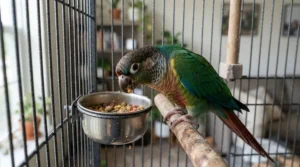
Lovebird Food for Breeding Pairs: Breeding Nutrition That Actually Matters
Lovebird food for breeding pairs has a different job. A laying hen draws heavily on calcium reserves. Lafeber’s veterinary resource, Why Are Pellets Better Than Seeds for Pet Birds?, explains that birds pull calcium from their bones during egg-laying. If dietary calcium falls short, bones can turn brittle and prone to fractures. The same source points out that vitamin A, important for reproduction, is minimal in seed-based diets.
Good breeding nutrition therefore rests on three things: reliable calcium and vitamin D, adequate protein, and an overall diet that isn’t fat-heavy.
Roudybush High Energy Breeder is designed for birds feeding chicks, adding extra protein, calcium and vitamin D3. The maker suggests blending one-third breeder with two-thirds maintenance for chronic egg-layers, and advises against adding vitamins or cuttlebone on top. Kaytee Forti-Diet Pro Health Egg-Cite! offers an egg-based alternative.
Fresh support helps too. Offer dark leafy greens, and keep a cuttlebone available if you feed a seed-based diet. Some keepers add cooked egg with crushed shell as a calcium and protein boost.
Avoid overbreeding. One breeder’s guideline in a long-running aviculture publication limits pairs to two clutches in 12 months. Check with an avian vet about egg-binding risk and your pair’s condition, then step back to maintenance feeding once chicks are weaned.
Pair Bonding Behaviour and the Food Bowl
Lovebirds earned their name for a reason, and pair bonding behaviour shows up in the feed dish. Mate feeding, where one bird regurgitates food to the other, is normal courtship behaviour. Persistent regurgitation focused on a single target, however, signals active breeding condition rather than mere affection.
Diet feeds into that signal. In the wild, birds breed when food is plentiful. Captive birds with unlimited access to rich, high-calorie food receive constant “conditions are ideal” messages. Pair bonding behaviour is wonderful to watch, but you don’t want it stuck permanently on.
Practical steps:
- Two feeding stations. Separate dishes cut competition and protect shy eaters.
- Steady, measured portions. Avoid an always-full bowl of rich seed.
- Lean pellets as the base. Roudybush Daily Maintenance Mini and ZuPreem Natural Small Bird keep the nutritional baseline steady.
- Foraging for energy. Berries in a toy, such as Lafeber Sunny Orchard Nutri-Berries, burn bonded-pair energy without extra calories.
Pairs also eat more than singles. ZuPreem’s own table is written per bird, so double it for two. Watch body condition, not just the bowl.
Features That Actually Matter (And Those That Don’t)
Marketing loves adjectives. Your lovebird’s liver doesn’t. Here’s how to sort signal from noise.
What matters:
- Pellet size and texture. If it doesn’t fit the beak, it won’t get eaten.
- Guaranteed analysis. Protein and fat minimums tell you how rich a food is.
- Ingredient order. Whole grains and named ingredients beat vague descriptions.
- Life-stage fit. Maintenance, molting and breeding diets aren’t interchangeable.
- Freshness window. A 30–45 day post-opening guideline changes which bag size to buy.
What doesn’t (much):
- Fruit photos on the bag. Dried fruit pieces may be tiny, or the bird may leave them behind.
- “Gourmet” or “premium” labels. These words aren’t standards.
- Rainbow colours. ZuPreem Natural Small Bird uses uniform colour precisely because variety encourages picking.
- “Vet recommended” badges. Helpful context, but not a substitute for reading the analysis.
One feature that deserves mention is organic certification. For owners who value it, Harrison’s Adult Lifetime Fine is the clear option here, but it’s a preference rather than a nutritional requirement.
Long-Term Cost and Storage in Canada
Cost per bag is a poor measure. Cost per day, and per usable day, tells the truth. At the label’s suggested 16 g (1/8 cup) for Kaytee Forti-Diet Pro Health Conure & Lovebird, a single bird would take around 112 days to finish a 1.8 kg bag. A pair would take about 56. Both exceed the 30–45 day post-opening window. For singles, smaller bags or freezing portions make more sense, and many owners freeze pellet and blend portions to protect freshness.
At the CAD ranges above, feeding one lovebird works out to roughly C$7–C$15 a month before waste. A lovebird pellet diet with less picking can be more economical than seed, even when the bag costs more.
Canadian-specific tips:
- Winter humidity swings. Store food airtight, cool and dry, and avoid unheated garages.
- Limited winter sunlight. Merck’s psittacine guidance recommends direct sunlight (with heat cautions) or properly used UVB bulbs, which matters for vitamin D.
- Order ahead. Winter weather can delay shipments, so keep a spare bag.
Safety, Storage and Canadian Regulations: What Bird Owners Should Know
Food safety goes beyond the bag. Avoid avocado, chocolate, caffeine, alcohol and heavily salty, sugary or fatty human foods. When in doubt, ask an avian vet.
Disease risk also matters. The Canadian Food Inspection Agency publishes guidance on keeping your birds safe from avian influenza. It is worth bookmarking if you keep birds near windows, balconies or outdoor aviaries. If you suspect avian influenza in a pet bird, the CFIA says to contact your nearest CFIA Animal Health office.
If you ever import a pet bird, CFIA rules require an import permit and, for birds from countries other than the United States, a minimum 45-day quarantine on arrival. Requirements change, so verify them before you travel.
Keep food records too: bag batch numbers, purchase dates and any recalls you hear about. A small habit now saves headaches later.
FAQ
❓ How much food does a lovebird eat per day?
❓ Can lovebirds eat sunflower seeds every day?
❓ Do lovebirds on pellets still need cuttlebone?
❓ What is the best lovebird food for a picky eater?
❓ How long does an opened bag of lovebird food stay fresh?
Conclusion
If there’s a single takeaway about the best lovebird food, it’s this: build around a lean, balanced pellet and treat seed as the garnish. Harrison’s Adult Lifetime Fine suits owners who want a certified-organic, no-nonsense base. Roudybush Daily Maintenance Mini is the gentle option for converting seed-lovers, and ZuPreem Natural Small Bird keeps the entry cost low.
For owners who still want a seed-style bowl, Higgins Vita Seed Conure & Lovebird and Kaytee Forti-Diet Pro Health Conure & Lovebird are the more thoughtful blends in this lineup. Kaytee Forti-Diet Pro Health Egg-Cite! earns a seasonal slot for active breeding pairs, and Lafeber Sunny Orchard Nutri-Berries brings enrichment and a bribe for fussy eaters.
Beyond the brand names, remember what ties it all together. Good breeding nutrition protects the hen, careful portions help calm aggression and diet problems, and two feeding stations keep pair bonding behaviour sweet instead of territorial. Check current prices and availability on Amazon.ca, introduce changes slowly, and loop in an avian vet whenever weight, droppings or behaviour change.
Recommended for You
- Best Cockatiel Food: 7 Proven Picks For Canadian Owners 2026
- Best Budgie Food: 7 Essential Picks For Canada (2026)
- Small Bird Pellets vs Seed Mix: 7 Best Picks For 2026 (Avoid Risks)
Disclaimer: This article contains affiliate links. As an Amazon Associate, I earn from qualifying purchases. If you purchase products through these links, we may earn a small commission at no additional cost to you.
✨ Found this helpful? Share it with your friends! 💬🤗
