
In This Article
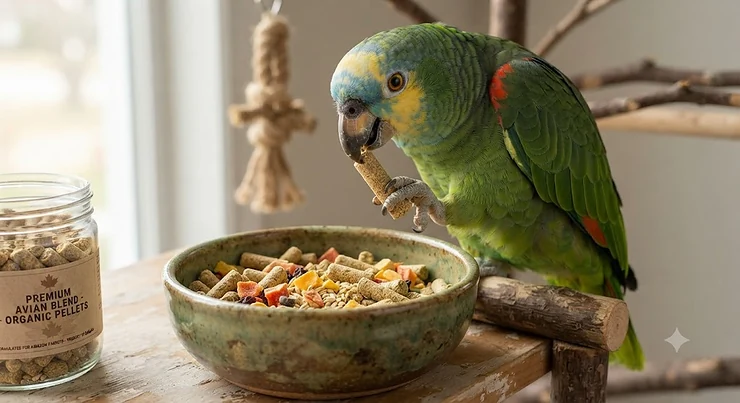
If you share your living room with a green, opinionated, occasionally shouty Amazon parrot, you already know feeding time is never simple. The best amazon parrot food is a nutritionally complete pellet diet formulated for the species’ documented tendency toward obesity — typically lower in fat than standard parrot mixes, fortified with vitamins A and D3, and free of the sunflower-seed-heavy fillers that pack on weight fast. Amazon parrots (the stocky, forest-green birds of genus Amazona, not anything to do with the retailer) are notorious among avian veterinarians for turning almost any all-seed diet into a one-way ticket toward a fatty liver.
That reputation isn’t exaggerated, and it isn’t your bird’s fault, either — it’s a mismatch between a diet built for wild foraging energy expenditure and the calorie-dense, low-effort bowl sitting in a cage all day. Here in Canada, where indoor birds get even less flight time during our long winters, the stakes climb higher. This guide walks through seven real pellet brands sold on amazon.ca, breaks down what “low-fat” actually means on a nutrition label, and digs into the obesity and fatty-liver risks that make food selection genuinely a life-or-death decision for these long-lived, big-personality birds. We researched real products, real specs, and real aggregated reviewer sentiment — no invented ratings, no fabricated hands-on stories, just an honest comparison to help you choose well.
Quick Comparison Table
Before the deep dive, here’s the shortlist. Every entry below is a real pellet product available through amazon.ca, ranked with weight-conscious Amazon owners in mind.
| Product | Type | Best For | Price Range (CAD) |
|---|---|---|---|
| RoudyBush Low Fat Pellets | Extruded, low-fat | Obesity-prone Amazons | C$60–C$140 |
| Harrison’s Adult Lifetime Coarse | Baked, certified organic | Lifelong maintenance | C$20–C$85 |
| TOPs Organic Parrot Pellets | Sprouted, organic | Clean-label households | C$35–C$170 |
| Lafeber’s Premium Daily Diet | Extruded, vet-formulated | Digestive support | C$18–C$180 |
| ZuPreem Natural Pellets | Extruded, natural | Budget daily staple | C$18–C$24 |
| Higgins InTune Natural | Extruded, naturally preserved | Mid-range quality | C$22–C$28 |
| Kaytee Exact Rainbow | Extruded, colour-coded | Seed-to-pellet converts | C$20–C$95 |
Looking at the spread, RoudyBush Low Fat Pellets stands apart as the only formula purpose-built around the fat ceiling avian vets actually recommend for Amazons, while ZuPreem Natural Pellets and Higgins InTune Natural anchor the budget end without sliding into low-quality filler territory. Price scales heavily with bag size, so a household with three Amazons will see very different per-bird economics than someone feeding one bird.
💬 Just one click — help others make better buying decisions too!😊
Top 7 Amazon Parrot Foods: Expert Analysis
1. RoudyBush Low Fat Pellets (Maintenance Formula) — purpose-built for obesity-prone Amazons
RoudyBush Low Fat Pellets exist for almost exactly this article’s premise: a nutritionally complete diet with the fat dialled down for species that pack on weight easily. Where RoudyBush’s standard Maintenance formula runs closer to 9–10% crude fat, the Low Fat line is formulated in the roughly 4–5% range, a meaningful difference when you’re feeding the same bowl every day for twenty-plus years. The extrusion process — cooking under pressure rather than baking — is also associated with better starch gelatinization, which several avian nutritionists argue improves nutrient bioavailability compared to simple baked pellets.
Who should buy this? Honestly, almost any Amazon owner whose bird has already been flagged as overweight by a vet, or any owner starting a young Amazon on pellets from day one rather than waiting for a weight problem to develop. Reviewers consistently report that the pellets hold their shape well in humid cages and don’t crumble into dust the way some cheaper extruded brands do, though a recurring theme in aggregated feedback is that the plain, undyed colour makes conversion from seed mixes slower for stubborn eaters.
Pros:
- ✅ Purpose-built low-fat recipe near 4–5% crude fat for weight-prone Amazons
- ✅ Extruded format linked to better nutrient absorption than baked pellets
- ✅ Long track record with avian veterinarians and breeders
Cons:
- ❌ Plain, undyed appearance is a harder sell for picky, seed-loving Amazons
- ❌ Narrower retailer availability than the big box brands
At the time of research, smaller bags run in the C$60–C$75 range with the 25 lb size landing around C$115–C$140 — genuinely good value per kilogram if you’re feeding a larger flock, though check current price and availability before ordering, since formats shift.
2. Harrison’s Adult Lifetime Coarse — certified organic, vet-developed for lifelong health
Harrison’s Adult Lifetime Coarse was developed by an avian veterinarian, Dr. Greg Harrison, and it shows in the ingredient philosophy: certified organic grains and seeds, no synthetic preservatives, no artificial dyes, and no added sugar. The “coarse” grind is sized for medium-to-large parrots like Amazons, Amazon-sized conures, and small macaws, so you’re not dealing with pellets scaled for a budgie.
What the spec sheet won’t tell you outright is how much this formula leans on whole-food nutrition rather than synthetic vitamin premixes — a point Harrison’s markets heavily, and one that resonates with owners chasing a “clean label” diet. Based on the ingredient comparison against competitors, the trade-off is a fat content that sits a touch higher than RoudyBush’s dedicated low-fat line, closer to 8%, so it’s a strong lifelong maintenance diet rather than a targeted weight-loss tool. Aggregated reviewer sentiment skews positive on feather condition and stool quality after switching, with a recurring complaint being the drab brown-green colour that some Amazons initially reject.
Pros:
- ✅ Certified organic, human-grade ingredient sourcing
- ✅ Formulated specifically by an avian veterinarian
- ✅ Free of synthetic preservatives, dyes, and added sugar
Cons:
- ❌ Premium price point relative to mainstream pellet brands
- ❌ Drab colour slows conversion for some seed-dependent Amazons
Expect the 1 lb trial size around C$20–C$25 and the 5 lb bag in the C$70–C$85 range at the time of research — a reasonable way to test acceptance before committing to a bulk order.
3. TOPs Organic Parrot Pellets — sprouted, whole-grain formula without synthetic binders
TOPs Organic Parrot Pellets (short for Totally Organic Pellets) take a genuinely different manufacturing approach: whole grains and legumes are sprouted before processing, a step the brand argues improves digestibility and nutrient availability compared to unsprouted grain flour. It’s USDA-certified organic and non-GMO, with no synthetic binding agents holding the pellet together.
Here’s what that means in practice — sprouting partially breaks down phytic acid, a compound that can bind minerals and reduce their absorption in grain-heavy diets, so in theory your Amazon extracts more usable nutrition per gram of food. Whether that translates into a measurably healthier bird is hard to verify without controlled trials, but the ingredient transparency is genuinely a step above most competitors. Reviewers frequently mention a stronger, more “food-like” smell compared to bland commercial pellets, and several long-time breeders cite it as their go-to for birds with sensitive digestion.
Pros:
- ✅ USDA-certified organic and non-GMO sourcing
- ✅ Sprouted-grain process may improve mineral bioavailability
- ✅ No synthetic binders or artificial preservatives
Cons:
- ❌ Higher price per pound than most mainstream brands
- ❌ Shorter practical shelf life; needs cool, dry, sealed storage
Smaller 4 lb bags sit around C$35–C$45, while the 25 lb bulk option runs roughly C$140–C$170 at the time of research — worth it for multi-bird households willing to store food properly.
4. Lafeber’s Premium Daily Diet Pellets — avian-vet formulated with added probiotics
Lafeber’s Premium Daily Diet Pellets trace back to Dr. Ted Lafeber, one of the founding figures in North American avian veterinary medicine, and the current formula reflects decades of clinical iteration: non-GMO, human-grade ingredients, plus added probiotics aimed at supporting gut flora. It’s one of the most widely stocked pellet brands in Canada, which matters more than it sounds — running out on a long weekend is a real problem when your bird only eats one brand.
The probiotic angle is worth unpacking rather than just listing. A healthy gut microbiome plays into everything from nutrient absorption to immune resilience, and Lafeber’s marketing leans on this as a differentiator from bare-bones pellet competitors. On the flip side, based on the ingredient panel comparison, fat content sits in the mid-range rather than at the low end RoudyBush targets, and some batches include small dried fruit pieces that nudge sugar content upward — fine for an active bird, less ideal as the sole diet for one already flagged as overweight.
Pros:
- ✅ Formulated by avian veterinarians with added probiotics
- ✅ Human-grade, non-GMO ingredient sourcing
- ✅ Excellent availability across Canadian retailers
Cons:
- ❌ Mid-range fat content, not a dedicated weight-loss formula
- ❌ Some batches include dried fruit pieces that add sugar
The 1.25 lb tub runs around C$18–C$24, with larger 25 lb bags priced roughly C$150–C$180 at the time of research; prices may vary by retailer.
5. ZuPreem Natural Pellets for Large Birds — additive-free, budget-friendly daily staple
ZuPreem Natural Pellets strip out the artificial colours and flavours that made ZuPreem’s older FruitBlend line controversial among some avian vets, landing on a simpler, more neutral formula sized specifically for large birds — Amazons, macaws, and cockatoos included. It’s one of the most widely available pellet brands on Amazon.ca, which keeps the price genuinely competitive.
What most buyers overlook about the Natural line specifically is that it’s a meaningfully different product from ZuPreem’s dyed FruitBlend pellets, so it’s worth double-checking the bag before assuming “ZuPreem” automatically means artificial colouring. Based on the spec comparison, fat content runs higher than RoudyBush’s dedicated low-fat formula, so it functions better as a general maintenance diet for an already-lean Amazon than as a corrective diet for one carrying extra weight. Aggregated reviews note good acceptance rates among birds transitioning from seed, likely because the pellet retains a milder, less “medicinal” smell than some organic competitors.
Pros:
- ✅ Budget-friendly everyday staple with strong value per kilogram
- ✅ No artificial colours or flavours in the Natural line
- ✅ Extremely wide retail availability for easy restocking
Cons:
- ❌ Higher fat content than formulas built specifically for weight management
- ❌ Less ingredient-sourcing transparency than boutique organic brands
Bags typically land in the C$18–C$24 range for a 3 lb bag at the time of research — one of the more affordable entries on this list.
6. Higgins InTune Natural Parrot Pellets — naturally preserved, chelated-mineral formula
Higgins InTune Natural Parrot Pellets occupy a useful middle ground: naturally preserved without propylene glycol (a preservative some owners specifically avoid), with chelated minerals — a form bonded to amino acids that’s generally considered easier for the body to absorb than plain mineral salts. It’s a smaller-footprint brand than ZuPreem or Kaytee, but it has built a loyal following among rescue organizations and smaller aviaries.
Chelation matters more than the marketing copy usually explains: minerals in their raw, unchelated form can pass through a bird’s digestive tract largely unused, while chelated versions are more readily absorbed into the bloodstream. That’s a genuine formulation upgrade, not just label dressing. Reviewers consistently mention good pellet texture and low dust/crumble in the bag, though the trade-off is a thinner body of independent, third-party nutritional analysis compared to the bigger legacy brands.
Pros:
- ✅ Naturally preserved, free of propylene glycol
- ✅ Chelated minerals for improved nutrient absorption
- ✅ Reasonable mid-range pricing for the quality tier
Cons:
- ❌ Smaller bag sizes mean more frequent reordering for larger flocks
- ❌ Fewer independent nutritional studies published compared to legacy brands
Expect to pay roughly C$22–C$28 for a 3 lb bag at the time of research, positioning it just above ZuPreem Natural but below the organic specialty brands.
7. Kaytee Exact Rainbow Parrot Food — colour-coded pellets for easing seed-to-pellet conversion
Kaytee Exact Rainbow Parrot Food takes the opposite approach from the “clean label” organic brands: multicoloured pellets, specifically designed to visually resemble the variety a seed-only bird is used to seeing in its bowl. It’s a deliberate strategy for the notoriously stubborn subset of Amazons that flatly refuse plain, single-colour pellets, and it includes added prebiotics and probiotics for digestive support.
Here’s the honest trade-off: the added dyes are a dealbreaker for owners chasing an additive-free diet, but for a bird that’s been on seed for a decade and needs a bridge diet to get started on pellets at all, “imperfect but eaten” beats “perfect but ignored” every time. Based on the formulation, fat content isn’t specifically engineered for weight management, so it’s best treated as a conversion tool rather than a long-term solution for an overweight Amazon. Aggregated reviewer feedback frequently praises acceptance rates among reluctant converts, with the most common complaint centring on the artificial colouring itself.
Pros:
- ✅ Colour variety significantly eases conversion from seed-only diets
- ✅ Added prebiotics and probiotics support digestion
- ✅ Strong bulk-bag value for budget-conscious households
Cons:
- ❌ Artificial colouring conflicts with “clean label” preferences
- ❌ Not formulated specifically for weight management
The 4 lb bag runs about C$20–C$26, and the 20 lb bulk bag lands around C$75–C$95 at the time of research — one of the better per-kilogram deals for large collections mid-conversion.
Detailed Specs at a Glance
| Product | Approx. Fat % | Format | Bag Sizes | Best For |
|---|---|---|---|---|
| RoudyBush Low Fat Pellets | ~4–5% | Extruded | 10–25 lb | Weight-loss maintenance |
| Harrison’s Adult Lifetime Coarse | ~8% | Baked, organic | 1–25 lb | Lifelong clean-label diet |
| TOPs Organic Parrot Pellets | ~9–10% | Sprouted, organic | 4–25 lb | Digestive sensitivity |
| Lafeber’s Premium Daily Diet | ~10–12% | Extruded | 1.25–25 lb | General maintenance |
| ZuPreem Natural Pellets | ~12% | Extruded | 3 lb | Budget staple |
| Higgins InTune Natural | ~9% | Extruded | 3 lb | Mineral absorption |
| Kaytee Exact Rainbow | ~12% | Extruded | 4–20 lb | Seed-to-pellet transition |
The fat percentages above reflect approximate figures reported at the manufacturer level and can shift slightly between production batches, so always check the guaranteed analysis panel on the actual bag you receive. Interpreted together, only RoudyBush Low Fat Pellets sits meaningfully below the roughly 8% ceiling many avian vets recommend as a soft cap for sedentary companion Amazons, which is exactly why it tops this list for weight-conscious households.
Transformation: Practical Guide to Switching Your Amazon Onto a Low-Fat Diet
Converting a seed-committed Amazon to pellets is less about the food itself and more about patience and method. Start by weighing your bird weekly on a gram scale — not a bathroom scale — so you have an objective baseline before changing anything, since Amazons hide weight gain remarkably well under dense plumage. For the first two weeks, offer pellets alongside the existing seed mix in separate dishes rather than mixing them together; birds are visual foragers, and a mixed bowl usually just gets picked through for the familiar seeds while the pellets sit untouched.
Gradually reduce the seed portion by roughly 10% every few days rather than pulling it cold turkey, watching droppings and weight closely throughout — a sudden total food change can trigger a dangerous refusal-to-eat response in a stressed bird, so this has to be gradual, not abrupt. Warming pellets slightly or lightly misting them with water can increase aroma and appeal during the transition window, though wet food left out more than a few hours becomes a bacterial risk and should be removed. A common first-30-days mistake is giving up too early: full conversion in an adult bird that’s eaten seed for years can genuinely take four to eight weeks, and reverting to seed at week two because “she’s not eating it yet” resets the entire process.
Once fully converted, treat the pellet as roughly 70–80% of daily intake, filling the remainder with fresh vegetables, limited fruit, and the occasional nut as a training treat rather than a dietary staple. Building a genuinely sustainable low-fat amazon parrot diet is as much about this conversion process as it is about which bag you buy — the best formula in the world does nothing if it stays in the dish untouched.
Transformation: Real-World Scenarios — Matching the Right Food to Your Amazon
Scenario one: a newly adopted, overweight Double Yellow-Headed Amazon coming from a seed-only household, budget-conscious, urban apartment with limited flight space. Here, RoudyBush Low Fat Pellets paired with a gradual conversion plan and daily supervised out-of-cage time makes the most sense — the dedicated low-fat formula does the heavy lifting nutritionally while the owner rebuilds an exercise routine from scratch.
Scenario two: a breeder or multi-bird household with several healthy-weight Amazons, moderate budget, prioritizing ingredient transparency over price. TOPs Organic Parrot Pellets or Harrison’s Adult Lifetime Coarse fit well here, since neither bird needs aggressive fat restriction and the household values the organic, additive-free sourcing enough to absorb the higher per-kilogram cost.
Scenario three: a long-time owner with a single, stubborn, seed-loving Amazon that has refused every pellet attempt for years, moderate budget, mainly concerned with getting any pellet acceptance at all before tackling fat content. Kaytee Exact Rainbow as a bridge diet, later transitioning toward ZuPreem Natural Pellets or Lafeber’s Premium Daily Diet once the bird reliably eats pellets, is the more realistic path than jumping straight to a plain low-fat formula the bird may reject outright.
✨ Don’t Miss These Exclusive Deals!
🦜 Whichever scenario matches your household, take a closer look at today’s pricing on any of the seven products above — checking current availability only takes a minute, and getting your Amazon onto the right food sooner beats waiting for a health scare to force the issue.
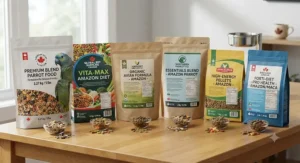
How to Choose the Best Amazon Parrot Food
- Check the guaranteed analysis panel first. Crude fat should ideally sit below roughly 8% for a sedentary companion Amazon; anything meaningfully higher works better as an occasional food than a daily staple.
- Confirm it’s a complete diet, not a supplement mix. Look for language like “complete and balanced” rather than blends marketed as add-ons to seed.
- Match pellet size to beak size. Medium/large parrot pellets are typically sized for Amazons; parakeet-sized pellets are too small and get wasted, while macaw-sized pellets can be genuinely hard to manage.
- Prioritize ingredient order. Whole grains and vegetables listed before “animal digest” or vague “natural flavour” entries generally indicate a more transparent formulation.
- Weigh organic certification against budget realistically. Certified organic formulas like Harrison’s or TOPs cost more; it’s a legitimate value trade-off, not an automatic requirement for good nutrition.
- Read aggregated reviews for acceptance rate, not just nutrition claims. The best-formulated pellet on paper is worthless if your specific bird won’t eat it.
- Plan for a transition period before buying in bulk. Start with a small bag to confirm acceptance before committing to a 20–25 lb order.
Common Mistakes When Buying Amazon Parrot Food
The single most common mistake is buying based on marketing language like “gourmet” or “premium” without ever checking the actual fat percentage on the guaranteed analysis panel — a colourful bag with fruit graphics printed on it says nothing about what’s inside. A close second is assuming a bird eating pellets is automatically eating a balanced diet; some owners fill the bowl with pellets, then supplement so heavily with high-fat seeds, nuts, and table scraps that the pellet’s careful formulation gets nutritionally drowned out.
Buying the largest available bag before confirming your specific bird will actually eat the product is another frequent and expensive misstep — pellets do have a shelf life, and a rejected 25 lb bag is both wasted money and wasted storage space. Owners also regularly overlook Canada’s own pet food oversight; imported bird food entering Canada is subject to inspection standards set out by the Canadian Food Inspection Agency, and checking that a brand’s Canadian distribution channel is legitimate is a worthwhile five-minute step before a bulk order. Finally, treating a “vet-formulated” claim as interchangeable across every product line from a given brand is a mistake — as the RoudyBush comparison above shows, standard and low-fat formulas from the same company can differ meaningfully in fat content.
Low-Fat Amazon Parrot Diet vs Standard Seed Diet
| Factor | Low-Fat Pellet Diet | Standard Seed Diet |
|---|---|---|
| Approx. fat content | 4–8% | 15–25%+ |
| Nutritional completeness | Formulated as complete diet | Deficient in vitamin A, calcium |
| Obesity risk | Lower, when portion-controlled | Significantly elevated |
| Selective feeding risk | Low (uniform pellet) | High (bird picks favourite seeds) |
| Cost per month (single bird) | Moderate | Often lower, but health costs offset savings |
A standard seed mix lets an Amazon selectively eat the high-fat sunflower and safflower seeds first, leaving the more balanced (and less palatable) seeds behind — which means the bird effectively self-selects the worst possible portion of an already unbalanced mix. A pellet diet removes that selective-feeding loophole entirely, since every piece delivers the same formulated nutrition, and that uniformity is precisely why avian veterinarians have pushed pellet-based diets so hard over the past two decades.
Considering the switch? Any of the low-fat picks above are worth a look before your next feeding-bowl refill — check today’s price and see which fits your bird and budget.
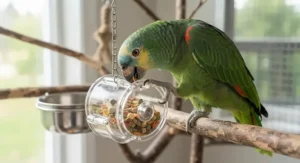
Amazon Parrot Pellet Brands Compared for Weight Management
Not every one of the amazon parrot pellet brands on the market was designed with weight management parrot food specifically in mind, and that distinction matters more for Amazons than almost any other commonly kept parrot species. Among the seven brands compared here, RoudyBush Low Fat Pellets is the only formula explicitly engineered around a reduced-fat target; Harrison’s Adult Lifetime Coarse and Higgins InTune Natural sit in a reasonable middle tier suitable for a lean, active bird on general maintenance; and ZuPreem Natural Pellets, Lafeber’s Premium Daily Diet, and Kaytee Exact Rainbow run higher in fat, functioning better as everyday staples for birds without an existing weight problem than as corrective diets.
What most buyers overlook is that brand reputation and weight-management suitability aren’t the same thing — a brand can be excellent on ingredient quality and organic sourcing while still being a poor fit for an already-overweight bird, simply because fat percentage is a separate axis from overall quality. If your Amazon has been flagged as overweight by a vet, the pragmatic move is prioritizing a dedicated low-fat formula first and layering in “clean label” or organic preferences second, rather than the reverse.
Obesity Risk and Fatty Liver Disease: What Every Amazon Parrot Owner Should Know
Obesity in companion Amazons isn’t a cosmetic issue — it’s a documented, serious health risk, and it’s disproportionately common in this genus compared to many other parrot species. According to VCA Canada’s overview of obesity in birds, excess body fat in pet birds is strongly linked to reduced flight and activity levels combined with energy-dense, seed-heavy diets — exactly the combination many indoor Canadian Amazons live with, especially through the winter months when out-of-cage time shrinks.
The most serious downstream consequence is hepatic lipidosis, more commonly called fatty liver disease: fat accumulates within liver cells faster than the organ can process it, progressively impairing liver function. In advanced cases it can trigger sudden collapse or death with little obvious warning, which is part of why avian vets treat it so seriously even in birds that otherwise seem fine day to day. Early signs are genuinely subtle — a slightly enlarged abdomen, reduced activity, overgrown or flaky beak keratin (the liver plays a role in beak growth regulation), and laboured breathing after minimal exertion are all worth a vet visit rather than a wait-and-see approach. Academic institutions with dedicated avian and exotics programs offer this kind of exotic-species care specifically because general small-animal practices don’t always have the specialized diagnostic tools — blood chemistry panels interpreting bile acids and liver enzymes look meaningfully different in birds than in mammals.
Prevention comes down to the same two levers repeatedly: a lower-fat, complete pelleted diet as the nutritional foundation, and daily supervised out-of-cage exercise to burn the calories that diet alone can’t fully offset. Neither lever works well in isolation — a perfect diet in a bird that never leaves its cage, or an active bird still eating an unrestricted seed mix, both remain at meaningful risk.
Portion Control Feeders and Smart Feeding Tools for Amazon Parrots
Free-feeding — leaving an unmeasured bowl available at all times — is one of the quieter contributors to Amazon obesity, because it removes any natural sense of “meal” from the bird’s day and makes overconsumption nearly invisible to the owner. Measured feeding is the low-tech fix: a simple kitchen scale used to portion a consistent daily gram amount does more for weight control than any specific brand choice, and a veterinary teaching hospital with an avian and exotics service, such as the Ontario Veterinary College at the University of Guelph, is a good resource for calculating a healthy target weight if your regular vet can’t.
For households wanting more structure, timed automatic feeders — originally designed for wild-bird feeding stations but increasingly adapted for cage use — dispense a preset amount at scheduled intervals rather than leaving food continuously available, which mimics a more natural feeding rhythm than an all-day buffet. Foraging-style feeders that require the bird to work for pellets, rather than simply reaching into an open dish, add a second benefit beyond portion control: they replicate some of the physical and mental effort of wild foraging, which is functionally exercise a caged bird otherwise misses entirely. Combining a measured daily portion with at least one foraging-style feeder is, based on the behavioural literature avian specialists cite, more effective for long-term weight management than either approach used alone — the goal isn’t just less food, it’s food that costs the bird some effort to get.

Frequently Asked Questions
❓ What is the best amazon parrot food for weight loss?
❓ How much pellet food should an Amazon parrot eat daily?
❓ Are seed mixes bad for Amazon parrots?
❓ Can Amazon parrots reverse fatty liver disease with diet alone?
❓ How do I switch my Amazon parrot from seeds to pellets?
Conclusion
Choosing the best amazon parrot food really does come down to one number most owners never think to check: the fat percentage on the guaranteed analysis panel. Everything else — organic certification, colourful pellets, probiotic add-ins — is a genuine value-add, but it’s secondary to that single figure for a species this prone to weight gain. RoudyBush Low Fat Pellets earns the top spot here specifically because it’s engineered around that number, while Harrison’s Adult Lifetime Coarse, TOPs Organic Parrot Pellets, Lafeber’s Premium Daily Diet, ZuPreem Natural Pellets, Higgins InTune Natural, and Kaytee Exact Rainbow each serve real, legitimate roles depending on your bird’s current weight, your budget, and how stubborn your particular Amazon is about trying something new in the food bowl.
None of these seven is a magic fix on its own. Diet, portion control, and daily exercise work as a package, and skipping any one of the three undermines the other two. If your Amazon has already been flagged as overweight, loop in an avian vet before making a drastic dietary change — the right pellet is a powerful tool, but it works best alongside professional guidance, not instead of it.
Recommended for You
- 7 Best Conure Pellet Diet Picks for 2026 (Vet-Backed Guide)
- Macaw Pellet Size Guide: 7 Trusted Picks for 2026
- 7 Best African Grey Parrot Food Picks for 2026 (Vet-Backed)
Disclaimer: This article contains affiliate links. As an Amazon Associate, I earn from qualifying purchases. If you purchase products through these links, we may earn a small commission at no additional cost to you.
✨ Found this helpful? Share it with your friends! 💬🤗
