
In This Article
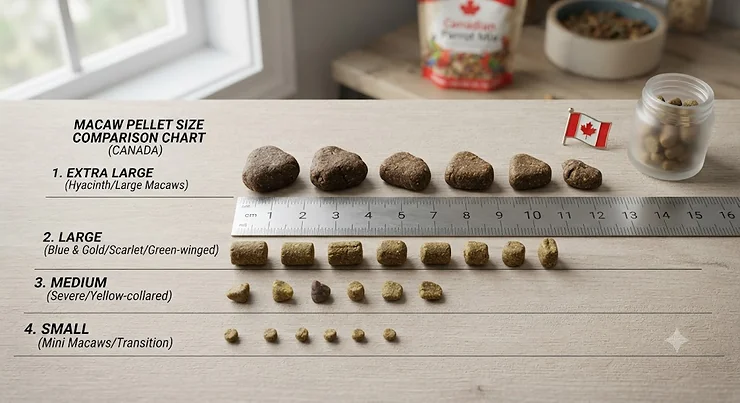
If you’ve ever poured a scoop of pellets into your macaw’s bowl and watched her fling half of it onto the floor like it personally offended her, you already know that macaw pellet size isn’t some throwaway detail on the bag. It’s the difference between a bird that eats enthusiastically and one that picks around the edges of every meal, leaving crumbs and frustration behind. Macaws are big-bodied, big-beaked parrots — a blue-and-gold or green-winged macaw can crack a Brazil nut without blinking — so a pellet sized for a cockatiel just disappears in that beak, sometimes literally swallowed whole with barely a chew, which isn’t great for digestion or enrichment.
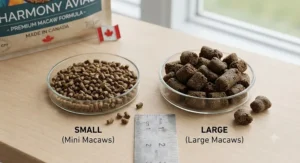
What is macaw pellet size? In practical terms, it refers to the diameter and shape of the extruded pellet a manufacturer formulates for large parrots, typically ranging from roughly 3/8 inch up to about 3/4 inch, versus the smaller granules made for budgies or conures. Getting this right affects chewing satisfaction, foraging behaviour, and how much of the bird’s natural beak-conditioning work actually happens at mealtime, a point that groups such as the Hagen Avicultural Research Institute have written about extensively when it comes to converting parrots onto pelleted diets.
This guide walks through seven real, currently available pellet options sized appropriately for macaws, breaks down where each one shines and where it stumbles, and folds in the related questions Canadian bird owners keep typing into Amazon.ca’s search bar — from high-energy macaw diet formulas to nut-based treats and tropical fruit supplementation. None of the pricing below is exact, because Amazon prices shift by the week; instead, you’ll get honest ranges in Canadian dollars so you can compare apples to apples (or, more appropriately, pellets to pellets).
Quick Comparison Table
| Product | Pellet Size | Best For | Price Range (CAD) |
|---|---|---|---|
| Lafeber Premium Daily Diet Pellets | Large, coarse | Everyday maintenance | C$30–C$110 |
| Lafeber Tropical Fruit Gourmet Pellets | Large, uniform | Fussy eaters, tropical flavour | C$25–C$95 |
| ZuPreem True Harvest Macaw & Cockatoo | Large, uniform | Picky birds, clean bowls | C$25–C$60 |
| ZuPreem Pure Fun Bird Food Mixer | Mixed shapes | Foraging enrichment | C$15–C$35 |
| Kaytee Fiesta Macaw Food | Large, varied texture | Budget-conscious owners | C$18–C$40 |
| Harrison’s High Potency Coarse | Extra-large, coarse | High-energy, breeding, moulting birds | C$40–C$130 |
| TOP’s Organic Parrot Pellets (Large) | Large, 1/4″–3/8″ | Organic-focused households | C$30–C$100 |
Even at a glance, the spread here tells a story: Lafeber Premium Daily Diet Pellets and Kaytee Fiesta Macaw Food anchor the budget-to-mid range for daily feeding, while Harrison’s High Potency Coarse sits at the premium end because of its organic, energy-dense formulation aimed at birds with higher metabolic demands. The mixers and gourmet pellets, meanwhile, aren’t really competing on price at all — they’re solving a behavioural problem (boredom, pickiness) rather than a pure nutrition one, so it’s worth reading past the price tag before you decide.
💬 Just one click — help others make better buying decisions too!😊
Top 7 Macaw Pellets: Expert Analysis
1. Lafeber Premium Daily Diet Pellets — the everyday workhorse formula
The standout here is consistency: every bag delivers the same large, coarse pellet shape batch after batch, which matters more than people expect once a macaw has finally converted off seed. Lafeber formulates this as a nutritionally complete daily diet with balanced omega 3 and 6 fatty acids, and the pellet diameter is sized specifically for macaws and cockatoos rather than scaled down from a smaller-bird base — in practice, that means less waste from your bird mouthing and dropping pellets that feel wrong in the beak. Based on the spec comparison against smaller “one-size-fits-all” bird pellets, this is the safer starting point for anyone converting a mature macaw who has never touched a pellet before, since an appropriately sized piece is easier to accept as food rather than a foreign object. Reviewers consistently report that even stubborn, older seed-junkie macaws tend to accept this brand faster than smaller-format pellets, though a handful note the bag’s resealable strip wears out before the food is gone. Best for owners who want a reliable, no-fuss base diet rather than a novelty option.
Pros:
- ✅ Correctly sized large pellet for macaw beaks
- ✅ Balanced omega fatty acids for skin and feathers
- ✅ Widely stocked in multiple bag sizes on Amazon.ca
Cons:
- ❌ Plain colour and shape can bore visually stimulated birds
- ❌ Resealable packaging strip wears out before bag empties
Price sits in the C$30–C$110 range depending on bag size, and for a daily staple diet, that’s reasonable value per feeding day.
2. Lafeber Tropical Fruit Gourmet Pellets — best flavour bridge for fussy eaters
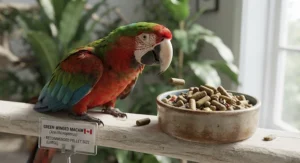
What most buyers overlook about this pellet is that it’s not just “fruity” for the sake of marketing — it’s formulated with real dried pineapple, papaya, and mango folded into the pellet itself, with no added sugar or fructose, which lets you use natural flavour as a conversion tool without the guilt of a sugary treat. The pellet size is uniform and large, matching the daily diet line, so the sizing itself isn’t a gamble; it’s the flavour profile that does the heavy lifting. For a bird that turns her beak up at plain pellets, this often works precisely because it tastes like the fruit foraging behaviour macaws are wired for in the wild. Aggregated review sentiment across major retailers points to strong acceptance rates among “converted but reluctant” macaws, with some owners mixing it 50/50 with the plain daily diet to stretch the cost. On paper, this means slightly less protein-dense than the base formula, so it’s better used as a partial diet or transition tool rather than the sole food source for a bird with heavy energy demands.
Pros:
- ✅ Real fruit inclusion without added sugar
- ✅ High acceptance rate among picky or converting birds
- ✅ Same large pellet sizing as the standard Lafeber line
Cons:
- ❌ Slightly lower protein density than the base formula
- ❌ Costs more per kilogram than plain pellets
Expect a C$25–C$95 range across bag sizes; the value verdict is strongest when used as a 30–50% blend rather than a full replacement.
3. ZuPreem True Harvest Macaw & Cockatoo Food — cleanest bowl, most uniform bite
The uniform pellet shape is the whole pitch here: every piece is roughly the same size and texture, which sounds like a small thing until you’ve dealt with a macaw who sorts through a mixed-texture bag looking for her favourites and ignores the rest. ZuPreem markets this as a “large” formulation specifically for macaws, cockatoos, and amazons, with grain and vegetable-based nutrition rather than a seed-hull base. Here’s what to weigh: uniformity reduces selective eating (a genuine problem in large parrots that can lead to nutritional gaps), but it also means less textural variety for foraging enrichment compared to a mixed-shape product. Reviewers frequently mention that this is the pellet their vet actually recommended after a nutrition consult, and that macaws seem to settle into it without the dramatic refusal phase some other pellets trigger. This makes it a strong pick for owners prioritizing nutritional consistency over novelty.
Pros:
- ✅ Uniform size reduces picky, selective eating
- ✅ Frequently vet-recommended for large parrot diets
- ✅ Grain-based formula without seed hulls
Cons:
- ❌ Less textural variety limits foraging challenge
- ❌ Some macaws find the taste bland long-term
Price typically lands between C$25 and C$60, making it one of the more accessible “vet-grade” options on this list.
4. ZuPreem Pure Fun Bird Food Mixer — best for foraging enrichment, not sole nutrition
This one is honest about what it is: a mixer, not a complete diet. It combines pellet pieces with dried banana, pea, and carrot chunks in varied shapes and sizes, deliberately designed to slow a macaw down and force some actual foraging behaviour instead of the five-second bowl-inhale routine. What most owners overlook is that mixed-texture and mixed-size foods like this one are closer to how a wild macaw actually forages — nothing in the rainforest is uniform — so from a behavioural enrichment standpoint, it earns its keep even though it shouldn’t be the only thing in the bowl. Based on the ingredient list, this leans toward supplemental use: mix it into a base diet like the Lafeber or ZuPreem True Harvest pellets at a ratio of maybe 20–30% rather than feeding it exclusively. Aggregated reviews highlight that birds get visibly more engaged at mealtime with this mixed in, though a few owners note their macaws will pick out the fun bits and leave the plain pellets behind, defeating the purpose if you’re not watching.
Pros:
- ✅ Varied textures encourage natural foraging behaviour
- ✅ Real dried fruit and vegetable pieces included
- ✅ Breaks up mealtime monotony for bored birds
Cons:
- ❌ Not nutritionally complete on its own
- ❌ Selective birds may pick out only the treats
Expect roughly C$15–C$35 for a 2-lb bag, which is fair for a supplemental enrichment product rather than a base diet.
5. Kaytee Fiesta Macaw Food — budget pick that still respects pellet size
Budget doesn’t have to mean “wrong size,” and that’s the honest case for Kaytee Fiesta: it’s formulated at a scale appropriate for macaws rather than shrunk down from a smaller-bird product, and it blends pellets with seeds and dried fruit pieces for variety at a noticeably lower price point than the premium organic options on this list. The spec sheet won’t tell you this, but user reports suggest the seed content here is modest enough that it doesn’t undo the nutritional benefits of a pellet-based diet, while still giving picky eaters something familiar to nibble alongside the pellet pieces. For owners managing multiple large parrots or working with a tighter grocery budget, this is a reasonable middle ground rather than a compromise that sacrifices sizing accuracy. Reviewers describe it as a solid “in-between” food — not as nutritionally dense as the vet-formulated brands, but a clear step up from an all-seed diet, and considerably cheaper per kilogram than the organic competitors here.
Pros:
- ✅ Appropriately sized pellets at a lower price point
- ✅ Blend keeps seed-loving macaws engaged
- ✅ Widely available across Canadian pet retailers
Cons:
- ❌ Higher seed content than pure-pellet formulas
- ❌ Less nutrient density than premium organic options
Priced around C$18–C$40 depending on bag size, this is the value pick for households feeding more than one large bird.

6. Harrison’s High Potency Coarse Organic Pellet — best for high-energy, breeding, or moulting macaws
This is the pellet formulated specifically for birds with elevated nutritional demands — moulting, breeding, weaning, recovering from illness, or simply living in a colder Canadian climate where more energy goes toward maintaining body heat. The “coarse” grind is genuinely large and dense, made from certified organic whole grains and legumes with naturally occurring vitamins rather than synthetic top-dressing, which is a meaningfully different manufacturing approach than most extruded pellets on the market. Based on the spec comparison, the higher fat and protein content here directly answers the high-energy macaw diet question that comes up constantly in owner forums — this is the formula avian nutritionists typically point to when a bird needs more calories per bite rather than more volume in the bowl. Aggregated review sentiment is genuinely mixed on this one: many long-term Harrison’s feeders report excellent feather condition and steady weight, but a real subset of owners describe digestive upset or behavioural changes during the transition, particularly if converted too quickly, so a gradual introduction over the manufacturer’s recommended conversion period matters more here than with milder formulas.
Pros:
- ✅ Certified organic, non-GMO whole-grain formulation
- ✅ Higher energy density suited to moulting or breeding birds
- ✅ Coarse grind matches large macaw beak size well
Cons:
- ❌ Some birds react poorly to a fast diet switch
- ❌ Premium pricing compared to standard maintenance pellets
Expect a C$40–C$130 range depending on bag size — the higher end of this list, but arguably justified for birds with genuinely elevated energy needs rather than as a default everyday food.
7. TOP’s Organic Parrot Pellets (Large) — cold-pressed organic alternative
TOP’s takes a different manufacturing route than the extruded pellets dominating this list: their pellets are cold-pressed rather than heat-extruded, which the company argues preserves more natural nutrient content, and the large size option is specifically sized for macaws down through mid-sized parrots. What stands out on the spec sheet is the ingredient simplicity — no corn or soy fillers, no synthetic preservatives, with natural preservation coming from rosemary, rose hips, and citrus peel instead. Here’s what to weigh: cold-pressing is gentler on heat-sensitive nutrients, but the trade-off some owners report is a shorter shelf life once opened compared to heavily preserved extruded pellets, so buying smaller bags more frequently tends to work better than bulk-buying this one. Reviewers who’ve switched from conventional pellets often describe visibly glossier feathers within a few months, though this is aggregated anecdotal sentiment rather than a controlled outcome, and it’s worth noting genuinely allergic or sensitive birds seem to do particularly well on the simplified ingredient list.
Pros:
- ✅ Cold-pressed process preserves natural nutrients
- ✅ Simple ingredient list with no corn or soy fillers
- ✅ Naturally preserved without synthetic additives
Cons:
- ❌ Shorter shelf life once the bag is opened
- ❌ Less widely stocked than mainstream pellet brands
Pricing runs roughly C$30–C$100, positioning it as a premium but ingredient-transparent alternative to the more mainstream organic pick on this list.
Top 7 Products at a Glance
| Product | Type | Organic | Best For |
|---|---|---|---|
| Lafeber Premium Daily Diet Pellets | Extruded | No | Daily maintenance diet |
| Lafeber Tropical Fruit Gourmet Pellets | Extruded | No | Flavour-driven conversion |
| ZuPreem True Harvest Macaw & Cockatoo | Extruded | No | Reducing selective eating |
| ZuPreem Pure Fun Bird Food Mixer | Mixed/extruded | No | Foraging enrichment |
| Kaytee Fiesta Macaw Food | Extruded/seed blend | No | Budget-conscious feeding |
| Harrison’s High Potency Coarse | Extruded | Yes | High-energy, breeding, moulting |
| TOP’s Organic Parrot Pellets (Large) | Cold-pressed | Yes | Ingredient-sensitive birds |
Stacking all seven side by side makes the real decision point obvious: it’s less about which pellet is “best” in the abstract and more about matching the formula to your bird’s current life stage and your household budget. A healthy, non-breeding adult macaw on a stable routine genuinely doesn’t need the premium energy density of Harrison’s High Potency Coarse — that budget is better spent letting Lafeber Premium Daily Diet Pellets carry the daily load while a mixer or gourmet pellet adds enrichment on top.
Practical Usage Guide: Converting Your Macaw to the Right Pellet Size
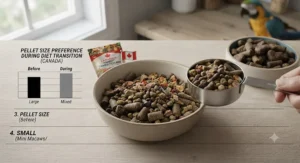
Switching an adult macaw’s diet is less like flipping a switch and more like renegotiating a long-standing relationship — rushed changes tend to backfire. Start by introducing the new pellets alongside the current diet rather than replacing it outright; most avian care resources, including the Hagen Avicultural Research Institute’s conversion guidance, recommend a gradual overlap period of several weeks rather than a cold swap. In the first week, simply scatter a few appropriately sized pellets into the existing food dish so your macaw encounters them without pressure. By weeks two and three, start reducing the old food’s proportion while keeping fresh water and a second dish of pellets always available, watching droppings and body weight for signs the bird is actually eating the new food rather than just relocating it around the cage.
A common first-30-days mistake is judging the pellet size wrong from a single feeding — macaws are famously suspicious of new textures, and it can take a dozen exposures before genuine interest kicks in. If after three weeks there’s still visible weight loss or the bird is eating almost nothing, that’s the point to call an avian vet rather than push through alone. Once the conversion sticks, a simple maintenance rhythm works well: fresh pellets daily, bowl washed to prevent bacterial buildup, and a rotating 10–20% mix of fresh vegetables or a gourmet/mixer pellet to keep mealtime interesting without diluting the core nutrition.
✨ Ready to start the switch? Browse the sizes above and pick the one that matches your bird’s current stage — your macaw’s bowl (and your floor) will thank you.
Real-World Scenarios: Matching Pellet Size to Your Macaw’s Life
Picture three very different Canadian households, each with a macaw and a completely different feeding reality. First, there’s the first-time owner in a Toronto condo with a young, recently rescued green-winged macaw who’s never seen a pellet in her life — for her, Lafeber Premium Daily Diet Pellets blended with a small ratio of the Tropical Fruit Gourmet Pellets makes the most sense, since the fruit flavour smooths over the initial suspicion while the base formula anchors long-term nutrition. Second, consider the breeder in rural Alberta managing a pair of blue-and-gold macaws through an active breeding season during a cold prairie winter — this is exactly the scenario Harrison’s High Potency Coarse was built for, where elevated energy demands from both breeding physiology and outdoor temperature swings genuinely call for a denser formula rather than standard maintenance food.
Third, there’s the multi-bird household in Vancouver with three large parrots and a grocery budget that has to stretch across all of them; here, Kaytee Fiesta Macaw Food as the daily base, topped occasionally with the ZuPreem Pure Fun Bird Food Mixer for enrichment, balances cost against variety without leaving anyone nutritionally shortchanged. None of these situations calls for the “best” pellet in some universal sense — they call for the pellet that matches the bird’s life stage, the household’s climate and budget, and how much time the owner has for gradual dietary transitions.

How to Choose the Right Macaw Pellet Size
Picking the right pellet size for macaw pellet size comes down to seven practical checkpoints, and working through them in order avoids most of the common regret purchases:
- Measure the current beak, not just the species. A young macaw’s beak is smaller than a mature bird’s, so size up gradually rather than jumping straight to the largest pellet available.
- Check the manufacturer’s species guidance. Brands like Lafeber and ZuPreem specify “macaw and cockatoo” sizing separately from smaller-parrot lines — don’t assume a generic “large bird” label means macaw-appropriate.
- Prioritize uniform shape for picky eaters. Birds prone to selective eating do better on consistent pellets like ZuPreem True Harvest, since there’s nothing to sort through and reject.
- Match energy density to life stage. Breeding, moulting, or juvenile birds benefit from higher-calorie formulas like Harrison’s High Potency Coarse; a sedentary adult usually doesn’t need that intensity.
- Budget for a transition period, not just a bag. Expect to buy both the old and new food simultaneously for several weeks, so factor that overlap cost into your decision.
- Read aggregated review themes, not star averages alone. A 4.5-star rating hides a lot of nuance — look for repeated mentions of acceptance rate, digestive tolerance, or packaging complaints specific to macaws.
- Confirm current availability and price range before committing to a bag size. Prices fluctuate, so check current pricing on Amazon.ca rather than assuming last month’s number still holds.
Macaw Pellet Size vs Seed-Based Diets: The Real Difference
Seed mixes still line pet store shelves, and it’s worth being direct about why the pelleted route generally wins for macaw health, without pretending seed has zero role. Seeds are calorie-dense but nutritionally incomplete on their own — a macaw allowed to selectively pick out sunflower seeds and ignore everything else in a mix ends up with a diet heavy in fat and light in the vitamins and minerals a complete pellet formula bakes into every single bite. That selective-eating problem is exactly what appropriately sized, uniform pellets solve: because every piece contains the same balanced nutrition, there’s no “favourite bit” to hunt for and no nutritional gap from what gets left behind in the bowl.
That said, seed isn’t the enemy — it’s the sole reliance on seed that creates problems like the cholesterol and vitamin A deficiency issues avian veterinary literature has documented in pet macaws for decades. A small proportion of seed or a seed-inclusive product like Kaytee Fiesta Macaw Food can coexist with a pellet-based core diet just fine, especially as an enrichment or training treat rather than the nutritional backbone.
| Factor | Seed-Only Diet | Pellet-Based Diet |
|---|---|---|
| Nutritional completeness | Low — selective eating creates gaps | High — every bite is balanced |
| Fat content | Often excessive | Formulated and controlled |
| Best For | Occasional treats, training | Daily core nutrition |
The table above underscores why avian vets so consistently steer owners toward pellets as the base diet: the “Best For” column isn’t close. Seed still earns its place as a training tool and enrichment supplement, but as the sole diet for a macaw, it’s associated with the very health problems that pelleted diets were originally developed to prevent.
Common Mistakes When Buying Macaw Pellets
The single most frequent mistake is buying based on brand recognition alone rather than checking the actual pellet size listed for macaw and cockatoo formulations specifically — a bag labelled simply “parrot food” without species-specific sizing can be built for birds a fraction of a macaw’s size. A second common misstep is switching foods too abruptly; even a nutritionally superior pellet can trigger a hunger strike if introduced as a sudden, total replacement rather than a gradual blend. Third, owners sometimes chase the lowest price per bag without calculating cost per feeding day, which can make a cheaper bag actually more expensive over a month if the bird eats more of it to meet the same energy needs.
A fourth mistake worth naming: assuming a mixer or gourmet pellet like ZuPreem Pure Fun can replace a complete diet, when it’s genuinely intended as a supplement. And fifth, skipping the packaging date check — pellets do go stale, and a bag that’s been sitting on a shelf for months loses potency in fat-soluble vitamins well before it visibly spoils.

What to Expect: Real-World Performance and Beak Wear
Specs on a bag only tell part of the story; what actually happens at the food bowl and on the beak itself is where pellet size proves its worth. An appropriately sized, firm pellet gives a macaw’s powerful beak something genuinely useful to do — cracking, crushing, and manipulating a large pellet mimics the mechanical work involved in opening a nut in the wild, which contributes to natural macaw beak wear patterns that keep the beak from overgrowing. A pellet that’s too small or too soft, by contrast, gets swallowed with minimal chewing, removing that conditioning benefit almost entirely and potentially contributing to the overgrown or misshapen beaks veterinarians sometimes have to correct.
In everyday terms, this means owners feeding Harrison’s High Potency Coarse or the standard Lafeber Premium Daily Diet Pellets often report their macaws spending noticeably longer at the food bowl, engaged in active chewing rather than a quick gulp-and-leave. That extra time isn’t wasted — it’s functional beak maintenance happening as a side effect of an appropriately sized meal, something a soft, undersized pellet simply can’t replicate no matter how nutritionally complete its label claims to be.
High-Energy Macaw Diets: Fat, Protein and Pellet Size Together
The phrase “high-energy macaw diet” gets thrown around loosely, but it has a specific practical meaning: a formula with elevated fat and protein content designed for birds burning more calories than a sedentary companion parrot — think breeding pairs, actively moulting birds regrowing feathers, juveniles still developing, or birds kept in genuinely cold Canadian aviaries where thermoregulation eats into daily energy budgets. Harrison’s High Potency Coarse is the clearest example on this list, built explicitly as a year-round diet for birds with these elevated needs rather than as a general maintenance food.
What most buyers overlook is that pellet size and energy density aren’t the same variable, even though they often move together in product lines — a large pellet doesn’t automatically mean a high-energy formula, and a high-energy formula isn’t always packaged in an oversized pellet. Reading the guaranteed analysis panel for fat and protein percentages matters just as much as checking the size chart, particularly for owners managing a bird through a specific life stage rather than feeding a healthy adult on a stable year-round routine. Feeding a high-energy formula to a sedentary, already-overweight macaw can tip the scale the wrong direction just as easily as underfeeding a breeding bird can cause weight loss.
Nut-Based Treats and Tropical Fruit Supplementation: Rounding Out the Diet
Pellets should form the core of a macaw’s diet, but they’re not meant to be the entire diet in isolation — this is where nut-based treats and tropical fruit supplementation earn their place, provided they stay proportionate. Macaws evolved cracking hard-shelled nuts as both a nutritional strategy and a behavioural outlet, so offering whole or shell-on nuts like almonds, walnuts, or Brazil nuts (in moderation, given their fat content) taps into that same beak-conditioning benefit discussed earlier, just with an even more resistant material than a coarse pellet. The key word is moderation: nuts are calorie-dense, and a handful of Brazil nuts can quietly undo a day’s worth of careful pellet-based portion control if treated as a free-feed item rather than an occasional reward.
Tropical fruit supplementation works similarly — fresh mango, papaya, or banana offered a few times a week adds genuine vitamin content and mirrors the foraging variety of a wild diet, echoing the same logic behind Lafeber’s Tropical Fruit Gourmet Pellets. The honest caveat is that fresh fruit spoils fast in a cage dish, so removing uneaten portions within a few hours matters more with tropical fruit than with shelf-stable pellets. Used as roughly 10–20% of total intake alongside a pellet-based core, both nuts and fruit round out the diet without displacing the balanced nutrition pellets are specifically formulated to provide.
Long-Term Cost & Maintenance: Budgeting for Macaw Pellets on Amazon.ca
Comparing macaw food brands Amazon.ca shoppers actually buy repeatedly comes down to cost per feeding day, not just cost per bag — a large bag of a denser, pricier formula can genuinely work out cheaper per month than a smaller bag of a cheap blend if the macaw eats less of it to meet the same energy needs. As a rough framework: budget-tier options like Kaytee Fiesta Macaw Food tend to land around C$1–C$2 per feeding day for a single macaw depending on bag size purchased, mid-tier options like the Lafeber and ZuPreem lines run closer to C$1.50–C$3, and premium organic formulas like Harrison’s High Potency Coarse or TOP’s Organic Parrot Pellets can push toward C$2.50–C$4.50 per day.
| Tier | Example Product | Approx. Cost Per Day (CAD) |
|---|---|---|
| Budget | Kaytee Fiesta Macaw Food | C$1–C$2 |
| Mid-range | ZuPreem True Harvest Macaw & Cockatoo | C$1.50–C$3 |
| Premium | Harrison’s High Potency Coarse | C$2.50–C$4.50 |
The gap between tiers narrows considerably once you factor in reduced vet bills from better long-term nutrition, which is the real argument for spending more on a life-stage-appropriate formula rather than defaulting to whatever’s cheapest per kilogram. Buying larger bags when a macaw has confirmed acceptance of a food also meaningfully lowers the per-day cost across every tier, since smaller bags carry a price premium for convenience and freshness guarantees.
Safety, Regulations and Buying From Amazon.ca in Canada
Bird food sold in Canada isn’t regulated with quite the same intensity as human food, but it isn’t a free-for-all either. Pet food brought into Canada, including bird pellets manufactured in the United States, falls under Canadian Food Inspection Agency import requirements focused on animal health safeguards rather than nutritional adequacy claims, which is worth knowing if you ever consider importing a niche brand personally rather than buying through an established Amazon.ca listing already stocked for the Canadian market. Practically speaking, sticking to established brands sold directly through amazon.ca sidesteps most of this complexity, since those listings are already routed through compliant supply chains.
On the nutrition side, consulting an avian veterinarian or a resource like the Ontario Veterinary College’s pet nutrition program before making a major diet change is genuinely worthwhile for birds with existing health conditions, since generic pellet guidance can’t account for individual medical needs the way a tailored consult can. Beyond that, basic food safety applies just as it would for any pet: store pellets in a cool, dry, sealed container away from direct sunlight, check expiry dates before bulk-buying, and discard any bag showing signs of moisture or mould regardless of how much product remains.
Frequently Asked Questions
❓ What size pellet is best for a macaw?
❓ Can macaws eat cockatiel-sized pellets?
❓ How much pellet food should a macaw eat per day?
❓ Are nut-based treats safe for macaws?
❓ What is the best macaw food brand on Amazon.ca?
Conclusion
Getting macaw pellet size right isn’t a minor technicality buried in the fine print — it shapes whether your bird actually eats a nutritionally complete diet or quietly avoids half of what’s in the bowl. Across the seven options here, there’s genuinely no universal winner: Lafeber Premium Daily Diet Pellets and ZuPreem True Harvest Macaw & Cockatoo cover dependable daily maintenance, Harrison’s High Potency Coarse answers the high-energy macaw diet question for breeding or moulting birds, and the mixers, gourmet pellets, nut-based treats, and tropical fruit supplementation round things out as enrichment rather than a base diet.
The practical path forward is simple: match the pellet to your bird’s current life stage, introduce any change gradually over several weeks, and keep an eye on how much actual chewing happens at the bowl — that’s often the clearest sign the size is right. Check current prices and availability on amazon.ca before committing to a bag size, since a smaller trial bag is almost always the smarter first move than a bulk purchase of an untested food.
✨ Don’t Miss These Exclusive Deals!
🔍 Take your macaw’s daily diet to the next level with the pellets compared above. Click through to check current pricing and availability on amazon.ca, and give your bird the nutrition — and the beak workout — she’s actually built for!
Recommended for You
- 7 Best African Grey Parrot Food Picks for 2026 (Vet-Backed)
- Parrot Food for Large Parrots: 7 Best Picks for
- Parrot Pellets vs Seed Mix: 7 Best Picks for 2026
Disclaimer: This article contains affiliate links. As an Amazon Associate, I earn from qualifying purchases. If you purchase products through these links, we may earn a small commission at no additional cost to you.
✨ Found this helpful? Share it with your friends! 💬🤗
