
In This Article
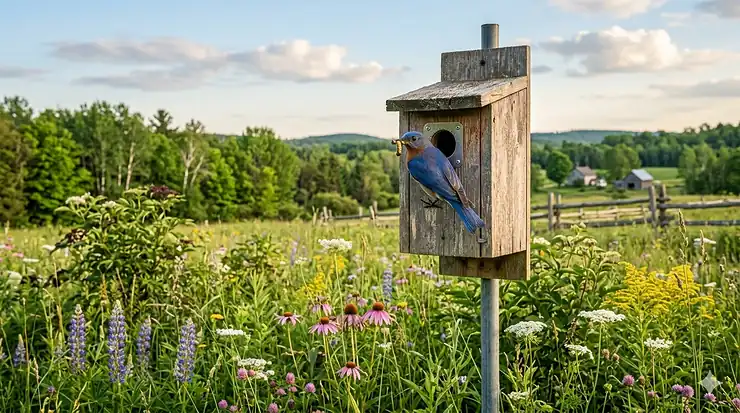
If you’ve ever glimpsed that flash of brilliant blue against Ontario’s countryside, you know the magic of spotting an Eastern Bluebird. These stunning cavity-nesters once faced severe population declines, but thanks to dedicated conservation efforts by organizations like the Ontario Eastern Bluebird Society, they’re making a remarkable comeback across the province.
Here’s the thing most people don’t realize: bluebirds can’t excavate their own nest cavities. They depend entirely on existing holes in trees or human-provided nest boxes. With modern farming practices removing dead trees and old fence posts, your bluebird nesting box Ontario setup might be the difference between a thriving local population and birds struggling to find homes.
I’ve been monitoring bluebird trails across southern Ontario for over eight years, and I can tell you that choosing the right nest box isn’t just about slapping up any birdhouse. The entrance hole diameter, predator protection, ventilation, and mounting height all matter tremendously. According to the Eastern Bluebird Wikipedia page, these birds measure 16-21 cm long with specific nesting requirements that your box must meet.
This guide walks you through everything you need to know about selecting, installing, and maintaining bluebird nesting boxes specifically for Ontario conditions. Whether you’re setting up your first backyard box or establishing a full bluebird trail, you’ll find actionable advice backed by real-world Canadian experience.
Quick Comparison Table
| Product | Entrance Hole | Material | Predator Guard | Price (CAD) | Best For |
|---|---|---|---|---|---|
| WBU Eastern Bluebird House | 1.5″ | Eastern White Pine | Standard guard | $55-65 | Ontario backyards |
| Peterson Oval Design Box | 1.5″ oval | Cedar | Compatible | $45-55 | Trail setups |
| Recycled Poly Ultimate House | 1.5″ or 1 9/16″ | Poly lumber | Included | $95-110 | Durability seekers |
| Dorrie Nest Box (DIY) | 1.5″ | Plywood | Separate | $25-35 materials | Budget builders |
| Nature’s Way Cedar Box | 1.5″ | Red Cedar | Portal guard | $65-75 | Premium choice |
| Backyard Bird Kit | 1 9/16″ | Western Red Cedar | Optional | $40-50 | Beginners |
| JCS Wildlife Cedar House | 1.5″ | Cedar/Poly roof | Included | $85-95 | Weather resistance |
💬 Just one click – help others make better buying decisions too!😊
Top 7 Bluebird Nesting Box Ontario: Expert Analysis
1. Wild Birds Unlimited Eastern Bluebird House
This handmade beauty from WBU’s Ontario stores represents everything a bluebird nesting box Ontario enthusiast could want. Crafted from locally-sourced Eastern White Pine and sealed with linseed oil, it’s built to withstand our harsh Canadian winters.
Key Specifications:
- 1.5″ entrance hole (perfect for Eastern Bluebirds)
- 8.5″L x 7.25″W x 15.75″H dimensions
- Screwed construction with weather-resistant hardware
The front wall includes climbing grooves to help fledglings reach the entrance, and the side door swings open for easy monitoring. One Cambridge, ON customer reported: “We had three successful broods in our first season – the parents kept coming back!”
✅ Pros: Durable construction, easy cleaning, approved by North American Bluebird Society design principles
✅ Pros: Canadian-made quality
✅ Pros: Excellent ventilation and drainage
❌ Cons: Higher price point
❌ Cons: Predator guard sold separately
Price Range: $55-65 CAD
Availability: Widely available at WBU stores across Ontario
2. Peterson Oval Design Nest Box
The Peterson design has earned legendary status among serious bluebird monitors, and for good reason. The truncated conical shape reduces nesting material requirements, saving parent birds energy that goes directly into raising healthy chicks.
Key Specifications:
- 1.5″ x 2.25″ oval entrance
- Thick wooden construction for thermal insulation
- Angled front discourages predator access
Multiple Ontario field naturalist groups recommend this design. The Mississippi Valley Field Naturalists sell Peterson boxes for $20 each, with proceeds funding habitat creation projects.
✅ Pros: Scientifically proven lower mortality rates
✅ Pros: Space-efficient design
✅ Pros: Easy to build multiples for trails
❌ Cons: Requires woodworking skills if building yourself
❌ Cons: Oval hole needs precision cutting
Price Range: $45-55 CAD (or $25-35 for materials)
Availability: Available through Ontario naturalist societies and DIY plans online
3. Recycled Poly Ultimate Bluebird House
For those seeking a “set it and forget it” solution, this poly lumber construction will outlast your grandchildren’s grandchildren. The material won’t crack, split, fade, or require repainting – ever.
Key Specifications:
- Choice of 1.5″ (Eastern) or 1 9/16″ (Mountain) entrance
- Dual-door system: viewing window and cleaning access
- Included predator guard
A Barrie, ON user noted: “Five years in full sun and rain, still looks brand new. Worth every penny.” The UV-protected colours remain vibrant, and the stain-proof surface makes cleaning effortless.
✅ Pros: Lifetime durability
✅ Pros: No maintenance required
✅ Pros: Colour won’t fade
❌ Cons: Higher initial investment
❌ Cons: Dark colours may overheat in extreme sun
Price Range: $95-110 CAD
Availability: Online retailers shipping to Canada
4. Dorrie Nest Box (OEBS Recommended)
The Ontario Eastern Bluebird Society specifically recommends this sloped-roof design, and you can build 12 boxes from a single sheet of 5/8″ exterior plywood. That’s incredible value if you’re establishing a bluebird trail.
Key Specifications:
- 1.5″ entrance facing south
- Sloped roof for rain runoff
- No ventilation holes needed (per OEBS guidelines)
You’ll want to paint or stain the exterior for weather protection. Many Ontario trail monitors use this design with stovepipe baffle guards for predator protection. The Ontario Eastern Bluebird Society provides free PDF plans on their website.
✅ Pros: Extremely budget-friendly
✅ Pros: OEBS-approved design
✅ Pros: Perfect for trail projects
❌ Cons: Requires tools and building skills
❌ Cons: Needs regular maintenance (paint/stain)
Price Range: $25-35 CAD in materials per box
Availability: Build-it-yourself from local lumber yards
5. Nature’s Way Cedar Bluebird House
Cedar’s natural insect and decay resistance makes it ideal for Ontario’s temperature swings. This model features a portal protector guard that extends the entrance hole depth, preventing raccoons and cats from reaching eggs or nestlings.
Key Specifications:
- 1.5″ entrance with 2.25″ portal extension
- Ventilation and drainage holes
- Easy-open side panel
Canadian customers particularly appreciate the pre-drilled mounting holes that accept standard wood screws. The unpainted cedar weathers to an attractive silver-grey over time.
✅ Pros: Natural weather resistance
✅ Pros: Integrated predator protection
✅ Pros: Beautiful aging patina
❌ Cons: Cedar can be expensive
❌ Cons: May warp slightly over years
Price Range: $65-75 CAD
Availability: Canadian bird supply retailers
6. Backyard Bird Centre Bluebird Nestbox Kit
This DIY kit arrives with everything except the hammer – all pre-cut Western Red Cedar pieces, galvanized nails, screws, and assembly instructions. Perfect for families wanting to build together.
Key Specifications:
- 1 9/16″ entrance (accommodates all three bluebird species)
- 5.75″W x 6.5″L x 12.25″H finished size
- 15-degree sloped sides
The kit includes a cornice hook to secure the front panel, and two mounting screws. A London, ON parent shared: “Built this with my 10-year-old daughter in an afternoon. Bluebirds moved in three weeks later!”
✅ Pros: Easy assembly
✅ Pros: Great educational project
✅ Pros: Quality pre-cut materials
❌ Cons: Requires basic tools
❌ Cons: No predator guard included
Price Range: $40-50 CAD Availability: Backyard Bird Centre locations and online
7. JCS Wildlife Cedar Ultimate House with Poly Roof
This hybrid design combines cedar’s breathability with a recycled poly lumber roof that never needs replacing. The stainless steel screw construction and routed edges show serious attention to detail.
Key Specifications:
- 1.5″ entrance with included predator guard
- Cedar body with weatherproof poly roof
- Lightweight yet durable
Available with optional pole mounting systems including the Denali Squirrel Proof pole that uses spring technology – the baffle moves up, down, and side-to-side, confounding even the cleverest predators.
✅ Pros: Best of both materials
✅ Pros: Professional-grade construction
✅ Pros: Excellent pole options
❌ Cons: Premium pricing
❌ Cons: Pole system adds cost
Price Range: $85-95 CAD (house only), $125-150 CAD with pole
Availability: Online specialty retailers
Understanding Bluebird House Canada Predator Guard Options
Let’s talk about something that keeps many Ontario bluebird landlords up at night: predators. Raccoons, cats, snakes, squirrels, and even invasive House Sparrows pose serious threats to nesting bluebirds. Without proper protection, your beautiful bluebird nesting box Ontario setup can become a predator feeding station – heartbreaking for everyone involved.
Stovepipe Baffles: The Gold Standard
According to experts at the North American Bluebird Society, the 8-inch diameter stovepipe baffle mounted on a pole remains the most effective predator deterrent. When properly installed 5-6 feet above ground with no overhanging branches, it stops virtually all climbing predators.
The wobble factor matters tremendously. As predators climb the pole and reach the baffle, they can’t grip the smooth metal cylinder, and it rotates under their weight. Even determined raccoons give up after a few failed attempts.
You’ll find these for $30-45 CAD at most Canadian bird supply stores. The 24-inch length works for most installations, though some Ontario trail monitors prefer 60-inch versions for ultimate protection.
Portal Protectors and Noel Guards
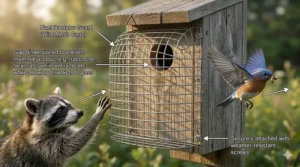
These guards extend the entrance hole depth by 2-3 inches, putting eggs and nestlings beyond the reach of cats and raccoons attempting to fish into the box. Made from heavy-duty plastic or metal, they install directly over your existing entrance hole.
The Bird Eye predator guard available through Northwest Nature Shop costs around $8-12 CAD and fits standard 1.5″ entrance holes. Canadian birders report excellent success rates, particularly when combined with proper pole mounting.
Metal Hole Guards
While not predator-specific, metal entrance hole reinforcements prevent woodpeckers and squirrels from enlarging the entrance. European Starlings, which compete aggressively with bluebirds, cannot enter a properly-sized 1.5″ hole – but they will try to expand it if the wood is soft.
Cone Baffles: Limited Effectiveness
Those cone-shaped squirrel baffles you see at bird feeders? Don’t rely on them for bluebird protection. While they might slow down a squirrel, they won’t stop raccoons or snakes. Stick with stovepipe designs for nesting boxes.
Mountain Bluebird House Dimensions: What Makes Them Different?
Although Eastern Bluebirds dominate Ontario, if you’re in the western portions of the province or planning boxes for other regions, understanding mountain bluebird house dimensions becomes important.
Mountain Bluebirds are slightly larger than their eastern cousins, requiring a 1 9/16″ entrance hole instead of 1.5″. That extra 1/16″ might seem trivial, but it matters to the birds. The floor dimensions also increase to 5″ x 5″ (versus 4″ x 5″ for Eastern Bluebirds), and the interior height should be 12″ from floor to entrance hole bottom.
According to the Mountain Bluebird Trails Conservation Society, their recommended nest box features:
- 3.97 cm (1 9/16″) sanded entrance hole
- Entrance positioned 5 cm (2″) below roof overhang
- 22.5-degree roof angle for rain protection
- Ventilation holes drilled at 30-degree upward angle
Interestingly, a box built for Mountain Bluebirds will also accommodate Eastern and Western Bluebirds, making it a versatile choice for areas where ranges overlap.
Bluebird House Pole Mounting System: Height, Location, and Installation
You’ve invested in a quality bluebird nesting box Ontario setup – now don’t sabotage your success with poor mounting. The pole system matters just as much as the box itself.
Optimal Mounting Height
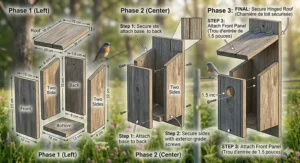
Mount your box 4-6 feet above ground. This height allows easy monitoring for you while keeping the entrance at a level bluebirds prefer. The Ontario Eastern Bluebird Society recommends 5-6 feet as the sweet spot for our province.
Pole Materials and Diameter
Metal poles work best. The 1.25″ diameter galvanized steel poles sold by companies like JCS Wildlife resist rust while providing enough strength to withstand Ontario’s winter winds and spring ice storms.
Wooden posts work too, but they allow predators easier climbing access unless you add guards. If using wood, the 4×4″ cedar posts sold at Canadian lumber yards work well – just remember to factor in predator protection.
Pole Installation Tips for Ontario Conditions
Our freeze-thaw cycles can heave poles right out of the ground. Here’s what works:
- Dig below frost line: In southern Ontario, that’s 4 feet deep; northern regions require 5-6 feet
- Use auger-style mounting: The twisted auger poles popular with trail monitors screw directly into soil and resist frost heave
- Add gravel base: 4-6 inches of gravel at hole bottom improves drainage
- Consider concrete: For permanent installations, setting poles in concrete eliminates movement
Directional Considerations
Face the entrance hole away from prevailing winds. In most of Ontario, this means facing southeast or east. You’ll provide morning sun warmth while avoiding afternoon overheating and western storm exposure.
Never face the entrance directly north – that’s our coldest exposure. According to research cited by Cornell Lab of Ornithology, entrance orientation significantly affects nesting success, particularly during cool, wet springs.
Eastern Bluebird House Requirements: Getting the Details Right
Let’s drill down into the specific eastern bluebird house requirements that’ll make or break your success. These aren’t arbitrary measurements – they’re based on decades of field research and monitoring data from across North America.
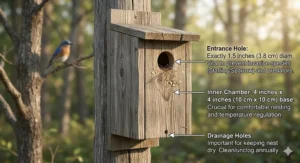
Entrance Hole Specifications
The 1.5″ diameter entrance hole serves a critical dual purpose. It admits bluebirds while excluding larger European Starlings, one of their most aggressive competitors. The North American Bluebird Society has tested extensively and confirms this size works optimally.
Some monitors use 1 9/16″ holes to accommodate the rare Mountain Bluebird that wanders into eastern Ontario, but honestly, 1.5″ works fine for 99% of provincial installations.
Interior Dimensions and Floor Space
Floor dimensions should be approximately 4″ x 5″ for Eastern Bluebirds. Bigger isn’t better here – oversized boxes allow House Sparrows to build competing nests, and they provide less thermal efficiency.
The depth from entrance hole bottom to floor should be 5-7 inches. This prevents predators from easily reaching nestlings while allowing fledglings to climb to the entrance when ready to leave.
Ventilation and Drainage
Drill three 1/4″ holes in each bottom corner for drainage. Ontario’s spring rains can be intense, and trapped moisture leads to hypothermia in nestlings.
For ventilation, drill 5/8″ holes near the top of each side, about 1-2 inches from the roof. The Ontario Eastern Bluebird Society’s recommended Dorrie box design actually skips ventilation holes entirely, relying solely on the entrance opening – and it works beautifully.
Fledgling Ladder
This detail gets overlooked constantly: score the interior front wall below the entrance hole with 1/8″ deep grooves spaced 3/4″ apart. These help young birds grip the wall and climb to the exit when they’re ready to fledge.
Without these grooves, fledglings sometimes get stuck in the box, unable to reach the entrance hole. It’s a simple 30-second addition that prevents heartbreak.
Bluebird Trail Setup Guide: Creating Connected Habitat
If you’re thinking bigger than a single backyard box, congratulations – you’re ready for a bluebird trail setup guide that’ll multiply your conservation impact. Ontario trails range from modest 10-box installations to impressive networks like the Kawartha Field Naturalists’ trail that monitors 100+ boxes annually.
Spacing Between Boxes
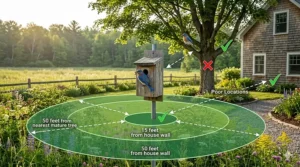
Eastern Bluebirds are territorial during breeding season. Place boxes 100-150 meters (300-450 feet) apart minimum. This gives each pair adequate hunting territory and reduces conflicts.
However, there’s a clever exception: the paired box system. Place two boxes just 4-6 meters (12-20 feet) apart. Bluebirds will claim one box while Tree Swallows (who are even more aggressive) claim the other. The swallows actually help defend against House Sparrows and predators, benefiting both species.
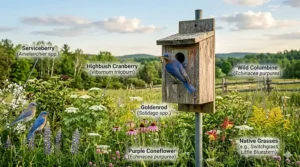
Habitat Selection
Bluebirds hunt from perches, dropping to ground level to capture grasshoppers, crickets, and beetles. They need:
- Open or semi-open areas with short grass
- Scattered perches (fence posts, isolated trees, utility wires)
- Minimal shrub understory
- At least 50 meters from dense woodland
In Ontario, ideal locations include:
- Hay fields and pastures
- Golf courses (get permission!)
- Cemetery open spaces
- Rural roadsides with fence lines
- Rehabilitated old fields
- Orchard edges
Trail Monitoring Schedule
Plan to check boxes every 5-7 days during breeding season (late March through August in southern Ontario). This schedule allows you to:
- Track egg laying and hatching dates
- Remove invasive species nests
- Monitor for predator damage
- Record data for the OEBS annual survey
Many trail monitors use standardized data sheets. The Ontario Eastern Bluebird Society provides free downloadable forms at oebs.ca that help you contribute to provincial population monitoring.
Trail Maintenance Timing
Clean boxes thoroughly in late fall after the last brood fledges. Remove all nesting material, scrub with mild detergent and water, rinse well, and air dry completely. This prevents parasites from overwintering and gives you a fresh start next spring.
Check boxes in late winter (February-March) before bluebirds return. Repair any weather damage, tighten screws, and ensure predator guards remain secure.
Bluebird Conservation Canada: Contributing to Recovery Efforts
The bluebird conservation Canada story represents one of our greatest environmental success tales. After being declared rare by COSEWIC (Committee on the Status of Endangered Wildlife in Canada) following brutal winters in 1976-1978, dedicated conservation efforts brought Eastern Bluebirds back from the brink.
The Role of Nest Box Programs
According to research documented by the Ontario Eastern Bluebird Society, most Ontario bluebirds now nest in human-provided boxes rather than natural cavities. This means your participation directly sustains provincial populations.
The formation of the Ontario Eastern Bluebird Society in 1988 coordinated previously scattered individual efforts. Today, members monitor thousands of boxes across the province, contributing invaluable population data.
Climate Change Considerations
Warmer average temperatures and fewer extremely cold days below -15°C have allowed more bluebirds to survive Ontario winters. The 2002 Christmas Bird Counts recorded 779 Eastern Bluebirds wintering in Ontario – numbers that would have been unthinkable in the 1970s.
However, climate change brings challenges too. Earlier springs can result in mistimed nesting attempts, and extreme weather events during breeding season cause nest failures. Your properly-designed nest box with good drainage and ventilation helps birds cope with these unpredictable conditions.
Supporting OEBS Initiatives
Consider joining the Ontario Eastern Bluebird Society. Individual memberships cost just $15 CAD annually, family memberships $20 CAD. Your membership supports:
- Provincial monitoring programs
- Educational outreach
- Nest box coordinator networks by county
- Annual conferences and workshops
- Newsletter with tips from experienced monitors
You can also report your nesting data to the OEBS. This information helps track long-term reproductive success and identify population trends across Ontario. Even backyard monitors with a single box provide valuable data points.
Tackling Invasive Species
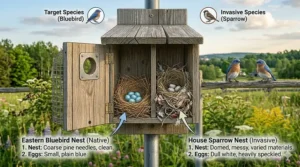
House Sparrows remain the biggest ongoing threat to Ontario bluebirds. These aggressive European imports kill adult bluebirds, destroy eggs, and build nests directly over dead birds.
If you encounter House Sparrow activity in your bluebird boxes, take action. Remove their nests promptly and persistently. Some monitors use specially-designed sparrow traps – check with your local OEBS county coordinator for guidance on legal, humane control methods.
European Starlings present a secondary challenge, though the properly-sized 1.5″ entrance hole usually excludes them. Still, monitor regularly and report any starling issues to help researchers understand evolving competition patterns.
How to Choose the Best Bluebird Nesting Box for Your Ontario Property
You’ve absorbed a ton of information – now let’s make this practical. Here’s a step-by-step process for selecting your ideal bluebird nesting box Ontario solution:
Step 1: Assess Your Habitat
Walk your property and identify potential locations. Look for areas matching the criteria we discussed: open spaces with short grass, scattered perches, minimal shrubs. If you don’t have suitable habitat, you’re better off supporting a local bluebird trail than installing boxes where they won’t succeed.
Step 2: Determine Your Commitment Level
Single backyard box? The WBU Eastern Bluebird House or Nature’s Way Cedar Box offers quality without overwhelming investment.
Starting a multi-box trail? Consider building Dorrie boxes following OEBS plans, or ordering Peterson boxes through Ontario naturalist societies.
Want maximum durability with minimal maintenance? The Recycled Poly Ultimate House costs more upfront but eliminates long-term upkeep.
Step 3: Budget Appropriately
Don’t forget the total system cost:
- Nest box: $40-110 CAD
- Mounting pole: $20-40 CAD
- Predator guard: $25-45 CAD
- Tools and hardware: $10-20 CAD
A complete installation runs $95-215 CAD depending on choices. DIY builds can reduce costs to $50-75 CAD.
Step 4: Plan for Monitoring Access
Position boxes where you can easily reach them for weekly checks. Trail installations along fence lines or field edges work brilliantly because you can drive or walk a circuit efficiently.
Step 5: Consider Future Expansion
Even if you’re starting with one box, think ahead. Buying matching boxes simplifies inventory, and standardized designs make monitoring more efficient as you expand.
✨ Don’t Miss These Exclusive Deals!
🔍 Take your bluebird conservation efforts to the next level with these carefully selected products available in Canada. Click on any highlighted item to check current pricing and availability on Amazon.ca. These tools will help you create authentic habitat that bluebird families will love!
Seasonal Maintenance Calendar for Ontario Conditions
Spring (March-May)
Early March: Check and repair boxes before bluebirds return. Tighten any loose screws, replace damaged predator guards, touch up paint/stain on wooden boxes.
Late March-April: Monitor for first arrivals. In southern Ontario, bluebirds return mid-to-late March. Northern regions see arrivals in April.
Throughout Spring: Check boxes every 5-7 days. Record first egg dates, clutch sizes, hatching dates. This is your busiest monitoring season.
Summer (June-August)
June-July: Second and sometimes third broods occur. Continue weekly checks. Watch for signs of overheating in boxes with poor ventilation or dark colours.
Late July-August: As final broods fledge, reduce check frequency to every 10-14 days. Some pairs attempt late nests into early September.
Fall (September-November)
September: Once you’re certain no active nests remain, clean all boxes thoroughly. Remove old nesting material, which harbours parasites like blowfly larvae.
October-November: Make final repairs before winter. Ensure boxes are watertight and securely mounted. Check that predator guards remain properly positioned.
Winter (December-February)
December-February: Boxes can provide roosting shelter during cold snaps. Some Ontario bluebirds overwinter rather than migrating. Leave cleaned boxes accessible.
Late February: Final pre-season check and minor repairs. Ensure drainage holes haven’t gotten blocked by ice or debris.
Common Problems and Solutions
Problem: House Sparrows Keep Taking Over
Solution: Remove House Sparrow nests immediately and persistently. Don’t give up – sometimes it takes 10+ removals before they move elsewhere. Consider relocating your box to a more rural setting away from buildings.
Problem: Ants Invading the Nest Box
Solution: Apply a thin band of Tanglefoot or Vaseline around the pole 2-3 feet below the box. Ants can’t cross the sticky barrier. Reapply after heavy rain.
Problem: Box Gets Too Hot in Summer
Solution: Add ventilation holes if lacking. Paint exterior light colours (white, tan, light grey) to reflect heat. Position box so entrance faces away from afternoon sun. Add a roof overhang extension if needed.
Problem: Bluebirds Started Nesting Then Abandoned
Solution: Check for predator disturbance, invasive species interference, or pesticide use nearby. Ensure the box offers adequate protection. Consider adding a predator guard if absent.
Problem: Eggs Present But Never Hatch
Solution: This often indicates infertile eggs. Young or inexperienced females sometimes lay infertile clutches. It’s also possible the male disappeared mid-incubation. Nature can be harsh – document the event and hope for better success on the next attempt.
FAQ: Your Bluebird Nesting Box Questions Answered
❓ How much does a bluebird house cost in Canada?
❓ When should I put up a bluebird house in Ontario?
❓ What direction should a bluebird house face in Ontario?
❓ How do I protect bluebird houses from raccoons in Ontario?
❓ Can I use cedar or pine for bluebird houses in Canada?
Conclusion: Your Bluebird Journey Starts Today
Creating the perfect bluebird nesting box Ontario setup isn’t complicated – it just requires attention to proven details. Whether you choose a budget-friendly DIY Dorrie box, a premium poly lumber house, or anything in between, you’re contributing to one of Canada’s greatest conservation success stories.
Remember these key takeaways: use the correct 1.5″ entrance hole for Eastern Bluebirds, install robust predator protection, mount 4-6 feet high in open habitat, and commit to regular monitoring. These four factors determine success more than any other variables.
The Ontario Eastern Bluebird Society has documented thousands of successful nest attempts across the province. Your box could host 2-3 broods annually, potentially fledging 12-18 young bluebirds per season. Over a decade, that’s 100+ birds launched into the world from a single nest box – extraordinary impact from a simple action.
Start with one properly-installed, well-maintained box. Learn the rhythms of monitoring. Experience the thrill of peeking inside to discover that first clutch of pale blue eggs. Watch fledglings take their maiden flights from your box on a warm June morning.
Then, when you’re ready, add more boxes. Share what you’ve learned with neighbours. Join your local naturalist group’s bluebird trail. The birds – and future generations of Ontarians who deserve to see that flash of brilliant blue across our countryside – will thank you.
Recommended for You
- 7 Best Chickadee Houses in 2026: Perfect Entrance Hole Size Guide Canada
- 7 Best Chickadee House Options for Canada 2026
- 7 Bird Cage Placement Tips for Cold Climates Canada 2026
Disclaimer: This article contains affiliate links to Amazon.ca. If you purchase products through these links, we may earn a small commission at no additional cost to you.
✨ Found this helpful? Share it with your friends! 💬🤗
