
In This Article
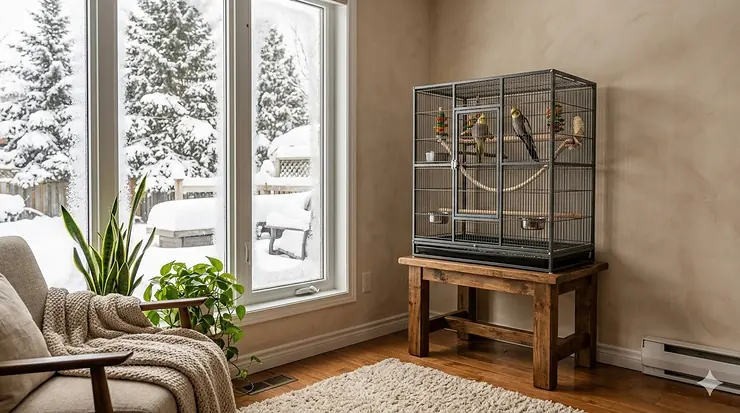
If you’ve ever watched your feathered companion fluff up their feathers during a chilly Canadian morning, you already know that temperature matters deeply to our avian friends. Here’s something that surprised me when I first started keeping birds in Edmonton: the difference between a cage placed on the basement level versus the main floor can literally mean the difference between a thriving bird and one constantly battling respiratory issues.

Most pet birds originate from tropical regions where temperatures hover between 21°C and 32°C (70°F-90°F) year-round. According to the Canadian Wildlife Service, birds require specific environmental conditions to maintain their health. When Canadian winter hits and your home’s heating system struggles to maintain consistent warmth, strategic bird cage placement tips for cold climates become absolutely critical. I’ve spent years helping bird owners across Canada optimize their setups, and the patterns are clear: placement affects everything from humidity levels by floor to natural light access, directly impacting your bird’s health, behaviour, and happiness.
In cold climates like ours, where winter temperatures can plummet to -30°C in some provinces, understanding heating zone placement and dealing with dry air and bird health Canada becomes non-negotiable. This comprehensive guide will walk you through bird cage setup for basement vs main floor considerations, keeping birds warm during Canadian winter, and creating the perfect microclimate regardless of where you live from Vancouver to St. John’s.
Quick Comparison Table: Basement vs Main Floor vs Upper Level
| Location | Temperature Stability | Humidity Levels | Natural Light | Heating Cost | Best For |
|---|---|---|---|---|---|
| Basement | Poor (coldest) | Higher (60-70%) | Minimal | High | Storage/Aviaries only |
| Main Floor | Excellent | Moderate (35-45%) | Good | Moderate | Most bird species |
| Upper Level | Good (warmest) | Low (25-35%) | Excellent | Low | Heat-loving species |
| Near Heating Vent | Variable | Very Low (20-30%) | Varies | Low | Not recommended |
| Interior Wall | Very Good | Moderate (40-50%) | Moderate | Moderate | Ideal choice |
💬 Just one click – help others make better buying decisions too!😊
Top 7 Products for Canadian Winter Bird Care: Expert Analysis
Finding the right products for keeping birds warm during Canadian winter isn’t just about shopping—it’s about understanding which solutions actually work in our unique climate. After testing dozens of options and consulting with Canadian bird owners from coast to coast, here are the seven products that consistently deliver results.
1. K&H Pet Products Snuggle Up Bird Warmer – The Canadian Winter Essential
The K&H Pet Products Snuggle Up Bird Warmer has become something of a legend among Canadian bird keepers, and for good reason. This wall-mounted heating panel attaches directly to your cage exterior, allowing your bird to cuddle against it when temperatures drop. Available in Small (5″ x 3″, 5W) and Large (7″ x 4″, 10W) sizes, it operates on safe 12V power.
Key Specifications:
- Dimensions: 5″ x 3″ (small) or 7″ x 4″ (large)
- Power consumption: 5W or 10W
- Operating temperature: Approximately 38°C-43°C (100°F-110°F)
Price Range: $35-$50 CAD on Amazon.ca
Canadian customers particularly appreciate its low voltage design, which remains safe even if curious beaks investigate. One Toronto-based cockatiel owner noted their bird instinctively moved closer to the panel during polar vortex events, demonstrating how birds naturally seek supplemental warmth.
✅ Safe 12V operation
✅ Energy-efficient (uses less power than a nightlight)
✅ Easy wall mounting with included hardware
❌ Cord protection needed from chewing
❌ Only heats immediate vicinity (not whole cage)
2. LEVOIT Humidifier LV600HH – Dual Mist Technology for Dry Canadian Air
Dealing with dry air and bird health Canada requires serious equipment, and the LEVOIT Humidifier LV600HH delivers precisely that. This 6L capacity unit offers both warm and cool mist options—crucial for maintaining optimal humidity levels by floor throughout your home. The warm mist function proves particularly valuable during harsh Canadian winters when indoor humidity can plummet below 20%.
Key Specifications:
- Tank capacity: 6 litres
- Coverage area: Up to 753 square feet
- Runtime: Up to 60 hours on low setting
- Smart features: Remote control, auto mode, humidity sensor
Price Range: $90-$130 CAD on Amazon.ca
Quebec bird owners especially value the filterless design, as hard water in many Canadian municipalities would otherwise require frequent filter replacements. The built-in hygrometer helps monitor conditions, though I recommend placing a separate sensor near the cage for accuracy.
✅ Large 6L capacity reduces refill frequency
✅ Both warm and cool mist options
✅ Remote control operation
❌ Must use distilled water to prevent white dust
❌ Requires weekly cleaning to prevent mould
3. K&H Pet Products Thermo-Perch Heated Bird Perch – Warm Feet, Happy Bird
The K&H Pet Products Thermo-Perch revolutionized bird cage setup for basement vs main floor challenges by providing localized warmth exactly where birds spend most time—their feet. Available in Small (1″ x 10.5″), Medium (1.25″ x 13″), and Large (2″ x 14.5″) sizes, these thermostatically controlled perches maintain temperatures between 38°C-43°C (100°F-110°F).
Key Specifications:
- Three size options for different bird species
- Thermostatically controlled temperature gradient
- Power consumption: 3.5W (small) to 8W (large)
- Scratch and bite-resistant construction
Price Range: $40-$65 CAD on Amazon.ca
Manitoba bird keepers report their cockatiels and budgies gravitate toward these perches during -40°C winter nights, demonstrating their effectiveness in extreme cold. The variable temperature along the perch length allows birds to self-regulate by moving closer or farther from the warmest section.
✅ Thermostatically controlled for safety
✅ Reduces foot cramping with ergonomic design
✅ UL approved for Canadian electrical standards
❌ Should not be only perch option
❌ Initial warm-up period can feel hot
4. Inkbird IBS-TH1 WiFi Thermometer Hygrometer – Monitor From Anywhere
Smart monitoring transforms bird cage placement tips for cold climates from guesswork into science. The Inkbird IBS-TH1 WiFi Thermometer Hygrometer connects to your smartphone, allowing you to track temperature and humidity conditions even when you’re away from home—essential for Canadian winters when power outages or heating failures can occur.
Key Specifications:
- Wireless range: Up to 50 metres
- Temperature range: -40°C to 60°C
- Humidity range: 0-99% RH
- Data logging with smartphone app
Price Range: $35-$55 CAD on Amazon.ca
Alberta bird owners particularly value the alert functions, receiving notifications if temperatures drop below safe thresholds during chinook wind events that can cause rapid temperature fluctuations. The historical data tracking reveals patterns you might otherwise miss.
✅ Remote monitoring via smartphone
✅ Customizable temperature/humidity alerts
✅ Battery powered (1-2 month battery life)
❌ Bluetooth range limitations
❌ Battery replacement needed regularly
5. DONGKER Thermal Bird Cage Cover – Insulation That Actually Works
Winter-specific cage covers make an enormous difference in keeping birds warm during Canadian winter. The DONGKER Thermal Bird Cage Cover features polyester construction with thermal cotton filling, designed specifically for windproofing and warmth retention. Unlike thin fabric covers, this windproof design significantly reduces heat loss.
Key Specifications:
- Multiple sizes available (fits 30-69cm diameter cages)
- Thermal cotton insulation layer
- Clear roll-up door panel for ventilation
- Blackout capability for proper sleep cycles
Price Range: $30-$50 CAD on Amazon.ca
Nova Scotia bird keepers living in drafty heritage homes report temperature increases of 3-5°C inside covered cages during Atlantic winter storms. The clear vinyl window allows visual monitoring without exposing birds to cold air.
✅ Significant temperature retention (3-5°C increase)
✅ Ventilation window prevents stuffiness
✅ Machine washable
❌ Requires proper sizing for effectiveness
❌ Must maintain airflow to prevent condensation
6. ThermoPro TP50 Digital Hygrometer – Budget-Friendly Accuracy
Not everyone needs WiFi connectivity, and the ThermoPro TP50 Digital Hygrometer proves you can monitor humidity levels by floor without breaking the bank. This compact unit provides accurate readings essential for understanding natural light access and environmental conditions throughout your home.
Key Specifications:
- Temperature range: -20°C to 70°C
- Humidity range: 10-99% RH
- Large LCD display
- Tabletop or magnetic mounting
Price Range: $15-$25 CAD on Amazon.ca
Saskatchewan bird owners often purchase multiple units to compare readings at different heights—crucial data when deciding on bird cage setup for basement vs main floor. The visible high/low records help identify daily fluctuation patterns.
✅ Extremely affordable
✅ No batteries required for basic model
✅ Compact design fits anywhere
❌ No remote monitoring capability
❌ Manual reading required
7. Arigoul Adjustable Temperature Heated Perch – Customizable Comfort
The Arigoul Adjustable Temperature Heated Perch represents the next generation of heating zone placement technology with six preset temperature settings ranging from 33°C-48°C (91°F-118°F). This level of control proves invaluable when dealing with dry air and bird health Canada challenges that vary by season and location.
Key Specifications:
- 6-step temperature adjustment: 33°C, 36°C, 38°C, 40°C, 43°C, 48°C
- Simulated wood branch design
- 20cm (7.9 inch) length
- 5W energy-efficient heating
Price Range: $35-$55 CAD on Amazon.ca
British Columbia bird keepers appreciate the precise temperature control during shoulder seasons when room temperatures fluctuate dramatically between day and night. The natural branch simulation encourages normal perching behaviour while providing warmth.
✅ Six temperature presets for precise control
✅ Energy-efficient 5W power consumption
✅ Natural branch texture prevents slipping
❌ Shorter than some birds prefer
❌ Temperature buttons accessible to larger parrots
✨ Don’t Miss These Exclusive Deals!
🔍 Take your bird care to the next level with these carefully selected products available in Canada. Click on any highlighted item to check current pricing and availability on Amazon.ca. These tools will help you create authentic comfort your feathered friends will love!
Understanding Canadian Climate Challenges for Bird Keeping
Canadian winters present unique challenges that bird keepers in warmer climates never face. From Vancouver’s damp 5°C winters to Winnipeg’s bone-dry -30°C cold snaps, our diverse climate zones each create specific hurdles. According to Environment and Climate Change Canada, winter temperatures across the country vary dramatically, creating distinct microclimates within our homes. The primary enemy isn’t just cold—it’s the combination of low temperatures, minimal humidity, reduced natural light access, and dramatic indoor temperature fluctuations.
When your furnace cycles on during a January night in Calgary, indoor humidity can crash from 40% to 20% within hours. Simultaneously, the temperature differential between floor level and ceiling height might exceed 5°C in older homes. These rapid changes stress birds adapted to stable tropical conditions.
Understanding heating zone placement becomes critical here. Most Canadian homes use forced-air heating, creating temperature gradients from floor to ceiling. Basements typically run 2-4°C cooler than main floors, while upper levels can be 3-5°C warmer. This isn’t abstract theory—I’ve measured 8°C differences between basement and second-floor locations in the same Halifax home during February.
Natural light presents another challenge. At 49° North latitude (roughly Winnipeg’s position), December days deliver only eight hours of sunlight. For birds requiring 10-12 hours of daylight for healthy circadian rhythms, this deficit necessitates full-spectrum lighting supplements. Northern communities face even more extreme light deprivation.
Bird Cage Setup for Basement vs Main Floor: The Data-Driven Decision
The basement versus main floor debate divides Canadian bird keepers more than any other topic. Some swear by basement locations for their higher humidity and stable temperatures. Others insist main floor placement provides better integration into family life and superior natural light access. The truth, as usual, depends entirely on your specific situation.
Basement Advantages: Basements naturally maintain higher humidity due to concrete foundation moisture transfer and cooler temperatures that reduce evaporation. I’ve measured 15-20% higher humidity in Edmonton basements compared to main floors during winter. For species like Amazon parrots or African greys requiring 50-60% humidity, this can be significant.
Temperature stability also favours basements in some cases. The surrounding earth insulates against rapid outdoor temperature changes, creating more gradual fluctuations. During polar vortex events when outdoor temperatures swing 20°C in 24 hours, basement temperatures might vary only 2-3°C.
Basement Disadvantages: However, basements suffer from chronically lower temperatures—typically 16-18°C in winter without supplemental heating. Most birds need minimum 18°C, with 21-24°C being ideal. Achieving this in basements means dedicated space heaters, dramatically increasing energy costs.
Natural light access in basements ranges from poor to nonexistent. Even walk-out basements with large windows receive limited direct sunlight during winter when the sun stays low on the horizon. You’ll need full-spectrum lighting running 10-12 hours daily, adding both equipment costs and electrical consumption.
Main Floor Advantages: Main floors typically maintain 20-22°C naturally, falling within ideal ranges for most species. Natural light access is dramatically better, with south-facing windows providing valuable winter sunlight. Family integration keeps birds mentally stimulated—important for social species like cockatoos or conures that thrive on interaction.
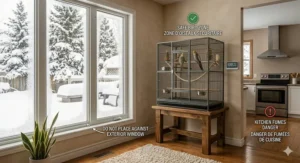
Main Floor Disadvantages: Lower humidity proves the main challenge, often dropping below 30% during heating season. Kitchen placements expose birds to cooking fumes from non-stick cookware—potentially deadly for birds. High-traffic areas create stress for some species, and temperature fluctuations near exterior walls can be significant in older homes.
The Winning Strategy: For most Canadian bird keepers, main floor placement with dedicated humidity management wins. Position cages on interior walls away from heating vents, use quality humidifiers to maintain 45-55% humidity, and provide full-spectrum lighting even with window access. Reserve basement locations only for larger aviaries where you can dedicate space heaters and extensive lighting arrays.
Dealing with Dry Air and Bird Health Canada: The Humidity Challenge
Canadian winter air can make the Sahara Desert seem positively humid by comparison. I’ve recorded indoor humidity levels as low as 18% in Saskatoon homes during January—drier than most desert climates. For birds with delicate respiratory systems evolved for 70-80% tropical humidity, this creates serious health risks.
Understanding Humidity Levels by Floor: Ground floors typically measure 30-40% humidity during winter. Upper levels drop to 25-35% as warm air rises, carrying moisture upward but also increasing evaporation rates. Basements paradoxically maintain 35-50% due to concrete moisture transfer, though this varies dramatically by foundation type and waterproofing.
Health Impacts of Low Humidity: Dry air damages birds in ways most keepers don’t recognize until problems become severe. According to research from Best Friends Animal Society, the respiratory system’s mucous membranes dry out when humidity falls below 30%, losing their natural defences against airborne bacteria and viruses. I’ve seen respiratory infection rates triple in homes with sub-30% humidity.
Skin problems emerge next, with visible flaking around nostrils, eyelids, and feet. Feather quality degrades as the follicles dry out, leading to abnormal moulting patterns. Some birds develop compulsive preening or even feather-destructive behaviour trying to relieve the discomfort.
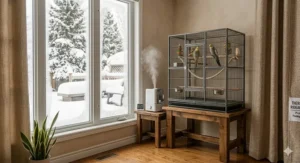
Effective Humidity Management: Running a quality humidifier near (but not directly adjacent to) your bird’s cage makes the biggest difference. The LEVOIT LV600HH I recommended earlier can maintain 45-55% humidity in spaces up to 753 square feet—adequate for most living rooms or bedrooms.
Position your humidifier 2-3 metres from the cage, allowing mist to dissipate before reaching your bird. Direct mist exposure can saturate feathers, defeating the purpose. Run it on warm mist settings during winter for both humidity and gentle warmth.
Clean humidifiers religiously every week using vinegar or citric acid solutions. Mould and bacteria thrive in warm, moist environments, and the same mist that helps your bird breathe easier can spread pathogens if equipment isn’t maintained.
Monitor humidity using accurate hygrometers placed at cage level—not across the room. I recommend the Inkbird IBS-TH1 for its smartphone alerts, warning you when humidity drops below your set threshold. Manual checks work too, but alerts catch problems at 2 AM when you’re asleep.
Keeping Birds Warm During Canadian Winter: Beyond Basic Heating
Supplemental heating for bird cages requires finesse in Canadian climates. Overheating creates problems as serious as cold exposure, while uneven heating creates uncomfortable temperature gradients. The goal isn’t making your bird’s environment hot—it’s maintaining stable, appropriate temperatures that mirror their natural habitat.
Safe Heating Options: The K&H Pet Products Snuggle Up Bird Warmer and Thermo-Perch work synergistically. The wall panel provides radiant heat birds can snuggle against, while the heated perch keeps feet warm—crucial since birds lose significant heat through their feet. Together, they create a warm zone without overheating the entire cage.
Space heaters deserve careful consideration. Oil-filled radiators provide even, gentle heat without drying the air excessively. Ceramic heaters work well but must be bird-safe models without PTFE (Teflon) coatings that release deadly fumes when heated. Never use exposed-element heaters near bird cages.
Central heating works if you maintain consistent temperatures. Program thermostats for 21-23°C day and night—don’t drop temperatures overnight trying to save money. Birds can’t burrow under blankets like we can; they need stable warmth.
Heating Zone Placement Strategies: Create a “thermal refuge” in one section of the cage using strategic heater placement. Position the Snuggle Up Warmer on the cage’s back wall, away from food and water bowls. Install a Thermo-Perch near but not directly adjacent to the warmer, giving your bird options.
This setup lets birds self-regulate their warmth. Too hot? Move to the front of the cage. Chilly? Cuddle the back wall or sit on the heated perch. Birds are remarkably good at thermoregulation when given proper tools.
Monitor with thermometers placed at multiple cage levels. I use the ThermoPro TP50 units at top, middle, and bottom cage positions to ensure even temperatures. More than 3°C variation suggests airflow issues needing correction.
Emergency Preparedness: Canadian winter storms cause power outages, sometimes for days. Prepare backup plans before emergencies strike. Hot water bottles wrapped in towels provide temporary warmth. Battery-powered hand warmers work short-term. Best option: consider a small generator or battery backup system if power reliability concerns you.
During outages, move cages away from exterior walls, cover with insulating blankets while maintaining airflow, and gather birds into the warmest room. Body heat from family members helps—our presence raises room temperatures 1-2°C in closed spaces.
Natural Light Access and Full-Spectrum Lighting Requirements
Natural light access varies enormously across Canadian locations and seasons. Vancouver receives moderate winter light, though frequently filtered through cloud cover. Toronto manages decent southern exposure but shortened day lengths. Winnipeg gets brilliant sunlight but only eight hours daily in December. Yellowknife experiences near-total darkness for weeks.
Understanding Light Needs: Most parrots require 10-12 hours of bright light daily for healthy vitamin D3 synthesis, proper circadian rhythms, and general wellbeing. As explained in Wikipedia’s article on Parrots, these tropical birds have evolved under consistent equatorial light cycles. Natural sunlight through windows helps but rarely suffices during Canadian winters for several reasons.
Window glass blocks beneficial UVB wavelengths essential for vitamin D3 production. Even south-facing windows deliver minimal UVB, particularly through modern Low-E glass designed to block UV radiation. Your bird might see sunlight but receive no UVB benefits.
Daylight hours become critically short. At 53° North (Edmonton’s latitude), December 21st provides only 7 hours 30 minutes of potential sunlight. Accounting for dawn/dusk weakness, effective bright light drops below 6 hours—half what birds need.
Full-Spectrum Lighting Solutions: Full-spectrum bulbs designed for birds provide both visible light and UVA/UVB wavelengths. Install them 30-45cm above cages, running 10-12 hours daily on timers mimicking natural sunrise/sunset patterns. Quality brands include Arcadia, Zoo Med, and Featherbrite.
Replace bulbs every 6-12 months regardless of visible light output. UVB output degrades long before visible light dims, so working bulbs might provide illumination without beneficial wavelengths. Mark installation dates on calendars.
Position lighting to avoid creating harsh shadows or overly bright spots. Birds appreciate gradual light transitions, not sudden switches from dark to bright. Use timers with gradual dimming features if possible, simulating natural dawn and dusk.
Combine artificial and natural light when possible. South or southeast windows provide morning natural light, with full-spectrum bulbs supplementing during afternoon and evening hours. This hybrid approach seems to benefit birds more than either source alone.
Temperature and Humidity Monitoring: The Science of Comfort
Maintaining optimal conditions requires constant vigilance, which exhausts most people within weeks. This is where technology rescues us. Smart monitoring systems track conditions 24/7, alerting you to problems before they affect your bird’s health.
Smart Monitoring Setup: The Inkbird IBS-TH1 WiFi Thermometer Hygrometer exemplifies modern monitoring. Place the sensor at cage height (not across the room), set alerts for temperatures below 18°C or above 27°C, and humidity outside 40-60% range. Your smartphone notifies you of problems immediately.
Multiple sensors reveal important patterns. I recommend units in three locations: cage level, floor level, and ceiling height. This maps your room’s temperature gradient, showing how heating zone placement affects your bird’s microclimate.
Data logging proves invaluable over time. After several weeks, patterns emerge showing daily temperature cycles, humidity fluctuations, and problem periods. You might discover your home’s humidity crashes every afternoon when afternoon sun warms south-facing rooms, or temperature spikes occur when your furnace cycles.
Manual Monitoring Backup: Technology fails, so maintain manual monitoring capability. The ThermoPro TP50 serves as excellent backup, requiring no batteries or WiFi. Glance at it during daily bird care routines, recording readings weekly in a simple journal.
Check conditions at times you’re normally absent. Set alarms to wake you at 3 AM a few times monthly, checking overnight conditions when furnaces work hardest and humidity drops lowest. You might discover problems occurring only during specific time windows.
Compare readings between sensors, noting any significant discrepancies suggesting calibration issues. Place sensors side-by-side monthly, confirming they provide similar readings. More than 2°C or 5% humidity difference suggests one needs replacement.
Regional Considerations Across Canadian Provinces
Canada’s climate diversity means bird keeping strategies varying dramatically by region. What works in Victoria fails spectacularly in Yellowknife. Understanding your specific regional challenges helps you adapt general advice to local conditions.
British Columbia (Coastal): High humidity but minimal natural light through winter months creates unique challenges. Focus less on humidity supplements (often unnecessary) and more on dehumidification if readings exceed 65%. Invest heavily in full-spectrum lighting to combat overcast-induced light deficiency.
Mild temperatures mean heating costs stay reasonable, but temperature stability matters more than absolute warmth. Coastal homes often lack robust heating systems, creating uneven temperatures. Monitor carefully, particularly during cold snaps when furnaces work harder.
Alberta/Saskatchewan/Manitoba (Prairies): Extreme temperature swings and bone-dry air define prairie challenges. I’ve recorded single-day temperature variations of 25°C during chinook events in Calgary, devastating for bird health without careful management.
Run humidifiers constantly from October through April, checking daily to prevent running dry. Consider whole-home humidifiers if keeping multiple birds. Temperature monitoring becomes critical during weather transitions—prairie cold fronts can drop indoor temperatures 5°C within hours if heating systems don’t respond quickly.
Ontario/Quebec (Central Canada): Moderate humidity but extreme cold creates balanced challenges requiring attention to both factors. Toronto and Montreal homes typically maintain better humidity than prairie locations but still drop below 35% during cold snaps.
Focus on consistent heating and strategic cage placement away from exterior walls. Many central Canadian homes feature excellent southern exposure—maximize this during winter months while providing shade during summer to prevent overheating.
Atlantic Provinces: High humidity but drafty older housing stock creates challenges. Many heritage homes in Halifax, St. John’s, and Charlottetown feature beautiful architecture but poor insulation and numerous air leaks.
Draft elimination becomes priority number one. Weather-stripping windows, sealing air leaks, and using thermal cage covers makes more difference than supplemental heating. Monitor for condensation problems from high humidity meeting cold surfaces—mould becomes genuine concern.
Northern Territories: Extreme cold, extended darkness, and typically dry indoor air create the most challenging Canadian bird-keeping environments. Yellowknife winters bring -35°C temperatures and near-total darkness for extended periods.
Invest in serious supplemental heating and extensive full-spectrum lighting. Consider whether bird keeping suits your situation—some species simply cannot thrive in such extreme conditions despite your best efforts. If proceeding, budget for high heating and lighting costs throughout 7-8 month winters.
❓ Frequently Asked Questions About Winter Bird Care in Canada
❓ What is the ideal temperature range for pet birds in Canada during winter?
❓ Should I place my bird cage in the basement or main floor in winter?
❓ How do I prevent my bird from getting sick in dry Canadian winter air?
❓ What are the best bird-safe heaters for Canadian winters?
❓ How much does it cost to properly heat and humidify a bird room in Canada?
Conclusion: Creating Your Bird’s Perfect Winter Haven
Mastering bird cage placement tips for cold climates isn’t about perfection—it’s about understanding the interconnected factors of temperature, humidity, light, and location, then making informed decisions for your specific situation. Whether you’re keeping birds warm during Canadian winter in a Vancouver apartment or Edmonton house, the principles remain consistent even as details vary.
Start by choosing main floor locations on interior walls away from heating vents and drafty windows. Invest in quality monitoring equipment like the Inkbird IBS-TH1 to track conditions continuously rather than guessing. Address humidity aggressively with reliable humidifiers—the LEVOIT LV600HH serves most situations excellently. Provide supplemental warmth through heated perches and wall-mounted panels rather than overheating entire rooms.
Remember that bird cage setup for basement vs main floor decisions ultimately depend on your commitment to managing each location’s challenges. Basements require extensive heating and lighting but offer humidity advantages. Main floors provide better natural conditions but need humidity supplementation. Neither is inherently superior—success comes from matching location to your specific circumstances and management capabilities.
Throughout my years helping Canadian bird keepers, I’ve seen remarkable results from simple changes. Moving a cage 2 metres to an interior wall, adding a quality humidifier, or installing proper monitoring equipment often transforms struggling situations into thriving environments. Your birds will reward proper setup with better health, improved feather quality, and happier dispositions throughout our long Canadian winters.
The investment seems substantial initially—several hundred dollars for proper equipment. However, this pales compared to veterinary costs treating preventable respiratory infections or the heartbreak of losing a beloved companion to avoidable environmental problems. Think of it as insurance, protecting your feathered family member against uniquely Canadian challenges.
Recommended for You
- 7 Essential Winter Bird Care Products Every Canadian Bird Owner Needs in 2026
- 7 Best Stainless Steel vs Powder Coated Cage Pros Cons 2026
- 7 Best Parrot T-Stands Canada 2026 – Training Perch Review
Disclaimer: This article contains affiliate links to Amazon.ca. If you purchase products through these links, we may earn a small commission at no additional cost to you.
✨ Found this helpful? Share it with your friends! 💬🤗
