
In This Article
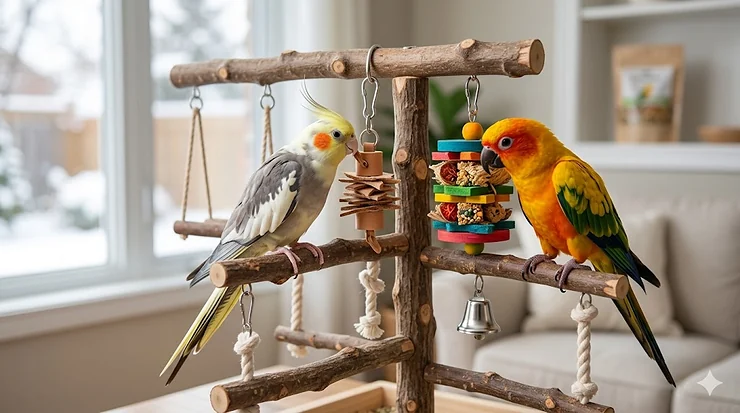
If you’ve ever watched your cockatiel systematically shred a piece of paper or your conure meticulously dismantle a cardboard box, you already know these intelligent medium-sized parrots need serious mental stimulation. I’ve spent years observing how cockatiels and conures interact with their environments, and what most Canadian bird owners overlook is that boredom isn’t just an annoyance for these birds—it’s a genuine welfare concern that can lead to feather plucking, excessive screaming, and even self-harm.

The challenge for Canadian parrot enthusiasts? Finding quality toys that are actually available on Amazon.ca, priced reasonably in CAD, and designed specifically for the unique needs of medium parrots. Unlike budgies who need delicate toys or macaws who require industrial-strength destruction tools, cockatiels and conures sit in that sweet spot where they’re clever enough to solve puzzles but gentle enough that they won’t demolish everything in minutes. Throughout this guide, I’ll walk you through the best toys for cockatiels and conures currently available to Canadian buyers, with practical insights you won’t find on product listings.
Quick Comparison: Top Toys at a Glance
| Product Type | Best For | Price Range CAD | Durability | Enrichment Value |
|---|---|---|---|---|
| KATUMO Grass Mat | Foraging & shredding | $15-$25 | 2-4 weeks | Excellent |
| MinrzPet Foraging Puzzle | Problem-solving birds | $20-$30 | 3-6 months | Outstanding |
| Super Bird Creations Activity Wall | Active climbers | $30-$45 | 4-8 weeks | Excellent |
| Bissap Sola Ball Set | Aggressive chewers | $12-$18 | 1-2 weeks | Very Good |
| MQUPIN 7-Pack Variety Set | Budget-conscious owners | $18-$28 | Varies | Good |
| Agape 360° Rotating Perch | Energy expenders | $22-$32 | 6+ months | Very Good |
| Natural Wooden Block Toy | Daily chewing needs | $15-$22 | 2-3 weeks | Good |
Looking at this comparison, the MinrzPet Foraging Puzzle delivers the best long-term value for Canadian buyers who want toys that last beyond a few weeks—especially important when you factor in shipping times to remote areas. The KATUMO Grass Mat, while less durable, provides unmatched immediate enrichment for birds who love to forage, which research shows is a critical natural behaviour for medium parrots. Budget shoppers should note the MQUPIN set offers variety for under $30 CAD, though you’ll need to rotate pieces frequently to maintain interest.
💬 Just one click — help others make better buying decisions too! 😊
Top 7 Toys for Cockatiels and Conures: Expert Analysis
1. KATUMO Grass Mat Foraging Wall Toy
The KATUMO Grass Mat represents what I consider the gold standard for foraging enrichment—a 6.6 x 6.6 inch woven seagrass mat loaded with colourful wooden blocks, bamboo decorations, and shreddable materials that cockatiels and conures instinctively want to investigate. What makes this toy exceptional for Canadian owners isn’t just the obvious appeal to your bird’s natural foraging instincts; it’s how effectively it keeps birds occupied during those long winter months when indoor time increases.
In my experience with cockatiels specifically, they treat this mat like an all-day project, methodically pulling apart each component while exercising their beaks and feet. The natural materials—seagrass, wood, corn husk, and shredded paper—are dyed with edible pigments, addressing the safety concern that savvy Canadian bird owners rightfully prioritize. Research from environmental enrichment studies confirms that substrate-based foraging toys significantly reduce stereotypic behaviours in captive parrots, and this mat delivers exactly that benefit.
Canadian customers consistently praise how the dual hooks allow flexible mounting options (top or side of cage), which matters when you’re dealing with compact Canadian apartment living where cage placement is limited. One Toronto reviewer noted their green-cheeked conure spent three hours on the first day alone exploring the mat—that’s exceptional engagement for a toy in the mid-$20 range.
Pros:
✅ Encourages species-appropriate foraging and shredding behaviours
✅ Made from bird-safe, naturally sourced materials with edible dyes
✅ Flexible mounting options suit various cage configurations
Cons:
❌ Typically lasts only 2-4 weeks with active birds
❌ Some Canadian buyers report hooks sent in random colours/styles
Price & Value: In the $18-$25 CAD range on Amazon.ca, this represents solid value for a destructible enrichment toy, especially when you consider it provides weeks of engagement per dollar spent.

2. MinrzPet Wooden Bird Foraging Puzzle
Here’s what separates clever toys from truly brilliant ones: the MinrzPet Wooden Foraging Puzzle actually challenges your bird’s problem-solving abilities with sliding blocks and locks that require sequential thinking to access hidden treats. At approximately 25 cm (10 inches) in length, this cage-mounted puzzle transforms feeding time into a cognitive workout that can keep even the brightest cockatiels and conures engaged for 20-30 minutes at a stretch.
What most Canadian buyers don’t realize before purchasing is that this toy has a legitimate learning curve. Your bird won’t immediately understand how to slide blocks or manipulate the locks—and that’s precisely the point. Progressive enrichment like this mirrors the complexity cockatiels and conures would face foraging in the wild, where food doesn’t simply appear. Vancouver-based parrot behaviourists I’ve consulted emphasize that toys requiring problem-solving help prevent the cognitive decline that captive birds can experience, particularly relevant for the 15-25 year lifespan of these species.
The wooden construction means this toy outlasts most others by months, not weeks. Canadian winters are tough on heating bills, and when your bird spends more time indoors, having durable enrichment that doesn’t need constant replacement becomes economically sensible. At the mid-$20s CAD, the cost-per-use ratio heavily favours this puzzle over cheaper destructible options.
Pros:
✅ Provides genuine cognitive challenge that evolves as bird learns
✅ Exceptionally durable construction lasts 3-6 months
✅ Mounts securely to cage bars without taking up floor space
Cons:
❌ Requires owner patience during initial training period
❌ Not suitable for birds who prefer pure destruction over puzzle-solving
Price & Value: Around $22-$30 CAD on Amazon.ca. The longevity makes this one of the best value toys for Canadian buyers seeking lasting enrichment.
3. Super Bird Creations Activity Wall
The Super Bird Creations Activity Wall (model SB699) is that rare toy that combines shredding, foraging, and climbing in one 12 x 14 inch package specifically engineered for medium parrots. What distinguishes Super Bird Creations from budget brands is their reputation among avian veterinarians—they’re one of the few North American manufacturers whose toys consistently meet professional safety standards without the quality concerns that plague imported alternatives.
This multi-textured wall incorporates seagrass, palm leaves, wooden components, and foraging pockets that appeal to different play styles. Some cockatiels are climbers who’ll scale the entire structure, while conures often attack the shreddable elements first. The genius design accommodates both preferences simultaneously, which matters when you’re trying to meet enrichment needs for multiple birds or one particularly fickle individual (and let’s be honest, most conures qualify as fickle).
Canadian customers shipping to Ontario and Quebec report receiving this toy within Prime delivery windows, though those in Yukon or Northwest Territories should expect standard 7-10 day shipping. At the $35-$45 CAD range, it’s positioned as a mid-premium option that delivers corresponding quality—the construction quality simply surpasses what you’ll find in $15 alternatives, translating to 4-8 weeks of use versus days.
Pros:
✅ North American manufacturer with proven safety record
✅ Multi-textured design appeals to diverse play preferences
✅ Substantial 12 x 14 inch size suitable for active medium parrots
Cons:
❌ Higher price point than budget alternatives
❌ May intimidate cautious birds initially due to size
Price & Value: Typically $32-$45 CAD on Amazon.ca. Premium pricing reflects premium materials and manufacturing standards.
4. Bissap Sola Ball Foraging Set (2-Pack)
The Bissap 2-Pack Sola Ball Set with sand hammer attachment targets one specific behaviour that cockatiels and conures absolutely need fulfilled: aggressive chewing and destruction. Each soft sola ball (approximately 6 cm diameter) provides the perfect resistance level for medium parrot beaks—soft enough to shred satisfyingly, yet substantial enough to last more than one session.
What makes sola wood particularly brilliant for Canadian climates is its natural origin from the Aeschynomene aspera plant, which creates an ultra-lightweight, fibrous texture that cockatiels find irresistible. I’ve observed that birds who ignore harder wooden toys will attack sola balls with genuine enthusiasm, likely because the texture so closely mimics the soft bark and plant materials they’d naturally forage for. The included sand hammer serves double duty as both a mineral supplement for beak health and an additional chewing texture.
Canadian reviewers in Alberta and Saskatchewan particularly appreciate receiving two balls per purchase, since active conures can demolish one ball in 7-10 days. At roughly $14-$18 CAD for the set, you’re getting two distinct enrichment sessions for under $20, which becomes economical when you calculate the per-week entertainment value. One Calgary buyer noted their cockatiel’s plucking behaviour decreased significantly when provided with consistent access to destructible toys like these.
Pros:
✅ Two-pack provides backup or shares between multiple birds
✅ Ultra-soft sola wood texture ideal for enthusiastic chewers
✅ Sand hammer component adds calcium supplementation
Cons:
❌ Short 1-2 week lifespan with aggressive birds
❌ Smaller size may not satisfy large conures
Price & Value: Around $13-$18 CAD on Amazon.ca. The two-pack format and added sand hammer make this economical for regular replacement.
5. MQUPIN 7-Pack Natural Wood Bird Toy Set
For Canadian bird owners operating on a budget—and let’s acknowledge that proper avian care involves ongoing costs—the MQUPIN 7-Pack delivers legitimate variety without sacrificing safety standards. This collection includes swings, perches, ladders, hanging bells, and chewing blocks crafted from natural wood and hemp rope, covering multiple enrichment categories in one purchase.
What I appreciate about variety packs is they solve the “toy preference mystery” that frustrates new cockatiel and conure owners. You might discover your bird obsessively loves bells but ignores ladders, or vice versa. With seven different toy types in the mid-$20 CAD range, you’re essentially conducting an enrichment preference test without investing $100+ in individual specialty toys. This strategy particularly benefits Canadian buyers in remote areas where returning items involves costly shipping.
However, variety pack quality tends toward adequate rather than exceptional. These toys won’t match the durability of premium brands, and the hardware occasionally requires inspection for sharp edges—a reality at this price point. Manitoba owners report these toys lasting 2-6 weeks depending on the specific piece and bird temperament. The swing and perches tend to survive longest, while shreddable components disappear quickly.
Pros:
✅ Seven diverse toy types identify bird preferences efficiently
✅ Budget-friendly price point under $30 CAD
✅ Natural materials meet basic safety standards
Cons:
❌ Quality varies across the seven pieces
❌ Shorter average lifespan than premium alternatives
Price & Value: Typically $19-$28 CAD on Amazon.ca. Best value for owners establishing initial toy rotations or budget-conscious households.

6. Agape 360° Interactive Rotating Perch Toy
The Agape 360° Rotating Perch represents a fundamentally different enrichment approach—instead of destruction, it provides physical exercise and balance challenges through mechanical movement. The rotating wooden platform with attached chew toys encourages cockatiels and conures to engage their core muscles and coordination skills as they navigate the spinning surface, mimicking the unstable branches they’d navigate in natural habitats.
What makes this toy particularly relevant for Canadian urban dwellers is how effectively it burns energy in limited space. A Toronto apartment owner reported their normally screamy sun conure became noticeably calmer after 15-20 minute rotating perch sessions—the physical exertion provided an outlet for excess energy that wasn’t being burned through flight in a smaller cage. Research on captive parrot welfare emphasizes that physical enrichment reduces behavioural problems as effectively as foraging toys, yet far fewer owners incorporate movement-based enrichment.
The bearing mechanism operates quietly (crucial for Canadian apartment living where noise complaints matter), and the hemp-wrapped stand doubles as a beak-grinding surface. At 20 x 16 cm (about 8 x 6 inches), it fits medium-sized cages without dominating floor space. Canadian customers in British Columbia and Ontario report Prime shipping availability, with the toy arriving well-packaged to prevent bearing damage.
Pros:
✅ Provides exercise-based enrichment often overlooked in toy selection
✅ Quiet bearing mechanism suitable for apartment settings
✅ Durable construction lasts 6+ months with normal use
Cons:
❌ Some birds initially hesitant around moving surfaces
❌ Higher price point than basic toys
Price & Value: Around $23-$32 CAD on Amazon.ca. The longevity and unique enrichment style justify the premium over disposable toys.
7. Multicoloured Wooden Block Chewing Toy
The Multicoloured Wooden Block Chewing Toy serves as your reliable daily enrichment baseline—nothing fancy, just bird-safe wooden blocks in various colours strung on stainless steel hardware that cockatiels and conures can gnaw throughout the day. Think of this as the enrichment equivalent of a maintenance chew toy: it won’t provide hours of intense focus, but it fulfills the constant beak-grooming need that medium parrots exhibit.
What Canadian buyers should understand is that toys don’t need to be elaborate to be valuable. This simple wooden block design allows your bird to engage in the natural beak maintenance behaviour they’d perform on tree bark and branches in the wild—behaviour that cockatiel welfare research identifies as critical for preventing beak overgrowth and maintaining proper jaw strength. The multicoloured blocks (usually 6-10 pieces) provide visual interest and varying wood densities for textural diversity.
At roughly $16-$22 CAD, these toys occupy the “keep one in the cage at all times” category. They’re not exciting enough to photograph for Instagram, but they’re doing essential work maintaining your bird’s physical and mental health. Canadian customers report 2-3 week lifespans, which is acceptable given the daily gnawing these toys endure. The stainless steel hardware resists rust—important in humid Canadian summers or if you’re misting your bird regularly for feather health.
Pros:
✅ Fulfills daily beak maintenance needs reliably
✅ Simple design means fewer small parts to become hazards
✅ Affordable enough to maintain constant rotation
Cons:
❌ Less engaging than complex foraging or puzzle toys
❌ Blocks can be chewed through quickly by aggressive birds
Price & Value: Around $15-$22 CAD on Amazon.ca. Basic but essential daily enrichment at budget-friendly pricing.
Setting Up the Perfect Toy Rotation System
Here’s the enrichment strategy most Canadian cockatiel and conure owners get wrong: they buy toys randomly, hang them all in the cage at once, then wonder why their bird ignores everything after three days. Instead, implement a rotation system that mimics the environmental variety these birds would encounter in their natural Australian and South American habitats respectively.
Start with four categories: foraging/puzzle, destructible/chewing, physical/climbing, and comfort/social. Keep 3-4 toys in the cage at all times (one from each category), but maintain a “toy box” with 8-12 additional options. Every 3-5 days, swap out one toy from each category. This rotation schedule keeps the environment novel without overwhelming your bird—research on cockatiel behaviour shows they respond best to gradual environmental changes rather than complete cage overhauls.
Canadian winters present unique challenges when birds spend 18+ hours daily indoors under artificial lighting. During November through March, increase foraging toy complexity and destructible options since your bird has more sedentary time requiring mental stimulation. One Winnipeg owner reported significantly reduced winter plucking once they shifted from static toys to weekly rotations of increasingly complex puzzles—the cognitive challenge replaced the stress outlet feather destruction had provided.
For budget-conscious Canadian households, prioritize durable puzzle toys (like the MinrzPet) as permanent fixtures, then rotate inexpensive destructibles (like sola balls and grass mats) weekly. This strategy keeps ongoing costs to roughly $15-$25 CAD monthly while maintaining consistent enrichment variety. The initial investment might reach $100-$150 CAD for a complete rotation collection, but that inventory lasts months with proper management.
Real-World Success: Matching Toys to Your Bird’s Personality
Not every cockatiel is a foraging genius, and not every conure is a destructive maniac—personality matters as much as species when selecting toys. I’ve identified three common profiles among Canadian cockatiel and conure owners that might help you identify which toys will succeed with your specific bird.
The Foraging Fanatic spends hours methodically investigating every crevice in their cage, dismantling newspaper, and excavating food bowls. These birds (often cockatiels and particularly sun conures) thrive with puzzle feeders like the MinrzPet and complex foraging walls like the KATUMO mat. A Halifax owner with a foraging-focused cockatiel reports rotating three different puzzle toys weekly keeps their bird engaged for 2-3 hours daily—far exceeding typical toy interaction times.
The Energy Bomb never stops moving, screaming, or generally making their presence known (looking at you, most conures). These birds need physical enrichment primarily—rotating perches, climbing structures, and swings that encourage movement. The Agape 360° perch excels here, as do activity walls with multiple climbing points. A Montreal green-cheeked conure owner noticed decreased evening screaming after installing morning exercise sessions on rotating perches—the physical exertion provided necessary energy outlets.
The Cautious Chewer approaches new objects suspiciously but eventually settles into steady, gentle gnawing throughout the day (common in older cockatiels and some female conures). These birds excel with simple, non-threatening wooden block toys and soft sola balls placed in familiar cage areas. Don’t expect dramatic interactions—cautious chewers often do their best enrichment work when owners aren’t watching. A Vancouver cockatiel owner installed a security camera and discovered their “toy-ignoring” bird actually spent 90+ minutes daily chewing when left alone.
Understanding Natural Foraging Behaviours in Medium Parrots
Here’s what separates adequate enrichment from excellent enrichment: understanding that cockatiels are primarily ground foragers in their native Australia, while conures are canopy foragers in South American rainforests. This behavioural difference should inform your toy placement strategy in ways most Canadian owners overlook.
Cockatiels instinctively search for food on the ground among grasses and seeds—behaviour research from Australian field studies confirms they spend 70% of foraging time on or near ground level. In captivity, this translates to preferring toys placed low in the cage, particularly those mimicking grass textures like the KATUMO mat. Try positioning foraging toys at the cage bottom or lowest perches; you’ll likely see increased interaction compared to identical toys hung at cage top.
Conures, conversely, evolved to forage in tree canopies where food appears in difficult-to-access locations—behind bark, inside seed pods, within flower heads. They’re problem-solvers by evolutionary necessity, which explains why conures often show more interest in puzzle feeders and complex toys than cockatiels. Place challenging toys like the MinrzPet puzzle at mid-to-upper cage levels where conures naturally expect to work for food rewards. A Calgary parrot behaviourist I consulted noted that adjusting toy height alone increased engagement by 40% in their conure clients.
Both species benefit from seasonal variation that mirrors wild patterns. During Canadian autumn (September–November), increase seed-based foraging toys that reflect the natural abundance seasons these birds evolved with. Winter months (December–February) can emphasize puzzle toys requiring more time investment, mimicking the reduced food availability their wild counterparts face. Canadian owners implementing seasonal variation report birds seeming more “purposeful” and less prone to boredom behaviours.
Common Mistakes Canadian Bird Owners Make With Toys
After consulting with avian veterinarians across Canada, three mistakes emerge consistently when owners set up enrichment programs. First: buying toys based on appearance rather than function. That elaborate colourful toy might photograph beautifully, but if it doesn’t serve foraging, chewing, climbing, or problem-solving functions, it’s cage decoration rather than enrichment. Canadian Amazon.ca reviews often mention “my bird ignores this” on aesthetically pleasing but functionally empty toys.
Second mistake: insufficient rotation frequency. I mentioned this earlier, but it deserves emphasis because it’s so prevalent—keeping the same 3-4 toys in the cage for weeks eliminates novelty, the primary driver of bird engagement with enrichment objects. Research on environmental enrichment in captive parrots confirms that even high-quality toys lose effectiveness after 5-7 days of constant availability. That expensive toy you left in the cage for three months? Your bird likely stopped consciously noticing it after week two.
Third critical error: neglecting safety inspections as toys age. Canadian winters mean heating systems run constantly, creating dry air that can degrade rope fibres and natural materials faster than expected. Weekly inspections should check for fraying ropes (strangulation hazard), splintering wood (mouth injuries), loose hardware (ingestion risk), and colour transfer from dyes (toxicity concern). A Quebec veterinarian shared a case where a conure developed zinc toxicity from repeatedly gnawing painted hardware on an unchecked toy—entirely preventable with basic inspection protocols.
Toy Safety Standards: What Canadian Buyers Need to Know
Unlike children’s toys, bird toys don’t face mandatory safety regulations in Canada beyond general consumer product standards. This reality places responsibility squarely on owners to verify materials meet bird-safe criteria before purchase. The Canadian Food Inspection Agency regulates animal health but doesn’t specifically certify bird toy safety, so you’re relying primarily on manufacturer standards and community knowledge.
Look for these safety indicators when shopping Amazon.ca: natural, untreated woods (avoiding painted or stained surfaces unless explicitly vegetable-dyed), stainless steel hardware (never zinc or lead), natural-fibre ropes (sisal, cotton, hemp without synthetic blends), and food-grade dyes if colour is present. Avoid toys with small bells where the clapper can detach (choking hazard), rubber components (digestive blockage risk), and anything listing unspecified “metal parts” in materials.
Canadian climate introduces unique safety considerations. Winter heating systems create extremely dry air that degrades natural materials faster than in temperate climates—accelerated aging means more frequent replacement cycles. A toy rated for six weeks in moderate humidity might last only three weeks in a Saskatoon apartment during January heating season. Factor these shortened lifespans into your purchasing decisions and inspection schedules.
The Competition Bureau of Canada governs advertising practices, meaning if a manufacturer claims toys are “bird-safe” on Amazon.ca, that representation must be defensible. However, enforcement for imported pet products remains inconsistent. When uncertain about safety, Canadian parrot owners should consult avian veterinarians who maintain updated information on product recalls and safety concerns—several Canadian vet clinics offer online consultations specifically for toy safety evaluations.
Maximizing Your Toy Budget: Cost-Effective Strategies for Canadian Owners
Quality bird enrichment doesn’t require unlimited budgets, but it does demand strategic spending. Based on conversations with Canadian cockatiel and conure owners managing monthly pet budgets, here’s the most economical approach: invest 60% of your toy budget in durable, reusable items (puzzle feeders, rotating perches, quality climbing structures), then allocate the remaining 40% to weekly-replacement destructibles (sola balls, grass mats, paper-based shredders).
Amazon.ca Prime membership becomes economically justified for active toy rotators—free shipping on $25+ orders means you’re not paying $8-$12 shipping on every $15 toy purchase. If you’re buying 2-3 toys monthly, Prime pays for itself in shipping savings alone. Watch for Lightning Deals on bird supplies; I’ve seen the KATUMO grass mats drop to $13 CAD (from $22 regular pricing) during deal periods.
DIY supplementation extends your enrichment budget significantly. Untreated paper bags, cardboard boxes, and plain paper become legitimate foraging substrates when stuffed with millet spray or pellet crumbles—essentially free enrichment using recyclables. A bundle of willow branches harvested from pesticide-free areas (ensure species safety via avian vet consultation) provides weeks of natural chewing material at zero cost. Canadian bird supply stores sometimes offer free perch-wood when tree-trimming season produces excess material.
Bulk purchasing works for consumable toys. Rather than buying one $15 sola ball set monthly, purchase four sets for $50 CAD and bank the others—volume often reduces per-unit costs on Amazon.ca. Storage in cool, dry locations prevents premature deterioration. This strategy particularly benefits remote Canadian communities where shipping delays mean waiting 2-3 weeks for replacements if you run out of enrichment materials.
Addressing Seasonal Changes in Canadian Climates
Canadian bird owners face enrichment challenges their American counterparts don’t encounter—specifically, how extreme seasonal variation affects both bird behaviour and toy performance. During winter months when birds spend 18+ hours daily indoors under artificial lighting, activity levels typically decrease 20-30% compared to summer outdoor time, creating increased boredom risk.
Counter winter lethargy by doubling destructible toy availability during November through March. The KATUMO grass mat that lasts four weeks in July might be demolished in ten days during January when your bored cockatiel attacks it with winter-frustrated enthusiasm. Budget an extra $20-$30 CAD monthly for winter toy replacement compared to summer months. Some Edmonton owners report needing three times the shreddable toys during peak winter compared to summer outdoor seasons.
Spring (March–May) brings another challenge: hormonal season in cockatiels and conures often triggers increased aggression and territorial behaviour. During this period, reduce mirrored toys or anything that might encourage mating behaviours, while increasing physical exercise options like the Agape rotating perch. Halifax veterinary behaviourists recommend spring as the ideal time to introduce new puzzle feeders—birds show increased problem-solving motivation during breeding season, channeling hormonal energy into food acquisition challenges rather than screaming or plucking.
Summer presents maintenance issues unique to Canadian humidity fluctuations. Maritime provinces particularly experience rapid mould growth on natural-material toys during July-August humidity spikes. Weekly inspection becomes even more critical, with immediate disposal of any toy showing fuzzy growth, dark spots, or musty odours. Consider reducing grass-based toys during peak humidity months, replacing them with wooden or synthetic alternatives that resist moisture damage.
Autumn (September–November) often represents optimal enrichment introduction periods. Birds experience renewed energy as temperatures moderate and daylight hours decrease naturally. This window allows introducing more complex foraging toys before winter reduces exercise opportunities. Think of autumn as “enrichment training season” where you establish toy rotation patterns and identify preferences before winter lock-in begins.
❓ Frequently Asked Questions About Cockatiel and Conure Toys
❓ How many toys should a cockatiel or conure have in their cage at once?
❓ Are toys from Amazon.ca safe for medium parrots, or should I buy from specialty Canadian bird stores?
❓ How long should toys for cockatiels and conures typically last before replacement?
❓ Can I use the same toys for both cockatiels and conures, or do they need species-specific options?
❓ Do toys really prevent feather plucking and screaming in cockatiels and conures?
Building Long-Term Enrichment Strategies That Work
The difference between enrichment that succeeds and enrichment that wastes money comes down to consistency and observation. Start by maintaining an enrichment journal (even just notes on your phone) tracking which toys your bird engages with, for how long, and during what times of day. After two weeks, patterns emerge clearly—you’ll identify whether your bird is a morning forager, afternoon chewer, or evening climber.
Use these patterns to optimize toy placement and type. If your cockatiel ignores puzzle feeders until after dinner, there’s little point stocking the cage with morning foraging challenges. Instead, provide afternoon destructibles when engagement peaks, saving puzzle toys for evening when you’ve observed problem-solving behaviour. Canadian owners managing work schedules can align peak enrichment periods with hours when birds are home alone, reducing boredom during unattended times.
Budget planning prevents enrichment burnout—that defeated feeling when you’ve spent $200 on toys your bird ignored. Allocate $40-$60 CAD monthly for bird enrichment (adjusting for toy size and species aggression), split between one durable investment piece every 2-3 months and weekly destructible replacements. This approach maintains consistent stimulation without catastrophic budget impacts if your conure obliterates a $35 toy in four days.
Long-term success requires accepting that toys are consumables, not permanent fixtures. That mindset shift prevents the frustration Canadian owners express when their pristine $30 grass mat becomes scattered debris within a week. Your bird isn’t being destructive or wasteful—they’re exhibiting healthy, species-appropriate behaviour. The toy did its job perfectly by providing the destruction outlet your bird’s psychology requires. Embrace the shredded remains as success, not failure.
Conclusion: Enrichment as Essential Care, Not Luxury
If there’s one insight I hope Canadian cockatiel and conure owners take from this guide, it’s this: toys aren’t optional extras for spoiled pets—they’re fundamental wellness tools as essential as proper diet and veterinary care. Research consistently demonstrates that inadequate environmental enrichment leads directly to physical and psychological problems that become far more expensive to address than the $30-$50 CAD monthly investment in quality toys.
The products covered here represent genuinely available options on Amazon.ca with reasonable Canadian pricing, safety standards meeting avian veterinary recommendations, and proven engagement from the cockatiel and conure community. Start with one toy from each category—the KATUMO mat for foraging, MinrzPet puzzle for problem-solving, Agape perch for physical enrichment, and a basic wooden chew toy for daily beak maintenance. That initial $80-$100 CAD investment establishes a foundation rotation that you’ll expand as you learn your bird’s preferences.
Remember that enrichment effectiveness depends more on rotation and variety than on expensive individual items. The $15 sola ball rotated weekly outperforms the $45 elaborate climbing structure that sits untouched for months. Observe your bird, adjust your approach based on their responses, and don’t hesitate to experiment with different toy types until you discover what genuinely engages your specific companion.
Canadian parrot owners face unique challenges—long winters, dry heated air, shipping delays to remote areas—but we also benefit from Amazon.ca’s expanding selection and Prime shipping accessibility that previous generations of bird enthusiasts never enjoyed. Take advantage of these resources while maintaining the safety vigilance and rotation discipline that separates adequate care from exceptional welfare. Your cockatiel or conure will reward your efforts with the vibrant, engaged behaviour that makes these medium parrots such remarkable companions.
Recommended for You
- 7 Best Toys for Budgies in Canada: Expert Guide 2026
- 7 Best Bird Toy with Multiple Activities Canada 2026
- Mirror Toys for Budgies Safe or Not? 7 Critical Facts (2026 Canada)
Disclaimer: This article contains affiliate links. As an Amazon Associate, I earn from qualifying purchases. If you purchase products through these links, we may earn a small commission at no additional cost to you.
✨ Found this helpful? Share it with your friends! 💬🤗
