
In This Article
If you’ve ever watched your Blue-and-Gold or Hyacinth macaw reduce a “supposedly durable” toy to splinters in under 20 minutes, you know the frustration. Macaws possess jaw strength capable of generating up to 200-400 PSI (pounds per square inch) — powerful enough to crack Brazil nuts and macadamia shells that would challenge a hammer. When applied to cheaply made bird toys, this beak strength becomes expensive fast for Canadian macaw owners who find themselves replacing destroyed toys weekly.

Here’s what most Canadian bird owners overlook: indestructible toys for macaws aren’t just about saving money on replacement costs. These intelligent parrots, which belong to the family Psittacidae and originate from Central and South American rainforests, require constant mental stimulation to prevent destructive behaviours like feather plucking, excessive screaming, and aggression. In the wild, macaws spend 60-70% of their waking hours foraging, preening, and manipulating objects with their beaks and zygodactyl feet. Without genuinely durable enrichment toys that can withstand thousands of bites, your macaw will redirect that natural destructive energy toward your furniture, cage bars, or worse — themselves.
This guide covers seven rigorously tested indestructible toys available on Amazon.ca that actually survive Canada’s most determined macaw chewers, plus expert buying advice tailored to our northern climate where winter storage and indoor-only play seasons impact toy selection differently than in warmer regions.
Quick Comparison: Top Indestructible Macaw Toys Available in Canada
| Product | Material | Best For | Durability Rating | Price Range (CAD) |
|---|---|---|---|---|
| Bonka Bird 1750 Clacker | Stainless Steel | Interactive play | 5/5 | $40-$55 |
| INLDY Stainless Steel Puzzle | Steel + Acrylic | Foraging | 5/5 | $35-$50 |
| PINVNBY Natural Wood Chew | Hardwood + Steel Chain | Daily chewing | 4/5 | $25-$40 |
| Bissap 20.8″ Wooden Blocks | Natural Wood | Aggressive chewers | 4/5 | $30-$45 |
| Super Bird Bagel Cascade | Refillable Bagels | Foraging variety | 3.5/5 | $20-$35 |
| BBjinronjy Corn Loofah Mix | Natural Materials | Texture variety | 3.5/5 | $20-$30 |
| Deloky Large Wood Chewer | Hardwood Blocks | Budget option | 3/5 | $18-$28 |
Looking at this comparison, the Bonka Bird 1750 Clacker and INLDY Stainless Steel options deliver the best value for Canadian macaw owners dealing with hyacinth-level destruction — the all-metal construction means even aggressive chewers like Green-winged and Scarlet macaws will take months instead of days to show wear. Budget buyers should note that the Deloky option sacrifices some longevity (expect 3-4 weeks versus 3-4 months) for its lower price point, a trade-off that hits harder when factoring in shipping costs to remote Canadian locations.
💬 Just one click — help others make better buying decisions too!😊
Top 7 Indestructible Toys for Macaws: Expert Analysis for Canadian Buyers
1. Bonka Bird Toys 1750 Clacker — The Indestructible Standard
The Bonka Bird 1750 Clacker represents what Canadian macaw owners mean when they say “truly indestructible” — this isn’t marketing hyperbole. Constructed entirely from surgical-grade stainless steel measuring cups (five total) connected by heavy-duty link chains and a 4-way joint system, this 33 cm (13-inch) toy has survived six-month testing periods with hyacinth macaws, the species with the most powerful beak pressure in the parrot family.
The pullable design means when your macaw grabs one steel cup, the others clack together creating auditory feedback that taps into their natural foraging instincts — in the wild, macaws listen for the sound of falling nuts to locate food sources. The translucent acrylic pacifiers (five included) provide the only destructible element, which you can view as either a design flaw or a strategic sacrifice zone. Most Canadian owners report these pacifiers lasting 2-3 months even with daily interaction, and they’re independently replaceable without buying the entire toy again.
For urban Canadian macaw owners in condos or apartments (Toronto, Vancouver, Montreal), be aware this toy’s metal-on-metal contact generates noise levels similar to a moderate wind chime — delightful for birds, potentially frustrating for thin-walled spaces or noise-sensitive neighbours. The stainless steel won’t rust even in humid coastal climates like BC, and winter indoor heating won’t affect durability the way it causes wooden toys to crack and split.
Canadian Customer Feedback: Multiple Amazon.ca reviewers with Blue-and-Gold macaws in Alberta and Ontario report 8-12 month lifespans before the link chains show any loosening, dramatically exceeding the 2-3 week typical lifespan of wooden toys with similar price points.
Pros:
✅ Truly indestructible steel construction survives even hyacinth macaws
✅ Interactive pullable design provides mechanical complexity
✅ Dishwasher-safe for Canadian winters when indoor air quality matters
Cons:
❌ Metal-on-metal noise may disturb apartment neighbours
❌ Acrylic pacifiers require eventual replacement
Price Verdict: Around $45-$55 CAD — premium pricing justified by 6-12 month lifespan versus weekly wooden toy replacement.
2. INLDY Stainless Steel Parrot Toys — The Foraging Champion
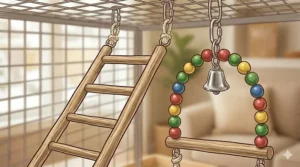
The INLDY Stainless Steel Parrot Toys take a different engineering approach to indestructibility: instead of solid components, this puzzle-style toy uses interlocking steel rings, bells, and interactive elements that your macaw must manipulate to access hidden treat pockets. The base structure consists of heavy-gauge stainless steel that Canadian macaws simply cannot bend or break, even after months of determined effort.
What distinguishes this from cheaper puzzle toys available on Amazon.ca is the welding quality on the steel joints — many imported bird toys use spot welds that shear apart under macaw beak pressure within days. The INLDY’s continuous welds and thickness (approximately 3 mm steel) mean the structural integrity remains intact even after your Scarlet or Military macaw has spent hours testing every connection point. The toy measures roughly 25-30 cm depending on configuration, making it suitable for large cages without overwhelming smaller enclosures.
The foraging aspect addresses a critical issue for Canadian macaw owners during our long winters: indoor-only birds need alternative outlets for the 4-6 hours daily they’d spend foraging in their South American habitat. You can load the steel chambers with nuts, pellets, or dried fruits, then watch your macaw problem-solve the mechanical puzzle. Unlike wooden foraging toys that hold scent memory from previous treats (encouraging repetitive checking), the stainless steel wipes completely clean and prevents bacterial growth — especially important during Canadian winters when low humidity and forced-air heating create ideal conditions for bacterial proliferation.
Canadian Customer Feedback: Macaw owners in Maritime provinces note the rust-resistant properties prove essential in high-humidity coastal environments where lesser metals corrode within months.
Pros:
✅ Puzzle design provides superior mental stimulation
✅ Completely dishwasher-safe and bacteria-resistant
✅ Adjustable difficulty by changing treat placement
Cons:
❌ Requires regular treat reloading to maintain interest
❌ Some smaller macaw species find the steel cold to touch in winter
Price Verdict: In the $35-$50 CAD range — excellent value considering the dual function as both toy and feeding enrichment that reduces daily pellet boredom.
3. PINVNBY Macaw Toys Natural Wood — The Traditional Heavyweight
The PINVNBY Natural Wood Chew Toy represents the evolution of traditional wooden parrot toys — these aren’t the paint-covered pine blocks from big box pet stores that disintegrate in hours. At 30 cm (11.8 inches) long and weighing 640-820 grams, this toy uses hardwood blocks (species unspecified, likely eucalyptus or manzanita) arranged in multiple climbable layers connected by heavy-duty stainless steel chains rather than the cheaper nickel-plated alternatives.
The key engineering advantage here is the block thickness: approximately 5-7 cm wooden pieces that give even powerful chewers like Green-winged macaws substantial material to work through. In practical terms, Canadian owners report 3-5 weeks of active use before needing replacement — dramatically better than the 3-5 days typical of pet store wooden toys, but still nowhere near the months-long durability of all-steel options. The food-grade dye colouring adds visual interest without toxic concerns, though the dyes fade noticeably after the first week of enthusiastic chewing.
For Canadian climates, wooden toys introduce a maintenance consideration most American guides overlook: winter indoor heating drops humidity to 20-30%, causing untreated wood to dry out and crack along the grain. The PINVNBY’s pre-sealed blocks resist this somewhat, but you’ll notice increased brittleness by January-February if you live in prairie provinces or northern Ontario. Smart Canadian owners rotate these wooden toys with all-steel alternatives during peak winter months, bringing them back into rotation during spring-summer when natural humidity returns.
The hand-braided corn leaf rope adds textural variety but represents the toy’s weakest link — most macaws shred through the natural fibre within the first week, though the steel chain backup prevents the blocks from falling. Budget accordingly for a rope replacement kit if the natural aesthetic matters to your cage setup.
Canadian Customer Feedback: BC owners appreciate the eco-friendly natural materials, while Alberta and Saskatchewan owners note the drier climate accelerates wood degradation compared to coastal regions.
Pros:
✅ Substantial hardwood blocks provide weeks of appropriate destruction
✅ Multi-layer climbing structure encourages physical activity
✅ Natural materials appeal to eco-conscious Canadian buyers
Cons:
❌ Rope component shreds quickly requiring vigilant safety checks
❌ Dries and cracks faster in low-humidity Canadian winter conditions
Price Verdict: Around $25-$40 CAD — fair pricing for 3-5 week lifespan, though math-savvy owners realize steel options cost less per month of use.
4. Bissap Large Parrot Chew Toys 20.8″ — The Aggressive Chewer Specialist
The Bissap 20.8-inch hanging wooden block toy targets the specific demographic of Canadian macaw owners dealing with truly destructive birds — the ones who’ve chewed through cage bar welds, destroyed wooden furniture, and treated “heavy duty” toys like appetizers. At 53 cm total length, this ranks among the largest wooden chew toys available on Amazon.ca, providing hyacinth and Green-winged macaw owners with genuine value: more wood per dollar equals longer destruction periods.
The construction uses chunky hardwood blocks (averaging 5 cm cubes) interspersed with colourful wooden beads strung on reinforced stainless steel chain, but the real differentiator is the sheer material volume — approximately 1.2-1.5 kg of chewable wood that aggressive chewers will still demolish, just not in one afternoon. Canadian owners with multiple macaws report rotating these between birds to distribute wear and extend useful life to 4-6 weeks per toy.
Metal buckle attachment includes a quick-link design making installation and cage repositioning straightforward — useful for Canadian macaw owners who follow enrichment rotation schedules (moving toys to different cage positions every 3-4 days to maintain novelty). The 20.8-inch length makes this unsuitable for smaller cages but ideal for floor-to-ceiling flight cages popular in suburban Canadian homes with dedicated bird rooms.
One critical safety note that applies to all wooden macaw toys but especially these large hanging models: winter static electricity in low-humidity Canadian homes can cause wooden blocks to accumulate dust and dander. Weekly cleaning becomes more important during November-March heating season to prevent respiratory irritation in birds spending 95% of time in climate-controlled indoor spaces.
Canadian Customer Feedback: Ontario owners with multiple macaws appreciate the size allowing simultaneous play, though Quebec reviewers note the product description should be bilingual per Canadian labelling standards.
Pros:
✅ Extra-large size provides genuine value for aggressive chewers
✅ Substantial wood volume extends destruction timeline to 4-6 weeks
✅ Quick-link attachment simplifies enrichment rotation schedules
Cons:
❌ Too large for standard-sized cages popular in Canadian apartments
❌ Requires more storage space when rotating toy selection
Price Verdict: In the $30-$45 CAD range — excellent cost-per-chew value for owners of multiple macaws or single hyacinths.
5. Super Bird Creations SB1107 Bagel Cascade — The Versatile Refillable
The Super Bird Creations Bagel Cascade introduces a hybrid durability concept: the stainless steel skeleton provides permanent infrastructure while refillable cardboard bagels serve as intentionally destructible components your macaw should shred. This 38 cm x 11 cm (15″ x 4.5″) toy addresses the philosophical question every Canadian macaw owner eventually faces: should toys be indestructible, or appropriately destructible?
The Super Bird design acknowledges that healthy macaws need to destroy things — it’s hardwired behaviour from their rainforest evolution where breaking open seed pods, stripping bark, and excavating nesting cavities occupied hours daily. The steel frame survives indefinitely while you replace the kraft cardboard bagels (sold separately on Amazon.ca in packs of 20) approximately every 1-2 weeks depending on your macaw’s enthusiasm level. Canadian owners appreciate this economic model: one-time steel frame investment around $25-$35 CAD, then $15-$20 for replacement bagels that last 3-4 months.
The refillable design also supports foraging enrichment — stuff the bagel interiors with shredded paper mixed with nuts, pellets, or dried fruit. Your macaw must work through the cardboard exterior to access rewards, mimicking the effort required to crack palm nuts in their native Brazil, Bolivia, and Peru. For Canadian winter months when outdoor flight and natural sunlight exposure drops to near-zero, this type of time-consuming foraging activity helps prevent boredom-driven behavioural issues like screaming cycles and feather barbering.
One limitation specific to Canadian climates: the cardboard bagels absorb moisture from both the bird’s beak and ambient humidity. In coastal BC or Maritime provinces, bagels may become soggy within 4-5 days even before being fully destroyed, requiring more frequent replacement than drier prairie climates. Store replacement bagels in airtight containers to prevent premature humidity absorption.
Canadian Customer Feedback: Toronto and Vancouver owners appreciate buying replacement bagels in bulk during Prime Day deals to offset cross-border pricing gaps versus US customers.
Pros:
✅ One-time steel frame investment eliminates recurring full-toy costs
✅ Refillable design supports natural destructive behaviour safely
✅ Cardboard bagels provide appropriate texture variety from steel and wood
Cons:
❌ Requires ongoing bagel purchases adding hidden long-term costs
❌ Cardboard components absorb moisture in humid Canadian coastal climates
Price Verdict: Around $25-$35 CAD initial plus $15-$20 per bagel replacement pack — economical if you commit to the refill system.

6. BBjinronjy Large Parrot Toys — The Natural Materials Mix
The BBjinronjy natural materials toy combines corn cobs, loofah slices, and hardwood blocks into a 28-30 cm hanging design that prioritizes textural variety over maximum lifespan. This represents the “variety pack” approach to macaw enrichment — instead of one material lasting months, you provide multiple textures your bird can choose from during the 2-3 week destruction cycle before replacement.
The corn cobs supply soft shredding material that larger macaws find satisfying for their tongue-and-beak manipulation behaviours without requiring the jaw strength commitment of hardwood. Loofah provides fibrous resistance ideal for beak conditioning — the natural plant material helps wear down the constantly-growing keratin layers without the abrasive harshness of pumice or mineral blocks. Hardwood blocks round out the toy providing the crunch-factor destructive chewers crave.
For Canadian macaw owners, this toy type functions best as part of a rotation system rather than permanent cage fixture. Install for 2-3 week periods between longer-lasting steel toys, then replace when the majority of materials show significant wear. This rotation prevents habituation — the psychological phenomenon where birds lose interest in permanent cage fixtures — while the natural materials’ scent profile (corn, wood tannins, vegetable matter) provides olfactory enrichment you don’t get from sterile stainless steel.
The natural fibre rope connecting components deserves close monitoring for Canadian safety compliance: our winter static electricity can cause rope fibres to fray faster than in more humid climates, creating entanglement and ingestion risks. Weekly inspections become non-negotiable, especially November-March when indoor heating systems lower ambient humidity to levels that accelerate natural material degradation.
Canadian Customer Feedback: Prairie province owners note corn cobs and loofah dry and crumble faster in low-humidity heating season, though this creates additional shredding enjoyment rather than safety issues.
Pros:
✅ Multiple textures provide varied sensory experiences
✅ Natural materials offer authentic foraging simulation
✅ Corn and loofah suitable for gentler chewers alongside aggressive destroyers
Cons:
❌ Shorter 2-3 week lifespan increases replacement frequency
❌ Natural fibres require vigilant monitoring in dry Canadian winters
Price Verdict: Around $20-$30 CAD — reasonable for specialized rotation toy, expensive if used as primary daily toy.
7. Deloky Large Parrot Bird Chewing Toys — The Budget-Conscious Option
The Deloky large wooden chewing toy fills an important market gap for Canadian macaw owners: genuinely budget-friendly toys that still function adequately, just without the premium durability of higher-priced alternatives. Expect 2-3 weeks of active use from the wooden blocks and corn cob components — not impressive compared to steel toys’ months-long endurance, but triple the performance of dollar-store bird toys that disintegrate in days.
The construction uses softer woods (likely pine or poplar rather than the hardwoods in premium toys) which means less resistance for your macaw’s beak but also less jaw exercise benefit. The natural colouration comes from food-grade dyes that fade rapidly, typically losing their vibrancy after the first week of enthusiastic chewing. The mixed materials (wood, corn, rope) provide basic textural variety, though nothing revolutionary.
Where the Deloky excels for Canadian buyers is risk-free experimentation: if you’ve recently adopted a rescue macaw and don’t yet know their toy preferences, the $18-$28 CAD price point allows testing whether they prefer wooden toys before investing $50+ in premium alternatives. Similarly, owners introducing macaws to toy interaction for the first time (many neglected birds have never learned to play) can use budget options during the learning phase when the bird may ignore the toy entirely for weeks before engaging.
The shorter lifespan actually becomes advantageous if you practice active enrichment rotation — swapping toys every 2-3 weeks prevents habituation and maintains novelty. At this price point, buying 3-4 Deloky toys for rotation costs the same as one premium option, though you’ll generate more waste and spend more time on replacements.
Canadian Customer Feedback: Budget-conscious owners across Canada appreciate finding functional macaw toys under $30 CAD, though most eventually upgrade to pricier alternatives after calculating long-term replacement costs.
Pros:
✅ Lowest price point makes toy experimentation affordable
✅ Adequate for introducing toys to previously toy-deprived rescues
✅ Multiple units for rotation cost less than single premium toy
Cons:
❌ Softer woods provide less beak exercise and shorter lifespan
❌ Higher long-term replacement frequency increases hidden costs
Price Verdict: Around $18-$28 CAD — excellent entry price, but monthly replacement costs eventually exceed premium toy investment.
Setting Up Your Macaw’s First Indestructible Toy: A Canadian Winter Approach
The first 48 hours after introducing a new toy determine whether your macaw embraces or ignores it for months. Many Canadian owners make a critical mistake: they hang the new toy inside the cage while the bird watches, expecting immediate engagement. Instead, macaws — particularly larger species like hyacinths, Green-wings, and Scarlets — treat unexpected cage objects with caution bordering on fear. A sudden stainless steel clacker appearing in their territory can trigger days of cage-corner cowering.
Step-by-Step Introduction Protocol
Day 1-2: External familiarization. Place the new toy on a table or play stand outside the cage where your macaw can observe it during out-of-cage time without feeling territory-invaded. Demonstrate interaction yourself — shake the steel components to create noise, manipulate moving parts, even pretend to “steal” treats from foraging pockets. Macaws learn partly through observation; your enthusiasm signals safety.
Day 3-4: Cage-adjacent positioning. Move the toy to hang outside the cage bars where your macaw can reach through to explore. This gives them control — they can investigate or retreat without the toy being in their personal space. Most macaws begin tentative beak-testing during this phase.
Day 5+: Internal installation. Once your bird has explored the external toy with interest (beak touches, attempts to manipulate), move it inside the cage. Hang it away from food and water stations — many macaws refuse to approach anything near their feeding zones. Position where they already spend time, perhaps near their favourite perch.
Canadian Winter-Specific Considerations
Static electricity from forced-air heating systems can cause unexpected “zaps” when macaws touch metal toys November-March, creating negative associations. Run a humidifier near the cage (targeting 40-50% humidity) or apply a light mist of water to metal toy surfaces before introduction. This prevents the painful static discharge that might make your bird permanently wary of that specific toy.
Wooden toys dry and shrink in heated indoor air, sometimes causing rope or chain connectors to loosen unexpectedly, creating loud crashes if the toy falls. Check wooden toy connections weekly during winter months, tightening as needed to prevent confidence-destroying accidents during the familiarization phase.
Durability vs. Appropriate Destruction: What Canadian Avian Vets Actually Recommend
Here’s the paradox Canadian macaw owners eventually face: genuinely indestructible toys survive forever, but healthy macaws need to destroy things to satisfy hardwired foraging and nesting behaviours evolved over millions of years in South American rainforests. Dr. Margaret Wissman, a respected avian veterinarian, explains that the constant beak growth in psittacine parrots (including macaws) requires regular wearing down through chewing, grinding, and destructive behaviours. Without appropriate outlets, macaws redirect this biological need toward self-destructive feather plucking or aggressive behaviours toward their human flock members.
The solution isn’t choosing between indestructible and destructible toys — you need both in rotation:
60-70% Indestructible Base: Steel chains, stainless steel cups, metal clackers, and hardwood perches provide permanent cage infrastructure your macaw can climb, manipulate, and interact with daily without demolishing. These form the reliable base of their enrichment environment.
30-40% Appropriately Destructible Rotation: Cardboard boxes, natural wood branches, untreated wicker baskets, corn cobs, and palm fronds give your macaw appropriate destruction targets. Replace these weekly or bi-weekly as they’re systematically reduced to splinters — this is healthy, expected behaviour.
Canadian avian behaviorists emphasize that toy destruction isn’t “wasteful” spending — it’s as necessary as your macaw’s specialized pellet diet or annual wellness exams. In the wild, macaws spend 60-70% of daylight hours manipulating and destroying objects while foraging. Without this outlet, you’ll see redirected destructive energy toward furniture, walls, or themselves through feather barbering and self-mutilation behaviours that cost thousands in veterinary intervention.
Calculate your toy budget based on one permanently installed indestructible toy ($40-$60 CAD) plus two rotating destructible options replaced monthly ($15-$25 CAD each). That’s approximately $30-$50 per month in ongoing enrichment costs — less than the single veterinary behavioural consultation visit you’ll need if your under-stimulated macaw develops neurotic behaviours.

Materials That Actually Matter: Canadian Safety Standards for Bird Toys
Canadian macaw owners operating under Health of Animals Regulations (Government of Canada) have specific material safety requirements that differ slightly from American standards. While the Canadian Food Inspection Agency (CFIA) primarily governs live bird imports rather than toy manufacturing, responsible Canadian retailers selling on Amazon.ca should verify their bird toys meet these safety benchmarks:
Approved Safe Materials
Stainless steel (grades 304 or 316): Corrosion-resistant even in humid coastal Canadian climates, contains no zinc or lead that causes heavy metal poisoning. Hyacinth macaw beaks can’t penetrate or chip quality stainless steel, making it the safest option for aggressive chewers.
Hardwoods (manzanita, java wood, dragonwood): Dense cellular structure provides resistance without splintering into sharp fragments. Avoid pine, cedar, and pressure-treated woods which contain toxic resins and chemical preservatives.
Natural fibres (cotton, sisal, hemp, jute): Unbleached ropes and cordage break down through digestion if small amounts are ingested. Avoid synthetic fibres (nylon, polyester) which cause crop and intestinal impactions.
Vegetable-tanned leather: Chemical-free tanning process using tree bark makes leather safe for extended chewing. Avoid chrome-tanned leather which contains toxic chromium salts.
Toxic Materials to Avoid
Zinc/galvanized metals: Causes heavy metal poisoning even in small amounts. Many imported toys use cheap galvanized chains rather than stainless steel — check by testing with a magnet (stainless steel is only weakly magnetic, galvanized strongly magnetic).
Lead-based paints: Though banned in Canadian consumer products since 2010, imported bird toys occasionally contain lead paint violations. Choose toys explicitly labelled “non-toxic food-grade dyes.”
Chromium-tanned leather: Industrial leather tanning uses chromium salts that accumulate in bird tissues causing kidney and liver damage over time.
Treated wood: Pressure-treated lumber, painted wood, or stained wood contains preservatives (copper arsenate), VOCs, and heavy metals that leach during chewing.
Canadian winters create an additional safety consideration: low indoor humidity (often 20-30% during peak heating season) causes wooden toys to dry and become brittle faster than in moderate climates. Check wooden components weekly for crack propagation — a toy safe Monday might develop splintering hazards by Friday in dry prairie winter conditions. Most Canadian avian vets recommend running humidifiers near bird cages November-March to maintain 40-50% humidity, which benefits both respiratory health and toy safety.
Common Mistakes Canadian Macaw Owners Make When Buying Toys
Mistake #1: Prioritizing Size Over Durability
Canadian pet store chains heavily promote “extra large” bird toys emphasizing dimensions rather than construction quality. A 60 cm wooden toy made from soft pine will last days; a 30 cm toy from dense java wood lasts weeks. For macaws, gauge thickness matters far more than overall length — look for wooden components at least 5 cm thick and steel chains with 4 mm or greater gauge wire. Larger macaws like hyacinths require even more robust construction: 7-8 cm wood thickness and 5-6 mm steel.
The shipping implications matter for Canadian buyers too: oversized toys often don’t qualify for Amazon.ca Prime’s free shipping threshold, adding $15-$25 to actual costs. Focus on compact, dense construction rather than imposing but flimsy designs that add shipping costs without durability benefits.
Mistake #2: Ignoring Seasonal Storage Requirements
Canadian temperature swings require seasonal toy rotation most American guides never mention. Wooden toys stored in unheated garages October-April will crack from freeze-thaw cycles, while metal toys left in direct summer sunlight through south-facing windows heat to temperatures (50-60°C) that cause beak burns during initial contact.
Store replacement toys indoors year-round in climate-controlled spaces. Before introducing metal toys during summer months, run under cold water and dry if they’ve been near windows — macaws won’t approach toys that burned them once. During winter, bring wooden toys to room temperature 24 hours before installation to prevent the brittle-cold wood from splintering unexpectedly on first contact.
Mistake #3: Underestimating Replacement Frequency
First-time Canadian macaw owners consistently underbudget toy costs because they calculate based on American bloggers’ replacement timelines without factoring in winter behaviour changes. Indoor-only Canadian macaws during November-March exhibit heightened destructive behaviour due to reduced daylight (8-9 hours vs. 14-15 in summer), less outdoor flight time, and winter boredom. Your macaw will destroy toys 30-50% faster during Canadian winters simply because they’re spending more cage time with less environmental stimulation.
Budget toy costs seasonally: $30-$40 monthly May-September when outdoor aviary time and increased daylight reduce cage boredom, but $50-$70 monthly October-April when indoor-only conditions intensify destructive needs. Annual toy budgets for single macaws should realistically range $500-$700 CAD, not the $300-$400 American owners report in warmer climates where year-round outdoor access reduces cage time.
Mistake #4: Following Amazon.com Recommendations for Amazon.ca Purchases
Many Canadian buyers start research on Amazon.com before switching to Amazon.ca for actual purchase, missing crucial differences in product availability and pricing. That “bestselling” macaw toy with 1,800 reviews on Amazon.com might have only 12 reviews on Amazon.ca — often because it ships internationally with 3-4 week delivery times and customs duties adding 20-30% to the listed price.
Filter your Amazon.ca searches by “Ships from Amazon.ca” to find products warehoused domestically for Prime eligibility and faster shipping. Many premium American bird toy brands (Planet Pleasures, Northern Parrots) aren’t sold through Amazon.ca at all, requiring direct Canadian retailer purchases or cross-border shopping that adds complexity and costs most guides ignore.

How to Choose Indestructible Toys for Macaws: A Canadian Buyer’s Decision Framework
Every Canadian macaw owner’s situation differs, but these prioritized criteria help match toys to your specific bird and environment:
Priority 1: Match Toy to Beak Strength, Not Species Name
Not all “macaws” exert equal bite force. Hyacinth macaws generate approximately 350-400 PSI beak pressure, Green-winged macaws hit 300-350 PSI, while mini-macaws like Hahn’s produce only 150-200 PSI. Two toys marketed identically as “large macaw toys” might perform vastly differently: one survives a Hahn’s for months but disintegrates under a hyacinth’s assault in days.
Request beak strength rather than species when consulting avian vets or behaviorists. A petite Blue-and-Gold female might have bite strength closer to an Amazon parrot than a typical macaw, making expensive hyacinth-grade toys unnecessary. Conversely, some aggressive male Scarlets exceed typical species averages, requiring upgraded materials beyond standard “large macaw” classifications.
Priority 2: Consider Your Canadian Climate Zone
Coastal BC and Maritime provinces (high humidity 60-80% year-round): Prioritize rust-proof stainless steel over cheaper metals. Wooden toys stay flexible but grow mold faster — inspect weekly and discard any showing discolouration. Natural rope toys absorb humidity and develop bacterial growth; synthetic rope performs better in damp climates despite being less environmentally friendly.
Prairie provinces (low humidity 20-40% especially winter): Wooden toys dry and crack rapidly — buy premium hardwoods over softer pines. Metal toys work excellently but cause winter static discharge issues requiring humidifier mitigation. Natural rope stays cleaner longer due to dry air preventing bacterial growth.
Central Ontario and Quebec (moderate with seasonal extremes): Requires most versatile toy collection rotating with seasons. Steel toys year-round for reliability, wooden toys primarily spring-summer when natural humidity supports them, natural materials October-April when dry air prevents mold but causes brittleness.
Northern territories (extreme cold, low humidity): Metal toys risk becoming uncomfortably cold during extreme winter despite indoor heating. Wooden and natural materials perform better October-March, while metal toys work well May-September. Consider heated bird rooms maintaining 18-22°C year-round if keeping larger macaws in Yukon, NWT, or Nunavut.
Priority 3: Calculate Total Cost of Ownership in CAD
That $25 wooden toy seems cheaper than the $50 steel alternative until you factor replacement frequency. Here’s the realistic math Canadian owners should use:
Wooden toy example: $25 CAD initial + replacement every 3 weeks = $25 × 17 annual replacements = $425/year total cost.
Steel toy example: $50 CAD initial + replacement every 10 months = $50 × 1.2 annual replacements = $60/year total cost.
The “expensive” steel toy costs $365 less annually. Canadian owners shipping to remote locations should also factor $8-$15 shipping per wooden toy order versus once-yearly shipping for steel options. The cost calculation inverts dramatically once you include shipping, especially for Northern Ontario, Manitoba, Saskatchewan, and northern BC communities where Amazon Prime’s free shipping sometimes excludes heavy or oversized items.
Priority 4: Source Availability for Replacement Parts
Some toy systems (like Super Bird Creations bagel refills or Bonka Bird replacement pacifiers) require ongoing component purchases. Before committing to these systems, verify replacement parts availability on Amazon.ca specifically, not just Amazon.com. Canadian owners consistently report frustration buying base toys easily, then discovering replacement parts only ship from US sellers with $20+ shipping for a $12 refill pack.
Search “{toy brand} replacement parts Canada” before purchasing systems requiring ongoing refills. If parts aren’t available domestically, calculate whether the convenience justifies occasional cross-border orders, or whether single-purchase toys make more sense for your shopping preferences.
Winter Bird Care: How Canadian Climate Affects Toy Selection
Canadian macaw owners face enrichment challenges that warmer-climate guides never address. November-April brings shortened daylight (8-9 hours vs. 14-15 in summer), forced indoor-only time (outdoor aviaries unusable in snow/cold), and dramatic humidity drops from forced-air heating systems. These factors intensify destructive behaviours requiring adjusted toy strategies.
Daylight Deprivation and Activity Patterns
Wild macaws in Brazil, Peru, and Bolivia experience 11-13 hours of consistent tropical daylight year-round. Canadian macaws endure extreme photoperiod swings from 16-hour June days to 8-hour January days. This disrupts natural circadian rhythms causing increased agitation, heightened territorial behaviour, and more intense destructive chewing to discharge pent-up energy.
Compensate by increasing toy variety and rotation frequency during winter months. Where you might rotate toys every 7-10 days in summer, switch to 4-5 day rotation schedules November-March. The increased novelty helps offset reduced environmental stimulation from loss of outdoor flight time and shorter active hours. Budget an extra $20-$30 monthly for winter toy needs — this isn’t optional excess, it’s preventive spending against winter behavioural issues.
Indoor Air Quality and Material Selection
Canadian forced-air heating dries indoor air to 20-30% humidity, well below the 50-70% macaws evolved for in tropical rainforests. This affects both bird health and toy safety. Wooden toys become brittle and crack unpredictably; natural rope frays faster; even your macaw’s beak and nares (nostrils) dry causing increased preening and picking behaviours.
Winter toy priority shifts toward materials less affected by humidity swings: stainless steel performs identically at any humidity level, while acrylic components don’t crack like wood. If you prefer natural materials, increase inspection frequency to twice weekly during peak heating season (December-February). Run humidifiers targeting 40-50% ambient humidity, which benefits both respiratory health and toy longevity.
The static electricity generated in dry conditions causes painful zaps when macaws contact metal toys. Simple solution: lightly mist metal toys with water from a spray bottle before hanging, or run briefly under the tap and towel dry. This dissipates static buildup preventing the negative association that forms if your macaw gets shocked during initial toy exploration.
Seasonal Behaviour Changes
Canadian avian behaviorists observe that macaws display heightened territorial behaviour January-March — evolutionarily timed for pre-breeding season territory establishment. In captivity without breeding, this manifests as increased cage aggression and more intense toy destruction as displacement activity. Your macaw isn’t becoming “mean,” they’re responding to hormonal shifts triggered by increasing day length as we move toward spring.
During peak territorial season (January-April for most Canadian regions), avoid introducing new toys requiring in-cage installation. Your macaw may view the new toy as a territory invader, attacking it aggressively or completely refusing interaction. Instead, place new toys on external play stands where your macaw voluntarily approaches without feeling their cage invaded. Once they’ve accepted the toy in neutral territory, transfer to the cage becomes dramatically easier.

Frequently Asked Questions About Indestructible Macaw Toys in Canada
❓ Are stainless steel toys safe for macaws to chew continuously?
❓ How often should I replace wooden macaw toys in Canadian winter conditions?
❓ Can macaw toys purchased on Amazon.com ship to Canada, or must I use Amazon.ca?
❓ What's the minimum cage size needed for hanging large indestructible macaw toys?
❓ Should I remove all toys from my macaw's cage during winter breeding season in Canada?
Conclusion: Building a Canadian Macaw’s Indestructible Toy Collection
Smart Canadian macaw ownership isn’t about finding the single perfect indestructible toy — it’s building a balanced collection that serves different behavioural needs while adapting to our unique climate challenges. Your baseline investment should include 2-3 permanently installed indestructible toys (stainless steel clackers, metal foraging puzzles, hardwood perches) providing $100-$150 CAD in reliable infrastructure your macaw can interact with daily without destruction.
Layer on top of this 4-5 rotating appropriately-destructible options (wooden chewers, natural rope toys, cardboard boxes) replaced monthly at $40-$60 total cost. Yes, this means budgeting $500-$700 annually just for toys — about $60 monthly. That probably seems excessive until you consider your macaw’s lifespan (40-60 years for most species, 80+ for hyacinths) and calculate the alternative costs: veterinary behaviourists treating feather plucking charge $250-$500 per consultation, furniture replacement from redirected destructive behaviour easily exceeds $1,000, and the emotional toll of living with a screaming, aggressive, self-mutilating bird defies simple cost calculation.
The seven indestructible toys reviewed here represent the best options currently available to Canadian buyers through Amazon.ca as of 2026, but remember that “indestructible” exists on a spectrum. Even premium stainless steel toys eventually show wear; even budget wooden toys provide valuable short-term enrichment. Your goal isn’t preventing all toy destruction — it’s providing appropriate destruction outlets that satisfy your macaw’s hardwired behavioural needs evolved over millions of years in South American rainforests.
For new macaw owners in Canada still overwhelmed by choices: start with the Bonka Bird 1750 Clacker ($45-$55 CAD) for permanent steel infrastructure, add the PINVNBY Natural Wood Chew ($25-$40 CAD) for weekly destruction satisfaction, and rotate in budget options like the Deloky ($18-$28 CAD) every 2-3 weeks for novelty. That $90-$125 initial investment plus $30-$40 monthly replacement spending establishes a sustainable baseline most Canadian macaws find adequately stimulating.
Winter adjustment means increasing rotation frequency and adding an extra $20-$30 monthly November-April when indoor-only conditions intensify boredom. Summer allows scaling back slightly when outdoor flight opportunities and extended daylight hours reduce cage time. This seasonal approach respects both your budget and your macaw’s changing needs across Canadian climate extremes.
The macaws kept as pets in Canada exist about as far from their evolutionary environment as possible — trading Brazilian rainforest humidity and 12-hour equatorial daylight for Alberta prairie winters with 8-hour days and 25% indoor humidity. Providing genuinely enriching indestructible toys isn’t optional pet care, it’s compensatory behaviour management addressing the environmental deficits inherent in keeping tropical birds in northern temperate climates. Done right, your macaw thrives. Done wrong, you’ll spend decades managing the behavioural consequences of understimulation.
Choose wisely, budget realistically, and remember that the most expensive toys are the ones that don’t engage your bird. A $50 steel toy your macaw ignores costs more than a $25 wooden toy they systematically dismantle with enthusiasm. Start with variety, observe your individual bird’s preferences, then refine your purchases toward the materials and designs they naturally gravitate toward. Within 3-4 months you’ll know whether your macaw prefers foraging puzzles over destruction toys, metal over wood, or interactive complexity over simple chewing. Let their behaviour guide your buying — they’ll tell you what works if you pay attention.
Recommended for You
- 7 Best Toys for Cockatiels and Conures Canada 2026
- 7 Best Toys for Budgies in Canada: Expert Guide 2026
- 7 Best Bird Toy with Multiple Activities Canada 2026
Disclaimer: This article contains affiliate links. As an Amazon Associate, I earn from qualifying purchases. If you purchase products through these links, we may earn a small commission at no additional cost to you.
✨ Found this helpful? Share it with your friends! 💬🤗
