
In This Article
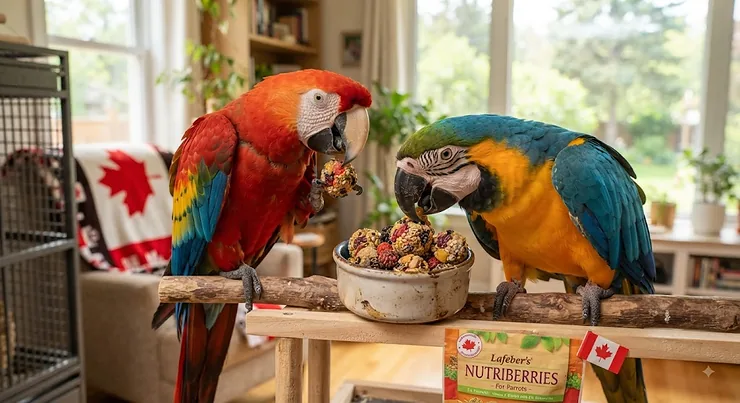
If you’ve ever watched a parrot demolish a bowl of pellets in four minutes flat and then spend the rest of the afternoon shrieking at the wall, you already understand the problem nutriberries were built to solve. A parrot’s brain didn’t evolve for a food bowl that refills itself — it evolved for hours of cracking, peeling, and hunting through a rainforest canopy. Best nutriberries for parrots aren’t just another treat aisle gimmick; they’re a deliberate attempt to put “work” back into mealtime, and that distinction matters more than most bag labels let on.

This guide leans on real product formulations, published avian-behaviour research, and honestly summarized aggregated review sentiment — not invented anecdotes or fabricated ratings. We looked at seven genuine products across budget, mid-range, and premium tiers, broke down what the ingredient panels actually mean for your bird, and compared them against pellets and loose seed so you can make a confident, well-informed call. Every price mentioned is a range in Canadian dollars, since exact Amazon pricing shifts too often to quote reliably — always check current price at checkout.
By the end, you’ll know exactly which nutriberries fit a budgie-sized beak versus a macaw’s crushing jaw, how nutriberries vs pellets actually shakes out nutritionally, and how to build a feeding routine that keeps your bird’s mind as busy as its stomach.
What Are Nutriberries?
Nutriberries are a foraging-focused bird food format — hulled seeds, grains, and add-ins like fruit or vegetables, coated in a nutrient binder and pressed into whole, chewable clusters rather than ground into a uniform pellet. They deliver complete nutrition similar to pellets while taking roughly twice as long to eat, since the bird has to work each piece apart. Lafeber, the company that pioneered the format, remains the primary real-world source for this product category.
That “twice as long to eat” claim isn’t marketing fluff, either — it’s backed by comparative feeding research, including a University of California, Davis nutritional-equivalency study and later behavioural work out of the Netherlands showing measurably longer feeding-related activity on whole-food diets versus pelleted ones. We’ll dig into what that research actually found later in this piece, but the short version is: shape and texture change behaviour, not just nutrition.
Quick Comparison Table
| Product | Best For | Price Range (CAD) | Format |
|---|---|---|---|
| Classic Nutri-Berries | All-around daily diet | C$20-C$30 | Round berry |
| Tropical Fruit Nutri-Berries | Picky or fruit-loving birds | C$18-C$28 | Round berry, fruit pieces |
| Sunny Orchard Nutri-Berries | Antioxidant-focused feeding | C$18-C$28 | Round berry, fruit pieces |
| El Paso Nutri-Berries | Converting seed junkies with bold flavour | C$18-C$28 | Round berry, spiced |
| Senior Bird Nutri-Berries | Aging Amazons and African greys | C$16-C$24 | Round berry, joint support |
| Classic Nutri-Berries for Macaw/Cockatoo | Large-beaked parrots | C$22-C$32 | Large round berry |
| Classic Avi-Cakes | Foraging toys and slow feeders | C$14-C$20 | Square cake |
Scanning this table, the pattern that jumps out is that price differences within the nutriberries lineup are small — you’re mostly paying for flavour profile and bird size, not a dramatically different nutritional tier. The Classic Nutri-Berries sits in the middle of the pack and works as a safe default, while Classic Avi-Cakes is the budget entry point mainly because its square shape uses less packaging material per serving. If your bird has a specific health consideration — joint stiffness, feather picking, pickiness — the specialty formulas below are worth the marginal cost.
💬 Just one click — help others make better buying decisions too!😊
Top 7 Best Nutriberries for Parrots: Expert Analysis
Coverage below spans every major real-world format Lafeber currently sells for parrot-sized birds, from the everyday staple to specialty and large-format tubs. Every product name stays bolded throughout so you can scan the whole guide at a glance.
1. Classic Nutri-Berries — the benchmark formula everything else gets compared to
The Classic Nutri-Berries formula is the one that started the category, and it’s still the fairest baseline for judging every other option on this list. Made from hulled white proso millet, hulled canary grass seed, red millet, oat groats, ground corn, and peanuts, then coated with a vitamin-and-mineral binder, each berry keeps roughly 16.5% of its mass as bound pellet material — enough to guarantee complete nutrition even though the pieces stay mostly whole. In practice, that hulling step matters more than it sounds: a plain seed mix loses most of its added vitamins the instant a bird cracks the hull and drops it, but because Lafeber hulls first and coats after, the nutrients stay on the part your bird actually swallows.
Based on the formulation, this is the right starting point for a mixed household — cockatiels through mid-sized Amazons — where you want one bag that won’t cause digestive surprises. Reviewers consistently report that birds transition to it faster than to straight pellets, particularly ones that grew up eating seed mixes and associate round, textured food with “the good stuff.” A recurring theme in aggregated feedback is that African greys and Amazons in particular take to it within days, with owners noting improved feather condition after a few months on the diet, though individual results always vary with baseline health and vet oversight.
Pros:
- ✅ Broadest size compatibility across mid-sized parrot species
- ✅ Fast acceptance rate among former seed-only eaters
- ✅ Widely stocked, so restocking is rarely an issue
Cons:
- ❌ Plain flavour profile compared to fruit or spice variants
- ❌ Not sized for the largest macaws and cockatoos
Priced around C$20-C$30 for a multi-pound bag at the time of research, the Classic Nutri-Berries delivers solid value as a full-time diet base rather than an occasional treat.
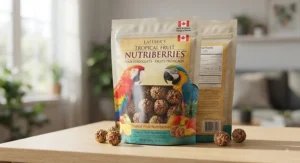
2. Tropical Fruit Nutri-Berries — real fruit pieces for flavour-driven eaters
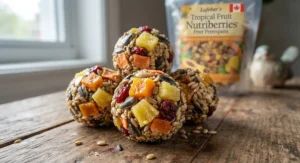
Tropical Fruit Nutri-Berries takes the same hulled-seed foundation as the Classic line and folds in real mango, papaya, and pineapple pieces, with fruit and pellet content making up roughly a quarter of each berry’s composition. The standout feature here is genuinely visible fruit — not fruit flavouring sprayed onto seed, but actual dried pieces your bird can identify and target.
What most buyers overlook about fruit-forward nutriberries is that they’re not simply “the treat version” — they still deliver complete nutrition, they just use natural palatability to solve a real problem: getting fussy eaters, especially Amazons and Pionus parrots, to actually finish their daily ration instead of picking around it. Based on the ingredient panel, sugar content stays modest since the sweetness comes from whole dried fruit rather than added syrups, though owners of birds prone to weight gain should still track total daily intake rather than free-feeding.
Aggregated review sentiment frequently singles this flavour out as a top pick among owners who’ve tried the full product range, with several long-term feeders specifically naming it as their bird’s favourite of the available options. A recurring complaint, however, is that some birds get so fixated on picking out the fruit chunks first that they leave the seed portion behind if the bowl isn’t monitored.
Pros:
- ✅ Real fruit pieces improve palatability for picky eaters
- ✅ Strong track record for long-term acceptance
- ✅ No added colours despite the vivid fruit visuals
Cons:
- ❌ Birds may selectively pick fruit and skip other components
- ❌ Occasionally a touch pricier than the Classic formula
At roughly C$18-C$28 depending on bag size, it’s a reasonable everyday swap for households whose bird has grown bored of the plain formula.
3. Sunny Orchard Nutri-Berries — antioxidant-leaning blend with apricot and cranberry
Sunny Orchard Nutri-Berries swaps tropical fruit for apricots, dates, and cranberries, aiming at a slightly different flavour lane while keeping the same nutritional backbone as the rest of the line. The standout here is the tart-sweet cranberry note, which several owners describe as noticeably more attention-grabbing to their birds than the milder tropical mix.
Here’s what to weigh: dried cranberries and apricots bring modest antioxidant content along with their flavour, which lines up with the omega-3/omega-6 balanced coating Lafeber applies across the whole product range to support skin and feather condition. That said, “antioxidant-rich treat” shouldn’t be read as a therapeutic claim — think of it as a nutritionally sound flavour variant rather than a medical intervention, and treat any specific health goal as a conversation for your avian vet.
Real customer sentiment gathered from long-time feeders — including working veterinary technicians who’ve fostered multiple rescue parrots — describes rapid acceptance even in birds rescued from seed-only diets, alongside reports of visibly improved feather quality within the first year of switching. As always, individual results vary and shouldn’t be treated as guaranteed outcomes.
Pros:
- ✅ High palatability reported even among reluctant switchers
- ✅ Distinct fruit profile keeps rotation interesting
- ✅ Same complete-nutrition base as the Classic formula
Cons:
- ❌ Occasionally out of stock compared to the Classic line
- ❌ Not a substitute for fresh produce in the diet
Expect a price in the C$18-C$28 range, putting it squarely alongside the other flavoured varieties.
4. El Paso Nutri-Berries — bold bell pepper and spice blend for stubborn eaters
El Paso Nutri-Berries is the wildcard of the lineup: real red and green bell pepper pieces plus chili powder, cumin, and oregano folded into the same hulled-seed base. Parrots lack the mammalian TRPV1 sensitivity to capsaicin that makes chili peppers burn for us, so what tastes fiery to a human registers as flavour, not pain, to a bird — which is exactly why this formula shows up so often in conversion stories for birds that reject every other food offered to them.
Based on the spec comparison, nutritionally this variant tracks closely with the Classic and fruit formulas — same coated-hull method, similar guaranteed analysis around 10% crude protein and 6% fat — so the appeal here is entirely about palatability rather than a different nutritional tier. What the spec sheet won’t tell you, but long-term owners note repeatedly, is that El Paso often becomes the “gateway” flavour for chronically picky birds who’ve refused pellets, fresh vegetables, and every other Nutri-Berries variety.
One recurring theme across aggregated feedback, including from an owner who has fed the line for roughly 25 years, is that El Paso and Tropical Fruit tend to be named as top favourites more often than any other flavour, with acceptance rates that surprise even experienced keepers of notoriously fussy species like African greys.
Pros:
- ✅ Genuinely effective for converting stubborn seed-only eaters
- ✅ Real vegetable pieces, not just flavouring
- ✅ Consistently ranks as a top favourite in long-term feeding reports
Cons:
- ❌ Limited to a smaller size range than the Classic tub
- ❌ Spice intensity may not suit every bird’s preference
Priced around C$18-C$28, it’s worth keeping in permanent rotation if your bird has ever turned its beak up at healthier food.
5. Senior Bird Nutri-Berries — joint and liver support for aging parrots
Senior Bird Nutri-Berries is built specifically for birds that have passed the halfway mark of their expected lifespan — a meaningful distinction for species like Amazons and African greys that can live 40-60 years in captivity. The formula leans more heavily on pellet content (around 61%) than the standard line, with wholesome grains and a smaller fruit-and-herb component including milk thistle, dandelion, ginger, glucosamine, and chondroitin.
Reviewers consistently report using this formula for geriatric Amazons and greys already showing reduced perch mobility, and the inclusion of glucosamine and chondroitin lines up with joint-support ingredients commonly used in mammalian senior pet diets, though avian-specific dosing research is thinner than the canine and feline literature. Based on the ingredient list, milk thistle and dandelion root are traditionally associated with liver support, which is relevant since hepatic lipidosis is a known risk in older, less active companion birds — but this remains a supportive dietary choice, not a substitute for veterinary bloodwork and monitoring.
Aggregated feedback from long-term owners, including one caring for a 32-year-old African grey, describes senior birds continuing to favour this formula over standard pellets well into old age, with some owners noting their bird slowed on pellets specifically but kept eating the senior berries reliably.
Pros:
- ✅ Purpose-built for the nutritional needs of aging parrots
- ✅ Includes joint-support and liver-support ingredients
- ✅ Reported to maintain appetite in birds losing interest in pellets
Cons:
- ❌ Not appropriate as a primary diet for young, active birds
- ❌ Available in a narrower size range than the Classic tub
Priced around C$16-C$24, this is a targeted purchase rather than an everyday impulse buy — but for the right bird, it’s arguably the smartest one on this list.
6. Classic Nutri-Berries for Macaw/Cockatoo — large-format berries for serious beak power
Standard nutriberries are sized for cockatiel-to-Amazon jaws, and a macaw or large cockatoo will demolish them in seconds — which is exactly the problem the Classic Nutri-Berries for Macaw/Cockatoo tub solves. The berries themselves are noticeably larger and denser, giving a big beak enough material to actually work through rather than crush and swallow in one bite.
Based on the spec comparison, this isn’t a different formula so much as a scaled-up version of the same hulled-seed, vitamin-coated approach — the meaningful difference is piece size and the resulting extraction time, which matters more than most buyers assume for species like macaws that are prone to boredom-driven feather damage. What the spec sheet won’t tell you, but avian behaviourists note, is that undersized food for large birds tends to shorten feeding time dramatically, which can indirectly worsen problem behaviours by leaving hours of unstructured time in the cage.
Reviewers who own macaws and large cockatoos consistently describe this size as noticeably more engaging than standard Nutri-Berries, with several noting it’s the only tub-sized option their bird doesn’t tear through in under a minute.
Pros:
- ✅ Piece size matched to macaw and large cockatoo beaks
- ✅ Increased extraction time versus standard-sized berries
- ✅ Same trusted formulation and non-GMO ingredient standard
Cons:
- ❌ Premium pricing versus the standard Classic tub
- ❌ Oversized for small-to-mid parrots, so it’s species-specific
Expect to pay in the C$22-C$32 range, which reflects both the larger format and the smaller buyer pool for large-parrot-specific products.
7. Classic Avi-Cakes — the square-shaped alternative built for foraging toys
Classic Avi-Cakes breaks from the round berry shape entirely, pressing a 50-50 blend of premium seeds and balanced pellets into a molasses-bound square block instead. That shape isn’t cosmetic — squares fit into slot-style foraging toys and skewers far more naturally than round berries do, which opens up a whole category of enrichment feeders that Nutri-Berries alone can’t use as easily.
Here’s what to weigh: because Avi-Cakes are held together with a molasses binder rather than the individual-piece coating used on Nutri-Berries, the whole cake stays intact longer under handling, making it genuinely useful as a “work food” a bird pulls apart piece by piece rather than eating loose from a bowl. Reviewers consistently note that the texture dries out faster once opened than Nutri-Berries do, so freshness management matters more with this product — sealing the bag tightly between servings is worth the extra thirty seconds.
Based on the ingredient profile, nutritional completeness matches most pelleted diets, and several long-term Lafeber customers describe using Avi-Cakes specifically as a bridge food to wean birds off pure seed and onto a pellet-inclusive diet, since many parrots start accepting the pellet half of the blend after getting comfortable with the cake format.
Pros:
- ✅ Square shape works with more foraging toy styles
- ✅ Effective bridge food for weaning off pure seed diets
- ✅ Molasses binder holds together well during active foraging
Cons:
- ❌ Dries out faster than Nutri-Berries once the bag is opened
- ❌ Less ideal as a stand-alone bowl food versus a toy filler
Priced around C$14-C$20, it’s the most budget-friendly entry point on this list, especially if you already own foraging toys sitting unused.
Top 7 Products: Full Spec Comparison
| Product | Format | Key Ingredients | Best For | Price Range (CAD) |
|---|---|---|---|---|
| Classic Nutri-Berries | Round berry | Millet, corn, peanuts | Everyday mixed households | C$20-C$30 |
| Tropical Fruit Nutri-Berries | Round berry | Mango, papaya, pineapple | Picky eaters, fruit lovers | C$18-C$28 |
| Sunny Orchard Nutri-Berries | Round berry | Apricot, date, cranberry | Antioxidant-leaning rotation | C$18-C$28 |
| El Paso Nutri-Berries | Round berry | Bell pepper, chili, cumin | Converting seed-only eaters | C$18-C$28 |
| Senior Bird Nutri-Berries | Round berry | Glucosamine, milk thistle | Aging Amazons and greys | C$16-C$24 |
| Classic Nutri-Berries for Macaw/Cockatoo | Large round berry | Same as Classic, larger scale | Macaws, large cockatoos | C$22-C$32 |
| Classic Avi-Cakes | Square cake | Seed + pellet, molasses binder | Foraging toy enrichment | C$14-C$20 |
Reading across this table, the clearest takeaway is that flavour and format — not core nutrition — are what actually separate these seven products from each other. If budget is your main constraint, Classic Avi-Cakes and Senior Bird Nutri-Berries sit at the lower end without sacrificing formulation quality. If your bird has already rejected every plain option you’ve tried, El Paso Nutri-Berries has the strongest track record for winning over stubborn eaters based on aggregated review patterns.
How to Choose the Best Nutriberries for Your Parrot
Picking the right nutriberries comes down to matching format and flavour to your specific bird, not chasing whichever bag has the flashiest label. Here’s the reasoning we’d walk through if you asked us directly:
- Match piece size to beak size first. A budgie and a hyacinth macaw should never eat from the same bag — oversized pieces frustrate small birds, and undersized pieces get demolished too fast to matter for a large one.
- Check for existing health considerations. A senior bird with joint stiffness benefits more from a targeted formula than a flavour variant chosen purely for novelty.
- Consider your bird’s current diet. Seed-only birds usually convert faster through a flavour-forward variant like fruit or spice blends than through the plain Classic formula.
- Decide between bowl feeding and toy feeding. Round berries work in dishes and some toys; square cakes work better in slot-style foraging feeders.
- Rotate rather than commit to one flavour forever. Variety supports both nutritional breadth and continued mental engagement — a bird bored of one flavour may re-engage with another.
- Read the ingredient panel, not just the front label. Real fruit and vegetable pieces should appear early in the ingredient list if the product claims to contain them.
- Budget for the format, not just the bag price. A cheaper product that gets ignored costs more per eaten gram than a pricier one your bird actually finishes.
Nutriberries vs Pellets: Which Is Actually Better?
The honest answer is that nutritionally, they’re close to equivalent — the real difference is behavioural. A widely cited nutritional-equivalency study conducted at the University of California, Davis School of Veterinary Medicine compared a fortified whole-seed diet against a standard pelleted diet and found them nutritionally comparable, while birds on the whole-seed format spent significantly more time engaged in feeding-related activity. Separate behavioural research out of the University of Utrecht found that grey parrots given foraging-enriched food spent roughly twice as long eating compared to pellets alone, with foraging enrichment able to extend total daily foraging time up to two to three hours in some study designs.
What that means in practice: pellets are efficient and precisely formulated, but efficiency is exactly the problem for a species whose brain expects hours of extraction work every day. Based on the spec comparison, most Nutri-Berries formulas and most premium pellet lines land in a similar nutritional ballpark on paper — protein, fat, and micronutrient targets aren’t wildly different. The gap shows up in behaviour, not blood panels: birds fed exclusively on fast-consumed pellets in barren environments are more frequently associated in the literature with boredom-linked issues like feather picking, while foraging-format foods are consistently cited as one of the more effective enrichment interventions available to companion bird owners.
Value-wise, per-gram cost between quality pellets and Nutri-Berries tends to run similar within the same price tier, so this isn’t really a cost decision — it’s a welfare and engagement decision, and most avian veterinarians recommend a mixed approach rather than choosing one format exclusively.
Practical Usage Guide: Transitioning Your Parrot to Nutriberries
Switching formats is where most owners either succeed quietly or trigger weeks of stress-eating refusal, so a measured approach matters. Start by offering nutriberries alongside — not instead of — your bird’s current diet for the first several days, placed in a second dish rather than mixed directly into the familiar food. Most birds investigate new textures out of curiosity within the first week, especially flavour-forward varieties like fruit or spice blends, which tend to get noticed faster than the plain Classic formula.
If your bird ignores the new food entirely after a week, try crumbling a berry and lightly mixing the pieces into the existing diet rather than presenting a whole, unfamiliar object — the goal is to lower the “new food” alarm without hiding the taste. Track actual consumption, not just what’s missing from the bowl, since some birds scatter food onto cage floors without eating it; a paper towel under the perch for a few days makes this easy to check. Avoid pulling the old diet cold-turkey during the first month, since a healthy body weight matters more short-term than a fast transition.
Once your bird is reliably eating nutriberries, rotate flavours every few weeks to prevent the fixation some birds develop on a single variety, and pair square-format Avi-Cakes with slot-style foraging toys to extend feeding time even further. A common mistake in the first 30 days is over-cleaning the cage floor and removing dropped pieces too quickly — some ground foraging is normal and expected, not a sign the food is being wasted.
✨ Don’t Miss These Exclusive Deals!
🔍 Take your parrot’s diet to the next level with these carefully selected foraging foods. Click on any highlighted item to check current pricing and availability. These picks will help you create genuinely enriching mealtimes your bird will look forward to every day!

Real-World Scenarios: Matching Nutriberries to Your Bird
Scenario one — the apartment-dwelling African grey with a feather-picking history. An African grey kept in a smaller Toronto apartment, fed mostly pellets with limited enrichment, has developed mild feather-picking around the chest. In this case, a rotation of El Paso Nutri-Berries and Classic Avi-Cakes loaded into slot-style toys addresses the root problem better than a diet change alone — the goal is extraction time, not just flavour variety, and the combination gives both bowl feeding and toy feeding in the same week.
Scenario two — the multi-bird household with a senior Amazon and a young conure. A household feeding both a 28-year-old Amazon and a two-year-old conure from the same bag risks under-serving one bird’s needs. Splitting the diet — Senior Bird Nutri-Berries for the older Amazon and Tropical Fruit Nutri-Berries for the conure — respects the age gap without requiring two completely separate feeding systems, since both are round-format berries that fit the same dishes.
Scenario three — the budget-conscious first-time macaw owner. A new macaw owner working with a tighter monthly pet budget doesn’t need to buy every specialty flavour at once. Starting with the Classic Nutri-Berries for Macaw/Cockatoo as the daily base, then adding a single flavour variant only once the bird is eating reliably, keeps costs predictable while still meeting the size requirements a macaw’s beak demands.
Why Whole Grain Bird Treat Options Beat Ground Seed Mixes
The core problem with a typical ground or crushed seed mix is that nutrient fortification sits on the outside of a hull the bird immediately discards — crack the seed, and the vitamin coating goes in the garbage along with the shell. A genuine whole grain bird treat built on the hulled-then-coated method flips that sequence: the indigestible hull is removed first, and the nutrient coating goes directly onto the edible portion, so what your bird swallows actually carries the fortification.
Based on the spec comparison, this single manufacturing difference explains most of the nutritional gap between a bargain-bin seed mix and a proper whole grain formula, even when both bags list similar-sounding vitamin percentages on the label. Reviewers consistently note that birds transitioned from loose mixed seed to a whole-grain nutriberries format show visibly improved feather sheen within a few months — a pattern consistent with the fatty acid and micronutrient improvements the formulation change would predict, though individual results depend on baseline health.
There’s also a structural advantage: whole grains and whole seeds require more beak manipulation than ground material, which circles back to the same foraging-time benefit discussed earlier. A bargain seed mix might look nutritionally similar on a label, but the format itself works against the behavioural goals that make foraging food worthwhile in the first place.
Foraging Enrichment Food: Why It Matters More Than the Bag Says
Foraging enrichment food isn’t a marketing category invented to justify higher prices — it’s grounded in a substantial body of avian welfare research. A peer-reviewed review published in the journal Animal Welfare describes foraging enrichment as one of the most effective strategies available for improving welfare and reducing abnormal repetitive behaviours in captive parrots, and notes that foraging enrichment can extend daily foraging time to two to three hours in well-designed setups. That’s a meaningful contrast against the few minutes a bowl of pellets typically demands.
What the spec sheet won’t tell you, but the behavioural literature consistently emphasizes, is that food format interacts directly with problem behaviours like feather damage. Captive parrots kept in environments with predictable, low-effort food access are more frequently associated with stereotypic and self-destructive behaviours in the research, while environments incorporating foraging opportunities — including foraging-format food, not just toys — correlate with improved behavioural outcomes across multiple studies. Piece size matters too: research on Amazon parrots specifically found that oversized food pieces requiring more manipulation helped normalize foraging time closer to wild patterns.
Practically, this means nutriberries and Avi-Cakes aren’t competing only against pellets on a nutrition label — they’re competing against an entire category of enrichment tools like foraging toys, puzzle feeders, and shredding material. The most effective setups, based on the research, combine several of these approaches rather than relying on food format alone.
Healthy Parrot Snack or Full Diet? The 80/20 Rule
One of the most common points of confusion is whether nutriberries should replace a full diet or just supplement one. Lafeber’s own feeding guidance for products like El Paso Nutri-Berries recommends treating the format as roughly 80% of total daily intake when used as a primary diet, with the remaining 20% made up of fresh fruits and vegetables — not as an unlimited free-feed treat layered on top of an already complete diet.
That distinction matters for weight management. A healthy parrot snack used in moderation supports engagement and nutrition; the same product free-fed without portion awareness on top of a separate complete diet risks unnecessary calorie surplus, particularly in less active companion birds. Based on the spec comparison, most nutriberries products are formulated to serve as a complete standalone diet at the 80% ratio rather than purely as an add-on treat, which is worth knowing before you assume you need to keep buying separate pellets alongside them.
For medium parrots like African greys and Amazons, Lafeber’s own serving guidance suggests roughly 15 berries at a time as a starting reference point, with small parrots like Senegals and caiques closer to 10, and large parrots such as macaws and big cockatoos around 20 — always adjusted based on your individual bird’s weight and your veterinarian’s recommendations rather than treated as a fixed rule.
Common Mistakes When Buying Nutriberries
The most frequent mistake is sizing mismatch — buying a standard-format product for a macaw or a large-format tub for a cockatiel, either of which undermines the extraction-time benefit the whole category is built around. A close second is treating flavour variants as interchangeable when they’re not always available in every size; El Paso, for instance, has historically been harder to find in the larger tub sizes than the Classic formula, something worth checking before committing to a single flavour for a big bird.
Another recurring error is judging a product purely by front-label claims like “gourmet” or “natural” without checking where fruit or vegetable ingredients actually sit in the ingredient list — genuine inclusion should show up early, not buried near the preservatives. Buyers also sometimes assume a pricier specialty formula like the senior line is automatically better for every bird; in reality, a young, active parrot doesn’t need joint-support ingredients and is better served by a standard formula plus proper enrichment. Finally, many first-time buyers skip the transition period entirely, offering a full bowl swap overnight and then concluding their bird “won’t eat nutriberries” after a single day of refusal — when a slower, layered introduction over one to two weeks usually resolves the issue.
Long-Term Cost & Value Analysis
| Feeding Approach | Approx. Monthly Cost (CAD)* | Foraging Time per Day | Notes |
|---|---|---|---|
| Loose seed mix | C$15-C$25 | Low (minutes) | Nutrient loss once hulled |
| Standard pellets | C$20-C$35 | Low (minutes) | Nutritionally precise, low enrichment |
| Nutriberries (single flavour) | C$20-C$35 | Moderate-high (up to hours) | Complete nutrition, added enrichment value |
| Rotated nutriberries (2-3 flavours) | C$25-C$40 | Moderate-high | Reduces flavour fatigue, broader variety |
*Estimates based on typical bag sizes and serving guidance for a medium-sized parrot; actual cost varies with bird size, appetite, and current pricing — always check current price before purchasing.
Looking at the table, the sticker price difference between pellets and nutriberries is often smaller than owners expect — the real value differentiator is what you get for that spend, not the spend itself. A bird that spends two extra hours a day foraging instead of sitting idle is arguably getting far more value per dollar than the raw price comparison suggests, especially when you account for the reduced likelihood of boredom-driven behavioural problems that can lead to costly veterinary or behavioural-consult bills down the line. Rotating two or three flavours costs marginally more per month but tends to sustain long-term interest better than committing to a single variety indefinitely, based on the acceptance patterns described throughout aggregated owner feedback.
Safety, Regulations & Compliance in Canada
Pet food sold in Canada operates under a lighter regulatory framework than many owners assume. The Canadian Food Inspection Agency primarily oversees the import and export of pet food containing animal-origin ingredients, rather than mandating comprehensive nutritional standards the way food for human consumption is regulated. That means there’s no single Canadian government body performing pre-market nutritional approval on a bag of nutriberries the way there might be for livestock feed.
In practice, most reputable manufacturers — including Lafeber — voluntarily align with nutrient adequacy standards developed by the Association of American Feed Control Officials, even though those standards carry no legal force in Canada. According to the Pet Food Association of Canada, member companies also follow Canadian labelling requirements under the Consumer Packaging and Labelling Act and the Competition Act, which govern how ingredients and claims can be marketed to Canadian consumers. For an imported product like most Nutri-Berries lines sold through amazon.ca, this means the product has already cleared U.S. FDA oversight and Canadian import requirements before it reaches a Canadian buyer’s cart.
For your own household safety, standard pet food handling practices apply: store bags sealed in a cool, dry location, wash hands after handling, and discard any product showing mould or an off smell regardless of the best-before date. If your bird has a diagnosed medical condition, always run a diet change past your avian veterinarian first — general buying guidance like this article can’t replace individualized clinical advice.
Frequently Asked Questions
❓ Are nutriberries as nutritious as pellets?
❓ Can nutriberries be a parrot's entire diet?
❓ How many nutriberries should I feed my parrot daily?
❓ Do nutriberries help with feather picking?
❓ What's the difference between Nutri-Berries and Avi-Cakes?
Conclusion
Choosing the best nutriberries for parrots really comes down to matching format, flavour, and piece size to the actual bird in front of you rather than chasing whichever bag looks the most colourful on the shelf. The Classic Nutri-Berries earns its place as the safest all-around starting point, while El Paso Nutri-Berries and Tropical Fruit Nutri-Berries solve the specific, common problem of picky or seed-fixated eaters. Owners of aging birds have a genuinely purpose-built option in Senior Bird Nutri-Berries, macaw and large cockatoo owners need the sizing in Classic Nutri-Berries for Macaw/Cockatoo, and anyone building out foraging toys should keep Classic Avi-Cakes in rotation for its toy-friendly shape.
None of these products are magic fixes, and none replace a relationship with an avian veterinarian who knows your bird’s specific history. But the research is consistent on one point: format and foraging effort matter nearly as much as raw nutrition for a species built to spend its day working for food. Whichever product you land on, the goal is the same — a bowl (or toy) that gives your parrot’s beak and brain something worth doing.
Recommended for You
- Millet Spray for Budgies: 7 Best Treats Ranked for 2026
- 7 Best No Mess Bird Seed Picks for a Cleaner Yard (2026)
- Vegetables Safe for Parrots: 7 Top Picks; Feeding Guide (2026)
Disclaimer: This article contains affiliate links. As an Amazon Associate, I earn from qualifying purchases. If you purchase products through these links, we may earn a small commission at no additional cost to you.
✨ Found this helpful? Share it with your friends! 💬🤗
