
In This Article
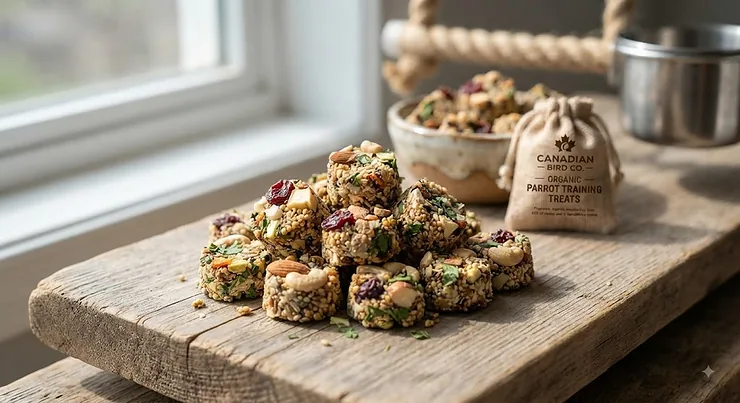
Your parrot already knows exactly what it wants. The trick is figuring out how to make “step up,” “stay,” or “no biting the remote” worth its while — and that’s where parrot training treats earn their keep. In plain terms, parrot training treats are small, high-value, food-based rewards — separate from a bird’s regular daily diet — used to mark and reinforce a specific behaviour the instant it happens. They’re not a meal. They’re a paycheque.
Here in Canada, that distinction matters more than most new owners expect. Winters mean less outdoor foraging opportunity, indoor birds get bored faster, and a lot of the “training treat” products lining pet-store shelves are really just repackaged seed mix with a bow on it. This guide sorts through seven real, currently available products — foraging berries, low-fat bite-sized rewards, dried fruit, natural millet, and the clicker-and-target-stick hardware that turns any of them into an actual training system.
We’ll walk through what separates a genuine training treat from a snack, how positive reinforcement and target training actually work with a prey-species brain, what behaviour shaping looks like in practice, and where bird owners commonly waste money. Every product mentioned below is a real item you can currently find listed for the amazon.ca marketplace, priced in Canadian dollar ranges rather than exact figures (Amazon pricing shifts too often to quote precisely). By the end, you’ll know which pick fits a budgie-sized beak, which one survives a macaw’s jaw pressure, and which clicker kit is worth skipping.
Quick Comparison Table: Parrot Training Treats at a Glance
| Product | Type | Best For | Price Range (CAD) |
|---|---|---|---|
| Lafeber’s Classic Nutri-Berries | Foraging treat/food hybrid | Daily bonding + training combo | C$10–C$50 (size-dependent) |
| Kaytee Pet Bird Bonding Bits | Purpose-built training treat | Rapid-fire clicker sessions | C$6–C$9 |
| ZuPreem Healthy Bites | Low-fat crunchy treat | Frequent training without weight gain | C$8–C$12 |
| Higgins Sunburst True Fruits | Dried fruit treat | Fruit-driven, less seed-motivated birds | C$5–C$8 |
| Hagen Living World Spray Millet | Natural millet spray | Budgies, cockatiels, small parrots | C$4–C$25 (size-dependent) |
| Parrot Wizard Clicker & Target Stick | Training hardware | Serious target/trick training | C$15–C$25 |
| LBH MARKET Bird Clicker Training Kit | Budget clicker + stick combo | First-time trainers on a budget | C$10–C$15 |
Looking at the spread, the real split isn’t budget versus premium — it’s food reward versus training hardware. Lafeber’s Classic Nutri-Berries and Hagen Living World Spray Millet double as enrichment food your bird would happily eat outside a training session, which stretches their value further than a treat used only during practice. The Parrot Wizard Clicker & Target Stick and LBH MARKET Bird Clicker Training Kit, by contrast, aren’t food at all — they’re the delivery mechanism that makes any treat on this list land with precise timing, which matters more than the treat itself once a bird understands the game.
💬 Just one click — help other Canadian golfers make a smarter bag choice too!😊
Top 7 Parrot Training Treats: Expert Analysis
1. Lafeber’s Classic Nutri-Berries — nutritionally complete, not just a sugar hit
The standout here is that this isn’t a stripped-down snack — it’s a full food formulated by avian nutritionists, which means you can use it generously during long sessions without throwing off your bird’s diet. Each berry is built around hulled grains bound with vitamins and minerals rather than ground into a pellet, so your bird has to work the shape apart with its beak and tongue — that manipulation is itself a form of enrichment, not just a reward. Available in sizes from a 10 oz bag up to multi-pound tubs for larger species like Amazons, African greys, and macaws.
Based on the formulation, this is the treat to reach for with birds that need frequent, low-guilt rewards — think multiple short sessions a day without risking obesity, a real concern flagged in the University of Guelph’s captive-parrot welfare research (linked below). Reviewers consistently report high acceptance rates across African greys, conures, and Amazons, with the most common complaint being that larger parrots demolish a berry in one bite rather than nibbling it — meaning you may need to break pieces apart for precise clicker timing.
Pros:
- ✅ Doubles as a complete food, not just a training extra
- ✅ Shape encourages natural foraging and beak exercise
- ✅ Widely accepted across most mid-to-large parrot species
Cons:
- ❌ Whole berries are too large for quick, repeated clicks
- ❌ Larger tub sizes aren’t practical for small-flock households
At around C$10–C$50 depending on bag size, Lafeber’s Classic Nutri-Berries offers strong per-session value if you buy the larger bag and break pieces down yourself.
2. Kaytee Pet Bird Bonding Bits — purpose-built for fast repetition
What stands out immediately is that this treat was designed for training, not dressed up as one — each piece is small enough to deliver a click-then-treat cycle in under two seconds. The 3 oz bag format keeps portions bite-sized across species from lovebirds and cockatiels up through African greys and cockatoos, meaning you’re not breaking apart oversized pieces mid-session.
What most buyers overlook about a dedicated bonding treat like this is that consistency in piece size actually speeds up learning — a bird that gets a differently sized reward every time takes longer to associate the click with a specific value. Aggregated buyer feedback on this product line skews positive for exactly that reason, with owners noting birds respond quickly during initial clicker-charging sessions; a smaller subset of reviewers note the ingredient list leans heavily on dried fruit and sugar-adjacent binders, so it shouldn’t replace a balanced diet.
Pros:
- ✅ Consistent bite size across most parrot species
- ✅ Fast to deliver — ideal for high-repetition clicker work
- ✅ Small bag keeps treats fresh through a full training cycle
Cons:
- ❌ Higher sugar content than a whole-food option
- ❌ Not nutritionally complete — training-only, not a meal replacement
Priced around C$6–C$9, this is one of the more affordable entries and a reasonable starting point for owners still testing whether their bird is food-motivated at all.
3. ZuPreem Healthy Bites — the lower-fat answer to a peanut habit
The stand-out feature is the crunchy-shell, soft-centre texture that mimics what parrots love about peanuts while cutting the fat content dramatically — roughly 15% fat per piece against the 50% typical of a raw peanut. That distinction matters more than it sounds: peanuts are a classic high-value parrot reward, but daily peanut-based training with a sedentary indoor bird can add up fast on the scale.
On paper, this makes ZuPreem Healthy Bites the pick for owners running multiple daily sessions with conures, caiques, cockatoos, or Amazons who are already treat-driven but need a lighter option. Reviewers consistently note strong acceptance among birds that were previously “spoiled” on peanuts, though a handful of owners with pickier eaters — particularly some African greys — report needing several exposures before the bird takes to the texture.
Pros:
- ✅ Meaningfully lower fat than traditional peanut treats
- ✅ Texture appeals to birds used to peanut-based rewards
- ✅ Suitable for frequent, multiple-session daily use
Cons:
- ❌ Some picky eaters need repeated exposure before accepting it
- ❌ Not as universally available in small trial-size bags
Expect to pay in the C$8–C$12 range, which lands mid-pack — reasonable for a treat that lets you train more often without the caloric guilt.
4. Higgins Sunburst True Fruits — for the fruit-obsessed, seed-indifferent bird
The standout advantage is real, identifiable dried fruit pieces rather than a seed-and-filler blend, which matters a lot for the subset of parrots — many eclectus and some Amazons among them — that are simply not that motivated by seeds or nuts. Ingredients include recognizable dried fruit with no added sugar, a detail worth flagging since “fruit treat” marketing elsewhere sometimes hides added sweeteners.
Here’s what to weigh: fruit-based rewards spoil the training value fast if your bird already gets fruit daily as part of its regular diet, since the whole point of a training treat is scarcity and novelty. Aggregated reviews trend positive on palatability specifically for fruit-driven species, with a recurring theme in feedback being that pieces are larger than expected and benefit from being cut down for precise clicker sessions — echoing the sizing issue seen with whole-berry treats above.
Pros:
- ✅ Genuine dried fruit pieces, no added sugar
- ✅ Strong pull for fruit-motivated species like eclectus
- ✅ No artificial colours in the formulation
Cons:
- ❌ Less effective if fruit is already a daily diet staple
- ❌ Pieces often need cutting down for training-sized portions
At roughly C$5–C$8 for a 5 oz bag, it’s one of the cheaper entries and a smart rotation option to keep novelty high — see the Problem → Solution section below for more on treat rotation.
5. Hagen Living World Spray Millet — the Canadian-made natural option
The standout feature is provenance: this is a Hagen product, and Hagen — through its Rolf C. Hagen Group and its Hagen Avicultural Research Institute (HARI) — is a Montreal-founded company that’s been formulating companion-bird products domestically since 1955. The millet itself is harvested from the wild with no additives and vacuum-packed, sold in sizes from a 100 g starter bag up to a 5 lb bulk pack.
What most buyers overlook about millet as a training treat is that individual seed heads let you dispense micro-rewards — a single seed at a time — which is exactly the portion control clicker training calls for with small parrots. Based on the ingredient list and format, this is the strongest match for budgies, cockatiels, lovebirds, and smaller conure species; larger parrots tend to treat a whole spray as one oversized snack rather than a series of clicks. Reviewers consistently describe it as close to a guaranteed hit for smaller birds, with the main criticism being that bulk bags require an airtight container to stay fresh.
Pros:
- ✅ Naturally portioned for precise, single-seed rewards
- ✅ No additives, harvested and vacuum-packed for freshness
- ✅ Canadian-founded brand with an established avicultural research arm
Cons:
- ❌ Less effective as a high-value reward for large parrots
- ❌ Needs airtight storage once opened in bulk sizes
Priced from roughly C$4 for a small bag up to about C$25 for a bulk 5 lb pack, this is arguably the best value-per-session option for anyone training a smaller companion bird.
6. Parrot Wizard Clicker & Target Stick — the dedicated trainer’s tool
The standout here isn’t food at all — it’s precision. This set pairs a small handheld clicker with a purpose-built target stick, giving you a consistent, unmistakable marker sound plus a visual target your bird can learn to touch on cue, which is the literal foundation of target training. That consistency is something no loose collection of a pen or chopstick substitute can reliably match session to session.
Based on how target training actually works, the value of a dedicated stick isn’t the material — it’s repeatability. A bird that’s been rewarded for touching the same shape, colour, and length every time generalizes the behaviour faster than one trained with whatever’s lying around the house. Reviewers who’ve used it alongside published clicker-training guides report faster “station” and recall training compared to improvised tools, while a smaller group notes the clicker’s sound is quieter than some competing designs, which can matter in loud households.
Pros:
- ✅ Purpose-built for consistent target-touch training
- ✅ Distinct, repeatable click sound aids precise timing
- ✅ Pairs with any of the food treats above
Cons:
- ❌ Clicker volume is on the quieter side for some setups
- ❌ Requires pairing with treats — no food included
At around C$15–C$25 for the set, this is a one-time hardware cost rather than a recurring consumable — arguably the best long-term value item on this list.
7. LBH MARKET Bird Clicker Training Kit with Target Stick — the budget all-in-one starter
The short version: this is the cheapest complete way to get a clicker and target stick in the same order, bundling a 9-inch acrylic target stick, a box clicker, and a printed bird-specific reference card. For someone who isn’t sure training will stick as a habit, that low barrier to entry matters.
What the spec sheet won’t tell you, but the format suggests, is that this kit is squarely aimed at first-time trainers rather than advanced trick work — the included reference card walks through station training and basic recall games, which is exactly where most new parrot owners should start rather than jumping straight to complex behaviour chains. Feedback trends positive for ease of setup, with the most common critique being that the acrylic stick is shorter and less rigid than premium alternatives, which can matter once you’re training larger, stronger-beaked species.
Pros:
- ✅ Complete beginner kit in a single purchase
- ✅ Includes a printed reference card for first sessions
- ✅ Lowest price point among dedicated training hardware here
Cons:
- ❌ Stick is less durable than premium alternatives long-term
- ❌ Less ideal for large, strong-beaked species like macaws
Expect to pay around C$10–C$15, making it the easiest entry point on this list for anyone testing the waters before committing to pricier gear.
Top 7 Products: Specs and Value Comparison
| Product | Format | Species Fit | Consumable? | Best For |
|---|---|---|---|---|
| Lafeber’s Classic Nutri-Berries | Whole-grain berry | Small–large parrots | Yes | Combined food + training reward |
| Kaytee Pet Bird Bonding Bits | Bite-sized pieces | Most companion parrots | Yes | Fast, repeated clicker sessions |
| ZuPreem Healthy Bites | Crunchy-shell bite | Peanut-loving species | Yes | Lower-fat frequent training |
| Higgins Sunburst True Fruits | Dried fruit pieces | Fruit-motivated species | Yes | Rotation treat, novelty value |
| Hagen Living World Spray Millet | Whole seed spray | Budgies, cockatiels, small parrots | Yes | Micro-portioned single-seed rewards |
| Parrot Wizard Clicker & Target Stick | Hardware | All trainable species | No | Precision target/trick training |
| LBH MARKET Bird Clicker Training Kit | Hardware | Beginner-friendly species | No | First-time trainer starter kit |
Reading this table against the first one, a pattern emerges: the two hardware items are the only non-consumables, which means their per-session cost drops toward zero the longer you own them, while every food-based treat carries an ongoing replacement cost. Households training more than one bird, or training daily over months, generally get better long-term value pairing one hardware set — either Parrot Wizard Clicker & Target Stick or the budget LBH MARKET Bird Clicker Training Kit — with a rotating stock of two or three of the food treats above, rather than relying on a single consumable indefinitely.
Practical Usage Guide: Setting Up Your First Training Sessions
Getting a clicker or target stick out of the box is the easy part — charging it correctly is where most first attempts stall. Start by “charging” the clicker: click once, immediately follow with a treat, and repeat 10–15 times in a calm, distraction-free space before you ever ask for a behaviour. Your bird needs to learn that the click always means a treat is coming before the click can mean anything else.
Keep initial sessions short — three to five minutes, once or twice a day — since parrots, as a prey species, tire of sustained focus faster than dogs typically do. Once the clicker is charged, introduce the target stick by simply holding it near your bird and clicking-and-treating any curious movement toward it, even an accidental glance. Gradually require closer approach before the click, a process trainers call “shaping” (covered in detail below).
Common first-30-days mistakes include training right after a full meal, when food motivation drops sharply, and over-using one treat until your bird gets bored of it — rotating between two or three of the treats above keeps value high. Maintenance is simple: keep sessions short, end on a success, and store treats in airtight containers away from the cage to preserve freshness and prevent your bird from self-serving.
Real-World Scenarios: Matching Treats to Your Situation
The apartment-dwelling budgie owner: limited space, a quiet indoor bird, and a tight budget point toward Hagen Living World Spray Millet paired with the budget LBH MARKET Bird Clicker Training Kit — cheap, precisely portioned, and enough to get station and recall training started without a big upfront spend.
The multi-parrot household with an African grey and a conure: frequent, varied sessions across two different appetite profiles call for a rotation of Lafeber’s Classic Nutri-Berries for daily bonding and Kaytee Pet Bird Bonding Bits for rapid clicker repetitions, backed by the more durable Parrot Wizard Clicker & Target Stick since it’ll see heavier daily use across two birds.
The owner managing a food-motivated but weight-conscious cockatoo: here, ZuPreem Healthy Bites solves the specific problem of wanting frequent training without the fat load of traditional peanut treats, while Higgins Sunburst True Fruits works well in rotation for novelty on lower-intensity days.
How to Choose Parrot Training Treats
- Match size to species. A budgie needs a treat the size of a single millet seed; a macaw can handle a whole Nutri-Berry. Oversized pieces slow down clicker timing.
- Check it isn’t already part of the daily diet. If your bird eats fruit or pellets daily, that same food loses its “special occasion” value as a training reward.
- Prioritize low mess and quick delivery. Sessions rely on speed — a treat you have to unwrap or break apart mid-session breaks your timing.
- Watch fat and sugar content for frequent trainers. If you’re running multiple sessions daily, a lower-fat option like ZuPreem Healthy Bites avoids weight creep.
- Buy hardware once, treats often. A clicker and target stick are a one-time cost; budget your recurring spend around the consumable treats instead.
- Rotate at least two treat types. Novelty maintains motivation — a bird bored of one treat stops working as hard for it.
- Confirm ingredient transparency. Look for products listing real, identifiable ingredients rather than vague “natural flavour” fillers.
Bird Training Treats vs Regular Parrot Diet
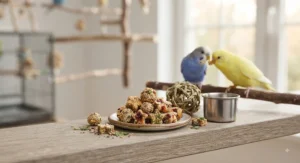
The temptation to just use a pinch of a bird’s regular pellet or seed mix as a training reward is understandable — it’s already on hand and it’s what the bird eats anyway. The problem is precisely that familiarity: a reward’s power comes partly from scarcity, and a food available in the bowl all day carries far less weight than something reserved exclusively for training wins.
| Factor | Regular Diet Food | Dedicated Training Treats |
|---|---|---|
| Perceived value to bird | Low–moderate (always available) | High (reserved, occasional) |
| Portion control | Harder to standardize | Pre-sized, consistent |
| Nutritional risk if overused | Minimal (it’s the diet) | Manageable with rotation |
| Best For | Daily nutrition | Marking and reinforcing specific behaviours |
The table makes the trade-off clear: regular diet food is nutritionally safer to overuse but weaker as a motivator, while a dedicated treat like Kaytee Pet Bird Bonding Bits or Hagen Living World Spray Millet is a stronger motivator precisely because it’s kept separate from daily meals. The practical middle ground most experienced trainers land on is using a genuinely novel treat during active training and reserving the regular diet for, well, the diet.
Clicker Training Treats for Birds: What Actually Matters
Not every treat suits clicker work equally well. The core requirement is speed — you need to be able to deliver a reward within roughly one to two seconds of the click, every single time, or the timing that makes clicker training effective starts to blur. That rules out anything that needs unwrapping, breaking apart, or chewing through a shell mid-session.
Bite-sized, pre-portioned options like Kaytee Pet Bird Bonding Bits or a single seed pulled from Hagen Living World Spray Millet are purpose-fit for this reason — they’re grab-and-deliver. Whole-berry treats like Lafeber’s Classic Nutri-Berries work fine for slower-paced sessions or as an end-of-session jackpot reward, but they’re clumsy for the rapid-fire repetitions clicker training often calls for early on. Reviewers consistently note that switching to smaller, faster-delivery treats speeds up the early “charging” phase specifically because the bird associates the click with reward more tightly when there’s no lag.
Positive Reinforcement Bird Training: The Science Bit
Positive reinforcement works by adding something the bird wants immediately after a desired behaviour, which increases the odds that behaviour happens again — the treat isn’t a bribe, it’s information. According to Wikipedia’s overview of parrot training, the approach is widely favoured over aversive methods precisely because parrots are a prey species that respond more reliably, and with less fallout, to reward-based learning than to punishment or forced handling.
This isn’t just folk wisdom. Research summarized by HARI, the Hagen Avicultural Research Institute, notes that reinforcement-based methods put a bird’s intelligence and energy to work for the owner rather than against them, provided the relationship is built on established trust first — a device or treat alone doesn’t substitute for that foundation. It’s also worth understanding what’s at stake if training and enrichment are skipped altogether: a University of Guelph-led study covered by ScienceDaily found that more intelligent parrot species are specifically prone to poor welfare outcomes in captivity without adequate mental stimulation — and structured training sessions are one of the more accessible ways an owner can provide that.
Target Training Treats: Getting the Size and Timing Right
Target training asks a bird to touch a specific object — usually the tip of a stick — on cue, and it’s often the very first formal behaviour taught because it’s low-pressure and easy to shape from a bird’s natural curiosity. The treat used here needs to be delivered the instant the beak makes contact with the target, so size and speed of delivery matter even more than in general clicker work.
Small, single-piece treats — a seed from Hagen Living World Spray Millet, or a piece of Kaytee Pet Bird Bonding Bits — pair naturally with either the Parrot Wizard Clicker & Target Stick or the budget LBH MARKET Bird Clicker Training Kit, since both give you a consistent target shape alongside a consistent marker sound. Reviewers who’ve used purpose-built target sticks over improvised alternatives report faster generalization to new behaviours, likely because the visual consistency of the stick reduces one more variable the bird has to sort out while learning.
Behaviour Shaping With Food Rewards: How It Actually Works
Shaping means rewarding successive approximations of a final behaviour rather than waiting for the whole thing to happen at once — click and treat for a glance toward the target, then only for movement toward it, then only for contact, gradually raising the bar. It’s the mechanism underneath almost every trick or husbandry behaviour a companion parrot learns, from stepping onto a scale to tolerating a nail trim.
The food reward’s role in shaping is to mark each tiny increment of progress clearly enough that the bird can tell what specifically earned it — which is why consistent, quickly delivered treats like ZuPreem Healthy Bites or Kaytee Pet Bird Bonding Bits tend to outperform larger, slower treats for this kind of incremental work. Based on how shaping is typically taught, rushing to demand too big a step too soon is the single most common reason a shaping plan stalls — smaller, more frequent approximations, each rewarded promptly, get there faster than fewer, bigger asks.
Common Mistakes When Buying (and Using) Training Treats
Buying the biggest bag available seems economical, but training treats used sparingly can go stale before you finish them — smaller, more frequent purchases usually work out better in practice. Another frequent misstep is choosing treats based on what looks appealing to a human shopper rather than what a specific bird actually responds to; a fruit-driven eclectus and a seed-driven budgie won’t rank the same products the same way.
Owners also commonly under-invest in the hardware side, using an improvised stick or skipping a clicker entirely and relying on verbal praise alone — workable, but slower, since a voice lacks the split-second consistency a mechanical click provides. Finally, many new trainers reward every attempt regardless of quality, which can accidentally reinforce a half-hearted or incorrect version of the behaviour rather than progressively raising the standard.
Safety, Regulations & Long-Term Cost in Canada
Canadian pet food and treat products sold nationally fall under general food-safety oversight, and reputable Canadian retailers only stock treats in original, unopened manufacturer packaging — a detail worth checking with any bird training treats canada purchase, since improperly repackaged bulk treats can lose freshness or become contaminated. Buying from established brands with a Canadian presence, such as Hagen’s Living World line, also means the product has typically been formulated with domestic climate and shipping conditions already accounted for.
Long-term cost breaks down predictably: hardware like the Parrot Wizard Clicker & Target Stick or LBH MARKET Bird Clicker Training Kit is a one-time expense, while consumable treats become the ongoing line item. A household training daily with a small bird might go through a bag of Hagen Living World Spray Millet every few weeks at the lower end of its price range, while a large parrot household cycling through Lafeber’s Classic Nutri-Berries and ZuPreem Healthy Bites should budget for a moderate recurring cost — still modest compared to the value of a well-behaved, mentally engaged companion bird.
👉 Ready to Start Training? Pick one food treat and one piece of hardware from this list, charge your clicker this week, and check current pricing and availability before you commit.
Frequently Asked Questions
❓ What treats are best for parrot training?
❓ How much should I feed my parrot during a training session?
❓ Can I use a clicker for any parrot species?
❓ Are dried fruit treats healthy for parrots?
❓ How long does it take to clicker train a parrot?
Conclusion
Picking the right parrot training treat comes down to matching three things: your bird’s species and size, how often you plan to train, and whether you’re buying a consumable reward or reusable hardware. For most Canadian owners starting out, a food treat like Kaytee Pet Bird Bonding Bits or Hagen Living World Spray Millet paired with an affordable clicker-and-target-stick kit like LBH MARKET Bird Clicker Training Kit covers the fundamentals without overspending.
For households already deep into daily training routines, investing in more durable hardware like the Parrot Wizard Clicker & Target Stick, combined with a rotation of two or three treats — say, Lafeber’s Classic Nutri-Berries for bonding sessions and ZuPreem Healthy Bites for lower-fat frequent repetitions — tends to hold a bird’s motivation over the long run better than sticking with a single product indefinitely. Whichever combination you land on, the underlying principle stays the same: clear timing, genuine novelty, and rewards reserved specifically for the behaviours you actually want to see again.
Recommended for You
- Best Nutriberries for Parrots 2026: 7 Vet-Backed Picks Ranked
- Millet Spray for Budgies: 7 Best Treats Ranked for 2026
- 7 Best No Mess Bird Seed Picks for a Cleaner Yard (2026)
Disclaimer: This article contains affiliate links. As an Amazon Associate, I earn from qualifying purchases. If you purchase products through these links, we may earn a small commission at no additional cost to you.
✨ Found this helpful? Share it with your friends! 💬🤗
