
In This Article
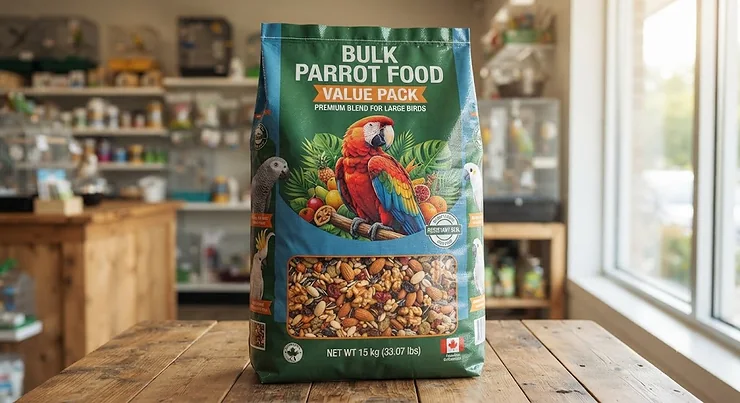
Here’s a number that tends to stop new parrot owners cold: an adult African Grey or Amazon parrot can go through 0.9 to 1.4 kg (2 to 3 lb) of food a month, easy, and that’s before you factor in the seed a cockatoo flings across the kitchen floor just for fun. Multiply that by a full year, or by two or three birds sharing a household, and the math on tiny bags starts looking painful. A bulk parrot food value pack is exactly what it sounds like: a larger-format bag or case of parrot food, typically 3.2 kg to 11.3 kg (7 to 25 lb), sold at a lower per-kilogram cost than the small pouches lining most pet store shelves. It’s the same nutrition, just packaged for households that feed birds regularly rather than occasionally.
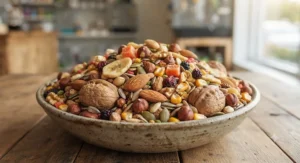
The appeal is obvious once you’ve done the arithmetic yourself, but the execution trips people up. Buy the wrong format and you’re stuck with 9 kg of seed your cockatiel picks through and wastes. Store it wrong and you’re feeding stale, bug-compromised food to a bird whose digestive system doesn’t forgive carelessness the way ours does. And Canadian shoppers face a wrinkle American buying guides never mention: not every 25-lb bulk bag sold south of the border actually ships to a Canadian address, which narrows the field considerably. According to CBC News reporting on Canadian household budgeting, bulk buying has become one of the more consistent strategies Canadians lean on as grocery and pet-care costs climb — and parrot owners, who are often feeding a bird with a multi-decade lifespan, have more reason than most to get this decision right.
This guide walks through seven real, currently available bulk parrot food value pack options on Amazon.ca, spanning budget seed blends, mid-range mixes, and veterinarian-formulated pellet diets. Along the way, we’ll dig into large bag parrot food economics, how economy parrot pellet bags actually differ from seed-based bulk bags, what storage containers and freshness sealing actually accomplish once that bag is open, and where the real bulk discount thresholds tend to kick in.
Quick Comparison Table
| Product | Bag Size | Format | Best For |
|---|---|---|---|
| Kaytee Fiesta Parrot Food | 11.3 kg (25 lb) | Seed, grain, fruit & pellet blend | Budget-conscious multi-bird homes |
| Hagen Tropimix Small Parrots Formula | 9 kg (20 lb) | Husk-free seed, nut & fruit mix | Zero-mess feeding, Canadian-made |
| Higgins InTune Natural Parrot | 8.2 kg (18 lb) | Extruded pellet with probiotics | Owners prioritizing natural ingredients |
| Kaytee Exact Parrot & Conure Natural Breeders | 11.3 kg (25 lb) | Pellet | Lowest cost-per-kilogram pellet diet |
| Roudybush Daily Maintenance Nibles | 4.5 kg (10 lb) | Vet-formulated pellet | Health-focused, low-waste feeding |
| Volkman Avian Science Super African Grey | 3.6 kg (8 lb) | Seed, grain & enrichment mix | Species-specific African Grey/Amazon diets |
| Schoen Farms Parrot Seed Mix | 3.2 kg (7 lb) | Canadian-grown seed mix | Single-bird homes wanting a smaller-batch bulk option |
Looking at this lineup, the split between seed-based blends (Kaytee Fiesta Parrot Food, Hagen Tropimix Small Parrots Formula, Volkman Avian Science Super African Grey, Schoen Farms Parrot Seed Mix) and pellet-based diets (Higgins InTune Natural Parrot, Kaytee Exact Parrot & Conure Natural Breeders, Roudybush Daily Maintenance Nibles) roughly mirrors the two schools of thought in avian nutrition today. Bag size also tracks a rough pattern: the seed blends tend to top out around 9-11.3 kg while the pellet diets in this lineup cap closer to 8-11.3 kg, largely because pellet manufacturers package in more graduated sizes for different flock counts. Neither format is objectively “more bulk” — the right pick depends on what’s already working for your bird and how much selective eating you’re willing to tolerate.
Just one click — help other Canadian bird owners make better buying decisions too!😊
Top 7 Bulk Parrot Food Value Packs: Expert Analysis
1. Kaytee Fiesta Parrot Food — best all-around value bulk bag
The 11.3 kg (25 lb) bag of Kaytee Fiesta Parrot Food is the one most Canadian pet stores actually stock in bulk, and there’s a reason it’s become a default starting point. It’s formulated by an in-house avian nutritionist around a mix of textures and shapes — sunflower and safflower seeds, oat groats, wheat, peanuts, almonds, and dried fruit pieces like banana and papaya — specifically to keep foraging behaviour engaged rather than boring a bird into feather-plucking habits. The guaranteed analysis lands at a minimum 15% crude protein and 14% crude fat, respectable numbers for a blend-format diet rather than a straight pellet.
What most buyers overlook about this line is that the “variety” format cuts both ways: it’s genuinely good for enrichment, but it also means a picky bird can shell-pick around the pellets and fruit bits, leaving a nutritional gap the label doesn’t reflect in the bowl. Aggregated feedback on this product line consistently circles back to two themes: birds enjoy the textures, and owners with selective eaters report needing to actively monitor what’s actually being consumed versus tossed aside.
Pros:
- ✅ Wide ingredient variety supports natural foraging behaviour
- ✅ Backed by a long-standing avian nutrition formulation team
- ✅ 11.3 kg bulk size stretches well across multi-bird households
Cons:
- ❌ Selective eating can undercut the nutrition on the label
- ❌ Contains peanuts and tree nuts, a concern for allergy-sensitive households
Expect a price in the C$60-C$85 range for the 11.3 kg bag at the time of research, which typically undercuts buying four or five smaller 1-2 kg bags of the same formula — solid value if you’re comfortable managing a foraging-format diet.
2. Hagen Tropimix Small Parrots Formula — zero-waste Canadian-made pick
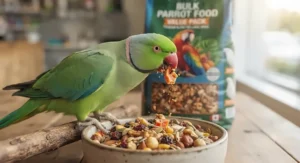
Hagen Tropimix Small Parrots Formula comes in a 9 kg (20 lb) handled bag, and the standout claim — “totally edible, no husks or shells” — actually holds up on inspection. Every seed, nut, and grain in the mix is either hulled or naturally shell-free, which matters more than it sounds like for anyone who’s swept up a kilogram of discarded sunflower husks from underneath a cage. The formula runs on dehydrated papaya, pineapple, banana, and coconut alongside walnuts, peanuts, and Brazil nuts, flaked grains, and legumes like chickpeas and green split peas, fortified with Tropican vitamin granules.
Here’s the detail worth knowing if you’re buying Canadian on principle: Hagen is manufactured by the Rolf C. Hagen Group, a pet-products company founded and still headquartered in Montreal, and documented as one of the longer-running Canadian names in the pet industry on Wikipedia. That’s not just trivia — it means shorter supply chains into Canadian warehouses and a formula built with this market’s regulatory expectations in mind from the outset. Owner discussions consistently note the husk-free format as the single biggest quality-of-life improvement over traditional seed mixes, with the trade-off being a lower protein percentage (12.5% minimum) than pellet-based competitors.
Pros:
- ✅ Genuinely shell-free — dramatically less cage-floor mess
- ✅ Canadian-manufactured with shorter Amazon.ca supply chains
- ✅ No artificial preservatives, colours, or animal by-products
Cons:
- ❌ Lower protein content than most pellet-format competitors
- ❌ Premium pricing relative to bag size compared to other seed blends
Priced around C$100-C$130 for the 9 kg bag at the time of research, this sits at the premium end of seed-based bulk — the trade-off is a cleaner feeding experience and a Canadian manufacturing story that resonates with a lot of buyers here.
3. Higgins InTune Natural Parrot — best premium bulk bag with probiotics
The 8.2 kg (18 lb) bag of Higgins InTune Natural Parrot is built around a straightforward premise: no artificial flavours, colours, or preservatives, full stop. The base is ground corn, brown rice, and soybean meal, layered with real fruit and vegetable inclusions — cranberries, apples, blueberries, celery, beets, spinach — plus flaxseed and brewer’s yeast. The differentiator worth flagging is the probiotic delivery method: Higgins encapsulates live cultures inside the pellet shapes themselves, a technique meant to survive the manufacturing process better than probiotics simply dusted on top.
Based on the ingredient panel, this reads less like a bulk commodity food and more like a premium small-batch formula that happens to be sold in a large bag — which is a genuinely useful hybrid for owners who want ingredient transparency without paying boutique 1.4-kg-bag prices forever. Reviewers of this line frequently mention that birds transitioning from seed diets take to the fruit-forward aroma faster than to plainer pellet competitors, though the naturally-derived flavouring means the pellets are noticeably less shelf-stable once opened than heavily preserved alternatives.
Pros:
- ✅ Zero artificial preservatives, colours, or flavours
- ✅ Probiotic technology built into the pellet structure
- ✅ Strong real-fruit and vegetable inclusion rate
Cons:
- ❌ Shorter post-opening shelf life without added preservatives
- ❌ Higher price-per-kilogram than conventional pellet diets
Expect a price in the C$115-C$140 range for the 8.2 kg bag, positioning it as one of the pricier bulk picks here — justified mainly if ingredient sourcing is a non-negotiable for your household.
4. Kaytee Exact Parrot & Conure Natural Breeders — lowest cost-per-kilogram pellet bag
Kaytee Exact Parrot & Conure Natural Breeders ships in an 11.3 kg (25 lb) bag and is, functionally, the breeder-grade version of Kaytee’s pellet line — meant for aviaries and rescues feeding multiple birds daily rather than a single household pet. That breeder positioning is exactly why it tends to land as the most economical true pellet option in this roundup: less packaging overhead, less marketing gloss, more food per bag.
What the spec sheet won’t tell you is that “breeder” formulas like this one are typically dialed toward consistent daily maintenance nutrition rather than the enrichment-forward textures of consumer-facing lines, so if your bird is used to foraging through a varied seed mix, expect a genuine adjustment period. Feedback patterns across pellet-format diets in general — well documented in Lafeber’s veterinary comparison of seed and pellet diets — consistently show that pellet transitions take patience regardless of brand, and this formula is no exception; birds accustomed to shelling seed often ignore uniform pellets for several days before accepting them.
Pros:
- ✅ Best cost-per-kilogram pellet option in this roundup
- ✅ Consistent daily-maintenance nutrition profile, less selective eating
- ✅ 11.3 kg breeder-scale bag suits multi-bird households
Cons:
- ❌ Less enrichment value than texture-varied seed blends
- ❌ Transition period from seed diets can be rocky
At around C$70-C$95 for the 11.3 kg bag at the time of research, this is arguably the best per-kilogram value in the entire lineup if your bird already eats pellets happily.
5. Roudybush Daily Maintenance Nibles — best vet-formulated bulk pellet
Roudybush Daily Maintenance Nibles comes in a 4.5 kg (10 lb) bag, smaller than some of its bulk competitors here but still meaningfully larger than the 0.6-1.2 kg bags most owners start with. The company, based in Gridley, California, builds its formulas with avian nutrition consultants and markets the line as veterinarian-recommended — a claim that, unlike vague marketing language, is backed by decades of use in breeding and rescue operations across North America.
Here’s what the spec comparison actually means in the feed bowl: the pellet format minimizes the selective eating that undermines seed-blend nutrition, so what’s printed on the guaranteed analysis panel is much closer to what your bird actually consumes. Reviewers and avian professionals who’ve used Roudybush over years consistently cite the “no artificial colours or unnecessary fillers” formulation as the reason they stick with it despite the smaller bag size relative to competitors — fewer additives generally means less picky-eater rejection tied to unfamiliar dyes or flavourings.
Pros:
- ✅ Veterinarian-recommended, widely used by breeders
- ✅ No artificial colours or unnecessary fillers
- ✅ Pellet format minimizes waste and selective eating
Cons:
- ❌ Smaller 4.5 kg bulk size than several competitors here
- ❌ Premium pricing per kilogram relative to seed-based bulk bags
Priced in the C$65-C$90 range for the 4.5 kg bag, the smaller format keeps the entry price lower even though the per-kilogram cost sits closer to the premium end.
6. Volkman Avian Science Super African Grey — best species-specific enrichment blend
The 3.6 kg (8 lb) bag of Volkman Avian Science Super African Grey is purpose-built rather than generic — formulated specifically for African Greys and Amazon parrots rather than “large birds” as a catch-all category. The guaranteed analysis backs that specificity up with a minimum 14.5% crude protein and 22% crude fat, notably higher fat content than most competitors here, which tracks with the naturally higher-fat foraging diet these species evolved to handle in the wild.
What most buyers overlook is the enrichment engineering baked into this formula: alongside safflower seed, oat groats, and dehydrated peas, the mix includes cinnamon sticks, star anise, and a cuttlebone piece — deliberately varied shapes, textures, and aromas meant to slow down feeding and encourage the kind of exploratory foraging that keeps a highly intelligent species like an African Grey mentally engaged. It’s Volkman’s best-selling blend in the Avian Science line, and aggregated owner feedback tends to highlight the cuttlebone inclusion specifically as a convenient built-in calcium source that saves a separate purchase.
Pros:
- ✅ Species-tailored fat and protein profile for African Greys and Amazons
- ✅ Built-in cuttlebone provides a familiar calcium source
- ✅ Aromatic enrichment elements encourage natural foraging behaviour
Cons:
- ❌ Smaller 3.6 kg bag size limits true bulk savings
- ❌ Less suited to households with mixed, non-African-Grey species
At roughly C$45-C$65 for the 8-lb bag, this is less about maximum bulk savings and more about getting species-correct nutrition without paying boutique per-gram prices.
7. Schoen Farms Parrot Seed Mix — best small-batch Canadian-grown alternative
Schoen Farms Parrot Seed Mix rounds out this list as the lesser-known pick, and it earns its spot for a specific reason: it’s marketed and sold as Canadian-grown, a distinction almost none of the bigger commercial brands in this category can make. The 3.2 kg (7 lb / 3.18 kg) bag blends sunflower seeds, safflower seeds, millet, and cracked corn — a simpler ingredient list than the fortified blends above, which some owners specifically prefer for birds with sensitivities to added vitamin premixes or synthetic fortification.
On paper, this is the most “back to basics” option in the lineup, and that simplicity is really the whole pitch: fewer processing steps, a shorter ingredient list, and a domestic supply chain that doesn’t cross the border. What the ingredient list won’t tell you is that, without heavy fortification, this mix works best as a supplement to a fortified pellet base rather than a sole diet — a nuance worth understanding before treating any seed-only mix as nutritionally complete on its own.
Pros:
- ✅ Canadian-grown ingredients with a domestic supply chain
- ✅ Simple, minimally processed ingredient list
- ✅ Smaller bulk size suits single-bird households well
Cons:
- ❌ Lacks the vitamin fortification of commercial blends above
- ❌ Smallest bag size here means the least aggressive bulk discount
Expect a price around C$25-C$35 for the 3.2 kg bag — the smallest investment on this list, and a smart way to trial a Canadian-grown option before committing to a larger bulk purchase.
✨ Don’t Miss These Exclusive Deals!
🔍 Take your parrot’s daily diet to the next level with these carefully selected bulk bags. Click on any highlighted product to check current pricing and availability on Amazon.ca — stocking up now means one less thing to think about for months.
Practical Usage Guide: Setting Up and Storing Bulk Parrot Food
Buying an 11.3 kg bag is the easy part. Keeping it fresh, pest-free, and nutritionally intact for the two to four months it’ll actually take to work through is where most first-time bulk buyers stumble.
Storage Containers That Actually Keep Bugs Out
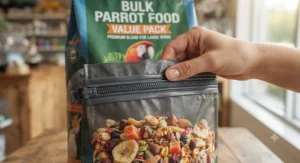
The single biggest mistake with bulk parrot food is leaving it in the original paper or woven bag after opening. Proper storage containers — food-grade airtight bins, ideally with a gasket seal rather than a simple snap lid — are the difference between food that’s still good in month three and food that’s attracting pantry moths by week six. Look for containers rated for at least 12-15 kg of capacity if you’ve bought a 25-lb bag, and always decant the entire bag at once rather than topping up an old container with fresh product on top of older residue, which accelerates spoilage in the older layer.
Freshness Sealing: Stopping Rancidity Before It Starts
Freshness sealing matters most for seed-based blends, because the oils in sunflower and safflower seeds go rancid faster than a pellet’s more processed structure. According to guidance from the Canadian Grain Commission on preventing infestations in stored grain, controlling moisture and maintaining a cool, dry, dark storage environment are the two factors that most reliably slow both insect activity and oxidation in stored grain products — advice that translates directly to a bag of parrot seed sitting in a Canadian kitchen or garage. Practically, that means keeping bulk containers away from stove heat, out of direct sunlight, and — if your climate runs humid in summer — considering a small food-safe desiccant packet inside the bin.
Pros:
- ✅ Airtight decanting can extend usable freshness by weeks
- ✅ Reduces pest infestation risk dramatically versus a stapled bag
Cons:
- ❌ Requires an upfront purchase of proper containers
- ❌ Large containers need dedicated storage space many condos lack
Real-World Scenarios: Matching Your Flock to the Right Bulk Bag
Buying bulk only pays off if the size actually matches your household. A few common Canadian scenarios illustrate how differently that math plays out.
Consider a single African Grey owner in a Toronto apartment: one bird, moderate space, and a strong preference for not sacrificing a whole kitchen cupboard to bird food. For this household, something in the 3.6-4.5 kg range — like Volkman Avian Science Super African Grey or Roudybush Daily Maintenance Nibles — hits the sweet spot between real savings and manageable storage, without the freshness risk of a bird working through 11.3 kg alone over eight or nine months.
Now picture a rescue or multi-bird household outside Calgary with five cockatiels and two conures. Here, the math flips entirely: an 11.3 kg bag of Kaytee Exact Parrot & Conure Natural Breeders or Kaytee Fiesta Parrot Food gets consumed in six to eight weeks rather than months, sidestepping the freshness concern almost entirely while delivering the steepest per-kilogram savings on this list. And for a budget-conscious first-time owner testing whether their new parrot even likes a particular formula, a smaller bulk option like Schoen Farms Parrot Seed Mix at 3.2 kg offers a lower-risk way to buy larger than the tiny starter bag without committing to a 20-lb gamble on an untested diet.
Problem → Solution: Fixing the Most Common Bulk Parrot Food Complaints
Problem: The bag arrived and my bird won’t touch the pellets. Solution: mix the new pellet, gradually increasing the ratio, into whatever the bird was already eating over two to three weeks rather than a cold swap — this is standard veterinary guidance for pellet transitions and applies directly to Roudybush Daily Maintenance Nibles or Kaytee Exact Parrot & Conure Natural Breeders.
Problem: There’s a layer of seed dust and hulls at the bottom of every bag. Solution: this is normal with seed-forward blends like Kaytee Fiesta Parrot Food — sift the bottom third with a mesh strainer before refilling the bowl, or switch entirely to a husk-free formula like Hagen Tropimix Small Parrots Formula if the mess is a dealbreaker.
Problem: I found small moths near the storage bin. Solution: discard the affected portion immediately, wash the container with hot soapy water, dry completely, and switch to airtight storage going forward — a full infestation almost always traces back to residual moisture or an imperfectly sealed lid, per the storage guidance referenced above.
Problem: My bird’s weight or feather condition changed after switching to a bulk bag. Solution: rule out a diet mismatch first — species-specific formulas like Volkman Avian Science Super African Grey exist precisely because generic “large bird” blends don’t always match every species’ fat and protein needs, and a veterinary check is worthwhile if changes persist beyond a few weeks.
Buyer’s Decision Framework: Which Bulk Bag Should You Actually Buy?
If you have one bird and limited storage space, choose a smaller bulk option in the 3.2-4.5 kg range, because the freshness window matters more than the marginal per-kilogram savings of a larger bag. If you’re feeding three or more birds daily, choose the 11.3 kg pellet or seed bags, because consumption speed neutralizes the freshness risk while maximizing the discount. If your bird has never eaten pellets, choose a seed-forward blend first and plan a gradual transition, because a cold pellet switch commonly results in a bird that simply doesn’t eat enough. If ingredient sourcing and additive-free formulation matter more to you than raw cost, choose Higgins InTune Natural Parrot or Schoen Farms Parrot Seed Mix, because both prioritize natural or minimally processed ingredient lists over shelf-stability additives.
How to Choose a Bulk Parrot Food Value Pack
- Match the format to your bird’s current diet. A bird that’s never seen a pellet won’t switch overnight, so jumping straight to an 11.3-kg pellet bag risks a lot of wasted food during the transition period.
- Size the bag to your consumption rate, not just the discount. A single bird working through 0.9-1.4 kg a month will take the better part of a year to finish a 25-lb bag — often longer than the food stays genuinely fresh.
- Check the guaranteed analysis, not just the marketing copy. Protein and fat minimums vary meaningfully between species-specific and generic blends, and the numbers on the label matter more than the packaging photography.
- Factor in storage capacity before you buy. A great bulk discount isn’t much of a deal if you don’t have anywhere food-safe to store the excess.
- Look for Canadian availability and manufacturing where it matters to you. Brands like Hagen Tropimix Small Parrots Formula and Schoen Farms Parrot Seed Mix offer shorter supply chains into Canadian warehouses, which can mean fresher stock turnover.
- Weigh ingredient philosophy against budget. Additive-light formulas like Higgins InTune Natural Parrot cost more per kilogram, and that’s a legitimate trade-off some households are happy to make.
- Read the allergen and ingredient notes carefully. Several bulk seed blends, including Kaytee Fiesta Parrot Food, contain peanuts and tree nuts — worth flagging if anyone in the household handles the food regularly.
Large Bag Parrot Food vs Economy Parrot Pellet Bags: What’s the Real Difference
“Large bag parrot food” and “economy parrot pellet bags” get used almost interchangeably in casual conversation, but they’re not the same thing, and conflating them leads to disappointed expectations. Large bag parrot food is a size category — it describes anything sold in a bigger-than-standard format, whether that’s seed, pellet, or a mixed blend. Economy parrot pellet bags are specifically pellet-format diets sized and priced for cost efficiency, like Kaytee Exact Parrot & Conure Natural Breeders, which trades enrichment value for consistent nutrition and the lowest per-kilogram cost in this roundup.
| Criteria | Large Bag Seed Blend | Economy Pellet Bag |
|---|---|---|
| Ingredient format | Whole seeds, grains, fruit pieces | Uniform extruded pellets |
| Waste level | Higher — shells, hulls, selective eating | Lower — minimal selective eating |
| Cost per kilogram | Moderate | Typically lowest |
| Shelf life after opening | Shorter (oil content in seeds) | Longer, especially with preservatives |
| Best for | Enrichment-focused feeding, foraging | Consistent daily-maintenance nutrition |
The practical takeaway: a large seed-based bag like Kaytee Fiesta Parrot Food delivers better foraging enrichment but genuinely does waste more food to selective eating, while an economy pellet bag like Kaytee Exact Parrot & Conure Natural Breeders delivers more consistent nutrition per dollar but sacrifices some of the behavioural engagement seed variety provides. Most experienced multi-bird households in this category end up running both — a pellet base for reliable daily nutrition, supplemented with a smaller seed portion for enrichment — rather than treating it as a strict either/or decision.
Bulk Discount Thresholds and Amazon.ca Subscribe & Save: The Real Math
Bulk discount thresholds aren’t linear, and understanding where they actually kick in saves real money. In general, the steepest jump happens between the smallest “starter” bag size (roughly 0.5-1.4 kg) and the first true bulk tier (3.2-4.5 kg) — that’s where per-kilogram cost typically drops the most in percentage terms. The gap between a mid-size bulk bag (4.5-9 kg) and the largest available format (11.3 kg) is usually smaller in percentage terms, because manufacturers have already captured most of the packaging-efficiency savings by that point.
| Bag Size Tier | Typical Per-Kilogram Cost Position | Best Fit |
|---|---|---|
| Starter (0.5-1.4 kg) | Highest | Trialing a new formula |
| Small bulk (3.2-4.5 kg) | Noticeably lower | Single-bird households |
| Mid bulk (8-9 kg) | Lower still | Two-bird households |
| Large bulk (11.3 kg) | Lowest | Multi-bird or aviary settings |
Amazon.ca’s Subscribe & Save program, where enrolled, layers an additional discount — typically a modest percentage off the current price — on top of whatever bulk-size savings already exist, and it’s worth checking availability on each specific listing since not every parrot food product on Amazon.ca participates. For a diet your bird eats daily without complaint, parrot food subscribe and save Amazon.ca enrollment on something like Kaytee Exact Parrot & Conure Natural Breeders can quietly compound the bulk-size discount over a year of repeat deliveries — but it’s only genuinely worthwhile once you’ve confirmed your bird actually likes the formula, since subscription discounts don’t offset the cost of food that ends up wasted.
Common Mistakes When Buying Bulk Parrot Food
The most expensive mistake isn’t picking the wrong brand — it’s buying more than your storage setup or consumption rate can realistically support before freshness degrades. A close second: buying a bulk bag of an entirely untested formula. What most buyers overlook is that switching foods, even to a nutritionally superior option, should always start with a small trial bag first; an 11.3-kg commitment to a diet your bird rejects is a genuinely painful loss, both nutritionally and financially. A third common misstep is assuming every “large bag parrot food” listing ships to Canada at the advertised size — several of the biggest bulk formats popular in the U.S. market simply aren’t stocked at full size on Amazon.ca, which is exactly why this list sticks to products verifiably available here. Finally, plenty of owners underestimate how differently seed and pellet formats age; treating a seed blend like a shelf-stable pellet and leaving it in a warm pantry for months is a fast track to rancid oils and a bird that mysteriously stops eating with enthusiasm.
Safety, Storage Regulations, and Canadian Feed Standards
Pet food sold in Canada, including parrot food, falls under the oversight of the Canadian Food Inspection Agency, which maintains import and labelling policy guidance for pet food entering the Canadian market. In practice, this means legitimately imported and domestically produced parrot food sold through established Canadian retail channels — including the products in this roundup — has cleared baseline import and labelling requirements before it reaches an Amazon.ca listing. That’s a meaningfully different bar than food purchased through unofficial resellers or grey-market imports, where labelling accuracy and ingredient sourcing become much harder to verify.
On the storage side, the safety consideration that matters most day-to-day isn’t regulatory — it’s mould. Any bulk bag exposed to moisture, whether from a leaking storage container or a humid Canadian basement in July, can develop mould colonies that are genuinely dangerous to a parrot’s respiratory system, which is considerably more sensitive than a mammal’s. If a bag ever develops a musty smell, visible discolouration, or clumping that wasn’t there at purchase, the safe move is discarding that portion entirely rather than trying to salvage it.
Bulk Parrot Food for Multi-Bird Households and Aviaries
Multi-bird households change the entire bulk-buying calculus, and not just because more mouths mean faster consumption. Feeding several birds from one bulk bag means variation in individual appetite and pickiness gets averaged out — a picky eater who leaves pellets untouched in a single-bird home might simply not get first access in a flock setting, meaning less waste overall relative to bag size. For households running four or more birds, the 11.3-kg formats — Kaytee Fiesta Parrot Food and Kaytee Exact Parrot & Conure Natural Breeders among them — tend to make the most financial sense, since consumption speed alone resolves most of the freshness concerns that plague single-bird bulk buying.
Aviaries and rescues have an additional consideration worth flagging: species diversity. A flock mixing African Greys, conures, and cockatiels genuinely benefits from a generalist formula rather than the species-specific Volkman Avian Science Super African Grey, since that blend’s fat and protein profile is calibrated for larger hookbills specifically and isn’t ideal as a one-size-fits-all aviary staple. In these settings, a base of an economy pellet bag supplemented with smaller species-specific bags for particular residents tends to outperform a single bulk formula stretched across every bird in the building.
Frequently Asked Questions
❓ Is buying bulk parrot food value pack actually cheaper than smaller bags?
❓ How long does large bag parrot food stay fresh once opened?
❓ What size bulk parrot food value pack should I buy for one parrot?
❓ Do economy parrot pellet bags expire faster than seed mixes?
❓ Is Amazon.ca subscribe and save worth it for parrot food?
Conclusion
There’s no single “best” bulk parrot food value pack, and honestly, anyone claiming otherwise hasn’t accounted for how differently a lone cockatiel and a five-bird aviary consume food. What the research does make clear is that the right choice comes down to matching format — seed versus pellet — to what your bird already eats, matching bag size to genuine consumption speed rather than the biggest discount on the shelf, and taking storage seriously enough that the bulk savings don’t evaporate into a mouldy bin six weeks later. Budget-focused households do well with Kaytee Fiesta Parrot Food or Kaytee Exact Parrot & Conure Natural Breeders; ingredient-conscious buyers should look at Higgins InTune Natural Parrot or Schoen Farms Parrot Seed Mix; and anyone feeding a species-specific bird will get more out of Volkman Avian Science Super African Grey than a generic blend. Whichever bag ends up in your cart, the storage containers and freshness sealing habits covered above matter just as much as the product choice itself — that’s genuinely where most of the value of buying bulk gets won or lost.
Recommended for You
- Affordable Parrot Bird Food: 7 Budget Picks Vets Approve (2026)
- Bird Nuts Canada Bulk: 7 Top Picks That Save Money in 2026
- Peanuts for Wild Birds: 7 Top Feeders to Try in 2026
Disclaimer: This article contains affiliate links. As an Amazon Associate, I earn from qualifying purchases. If you purchase products through these links, we may earn a small commission at no additional cost to you.
✨ Found this helpful? Share it with your friends! 💬🤗
