
In This Article
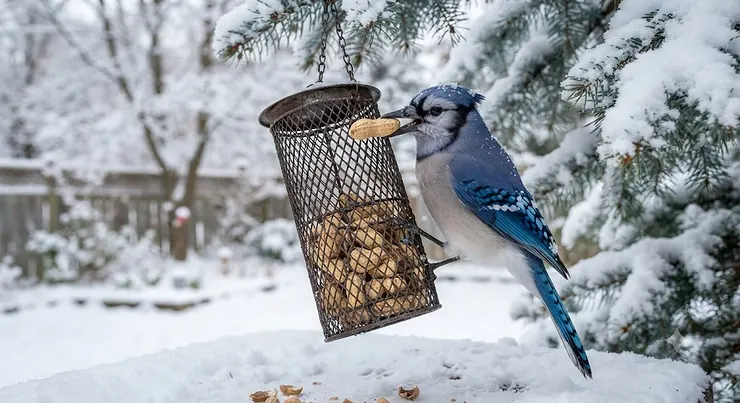
Walk past almost any feeding station in a Canadian backyard in January and you’ll notice something: the peanuts disappear faster than the seed mix, the sunflower hearts, even the suet. There’s a reason for that. Peanuts for wild birds aren’t a novelty add-on — they’re closer to backyard rocket fuel, a dense, high-fat, high-protein package that a chickadee can burn through in minutes on a minus-twenty morning. According to Birds Canada, peanuts should be offered raw and unsalted, either shelled or in the shell depending on which species you’re hoping to attract. That’s really the whole idea in one sentence: peanuts are simply a concentrated calorie source, split into two formats, that different birds access in different ways.
If you’ve only ever tossed out a scoop of black-oil sunflower, peanuts feel like a step up — messier to manage, pricier per kilogram, and a bit of a squirrel magnet if you’re not careful. But get the setup right and you’ll pull in blue jays, downy and hairy woodpeckers, red-breasted nuthatches, and chickadees that treat your yard like a drive-through window. This guide breaks down seven real feeders sold in Canada, walks through the eternal shelled-versus-in-shell debate, tackles the squirrel problem honestly, and gives you a practical setup you can copy this weekend. No fluff, no invented reviews — just what the research and the products actually say.
Quick Comparison Table: Peanut Feeders at a Glance
Before diving into the full breakdown, here’s the short version. Below is a snapshot of how the seven feeders stack up on capacity, price bracket, and who each one suits best. Treat this as your cheat sheet — the detailed reasoning for every pick follows in the next section.
| Feeder | Peanut Type | Capacity | Price Range (CAD) | Best For |
|---|---|---|---|---|
| Birds Choice Economy Nut Feeder | Shelled/mixed nuts | ~2 cups | Under C$25 | First-time feeders, small yards |
| Nature’s Way Cobalt Mesh Feeder | Shelled peanuts | 2 quarts | C$25-C$35 | Multi-species mesh feeding |
| iBorn 14″ Metal Mesh Feeder | Shelled/peanut mix | ~2 lb | C$30-C$40 | Woodpeckers, jays, titmice |
| Birds Choice XWPF Magnet Mesh | Whole in-shell | 2 quarts | C$30-C$45 | Jays and woodpeckers, in-shell fans |
| Birds Choice Recycled Poly Feeder | Whole in-shell | 2.25 quarts | C$45-C$60 | Weatherproof, long-term durability |
| Squirrel Buster Standard | Sunflower/mixed | 1.3 lb | C$55-C$70 range | Budget squirrel-proofing |
| Squirrel Buster Nut Feeder | Shelled peanuts | 1.3 lb | C$90-C$110 range | Serious squirrel-proof peanut feeding |
A quick read of the table above tells its own story: price climbs steadily with squirrel-deterrent engineering, not with capacity. The Birds Choice Economy Nut Feeder and Nature’s Way Cobalt Mesh Feeder are built for straightforward mesh feeding where squirrels are a minor nuisance, while the Squirrel Buster Nut Feeder exists almost entirely to solve one specific, expensive problem. If your yard has a resident squirrel population that treats every feeder as a personal buffet, that price gap is the cost of actually winning the argument.
💬 Just one click — help other Canadian backyard birders make better buying decisions too! 😊
Top 7 Peanut Feeders for Wild Birds: Expert Analysis
Choosing a feeder isn’t just about capacity or price — it’s about matching the mesh size, peanut format, and build quality to the birds already living in your yard. Below are seven real, currently available options spanning budget to premium, each assessed on genuine specs and aggregated review sentiment rather than marketing copy.
1. Birds Choice Economy Nut Feeder — best low-cost starter feeder
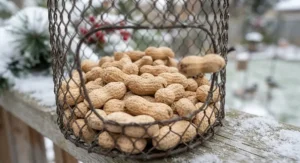
The Economy Nut Feeder is about as no-frills as peanut feeding gets, and that’s precisely its appeal for someone dipping a toe in for the first time. It’s a compact metal-mesh tube measuring roughly 8.75 inches tall (about 12 inches with the hanger), with a removable bottom rather than a center rod, which makes cleaning genuinely fast rather than a fifteen-minute chore. The tube holds around two cups of shelled peanuts or nut blend — modest, but that’s actually a feature for beginners since it forces you to rotate stock and avoid the spoilage that comes from letting a giant reservoir sit half-full for weeks. Based on the spec comparison with pricier mesh feeders, the main trade-off here is refill frequency, not quality: the gold-tone metal top and bottom are the same basic construction used across the category, just without the extras. It’s a sound pick for chickadees, titmice, nuthatches, and the occasional jay working the smaller mesh openings, and it’s an easy way to test whether your yard even has a peanut audience before committing to a bigger investment. Reviewers consistently note that the removable-bottom design makes seasonal cleaning far less fiddly than tube feeders with a fixed center pole, though a few mention the gold finish shows wear faster than darker powder coatings.
Pros:
- ✅ Very low cost of entry for testing peanut feeding
- ✅ Removable bottom simplifies cleaning and refilling
- ✅ Compact size suits balconies and small yards
Cons:
- ❌ Small capacity means more frequent refills
- ❌ Lighter-gauge metal shows wear sooner than premium models
Priced under C$25 at the time of research, this is squarely a value pick — the kind of feeder you buy to answer the question “will birds even come for peanuts here?” before spending more.
2. Nature’s Way Cobalt Metal Mesh Feeder — best all-around mesh design
Nature’s Way built this one to double as mixed-seed and peanut feeding, and the 2-quart capacity puts it a full step above entry-level economy models without tipping into premium pricing. The cobalt-blue powder coating isn’t just cosmetic — it’s a rust-resistant finish that matters more than it sounds like it should once you’ve watched a cheaper feeder’s paint flake off after one wet Ontario spring. What most buyers overlook about mesh feeders like this one is that the mesh gauge itself dictates which birds can actually use it: tighter weaves favour smaller-billed species like chickadees and nuthatches, while wider weaves let jays muscle in and clean the thing out in an afternoon. This model sits in the middle, which is exactly why it attracts a genuinely diverse crowd rather than getting monopolized by one species. Aggregated customer sentiment points to easy-fill access and a cling-friendly mesh surface as the standout features, with the 2-quart capacity cited repeatedly as enough to go several days between refills for a moderately busy yard. On the downside, a subset of reviewers flag that the powder coating can chip at the hanger attachment point after extended UV exposure, which is a fair trade-off given the price bracket.
Pros:
- ✅ 2-quart capacity reduces refill frequency
- ✅ Rust-resistant coating holds up through wet seasons
- ✅ Mesh gauge attracts a genuinely wide bird variety
Cons:
- ❌ Coating can chip at hanger point over time
- ❌ Not squirrel-resistant without a separate baffle
Expect to pay in the C$25-C$35 range, making this one of the strongest value-for-capacity picks on this list.
3. iBorn 14″ Metal Mesh Peanut & Sunflower Feeder — best for attracting woodpeckers
At 14 inches, the iBorn feeder is noticeably taller than most entries here, and that extra length translates directly into more clinging surface for birds that feed vertically — which matters a lot if woodpeckers are your target species. The flip-top lid is a small design choice with an outsized practical benefit: no assembly, no fumbling with a center rod, just lift and pour. Key specs worth flagging include the all-metal copper-finish construction and a drainage-designed bottom tray, which keeps peanuts from sitting in pooled moisture after rain — a detail that matters more than it sounds, since wet peanuts are the fastest route to mould. Based on the spec sheet, this design leans toward mixed feeding (sunflower and peanut together), which broadens the visiting species list beyond strict peanut specialists to include titmice and cardinals as well. Reviewers consistently describe the mesh window as useful for monitoring fill level at a glance, cutting down on the guessing-game refills that plague opaque hopper feeders. A recurring critique in aggregated feedback is that the antique copper finish, while attractive initially, can develop a slightly duller patina after a full season outdoors — cosmetic, not functional.
Pros:
- ✅ Taller design suits clinging woodpeckers well
- ✅ No-assembly flip-top lid speeds up refills
- ✅ Drainage tray reduces moisture-related spoilage
Cons:
- ❌ Copper finish dulls with prolonged UV exposure
- ❌ Mixed-feed design attracts more generalist species than peanut purists
Priced around C$30-C$40, this sits comfortably in the mid-range and earns its keep through the taller, woodpecker-friendly profile.
4. Birds Choice XWPF Magnet Mesh Whole Peanut Feeder — best for whole in-shell peanuts
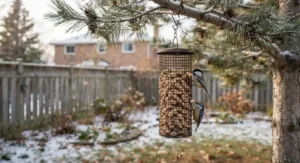
This is the feeder to reach for if your yard already has a blue jay problem — and by “problem,” I mean the good kind, where a family group shows up every morning expecting service. Built specifically for whole in-shell peanuts rather than shelled pieces, the XWPF uses an all-steel construction with polyester powder coating and a black mesh screen sized for whole nuts, holding up to 2 quarts. What the spec sheet won’t tell you, but user reports suggest, is that whole in-shell peanuts create a slower, more theatrical feeding experience than shelled versions — jays work at extracting the nut, which means longer visits and better viewing from your kitchen window rather than a quick grab-and-go. Manufactured in Wisconsin by a company that’s been in the niche specifically since its founding, it’s a purpose-built tool rather than a generalist feeder, and that focus shows in the mesh gauge, which is deliberately too wide for smaller birds — a filtering mechanism, not an oversight. Aggregated reviews highlight the magnetic mesh closure as genuinely easier to refill one-handed than screw-top competitors, while a smaller number of users note that the green-coated top can show scuffing where the hanging cable makes contact during wind.
Pros:
- ✅ Purpose-built for whole in-shell peanuts
- ✅ 2-quart capacity holds up well for jay families
- ✅ Magnetic mesh closure speeds up refilling
Cons:
- ❌ Mesh gauge excludes most small songbirds
- ❌ Cable contact point shows cosmetic wear over time
Look for this one in the C$30-C$45 range — solid mid-tier value if in-shell peanuts and jays are specifically what you’re after.
5. Birds Choice Recycled Poly-Lumber Peanut Feeder — best weatherproof build quality
Here’s where build materials start to genuinely separate the pack. This feeder swaps sheet metal for half-inch recycled poly-lumber, the kind of material that resists fading, cracking, and splitting in a way painted metal simply can’t over a multi-year timeline. The hinged roof is a smart, low-effort fill mechanism, and — more importantly — the overhang actually protects both the peanuts inside and the birds feeding from rain and snow, a detail that matters enormously in a Canadian climate where sleet in April is not exactly rare. At 7 by 10.5 by 14.75 inches with an 8.75-inch hanging cable, it’s a substantial presence in a yard, holding roughly 1.2 pounds (2.25 quarts) of whole peanuts. Here’s what most spec sheets skip: poly-lumber doesn’t just survive weather better, it also won’t absorb moisture the way wood-composite alternatives can, which directly reduces the mould risk that plagues peanut feeders left out in damp conditions. Reviewers consistently praise the roof overhang design for keeping contents dry through multi-day rain events, and the recycled-material angle resonates with buyers who want durability without a plastic footprint. The trade-off is straightforward: this is the heaviest, bulkiest option here, which some smaller-yard owners find awkward to mount.
Pros:
- ✅ Recycled poly-lumber resists cracking and fading long-term
- ✅ Roof overhang genuinely shields contents from rain and snow
- ✅ Large 2.25-quart capacity for less frequent refills
Cons:
- ❌ Bulkier footprint than metal mesh alternatives
- ❌ Higher price point for a non-squirrel-proof design
Expect a price range around C$45-C$60 — a fair ask for a feeder that’s genuinely built to last several seasons without visible degradation.
6. Squirrel Buster Standard — best budget-friendly squirrel-proofing
The Squirrel Buster line built its reputation on one clever mechanical idea, and the Standard model is the accessible entry point into that system. A weight-triggered metal shroud surrounds the seed reservoir; when a bird lands, nothing happens, but the moment a squirrel’s weight registers, the shroud slides down and seals off the feeding ports. It’s not a poison, a shock, or a deterrent spray — it’s pure mechanical engineering, and it works without harming the squirrel, just frustrating it into looking elsewhere. With four metal perches and 1.3 pounds of seed capacity, the Standard accommodates both clinging and perching birds, and the transparent tube design includes a ventilation system that lets trapped humidity and heat escape rather than condensing and spoiling the contents — a problem that plagues cheaper sealed tubes. Based on the spec comparison with basic mesh feeders, the real value here isn’t capacity, it’s the elimination of an entire category of daily frustration for anyone whose yard has more than one determined squirrel. Reviewers consistently describe the tool-free detachable design as genuinely easy to clean, and aggregated sentiment across the Squirrel Buster line points to a strong reputation for reliability — the company backs its products with a lifetime parts policy, which speaks to how confident they are in the mechanism holding up.
Pros:
- ✅ Weight-triggered mechanism reliably blocks squirrels
- ✅ Tool-free disassembly makes cleaning simple
- ✅ Four-port design suits multiple bird species at once
Cons:
- ❌ Not intended for whole in-shell peanuts specifically
- ❌ Requires 18 inches of clearance from structures to work properly
Priced roughly in the C$55-C$70 range, this is the more affordable doorway into genuinely squirrel-resistant feeding.
7. Squirrel Buster Nut Feeder — best squirrel-proof peanut specialist
If the Squirrel Buster Standard is the generalist, the Nut Feeder is the specialist — purpose-engineered specifically for shelled peanuts, mixed nuts, and dried fruit rather than sunflower seed. It uses the same patented weight-adjustable shroud mechanism, but pairs it with two interchangeable mesh sizes, letting you fine-tune the feeder for smaller birds one week and switch it up if larger species start dominating. Capacity sits at 1.3 pounds (about 750 mL), modest compared to bulk hopper feeders, but that’s a deliberate design choice for a food that spoils faster than seed and shouldn’t sit in large reservoirs for weeks at a time. What the spec sheet won’t tell you, but the mechanism itself makes clear, is that this feeder also discourages oversized birds — the same weight-sensitivity that shuts out squirrels can be tuned to exclude grackles or large jays if they’re crowding out your smaller visitors. Aggregated review sentiment across major retailers is strikingly consistent: owners report the shroud mechanism genuinely stops squirrels rather than merely slowing them down, a claim that holds up better than most “squirrel-resistant” marketing language in this category. The company is transparent that it won’t deter raccoons, bears, or juvenile flying squirrels, which is the kind of honest limitation that builds more trust than a feeder claiming to solve everything.
Pros:
- ✅ Purpose-built specifically for shelled peanuts and nuts
- ✅ Two interchangeable mesh sizes for species control
- ✅ Genuinely effective squirrel-proof mechanism, not just marketing
Cons:
- ❌ Premium price relative to overall capacity
- ❌ Doesn’t deter raccoons or juvenile flying squirrels
At around C$90-C$110, this is the most expensive feeder on the list — but for a yard where squirrels have already defeated two cheaper feeders, it’s frequently the one purchase that actually ends the arms race.
Peanut Feeders vs Traditional Seed Feeders
It’s worth stepping back and asking whether a dedicated peanut feeder earns its shelf space next to a standard hopper or tube feeder already stocked with black-oil sunflower. The short answer: yes, but for different reasons than you might assume.
| Factor | Peanut Feeder | Traditional Seed Feeder |
|---|---|---|
| Energy density | Very high (fat + protein) | Moderate (varies by seed) |
| Species drawn | Jays, woodpeckers, nuthatches | Broad general mix |
| Mess level | Low (mesh containment) | Higher (hulls, husks) |
| Spoilage risk | Higher in damp conditions | Lower, seed stores longer |
| Squirrel appeal | Very high without protection | High but more manageable |
The table makes the trade-off obvious: peanuts win decisively on energy density and on pulling in specific “character” species like woodpeckers and jays that a plain seed mix often misses, but they lose ground on shelf stability and squirrel appeal. A hopper feeder stocked with sunflower seed can sit for a month without much risk; leave peanuts out that long in humid conditions and you’re inviting mould. The practical answer for most Canadian yards isn’t choosing one over the other — it’s running a peanut feeder alongside a traditional seed feeder, letting each pull in the species it’s actually good at attracting.
How to Choose the Best Peanut Feeder for Birds
Picking the right peanut feeder for birds comes down to matching a handful of practical factors to your specific yard, not chasing the highest-rated option online. Here’s the decision framework, step by step:
- Identify your target species first. Jays and woodpeckers want whole in-shell peanuts and wider mesh; chickadees and nuthatches do better with shelled peanuts in tighter mesh.
- Assess your squirrel pressure honestly. A quiet suburban yard with occasional visitors doesn’t need the same investment as a property backing onto a wooded ravine.
- Match capacity to refill tolerance. Larger reservoirs mean fewer trips outside, but also longer exposure time for peanuts to spoil if conditions turn damp.
- Prioritize material durability over appearance. Poly-lumber and powder-coated steel outlast painted or unfinished metal by multiple seasons.
- Check for drainage or ventilation features. Trapped moisture is peanuts’ single biggest enemy, more than cold or even squirrels.
- Consider ease of cleaning. Tool-free, removable-bottom designs get cleaned more often in practice simply because they’re less annoying to maintain.
- Set a realistic budget band. Entry feeders under C$25 are fine for testing interest; squirrel-proof mechanisms justify the jump past C$80 only if squirrels are an actual problem for you.
Running through this list before you buy tends to save a second purchase down the line — most complaints about peanut feeders trace back to a mismatch between mesh size and target species, not a defective product.
Shelled Peanuts vs In-Shell Peanuts for Birds
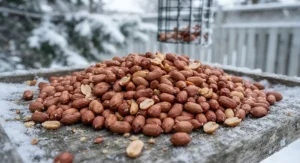
This is one of the most common points of confusion for anyone new to peanuts for wild birds, and the honest answer is: it depends entirely on which birds you’re trying to attract and which feeder you own. Whole in-shell peanuts are the natural favourite of larger, stronger-billed birds — blue jays in particular will work at cracking a shell open, often caching several in nearby crevices for later. Smaller birds like chickadees, nuthatches, and titmice generally lack the bill strength to manage a whole shell efficiently, which is exactly why shelled peanuts or peanut pieces exist as a separate category: they’re pre-processed convenience food for birds that would otherwise be locked out entirely.
Here’s what most buying guides skip: the feeder format has to match the peanut format, not the other way around. A mesh feeder with a tight weave designed for shelled peanuts will frustrate jays trying to extract whole nuts, while a wide-mesh whole-peanut feeder like the Birds Choice XWPF Magnet Mesh Whole Peanut Feeder will let shelled pieces fall straight through and land on the ground, where they’re more likely to attract rodents than birds. Cost is a secondary factor worth weighing too — shelled peanuts typically run more expensive per kilogram since they’ve already been processed, while whole in-shell peanuts offer more bulk for the price but generate shell litter under the feeder. If you’re feeding a genuinely mixed crowd, running two feeders — one shelled, one in-shell — solves the mismatch problem entirely rather than forcing a single format to do double duty.
Squirrel-Proof Peanut Feeder: What Actually Works
Every backyard birder eventually has the same conversation with themselves: is a “squirrel-proof” feeder actually squirrel-proof, or is that just marketing? The honest answer, based on the mechanical designs actually available, is that the weight-triggered shroud systems used in products like the Squirrel Buster Standard and Squirrel Buster Nut Feeder are genuinely effective — not because squirrels can’t physically reach the feeder, but because the mechanism closes access the instant their body weight registers on the shroud, regardless of where they position themselves. That’s meaningfully different from older “squirrel-resistant” designs relying purely on cage spacing, which clever squirrels frequently learn to work around within a season.
Nature Canada notes that peanuts are especially prone to attracting unwanted visitors like squirrels and raccoons, which is exactly why mechanism-based solutions tend to outperform passive ones for this specific food. Placement matters just as much as the feeder itself: manufacturers of weight-triggered systems typically recommend at least 18 inches of clearance from any structure a squirrel could leap from, since a squirrel that can reach the feeder without placing its full weight on the shroud effectively bypasses the mechanism entirely. Baffles mounted below the feeder add a second layer of defence for pole-mounted setups, blocking the climb before a squirrel even reaches the shroud. What’s worth being upfront about: no consumer feeder claims to stop raccoons, bears, or determined flying squirrels, and reputable manufacturers say so directly rather than overselling. Realistic expectations, paired with correct placement, are what actually separate a squirrel-proof feeder that works from one that becomes an expensive lawn ornament.
Peanuts as a High-Fat Energy Source for Birds
The nutritional case for peanuts comes down to one simple fact: fat delivers more than double the calories per gram compared to carbohydrates or protein, which makes it the single most efficient fuel a small bird’s body can burn to generate heat. Cornell Lab’s All About Birds describes peanut feeders as an “artful variation” on the classic tube design specifically because they concentrate this kind of energy-dense food in a format birds can access efficiently.
For species overwintering in Canada — chickadees, nuthatches, downy and hairy woodpeckers among them — that energy math isn’t academic. A black-capped chickadee weighing roughly the same as two toonies has to maintain a body temperature dozens of degrees above the surrounding air on a January night, and that requires burning through fat reserves at a pace that natural food sources alone often can’t replenish fast enough during short winter days. Here’s what most seed-mix marketing won’t tell you: cheaper filler seeds like milo and red millet offer comparatively little usable fat, meaning a bird has to eat considerably more volume to get the same energy return peanuts provide in a fraction of the quantity. That efficiency is exactly why peanuts see such heavy traffic in cold months, and why experienced birders treat them less as a treat and more as functional winter infrastructure — the equivalent of leaving a gas station open on a highway with few other stops.
Setting Up Your Peanut Feeding Station
Getting a peanut feeding station right on the first attempt saves weeks of trial and error. Start with placement: hang the feeder at least 1.5 to 2 metres from windows to reduce collision risk, and within 3 metres of cover like shrubs or a tree line so smaller birds have a quick retreat from hawks and other predators. For the first thirty days, resist the urge to overfill — smaller batches that get consumed within a few days cycle out faster than they can spoil, especially in humid or rainy stretches.
Maintenance should run on a simple schedule: a full clean with hot water and a stiff brush every two to three weeks during heavy-use winter months, and immediately after any visible mould or a stretch of wet weather. Common first-month mistakes include mounting the feeder too close to a fence or railing a squirrel can leap from (undermining even a squirrel-proof mechanism), and mixing old peanuts with fresh stock, which speeds up spoilage across the whole batch. One optimization trick that pays off fast: pair a peanut feeder with a nearby water source. Birds visiting for high-fat food in cold weather often need water just as urgently, and a heated bath or a simple shallow dish can noticeably increase how long visitors linger — and how often they return.
🔍 Ready to Build Your Backyard Feeding Station?
✨ Take your peanuts for wild birds setup to the next level with the feeders reviewed above. Click through to check current pricing and availability, and start turning your yard into the kind of stopover birds actually plan around.
Real-World Scenarios: Matching Peanut Feeders to Your Backyard
The apartment balcony birder: If you’re working with a small balcony and want to avoid mess complaints from neighbours below, the Birds Choice Economy Nut Feeder is the sensible starting point — compact, mesh-contained, and cheap enough to experiment with before committing further. Pair it with a small tray to catch drips and you’re set.
The suburban family with squirrel pressure: A backyard with mature trees nearby and a squirrel population that’s already cracked two previous feeders calls for the Squirrel Buster Nut Feeder. The added cost is justified almost immediately by the amount of wasted peanut it prevents, and the mechanism means kids can watch the “squirrel fails to get in” show without any risk to the animal.
The rural property with jay families: If blue jays already treat your yard as a regular stop, the Birds Choice XWPF Magnet Mesh Whole Peanut Feeder or the Birds Choice Recycled Poly-Lumber Peanut Feeder both suit whole in-shell feeding at scale, with the poly-lumber option adding weatherproof longevity for a more exposed rural setting.
Common Mistakes When Buying a Peanut Feeder
Even experienced birders trip over a handful of recurring errors. First, buying based on capacity alone — a huge reservoir sounds efficient, but peanuts spoil faster than seed, so oversized feeders in humid climates often mean more waste, not less. Second, ignoring mesh size relative to peanut format, which leads to shelled peanuts falling straight through wide mesh or whole peanuts jamming tight mesh entirely. Third, mounting a “squirrel-resistant” feeder within jumping range of a fence, deck rail, or overhanging branch — undermining even a well-engineered mechanism through poor placement rather than a product flaw. Fourth, skipping drainage or ventilation features to save a few dollars, then dealing with mouldy peanuts within weeks. Fifth, assuming all peanuts are created equal — raw, unsalted peanuts specifically formulated for wildlife are worth the modest premium over grocery-store snack peanuts, which often carry salt or flavouring unsafe for birds.
Peanut Feeding for Different Backyard Birds and Skill Levels
Beginners generally get the fastest results starting with a small, inexpensive mesh feeder like the Birds Choice Economy Nut Feeder, since it lowers the financial risk of discovering peanuts simply aren’t drawing traffic in a particular yard. Intermediate birders chasing a specific species — say, downy woodpeckers or nuthatches — benefit from taller, clinging-friendly designs like the iBorn 14″ Metal Mesh Feeder, which gives vertical-feeding birds more comfortable purchase. Advanced backyard birders dealing with heavy squirrel pressure or wanting precise control over which species can access the feeder should look toward the Squirrel Buster line, where adjustable weight sensitivity and interchangeable mesh sizes offer a level of fine-tuning that basic feeders simply can’t match. Seniors or anyone prioritizing low-maintenance feeding will appreciate tool-free, removable-bottom designs across nearly every price tier reviewed here — cleaning ease matters more long-term than almost any other single spec.
Safety, Regulations & Long-Term Cost of Feeding Peanuts in Canada
There’s no federal licensing requirement to feed wild birds in most Canadian residential settings, but municipal bylaws around wildlife feeding do vary, particularly in areas with active bear activity, so it’s worth a quick check with your local municipality before setting up a permanent station. Peanuts themselves are, botanically, a legume rather than a true nut — a detail with real relevance for anyone managing a peanut allergy in the household, since shells and dust can linger on hands, clothing, and outdoor surfaces (see Wikipedia’s overview of peanuts for the botanical background). Always choose raw, unsalted peanuts formulated for wildlife rather than human snack peanuts, which frequently contain salt levels birds can’t safely process.
On long-term cost: a mid-range feeder in the C$30-C$45 bracket paired with a steady supply of wildlife-grade peanuts typically runs a modest weekly cost once you account for regional pricing, considerably less than most people initially assume once amortized against the entertainment and ecological value delivered over a multi-year feeder lifespan. Squirrel-proof models carry a higher upfront cost but often pay for themselves in wasted-peanut savings within a single winter season if squirrel pressure is genuinely high. Routine two-to-three-week cleanings extend feeder lifespan meaningfully — most reported “failures” of mesh and poly-lumber feeders trace back to neglected cleaning rather than material defects.
Frequently Asked Questions
❓ Can you feed wild birds peanuts year-round?
❓ Do peanuts attract squirrels more than other bird food?
❓ Should I use raw or roasted peanuts for birds?
❓ What birds eat peanuts from a feeder in Canada?
❓ How often should a peanut feeder be cleaned?
Conclusion
Peanuts for wild birds reward a small amount of upfront planning with an outsized return: more species variety, longer feeder visits, and a genuinely useful winter lifeline for the chickadees and woodpeckers already working your yard. The right feeder comes down to matching mesh size and peanut format to your target species, being honest about your squirrel situation, and prioritizing materials that shed moisture rather than trap it. Whether you start small with the Birds Choice Economy Nut Feeder or go straight for the mechanical certainty of the Squirrel Buster Nut Feeder, the seven options above cover the realistic range of budgets and problems most Canadian backyards actually face. Get the setup right once, and the birds tend to do the rest of the marketing for you.
Recommended for You
- No Melt Suet for Summer: 7 Blocks That Actually Survive the Heat (2026)
- Best Winter Suet Cakes 2026: 7 Top Picks That Won’t Freeze Solid
- Best Suet Cakes for Backyard Birds: 7 Top Picks for 2026
Disclaimer: This article contains affiliate links. As an Amazon Associate, I earn from qualifying purchases. If you purchase products through these links, we may earn a small commission at no additional cost to you.
✨ Found this helpful? Share it with your friends! 💬🤗
