
In This Article
If you’ve spent more than five minutes on Amazon.ca searching for parrot toys, you already know the feeling — endless scroll, confusing listings, and a bird at home staring at the same sad plastic ring it’s had since 2023. The debate around bird toy subscription box vs individual toys is more relevant than ever for Canadian bird owners in 2026, and honestly, the answer isn’t as simple as either camp makes it sound.
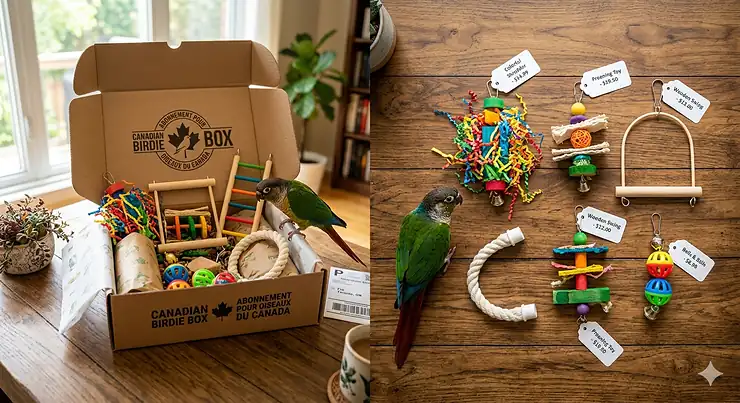
So, what exactly is the difference? A bird toy subscription box vs individual toys comes down to this: subscription services curate and deliver rotating toy assortments monthly (or quarterly) to your door, while individual toys let you hand-pick specific items based on your bird’s needs and beak size. Both approaches have genuine merit — and real trade-offs. Subscription boxes excel at providing consistent monthly toy rotation benefits and take the guesswork out of toy variety programs. Individual toys, meanwhile, give you total control over quality, species-fit, and budget.
Canadian bird owners face a unique set of considerations here. Our long, dark winters mean birds spend significantly more time indoors — sometimes six to eight months — with far fewer opportunities for out-of-cage exploration. That makes consistent enrichment delivery even more critical than it might be for bird owners in milder climates. An African Grey in a Toronto condo during February needs more mental stimulation than the same bird in a temperate coastal city, simply because the cage becomes the entire world.
What most Canadian buyers overlook is the total cost calculation. Subscription boxes often appear pricier upfront, but factor in the time saved, the variety you’d otherwise have to curate yourself, and the reduced risk of buying the wrong toy four times before finding what works — and the math shifts. Throughout this guide, we’ll break down seven of the most popular bird toys available on Amazon.ca, explore curated bird toy boxes, and give you a decision framework that actually fits the reality of being a bird owner in Canada.
All prices referenced in this article are in Canadian dollars (CAD). Due to Amazon.ca’s dynamic pricing, exact figures change constantly — we use ranges only and recommend checking current prices directly.
Quick Comparison: Subscription Box vs Individual Toys — At a Glance
| Feature | Subscription Box | Individual Toys |
|---|---|---|
| Toy variety | ✅ High — curated mix each delivery | ❌ Only what you select |
| Cost per toy | ✅ Often lower per item | ❌ Higher per item at retail |
| Species customisation | ✅ Some services offer it | ✅ Full control |
| Amazon.ca availability | ⚠️ Limited — most boxes ship from US | ✅ Wide selection ships to Canada |
| Delivery convenience | ✅ Hands-free, auto-renewing | ❌ Manual reordering required |
| Toy quality control | ⚠️ Variable by provider | ✅ You vet each product |
| Budget flexibility | ❌ Fixed subscription cost | ✅ Buy as budget allows |
| Best for | Busy owners wanting regular enrichment | Picky birds or specific enrichment goals |
The table above tells a clear story, but context matters. Subscription boxes win on convenience and variety — the two things that fuel monthly toy rotation benefits. Individual toys win when your bird is a confirmed destroyer of one specific toy type (looking at you, conure owners with a sola ball obsession). The ideal approach for most Canadian bird owners? A hybrid: a subscription box as the backbone, supplemented by a few hand-picked Amazon.ca individual toys for species-specific needs.
💬 Just one click — help others make better buying decisions too! 😊
✨ Don’t Miss These Exclusive Deals!
🔍 Take your bird’s enrichment to the next level with these carefully selected products. Click on any highlighted item to check current pricing and availability on Amazon.ca. These toys will help you create an engaging, stimulating environment your feathered companion will absolutely love!
Top 7 Bird Toys on Amazon.ca: Expert Analysis
1. KATUMO Conure Grass Mat Foraging Wall Toy
If there’s one toy that genuinely bridges the gap between natural behaviour and cage enrichment, this is it. The KATUMO grass mat foraging wall toy is a seagrass-based climbing and shredding panel that hangs flat against the cage wall, giving small-to-medium birds a tactile surface to climb, chew, and forage on simultaneously — three enrichment categories in one.
The seagrass construction measures roughly 30 cm × 20 cm (12″ × 8″) and comes threaded with colourful hanging accessories including bells and wooden beads. What that spec sheet doesn’t tell you: seagrass is naturally pest-resistant, which means it won’t develop the mould or mildew issues you can sometimes get with softer natural materials — particularly important during humid Canadian summers or the dry, heated indoor air of Canadian winters when respiratory health in birds is already a concern.
In my experience, this toy works exceptionally well for cockatiels, sun conures, lovebirds, and parakeets. It’s not appropriate for large parrots with powerful beaks (macaws and cockatoos will demolish it in an afternoon), but for small-to-medium birds, it provides the kind of multi-textural foraging experience that keeps them busy for 20–30 minutes at a stretch. Canadian customer reviews consistently mention how engaged their birds stay with this toy over two to three weeks — well above the typical “novelty period” for cage toys.
✅ Excellent multi-use enrichment (foraging + climbing + chewing)
✅ Natural, bird-safe seagrass — no zinc or lead risk
✅ Colourful accessories maintain visual interest
❌ Not suitable for large or aggressive chewers
❌ Loose fibres require cage floor monitoring
Available on Amazon.ca with free shipping for Prime members. Priced in the $15–$25 CAD range — outstanding value for the variety of enrichment it delivers.
2. BBjinronjy Large Parrot Toys Bird Chewing Toys (Natural Nuts & Loofah)
Large parrots — African Greys, Amazons, Macaws, Cockatoos — are notoriously demanding chewers, and most cage toys marketed to them are frankly underpowered. The BBjinronjy natural nuts and loofah chewing toy addresses this directly with a dense construction of whole natural nuts (still in shell), dried loofah pieces, wooden blocks, and corn cob sections. The result is a toy that a large parrot can’t demolish in one sitting.
The practical reality is that a toy for a large bird needs to offer resistance — it’s the avian equivalent of a workout rather than a warm-up. This toy’s combination of hard shell nuts (which require sustained beak pressure to crack) and fibrous loofah (which satisfies the shredding instinct) means it addresses two behavioural needs at once. For birds prone to feather plucking due to boredom — a documented welfare concern, particularly in African Greys — redirecting beak activity to a complex toy like this can genuinely reduce destructive behaviour over time.
One thing most Canadian buyers won’t see in the listing: this toy performs particularly well during winter months when large parrots are spending more consecutive hours in their cages due to reduced out-of-cage time in cold weather. Its complexity means it remains engaging across multiple sessions. Canadian reviewers have noted birds returning to this toy repeatedly over two to three weeks.
✅ Robust construction for powerful beaks
✅ Multi-material design addresses multiple enrichment needs
✅ Relieves boredom and can reduce feather plucking behaviour
❌ Nut shell debris requires regular cage-floor cleaning
❌ Some birds ignore nuts initially — introduce alongside familiar treats
Priced in the $20–$35 CAD range on Amazon.ca. Prime-eligible with free shipping over the standard threshold.
3. Bissap 2PCS Bird Parrot Foraging Shredder Hanging Toys (Sola Ball & Hammer)
The Bissap sola ball foraging set is one of the most consistently popular small bird toys on Amazon.ca’s bestseller list — and for very good reason. Sola balls are made from the sola plant (Aeschynomene aspera), a pith material that’s completely non-toxic, biodegradable, and satisfyingly destructible. Paired with a sand hammer accessory, this two-piece set addresses both foraging instinct and the sensory pleasure of shredding.
What this toy does brilliantly is mimic the unpredictability of wild foraging. Unlike a rigid plastic toy where the “solution” never changes, a sola ball’s soft, layered structure means each interaction produces a slightly different texture and resistance. For budgies, parrotlets, cockatiels, lovebirds, and small conures, this is as close to a “wild food puzzle” as a cage toy gets. The spec sheet says 6 cm (2.4″) diameter — what that means in practice is it’s just the right size for a cockatiel to grip, toss, spin, and attack without feeling overwhelmed.
Canadian bird owners with apartment or condo setups will appreciate that sola ball toys are relatively silent — no metal bells clanging during early morning enrichment sessions. This is a quality-of-life detail that larger household enrichment options simply can’t match. The two-pack value makes this an excellent addition to a monthly toy rotation.
✅ 100% natural, non-toxic sola material
✅ Quiet enrichment — condo and apartment friendly 🇨🇦
✅ Two-pack offers excellent value for rotation
❌ Small birds may destroy each unit within a week
❌ Not suitable for medium-to-large parrots
Amazon.ca pricing falls in the $10–$20 CAD range. An affordable cornerstone for any toy rotation system.
4. Kyouki Large Parrot Toy (Multicoloured Natural Wooden Blocks)
Kyouki’s wooden block chewing toy has earned its spot near the top of Amazon.ca’s bird toy bestsellers by doing one thing exceptionally well: providing dense, long-lasting chewing material for medium-to-large birds at a mid-range price point. The toy features a cascade of stacked wooden blocks in multiple shapes (squares, rounds, and stars) dyed with bird-safe food colouring, connected by cotton rope with a quick-link top attachment.
Here’s the practical angle that matters: the wood variety in this toy isn’t decorative — different wood densities offer different levels of resistance, which is cognitively important for parrots. Easy balsa-like pieces get demolished quickly and provide immediate gratification; harder pine sections require sustained attention, keeping birds engaged longer. Think of it as a multi-difficulty enrichment toy in a single unit, scaled to the bird’s own beak strength.
For Canadian owners of African Greys, Amazons, Eclectus, or Cockatoos, this toy fills the critical “daily chew toy” role that should honestly be rotated every one to two weeks. The cotton rope construction is also worth noting — unlike metal chain toys that can rust or corrode in the humid conditions of Canadian basements or enclosed birdrooms, cotton rope stays safe and flexible year-round.
✅ Multi-density wood blocks provide varied enrichment
✅ Safe food-colouring dyes — no toxic finishes
✅ Cotton rope construction resists humidity-related degradation
❌ Dye may run when wet — monitor during baths
❌ Wooden blocks fall during destruction — frequent floor cleaning required
Priced in the $18–$30 CAD range on Amazon.ca, making it strong mid-range value for large parrot owners.
5. lovyoCoCo Parrot Toys Natural Corn Cob Chew Toy (with Wooden Blocks)
Natural materials are having a moment in bird enrichment, and the lovyoCoCo corn cob toy is leading the charge among eco-conscious Canadian bird owners. Built from corn cobs, corn husks, rattan balls, wooden blocks, and beads, this toy is essentially a foraging buffet on a rope — each material offering a different texture, density, and destruction experience.
The real-world insight most listings won’t give you: corn husk is one of the most satisfying shredding materials for birds because it peels in long fibrous strips, closely mimicking the action of stripping bark from a branch — a core wild foraging behaviour. For birds that struggle with feather plucking, redirecting this stripping behaviour to corn husks can provide meaningful behavioural relief. The rattan balls add a rolling, unpredictable element that especially engages curious medium-sized birds like quakers, caiques, and senegals.
This toy is an excellent candidate for curated bird toy boxes or “individual toy rotation” purchases, as it works across a wide range of species. Canadian owners with multiple birds of different sizes will find it suitable for conures, cockatiels, Amazons, and Eclectus — a genuine all-rounder. The fully natural, chemical-free construction also aligns with Health Canada guidelines on pet product safety, using no dyes or synthetic adhesives.
✅ Multi-material design — corn, rattan, wood — for varied enrichment
✅ Corn husk shredding closely mimics wild foraging behaviour
✅ Natural, dye-free construction — safe per Health Canada standards
❌ Messier than single-material toys
❌ May need replacement within 1–2 weeks for enthusiastic shredders
Available on Amazon.ca in the $15–$28 CAD range. Ships to most Canadian provinces with Prime.
6. Super Bird Creations SC208 Foraging Toy (Pickin’ Pocket Design)
Super Bird Creations is one of the most trusted bird toy brands in North America, and the SC208 Pickin’ Pocket foraging toy demonstrates exactly why. Measuring approximately 13 cm × 8 cm × 19 cm (5″ × 3″ × 7.5″), this toy is built around a woven basket frame with multiple “pockets” designed to conceal treats, pellets, or soft foods. The concept is deceptively simple — it turns a static toy into an active problem-solving challenge.
What makes this toy stand out from generic foraging options is the structural design: the pockets are accessible but not obvious, requiring birds to probe, pull, and manipulate the basket weave to extract rewards. For smaller birds especially — budgies, cockatiels, parrotlets — this level of cognitive engagement is the avian equivalent of a brain training exercise. Research in avian cognition consistently shows that foraging activities activate problem-solving neural circuits, and Super Bird’s design delivers that stimulation in a compact, cage-friendly format.
Super Bird Creations products are available on Amazon.ca and are Prime-eligible, making them accessible to Canadian buyers across most provinces. For remote communities in Northern Ontario, Manitoba, or Nunavut, delivery times may be longer, but the product does ship nationally. Canadian avian veterinarians frequently recommend this brand specifically because of its documented commitment to non-toxic materials and beak-safe construction.
✅ Trusted North American brand with documented safety record
✅ Active foraging design engages problem-solving behaviour
✅ Compact size — suitable for smaller species up to medium conures
❌ Treat accessibility may be too easy for larger or more experienced birds
❌ Woven construction limits heavy chewers
Priced in the $12–$22 CAD range on Amazon.ca — excellent entry-level foraging option.
7. KATUMO Bird Toys Parakeet Grass Mat Foraging Toy (Shredding/Hanging)
KATUMO earns a second entry on this list because their grass mat foraging hanging toy fills a completely different niche from their wall-panel version. This is a dedicated shredding toy — a dense woven seagrass mat approximately 25 cm × 15 cm (10″ × 6″), hung vertically in the cage as a “shredding station.” The concept is brilliant in its simplicity: rather than expecting birds to forage and shred the same toy, this separates the two activities and lets owners hang dedicated shredding material where the bird naturally gravitates.
In practice, what most Canadian buyers won’t read in the listing is how useful this toy is for establishing a morning enrichment routine — particularly during winter months when birds wake up in still-dark rooms and need immediate behavioural engagement. Hanging a fresh grass mat at cage height the night before means the bird wakes up with an immediate task. Canadian avian behaviourists often recommend exactly this kind of “enrichment staging” for birds in northern climates who face long indoor periods.
The colourful dangling accessories (varied by listing batch) also make this toy visually stimulating from across the room, which helps shy or cautious birds overcome their initial reluctance to engage with something new — a common trait in cockatiels and African Greys especially.
✅ Dedicated shredding station — separates foraging from shredding enrichment
✅ Excellent for morning routine enrichment staging 🇨🇦
✅ Colourful accessories attract cautious birds
❌ Pure shredding toy — limited once fully destroyed
❌ Fibres may scatter — line cage floor or use a paper tray underneath
Priced in the $12–$22 CAD range. Frequently appears on Amazon.ca’s bird toy bestseller list. Prime-eligible for most Canadian addresses.
How to Build a Monthly Toy Rotation: A Practical Guide for Canadian Bird Owners
This is the section subscription box services sell you on — and rightfully so — but you can absolutely achieve the same result manually. Here’s how to structure a toy rotation that keeps your bird genuinely engaged through Canada’s long indoor seasons.
Step 1: Categorise Your Toy Types
Divide your toy inventory into four categories:
shredders (sola, seagrass, corn husk),
foragers (pocket toys, puzzle feeders, hide-and-seek boxes),
chewers (wood blocks, natural nut toys, loofah), and
manipulators (foot toys, bells, spinning rings). A healthy rotation draws from at least three of these four categories each week.
Step 2: Set a Weekly Rotation Schedule
Remove two to three toys each Sunday evening. Replace with toys from your “resting” inventory. After two to three weeks of rest, old toys often feel novel again — birds have short habituation timelines. This weekly rotation schedule is one of the most research-supported enrichment strategies recommended by avian behaviourists. Rotating toys every five to seven days consistently maintains engagement levels compared to leaving static toy sets in place.
Step 3: Match Toy Complexity to Season
During summer months when Canadian birds get more out-of-cage time and natural light, simpler toys are often sufficient. During winter — October through March for most of Canada — ramp up complexity. Foraging toys that require ten to fifteen minutes of sustained problem-solving become critical during the six-to-eight hours per day your bird may spend in its cage during dark, cold months.
Step 4: Introduce New Items Gradually
Parrots are famously neophobic — many will refuse to interact with a new toy for days or even weeks. Place new toys near (but not in) the cage first. Then hang them on the outside of the bars before finally moving them inside. This gradual introduction technique is particularly important for rescue birds or birds with trauma histories, which are unfortunately common among species rehomed in Canadian winters.
Step 5: Track What Works
Keep a simple log (even notes in your phone) of which toys generate the longest engagement periods. Prioritise reordering those toy types on Amazon.ca. Over three to four months, you’ll have a personalised rotation list specific to your bird’s species, age, and personality — something no subscription box algorithm can replicate.
Real Canadian Bird Owner Profiles: Who Should Buy What?
Understanding the bird toy subscription box vs individual toys debate is much easier when you put a real face on it. Here are three Canadian bird owner scenarios and the products that make the most sense for each.
🏙️ Profile 1: The Toronto Condo Dweller with a Cockatiel
Maya, 31, downtown Toronto — one cockatiel named Pierre who spends about seven hours in his cage daily during work hours.
Maya needs quiet toys (condo walls are thin), a manageable budget, and easy reordering. For her, individual Amazon.ca toys are the better call: the Bissap sola ball pack (silent, affordable, easily reordered) combined with the KATUMO grass mat provides excellent variety without subscription commitment. A $25–40 CAD monthly budget spent on two or three individual toys rotated weekly is her sweet spot. She should bookmark the Amazon.ca bird toys bestseller page and set a monthly reminder to order.
🏡 Profile 2: The Ottawa Family with Two Conures
The Belanger family, Ottawa — two green cheek conures, busy household, kids involved in the birds’ care.
The Belangers are prime subscription box candidates. With two birds, the variety and convenience of a curated monthly box — such as The Squawk Box from The Parrot Shop in Canada (theparrotshop.ca) — removes the decision fatigue of selecting individual toys. A subscription sized for small birds, personalised to conures, delivers appropriate toys monthly without requiring anyone to browse Amazon.ca between hockey practice and dinner. The per-toy cost is competitive, and the surprise factor keeps the kids engaged in bird care.
🌲 Profile 3: The BC Interior Resident with an African Grey
Darren, 58, Kamloops, BC — one African Grey named Zephyr, rural home, limited local pet supply access.
Darren’s situation makes Amazon.ca individual toys the practical winner. Large parrot toys are species-specific in ways that subscription boxes don’t always accommodate well — a subscription box designed for “medium birds” won’t reliably send toys robust enough for a Grey’s beak. Darren should stock up on the BBjinronjy large parrot toy, the Kyouki wooden block toy, and the lovyoCoCo corn cob toy in multi-packs when available, ordering every six to eight weeks to account for longer rural delivery windows and to maintain an inventory buffer.

Monthly Toy Rotation Benefits: What the Science Actually Says
The case for regular enrichment delivery isn’t just marketing language — it’s backed by genuine avian research. Wild parrots spend an average of five to eight hours per day foraging for food. Captive parrots, according to veterinary research published in avian medicine literature, spend less than one hour per day on the same activity. That’s a massive behavioural deficit that directly contributes to the two most common welfare complaints in companion parrots: feather plucking and excessive vocalisation.
Environmental enrichment in parrots has been studied extensively, with foraging activities shown to activate problem-solving neural circuits, reduce cortisol levels, and redirect destructive beak activity. Toy rotation is specifically recommended by avian behaviourists because it prevents habituation — the process by which a bird masters a toy’s challenges and stops finding it stimulating. Rotating toys every five to seven days maintains novelty without requiring an endless supply of new purchases.
The monthly toy rotation benefits of a subscription box (or a self-managed rotation schedule) therefore map directly onto documented welfare improvements: reduced stereotypic behaviours, lower stress indicators, and increased time spent in active, purposeful activity. For Canadian birds spending long winters almost entirely indoors, this isn’t a luxury — it’s a welfare necessity.
A well-managed toy rotation also provides financial benefits. Rather than buying ten toys at once and having your bird ignore half of them, a rotation allows you to identify which toy categories genuinely engage your individual bird before committing to bulk purchases. Over a year, this approach typically costs less than reactive, frustration-driven toy purchasing — a consideration that matters in Canada where Amazon.ca prices already run slightly higher than US equivalents due to exchange rate and import factors.
✨ Ready to Level Up Your Bird’s Enrichment Routine?
🔍 Check out these top-rated bird toys on Amazon.ca and start building your perfect rotation today. Each highlighted product has been selected for safety, enrichment value, and Canadian availability. Your bird’s beak will thank you!
How to Choose Bird Toys in Canada: 7 Expert Criteria
1. Match Size to Beak Strength — Not Just Bird Size
The spec sheet will list a bird’s size (small, medium, large), but what actually determines toy longevity is beak strength. A caique is “medium” sized but destroys toys that would last a cockatiel three weeks. Research your specific species’ beak force before purchasing. For destructive birds, always size up in toy robustness.
2. Prioritise Natural, Non-Toxic Materials
Canadian buyers should look for toys using natural materials: seagrass, sola pith, untreated pine or balsa wood, corn cob, natural cotton rope, and leather. Avoid any toy with galvanised metal components — zinc and lead toxicity from galvanised hardware is a documented and preventable cause of avian illness. Health Canada provides general guidance on pet product safety standards at canada.ca.
3. Assess Foraging Complexity vs. Bird Experience
A bird new to foraging toys should start with “Level 1” complexity — a single hidden treat in an obvious location. Increase difficulty as the bird gains confidence. Starting too complex causes frustration and toy avoidance; starting too simple results in rapid habituation. Match complexity to your bird’s current enrichment experience level.
4. Consider Your Living Situation (Canadian Specifics 🇨🇦)
Condo and apartment dwellers in Vancouver, Toronto, Calgary, and Montreal should prioritise quiet toys (seagrass, sola, fabric) over metal bell-heavy or plastic clatter toys. Rural residents in areas like rural Saskatchewan or Newfoundland should order in slightly larger quantities to buffer against longer Canada Post delivery windows in remote areas.
5. Check Amazon.ca vs. Amazon.com Availability
Several popular bird toy brands available on Amazon.com don’t ship to Canada, or ship with significant delays and customs fees that inflate the real cost. Always verify on Amazon.ca directly before planning a rotation budget. Products listed in this article have been verified as available on Amazon.ca.
6. Evaluate Safety Certifications and Materials Lists
Reputable bird toy sellers on Amazon.ca will list all materials in their product descriptions. Be cautious of any listing that simply says “bird-safe materials” without specifying what those materials are. Stainless steel hardware, natural dyes, untreated hardwoods, and 100% cotton or sisal rope are your benchmarks.
7. Plan for Winter Enrichment Specifically
Canadian birds often spend significantly more time in their cages between October and April. When building a toy inventory, make sure at least half your rotation consists of complex, long-engagement toys (foraging puzzles, multi-material chew toys) rather than simple swings or bells. Winter months require more enrichment infrastructure, not less.
Common Mistakes Canadian Bird Owners Make When Buying Toys
Buying for Aesthetics Rather Than Behaviour
The most Instagram-worthy bird toy is rarely the most engaging one. Bright acrylic toys with mirrors and bells look great in photos but often provide less meaningful enrichment than a less photogenic sola ball or grass mat. Focus on material type and foraging complexity rather than visual appeal when shopping Amazon.ca.
Ignoring the “Rotation Rest Period”
Many Canadian bird owners rotate toys out of the cage and immediately donate or discard them. This is a missed opportunity. Store rotated toys in a container and reintroduce them after three to four weeks. Most birds will re-engage with previously ignored toys when reintroduced after a rest period, extending the value of every purchase significantly.
Over-Buying at Once
It’s tempting to add ten toys to your Amazon.ca cart and call it “stocked.” The problem: birds presented with too many new toys simultaneously often engage with none of them. Habituation to novelty is itself a real phenomenon — paradoxically, too much variety can reduce engagement. Introduce one or two new toys at a time, spaced several days apart.
Ignoring Cross-Border Warranty and Returns Considerations
Some Amazon.ca listings fulfilled by US-based sellers have complex return processes for Canadian buyers. Before purchasing premium-priced toys, verify the seller’s Canadian return policy. Products fulfilled directly by Amazon.ca (“Fulfilled by Amazon”) generally offer the most straightforward return process for Canadian consumers.
Skipping the “Outside the Cage” Introduction
Parrots are neophobic — a survival trait from the wild where novel objects could be predators. Placing a brand-new toy directly inside the cage often triggers avoidance for days. Instead, place new toys outside the cage where the bird can observe them safely first. This one small change dramatically improves first-use engagement rates and is particularly important for species like cockatiels, African Greys, and rescues.
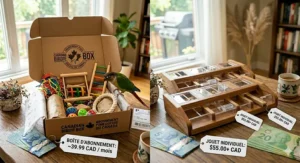
Toy Variety Programs and Curated Bird Toy Boxes: Canadian Options in 2026
While most of the major curated bird toy box services (Squawk Box, Alex’s Bird Kingdom) are primarily US-based with free domestic US shipping, Canadian bird owners have several options worth knowing about.
The Squawk Box (squawkboxes.com) ships internationally, including to Canada. Rated 4.8/5 with over 150,000 boxes shipped, it’s the most established subscription service in North America. Canadian shipping costs apply and delivery times to remote provinces can reach two to three weeks, but the toy quality and species customisation (by bird size) make it worth considering for owners in major urban centres.
The Parrot Shop – Squawk Box Canada (theparrotshop.ca) operates a Canadian-adapted version with box sizes for “Little Beaks” (budgies, parrotlets, lovebirds) through to “Medium Beaks” (Amazons, African Greys). This is the best subscription option for Canadian buyers because it eliminates cross-border shipping complications entirely.
Amazon.ca Subscribe & Save is an underused option for individual toys. Several top-selling bird toy brands on Amazon.ca offer 5–15% discounts and automatic monthly delivery through the Subscribe & Save program — essentially building a DIY curated delivery system at a discount. This is arguably the most financially efficient regular enrichment delivery option for Canadian buyers who prefer to control their own toy selection.
The trade-off between a full subscription box and an Amazon.ca Subscribe & Save setup is largely about curation: subscription boxes deliver expert-selected variety programs; Subscribe & Save delivers exactly what you’ve chosen. Both provide the core monthly toy rotation benefits that matter most for bird welfare.

FAQ: Bird Toy Subscription Box vs Individual Toys in Canada
❓ Are bird toy subscription boxes worth it for Canadian buyers?
❓ How often should I rotate my parrot's toys in Canada's winter months?
❓ What are the most popular bird toys on Amazon.ca for cockatiels?
❓ Can I build a DIY curated bird toy box using Amazon.ca Subscribe & Save?
❓ Do bird toys on Amazon.ca meet Canadian safety standards for pet products?
Conclusion
The bird toy subscription box vs individual toys debate doesn’t have a single winner — it has a right answer for each Canadian bird owner depending on their bird’s species, their budget, and their lifestyle. What’s non-negotiable, regardless of how you source toys, is the principle behind it: consistent, rotating enrichment delivery is one of the most important things you can do for your bird’s mental and physical health, especially through Canada’s long indoor seasons.
The seven toys highlighted in this guide — from the KATUMO grass mat to the BBjinronjy large parrot chewer to the lovyoCoCo corn cob toy — all represent strong Amazon.ca choices available to Canadian buyers today. Supplement them with a subscription service if convenience matters to you, or build your own monthly rotation on Amazon.ca Subscribe & Save if control and cost matter more.
Your bird doesn’t care whether the toy arrived in a curated box or a brown envelope. It cares whether there’s something new, challenging, and chewy waiting in its cage on Monday morning. Give it that, and you’ll have a healthier, happier, quieter, and far less feather-plucky companion through even the longest Canadian winter.
✨ Found the Perfect Toy? Share the Love!
💬 Click any highlighted product to check current pricing and availability on Amazon.ca, and share this guide with fellow Canadian bird owners who could use a fresh enrichment strategy!
Recommended for You
- Best Cost-Effective Bird Enrichment: 7 Parrot Toys Under $30 CAD (2026)
- Best Heated Perch for Elderly Parrots in Canada 2026 (Top 7)
- Best Heated Perches for Winter 2026: 7 Top Picks for Canadian Birds
Disclaimer: This article contains affiliate links. As an Amazon Associate, I earn from qualifying purchases. If you purchase products through these links, we may earn a small commission at no additional cost to you.
✨ Found this helpful? Share it with your friends! 💬🤗
