
In This Article
Picture this: it’s 3 AM on a January night in Winnipeg, and the temperature has plummeted to -35°C. While you’re snuggled under blankets, there’s a black-capped chickadee—no heavier than three loonies—perched in your backyard, shivering to stay alive. That tiny bird faces an 80-degree temperature gradient between its body and the frigid air, and it needs to survive until sunrise.
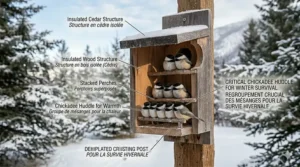
Here’s the thing most Canadians don’t realize: a proper roosting box for Canadian winter can literally mean the difference between life and death for these remarkable creatures. Unlike regular birdhouses designed for nesting, winter roosts have a completely different purpose—they’re thermal refuges that help small cavity-nesting birds like chickadees, nuthatches, and wrens conserve precious energy during our brutal winters.
I learned this the hard way three winters ago when I found a frozen chickadee beneath my empty nest box. That’s when I discovered that tree cavities can provide up to 15°C warmer temperatures than exposed sites—a massive 35% energy saving that extends a bird’s fasting endurance by seven hours. For a bird that burns 60% of its body weight daily just to stay warm, that’s not a luxury; it’s survival equipment.
This guide covers everything you need to know about choosing, placing, and maintaining a winter roosting box chickadee and other small birds will actually use. We’ll look at insulated bird roosting box Canada options, heated roosting box extreme cold solutions, and multi-perch roosting box designs that accommodate multiple birds huddling together for warmth—because yes, chickadees actually do share body heat on the coldest nights.
Quick Comparison Table: Top Roosting Boxes at a Glance
| Product | Entrance Size | Perches | Price (CAD) | Best For | Rating |
|---|---|---|---|---|---|
| Urban Nature Store Winter Roost | Bottom entry | 3 staggered | $45-55 | Black-capped chickadees | ⭐⭐⭐⭐⭐ |
| Woodlink Cedar Winter Roosting Box | 1-9/16″ | 2 vertical | $50-65 | Multiple species | ⭐⭐⭐⭐½ |
| Wild Birds Unlimited Convertible | 1-½” | 3 removable | $60-75 | Year-round use | ⭐⭐⭐⭐⭐ |
| Coveside Small Winter Roost | 1-5″ slate guard | 3 interior | $55-70 | Predator protection | ⭐⭐⭐⭐½ |
| Kettle Moraine Small Cedar | 1-¼” copper | 2 interior | $40-50 | Chickadees, nuthatches | ⭐⭐⭐⭐ |
| Stovall Large Roosting Box | 2″ rustic | 2 + back screen | $65-80 | Multi-species | ⭐⭐⭐⭐ |
| Nature’s Way Cedar Bluebird | 1-½” | 1 perch | $35-45 | Budget option | ⭐⭐⭐½ |
💬 Just one click – help others make better buying decisions too! 😊
✨ Don’t Miss These Exclusive Deals!
🔍 These roosting boxes are carefully vetted for Canadian winters. Click any highlighted product above to check current pricing and availability on Amazon.ca. Your purchase helps support local wildlife while giving birds the winter shelter they desperately need!
Top 7 Roosting Box for Canadian Winter: Expert Analysis
1. Urban Nature Store Winter Roost – The Canadian-Made Champion
Price: $48-55 CAD
Availability: In stock on Amazon.ca and Urban Nature Store direct
If there’s one roosting box designed specifically for Canadian conditions, it’s the Urban Nature Store Winter Roost. Handcrafted in St. Catharines, Ontario from white pine, this box understands our winters because it was literally built here.
The design is brilliant in its simplicity: entrance hole at the bottom (warm air rises and stays trapped inside), dark-stained roof to attract solar heat, and three staggered perches that let multiple chickadees roost without crowding. The tight seam construction prevents heat loss—critical when you’re dealing with -30°C nights in Alberta or bone-chilling winds across the Prairies.
Key Specifications:
- Material: White pine (natural insulation)
- Interior perches: 3 staggered
- Entry placement: Bottom-mounted for heat retention
- Dimensions: 7″ W × 8″ H × 6″ D
Customer Feedback (Canadian buyers): “We had four chickadees using it by the second night in Edmonton. The bottom entry is genius—no drafts!” Another Ontario buyer noted it survived three winters without any weathering issues.
✅ Pros:
- Made in Canada specifically for our climate
- Bottom entry maximizes heat retention
- Dark roof attracts solar warming
- Easy-clean front panel
❌ Cons:
- Pine may weather faster than cedar in coastal BC
- Limited to smaller birds (chickadees, nuthatches, wrens)
Target Users: Perfect for Canadians who want a proven, locally-made solution designed for our specific winter challenges.
2. Woodlink Cedar Winter Roosting/Shelter Box – The American Classic
Price: $52-68 CAD
Availability: Ships to Canada via Amazon.ca
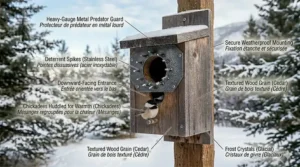
The Woodlink Cedar Winter Roosting Box is constructed from reforested inland red cedar with screwed (not nailed) construction. This matters in Canadian freeze-thaw cycles—screws hold, nails work loose.
What sets this apart is the 1-9/16″ entrance hole, slightly larger than typical chickadee boxes. This accommodates multiple small bird species while still excluding starlings and house sparrows. The two vertical perches inside provide roosting space, though not as optimal as staggered perches for group huddling.
Key Specifications:
- Material: Kiln-dried inland red cedar
- Entry hole: 1-9/16″
- Interior: 2 vertical perches
- Assembly: Screwed construction with mounting hardware
Customer Feedback: Canadian buyers appreciate the cedar durability. One Calgary reviewer mentioned it weathered two winters perfectly. However, several noted that squirrels can enlarge the entrance hole without a metal guard.
✅ Pros:
- Rot-resistant cedar construction
- Screwed assembly withstands freeze-thaw
- Convertible to nesting box in spring
- Well-known North American brand
❌ Cons:
- Vertical perches less ideal for huddling
- No predator guard included
- Slightly higher price point for Canadian shipping
3. Wild Birds Unlimited Convertible Roosting Box – The Year-Round Solution
Price: $62-76 CAD
Availability: Available through WBU stores across Canada and online
The Wild Birds Unlimited Convertible is handmade in Ontario from Eastern White Pine, and here’s what makes it exceptional: you literally flip the front panel and remove the perches come spring, and it transforms into a proper nesting box for bluebirds or tree swallows.
For winter use, it features three removable staggered perches—the gold standard for cold weather bird shelter. The entrance is at the bottom during winter mode, then you flip it to top-entry for nesting season. This dual functionality means you’re not buying separate boxes for different seasons, which appeals to both your wallet and storage space.
Key Specifications:
- Material: Eastern White Pine from Ontario
- Perches: 3 staggered, easily removable
- Convertible design: Winter roost ↔ Summer nest box
- Canadian-made with drainage holes and cleaning access
Customer Feedback: Barrie, Ontario customers report seeing up to 10-12 chickadees packed into these boxes on particularly cold nights. The conversion feature gets high marks for convenience.
✅ Pros:
- Dual-season functionality saves money
- Staggered perches perfect for group roosting
- Made in Ontario for Ontario winters
- Rough interior helps birds grip
❌ Cons:
- Higher initial investment
- Requires seasonal adjustment (removing/adding perches)
4. Coveside Small Winter Roost – The Predator-Proof Option
Price: $58-72 CAD
Availability: Ships to Canada, Maine-made
Crafted in Maine (similar climate to Atlantic Canada), the Coveside Small Winter Roost features 1″ thick Eastern White Pine for superior insulation—that extra thickness matters when wind chills hit -40°C in the Maritimes or Northern Ontario.
The standout feature is the repurposed slate guard around the 1.5″ entrance hole. This isn’t decorative—it prevents squirrels and woodpeckers from enlarging the hole, a common problem in Canadian winters when desperate animals seek any shelter. The front panel lifts with an L-shaped metal hook for spring cleaning.
Key Specifications:
- Wall thickness: 1″ Eastern White Pine
- Entrance: 1.5″ with recycled slate predator guard
- Interior: 3 perches for 6+ birds
- Made in USA (Maine), ships to Canada
Customer Feedback: Canadian buyers in rural areas especially appreciate the predator protection. One Saskatchewan customer mentioned red squirrels couldn’t chew through the slate guard after multiple winters.
✅ Pros:
- Extra-thick walls (1″) for extreme cold
- Slate guard prevents predator damage
- Slanted roof for rain/snow runoff
- Accommodates 6+ small birds
❌ Cons:
- Higher shipping costs to western Canada
- Heavier than standard boxes (installation consideration)
5. Kettle Moraine Small Cedar Roosting Box – The Budget Cedar Choice
Price: $42-52 CAD
Availability: Available on Amazon.ca
The Kettle Moraine Small Cedar offers solid cedar construction with a copper portal entrance at a more accessible price point. The 1-¼” entrance is perfectly sized for black-capped chickadees and nuthatches while excluding larger, more aggressive birds.
Two interior perches provide roosting space, and the optional hanging hook or pole-mounting bracket adds installation flexibility. The stainless steel hardware resists rust—essential in our salty winter road spray regions or coastal humidity.
Key Specifications:
- Material: Solid cedar with stainless hardware
- Entrance: 1-¼” with copper portal
- Perches: 2 interior
- Mounting: Optional hook or 1″ pole bracket
Customer Feedback: Toronto-area customers report good durability over multiple seasons. The copper entrance adds a decorative touch that doesn’t tarnish. Some mention the smaller size limits it to 2-3 birds maximum.
✅ Pros:
- Affordable cedar construction
- Copper portal prevents chewing
- Stainless hardware won’t rust
- Compact size easy to position
❌ Cons:
- Only 2 perches (limited capacity)
- Smaller interior than premium options
6. Stovall Large Roosting Box – The Multi-Species Haven
Price: $68-82 CAD
Availability: Amazon.ca with shipping to most provinces
The Stovall Roosting Box breaks the small-bird-only mold with its 2″ entrance and spacious 16″ × 11″ × 10¾” interior. This is the cold weather bird shelter for those who want to accommodate diverse species—wrens and chickadees on the perches, woodpeckers clinging to the rough back screen, nuthatches wherever they please.
The rustic finish with hand-sanded cedar and finishing washers creates an attractive piece that doesn’t look out of place in suburban yards. Two 15″ roosting perches plus that screened back wall provide multiple roosting strategies for different bird behaviours.
Key Specifications:
- Dimensions: 16″ H × 11″ W × 10¾” D (large capacity)
- Entrance: 2″ (accommodates multiple species)
- Interior: 2 long perches + rough back screen
- Material: All-cedar with stainless steel screws
Customer Feedback: Canadian buyers with larger properties appreciate the multi-species appeal. One 8-acre Ontario property owner reported both chickadees and downy woodpeckers using it simultaneously. Note: the larger entrance does require better squirrel protection strategies.
✅ Pros:
- Accommodates multiple species simultaneously
- Large interior for extreme crowding on coldest nights
- Back screen for clinging species (woodpeckers, nuthatches)
- Well-constructed with quality hardware
❌ Cons:
- 2″ hole allows larger, more aggressive birds
- Higher price point
- Requires predator baffle on pole mounting
7. Nature’s Way Cedar Bluebird Box – The Convertible Budget Option
Price: $38-48 CAD
Availability: Widely available on Amazon.ca
While technically marketed as a bluebird house, the Nature’s Way Cedar Bluebird Box works as a winter survival equipment birds can use with minor modifications. The rot-resistant cedar and rust-free stainless steel hardware handle Canadian winters, and the ventilation system (which you’ll want to block for winter use) indicates quality construction.
The 1-½” entrance suits most small cavity-nesting birds. Add your own perches (dowels from any hardware store work perfectly), and you’ve got an affordable roosting option. The clean-out door makes spring maintenance straightforward.
Key Specifications:
- Material: Rot-resistant cedar
- Hardware: Rust-free stainless steel
- Entrance: 1-½”
- Ventilation: Air vents (block for winter)
Customer Feedback: Budget-conscious Canadians appreciate the price point. Several DIY-ers mention adding their own perches and blocking vents with weatherstripping for winter use. One Nova Scotia buyer used it for three seasons with good results.
✅ Pros:
- Most affordable cedar option
- Good construction quality
- Wide availability across Canada
- Easy to modify for winter use
❌ Cons:
- No included perches (DIY required)
- Needs winter modifications (vent blocking)
- Not purpose-built as roosting box
Understanding Winter Roosting vs. Summer Nesting: Why It Matters
Most Canadians own birdhouses—but here’s what they don’t know: leaving a standard nest box up all winter might actually harm birds rather than help them. Let me explain the crucial differences.
The Physics of Warmth
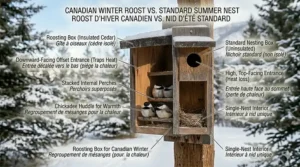
Summer nest boxes feature ventilation holes near the roof and drainage holes in the floor. Perfect for keeping eggs cool and preventing moisture buildup when adult birds are constantly entering and leaving. But in winter? Those ventilation holes become heat escape routes. Warm air generated by huddling birds rises straight out the top vents, while cold air drafts in through the bottom.
A proper roosting box for Canadian winter flips this design:
Entrance at the bottom – Warm air naturally rises and stays trapped in the upper portion where birds roost. Cold air that enters stays near the floor, below the roosting birds.
Sealed tight – No ventilation holes. During winter, birds aren’t creating the moisture problems that summer nests face. Every gap sealed means precious body heat retained.
Multiple perches – Staggered at different heights so birds can huddle closely without being in each other’s way. Research from the Manitoba Museum shows that chickadees sharing a winter roost can reduce individual energy expenditure by 35%.
The Behavioural Difference
Summer nesting is territorial—one pair per box, aggressively defended. Winter roosting is communal. On the coldest nights, you might find 8-12 nuthatches or chickadees packed into a single roosting box, sharing body heat. This is why multi-perch roosting box designs matter—they accommodate this natural cold-weather behaviour.
Canadian Winters Demand Canadian Solutions
Our winters aren’t Vermont winters. When Environment Canada forecasts windchills reaching -50°C in the Prairies, or Maritime ice storms coat every surface, or Vancouver Island experiences those rare deep freezes that catch everything off-guard—standard American birdhouse designs don’t cut it.
This is why insulated bird roosting box Canada options use thicker walls (1″ vs. the standard ¾”), denser woods (white pine or cedar over cheaper pine), and entrance designs that prioritize heat retention over easy access. The extra cost translates directly into survival rates for overwintering birds.
Comparison Table: Roosting Box Features vs. Traditional Birdhouses
| Feature | Winter Roosting Box | Summer Nest Box | Why It Matters |
|---|---|---|---|
| Entrance Location | Bottom-mounted | Top or side-mounted | Traps warm air inside vs. allows air circulation |
| Ventilation | Sealed/minimal | Multiple vent holes | Heat retention vs. egg temperature control |
| Interior Perches | 2-3 staggered perches | None (nesting material) | Enables huddling vs. flat nest platform |
| Wall Thickness | 1″ preferred | ¾” standard | Enhanced insulation for -40°C vs. shade in summer |
| Roof Design | Dark-stained (heat absorption) | Natural or light colour | Solar warming vs. heat deflection |
How Chickadees Actually Survive Canadian Winters (The Science)
Let me share something that blew my mind when I first learned it: a black-capped chickadee weighs 14 grams—about as much as a AAA battery. Its normal body temperature is 40°C. On a typical Manitoba winter night at -35°C, there’s an 75-80°C temperature gradient across just 2 centimetres of feathers.
How is that even possible?
The Torpor Trick
Chickadees employ a survival strategy called regulated hypothermia or torpor. Before roosting for the night, a chickadee will intentionally lower its body temperature by 10-12°C. This isn’t accidental—it’s controlled, like you turning down your thermostat before bed.
Research from the University of Manitoba shows this single adaptation provides a 25-50% energy savings overnight. For a bird that must consume 60% of its body weight in food daily just to survive, those saved calories mean an extra seven hours of fasting endurance. According to Hinterland Who’s Who, a Government of Canada resource, chickadees can lower their body temperature by 10-12°C at night to conserve precious energy. That could be the difference between making it to morning or not.
But here’s the catch: torpor only works if the bird has a safe, insulated roosting site. A chickadee exposed to wind and precipitation can’t afford to lower its body temperature—it would freeze. This is where your heated roosting box extreme cold or even just a well-insulated standard roost becomes survival equipment, not luxury housing.
The Huddle Effect
While chickadees often roost solo (they’re territorial even in winter), species like nuthatches and some chickadee populations will huddle together in roosting boxes on the coldest nights. Studies from Birds Canada document groups of 10-12 individuals crammed into small cavities when temperatures plummet below -30°C.
The math is simple: ten birds sharing body heat means each individual bird burns less energy maintaining its core temperature. A tree cavity—or your backyard roosting box—can provide an effective temperature difference of up to 15°C higher than an exposed site. For a 14-gram bird, that’s enormous. Studies documented on Wikipedia note that black-capped chickadees in parts of their range with severe winters show significantly higher survival rates when they have access to supplemental food and protected roosting sites.
Memory and Caching
Here’s another remarkable adaptation: a chickadee’s hippocampus (the brain region responsible for spatial memory) actually grows larger in fall. This expansion—up to 30% larger than summer size—enables the bird to remember thousands of cached food locations throughout winter.
Why does this matter for roosting boxes? Because chickadees with reliable roosting sites can cache food closer to home, reducing the energy expenditure of long-distance foraging flights in brutal weather. According to research published by Environment and Climate Change Canada, chickadees using regular roosting sites show better winter survival rates than those without consistent shelter.
Your roosting box becomes part of their winter survival infrastructure—a known, reliable thermal refuge they can plan their daily routines around.
Where to Place Your Roosting Box for Maximum Bird Use
I’ve installed eleven roosting boxes across my property over the years, and I’ve learned that location matters just as much as box quality. Here’s what actually works in Canadian conditions.
Height Matters (But Not How You Think)
Conventional wisdom says mount nest boxes 5-8 feet high. For winter roosts? Go higher—8-12 feet if possible. Why? Snow accumulation. That beautiful 2-foot snowfall that transforms your yard also buries ground-level vegetation and low boxes. Birds remember the clear flight path to your box in October; by January, that path might be blocked by snow drifts.
However, don’t go crazy high. Above 12-15 feet, you’re dealing with increased wind exposure. The Prairies and Atlantic Canada know wind. A roosting box swaying in 60 km/h gusts doesn’t invite occupancy—it invites nausea.
Direction: Think Like a Canadian
Face your roost entrance away from prevailing winter winds. In most of Canada, that means facing south or southeast. Alberta? Face east (away from those wicked westerly Chinook winds). Atlantic Canada? Northeast exposure protects from nor’easters. BC’s Lower Mainland? South-facing captures precious winter sun while avoiding rain-carrying Pacific systems.
One exception: if you’re in a spot with morning sun exposure, a slight southeast bias captures that early warmth. Chickadees emerge from torpor slowly, and those first rays of sun warming the box help them regain normal body temperature faster, conserving energy stores.
Mounting Strategy: Pole vs. Tree
Pole mounting offers predator control superiority. Use a metal pole with a baffle cone below the box. Squirrels, raccoons, and neighbourhood cats can’t climb past a properly positioned baffle. In rural areas where great horned owls hunt, this matters enormously.
However, tree mounting provides windbreak benefits. Mount on the leeward side of a large tree trunk, and that tree blocks significant wind. In exposed yards, this can make a measurable temperature difference inside the box.
My solution? I use both strategies on my property. High-traffic areas near my house get pole-mounted boxes (easier predator management). Sheltered back corners with mature trees get tree-mounted boxes (better natural protection).
The Evergreen Connection
Position roosting boxes within 10-15 metres of dense evergreens—spruce, pine, or cedar. These serve as staging areas where birds assess conditions before committing to enter the roost for the night. They also provide daytime shelter between feeding bouts.
Studies from the Cornell Lab of Ornithology show chickadees are far more likely to use roosting boxes with nearby conifer cover than isolated boxes, even when the boxes themselves are identical. The evergreens provide psychological security and physical windbreak.
Avoid These Location Mistakes
❌ Under eaves – Seems protected, but human activity near doors/windows disturbs roosting birds. They need quiet overnight.
❌ Near bird feeders – Daytime feeding happens there; nighttime roosting should be separate. Reduces disturbance and spreads bird activity across your property.
❌ Open fields – Unless you have absolutely no alternative. Wind exposure negates much of the box’s insulation value.
❌ South-facing walls – Yes, the wall blocks north wind, but afternoon sun can overheat the box. Too-warm roosts make birds waste energy thermoregulating upward instead of conserving energy.
Maintenance and Preparation: Getting Your Roosting Box Winter-Ready
Installing a roosting box in September and hoping for the best is like buying winter tires in January—technically possible, but you’ve already missed the optimal window. Here’s the maintenance timeline that actually works.
Fall Preparation (September-October)
Clean out summer nests completely. Old nesting material harbours mites, fleas, and bacteria that can sicken roosting birds. Use a stiff brush and scrape out everything. If the box saw heavy use, rinse with a 10% bleach solution (1 part bleach to 9 parts water), then let it air-dry completely for several days before reinstalling.
Add winter bedding. This step surprises most people: put 2-3 inches of wood shavings (NOT sawdust) in the bottom. Wood shavings provide ground-level insulation and give birds material to shuffle around for comfort. Sawdust compacts when wet and creates mould problems—stick with coarse shavings.
Wild Birds Unlimited stores across Canada sell appropriate wood shavings, or use clean aspen shavings from pet stores (sold for small animal bedding). Avoid cedar shavings—the oils can irritate birds’ respiratory systems in enclosed spaces.
Seal ventilation holes. If you’re converting a regular nest box, plug those top ventilation holes with weatherstripping or expandable foam (exterior grade). Leave drainage holes open—moisture from birds’ breath and snow infiltration needs somewhere to go.
Check entrance integrity. Run your fingers around the entrance hole. Any roughness or splintering? Sand smooth. Predators and winter weather will worsen even small damage over winter months.
Mid-Winter Monitoring (December-February)
Check mounting security monthly. Freeze-thaw cycles loosen screws and shift positions. I do a quick visual check whenever I refill feeders. Takes thirty seconds, prevents boxes crashing down during ice storms.
Monitor snow accumulation. After heavy snowfalls, verify the entrance isn’t blocked. I’ve seen boxes completely buried after lake-effect snow dumps in Southern Ontario. Gently clear entrance holes with a broom handle—no need to disturb birds inside.
Look for signs of use. Fresh droppings in snow below the entrance? Tiny footprints on the landing area? These confirm occupancy. You can also listen quietly at dusk—the soft rustle of birds settling in is unmistakable once you know what to listen for.
Do NOT open the box to check inside. Seriously. Mid-winter disturbance can cause birds to abandon the roost. A chickadee that flies out at 10 PM into -30°C weather may not survive to find alternative shelter.
Spring Transition (March-April)
Deep cleaning. Once temperatures consistently stay above freezing and migratory birds return, do a thorough cleaning. Remove all bedding, scrub interior surfaces, check for rot or damage.
Decide on conversion. If you have a convertible roosting box, this is when you flip the entrance panel and remove interior perches for nesting season. Standard roost boxes can either stay as-is (some species will nest in them without modifications) or be taken down and stored.
Inspect for repairs. Winter is hard on outdoor structures. Look for:
- Split wood seams (re-glue or replace)
- Rusty hardware (replace with stainless steel)
- Loose roof (re-seal or add new screws)
- Predator damage (reinforce with metal guards)
Make repairs in April/May before nesting season begins in earnest.
The Five-Year Deep Maintenance
Every 4-5 years, give your roosting box a complete overhaul. Sand and re-stain cedar boxes. Replace any warped panels. Check that the box is still properly sealed against drafts. Consider upgrading to better predator guards if you’ve had issues.
Quality roosting boxes can last 10-15 years with proper maintenance. My oldest Urban Nature Store box is entering its eighth winter and still performs perfectly because I’ve kept up with basic maintenance.
FAQ: Common Questions About Winter Roosting Boxes in Canada
❓ How cold can birds survive in a roosting box in Canada?
❓ Can multiple chickadees use one roosting box in winter?
❓ What's the difference between heated and insulated roosting boxes for Canadian winters?
❓ How much does a quality roosting box cost in Canada?
❓ When should I install a winter roosting box in Canada?
Conclusion: Making Winter Survival Possible for Canadian Birds
Three winters ago, I watched a chickadee huddle against my kitchen window at 2 AM during a -38°C cold snap, and I realized something important: these birds don’t migrate because this is home. Canada is home. They’ve evolved remarkable adaptations to survive our winters, but they’re also counting on us to provide what habitat destruction has removed—safe roosting cavities.
A roosting box for Canadian winter isn’t charity; it’s infrastructure. When we clear dead trees for safety (understandably), fence our properties with treated lumber, and create perfectly manicured yards without old growth, we eliminate the natural cavities these birds evolved to use. We owe them alternatives.
The good news? It’s simple to provide. A $45-75 roost box, properly positioned and maintained, can support multiple birds over 10+ winters. That’s thousands of bird-nights of shelter, protection from predators, and energy savings that directly translate to survival rates.
Whether you choose a Canadian-made option like the Urban Nature Store Winter Roost, invest in a convertible year-round solution like the Wild Birds Unlimited model, or opt for budget-friendly cedar construction, what matters is installing it. Do it in September. Add wood shavings. Mount it 8-12 feet high, facing away from prevailing winds, near evergreen cover.
Then watch. Listen for the soft rustle of birds settling in at dusk. Check for tiny footprints in fresh snow. Notice the same chickadees returning to your feeder each morning—thriving, surviving, living their full lifespans because you gave them what they needed.
That’s the real reward: knowing that when Environment Canada issues another -40°C windchill warning, there are birds in your backyard who’ll make it through the night because you gave them the shelter they needed to survive.
Recommended for You
- When to Put Up Purple Martin House: 7 Perfect Timing Tips (2026)
- 7 Best Purple Martin Houses for Beginners Canada 20262
- 7 Best Woodpecker House vs Regular Birdhouse Canada 2026
Disclaimer: This article contains affiliate links to Amazon.ca. If you purchase products through these links, we may earn a small commission at no additional cost to you. Prices and availability were accurate at publication but may change.
✨ Found this helpful? Share it with your friends! 💬🤗
