
In This Article
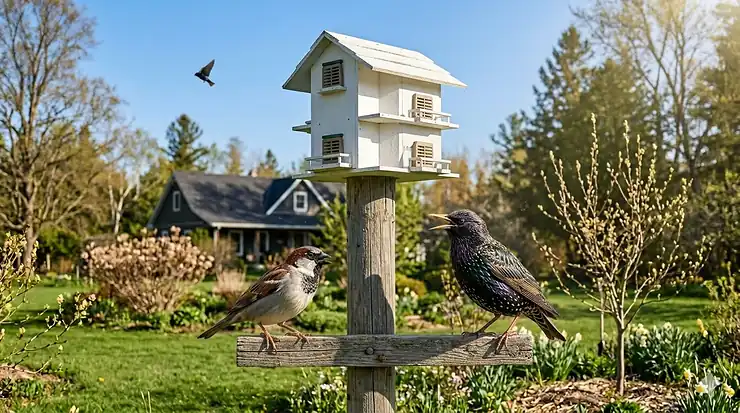
You’ve invested in a beautiful purple martin house, but here’s the thing most first-time landlords miss — timing isn’t just important, it’s everything. Put your house up too early, and European starlings will claim every compartment. Too late, and your martins will choose your neighbour’s colony instead.

I learned this the hard way during my first season in southern Ontario. My gorgeous 12-room house sat empty all summer because I opened it in March, thinking I was being proactive. By the time the martins actually arrived in early May, house sparrows had already built nests in half the compartments, and I spent weeks battling these invasive species instead of enjoying my colony.
Purple martins (Progne subis) are North America’s largest swallows, and in eastern Canada, they depend almost entirely on human-provided housing. These magnificent aerial acrobats migrate thousands of kilometres from the Amazon Basin each spring, arriving at precise times based on your latitude. Understanding when to put up purple martin house in your specific region — combined with knowing your local scout arrival patterns — transforms you from a hopeful beginner into a successful martin landlord. The difference between an empty house and a thriving colony often comes down to opening your compartments within a two-week window.
Quick Comparison Table: Regional Timing at a Glance
| Canadian Region | Scout Arrival | When to Put Up House | Opening Window | Climate Considerations |
|---|---|---|---|---|
| Southern Ontario | Late April–Early May | Mid-April | 1-2 weeks before scouts | Unpredictable spring weather |
| Southern Quebec | Late April–Mid May | Mid-April | 1-2 weeks before scouts | Monitor late frosts |
| Alberta (South) | Early–Mid May | Late April | Keep closed until scouts | Colder springs, shorter season |
| British Columbia (Coast) | Mid–Late April | Early April | Pacific population different | Mild, wet springs |
| Maritime Provinces | Mid–Late May | Early May | Latest arrival in Canada | Coastal weather delays |
💬 Just one click – help others make better buying decisions too! 😊
Top 7 Purple Martin Houses: Expert Analysis for Canadian Landlords
1. S&K 16-Room Purple Martin House Package – Complete Beginner Kit
The S&K 16-Room Purple Martin House is what I recommend to every new Canadian landlord asking where to start. This barn-style house comes as a complete package that removes the guesswork from your first season.
Key Specifications:
- 16 compartments (6″ x 6″ each)
- Durable polypropylene plastic construction
- Includes triangular telescoping pole, decoys, and guidebook
- White exterior for heat reflection
- Snap-together assembly (no tools required)
Price Range: $214-$250 CAD on Amazon.ca
Canadian Availability: Ships within Canada; typically arrives in 5-7 business days
This house addresses two crucial timing challenges Canadian landlords face. First, the included decoys help attract scouts during that critical first-arrival window — martins are more likely to investigate housing where other martins appear to be already settled. Second, the lightweight plastic construction means you can easily raise and lower the system multiple times per day during the scout-arrival period when you’re actively managing competitor species. One Ontario landlord reported, “The telescoping pole makes it so easy to close compartments when starlings show up, then open them again when I see martins circling.”
✅ Pros:
- Complete kit eliminates separate purchases
- Beginner-friendly assembly
- Lifetime warranty when used with S&K pole
❌ Cons:
- Plastic can heat up in extreme southern Ontario summers
- Requires S&K-specific pole system

2. Birds Choice Coates PMC12 – Premium Aluminum Construction
The Birds Choice Coates Original 12-Room Martin House represents the gold standard in purple martin housing — and for good reason. This Wisconsin-made aluminum house has been the industry benchmark since the 1980s.
Key Specifications:
- 3 floors, 12 rooms (6″ x 6″ standard)
- All-aluminum and stainless steel construction
- Reflective roof with ventilation panel
- Hinged cleanout doors on each compartment
- Dimensions: 19″L x 14″W x 20″H
Price Range: $249-$280 CAD (Amazon.com with shipping to Canada)
Canadian Availability: Ships to Canada; expect 10-14 days delivery
The aluminum construction solves a major Canadian challenge — temperature regulation during unpredictable spring weather. When southern Ontario experiences those sudden May heatwaves (which seem to happen right after scouts arrive), aluminum stays significantly cooler than plastic. The compartment-by-compartment access also proves invaluable during the scout-arrival period when you’re conducting daily checks to remove competitor nests. Canadian buyers consistently note, “Assembly takes 3-4 hours but the quality justifies the time investment. Mine’s been through five Canadian winters without a single issue.”
✅ Pros:
- Superior durability for harsh Canadian climate
- Excellent heat dissipation
- Individual compartment access
❌ Cons:
- Complex assembly process
- Higher initial investment
- Heavier (requires robust pole)
3. S&K 12-Family Purple Martin House – Budget-Friendly Performer
The S&K 12-Family Purple Martin House delivers reliable performance at a price point that makes getting started more accessible. This is the house I actually used during my second season after learning from my first-year mistakes.
Key Specifications:
- 12 compartments in traditional layout
- Polypropylene copolymer plastic
- 6″ x 6″ compartments with 2.25″ crescent entrances
- Compatible with S&K telescoping poles
- Snap-together assembly
Price Range: $185-$220 CAD on Amazon.ca
Canadian Availability: Available for Prime shipping in most provinces
This house strikes an ideal balance for the Canadian landlord who understands timing nuances but doesn’t want to invest $300+ before proving they can attract a colony. The maintenance-free plastic means you can focus your energy on the timing aspects — monitoring scout arrivals, managing competitors, conducting nest checks — rather than worrying about rust or wood rot during Canadian winters. Several Quebec landlords report success with this model, noting “Light enough to lower multiple times daily when managing house sparrows during the pre-arrival period.”
✅ Pros:
- Excellent value for money
- Easy maintenance
- Proven track record
❌ Cons:
- Standard 6″x6″ compartments (not deeper modern design)
- Requires separate pole purchase
- Limited colour options
4. Birds Choice PMSR16 – Starling-Resistant 16-Room House
The Birds Choice Premium Aluminum 16-Room House with SREH (Starling Resistant Entrance Holes) addresses the single biggest timing-related failure point for Canadian martin landlords — starlings claiming your housing before martins arrive.
Key Specifications:
- 4 floors, 16 rooms with crescent SREH entrances
- Aluminum construction with ventilated roof
- Entrance dimensions: 1 3/16″ height (starlings cannot enter)
- Hinged doors for cleaning
- Made in USA
Price Range: $299-$340 CAD (Amazon.com, ships to Canada)
Canadian Availability: Available with international shipping
Here’s why this house transforms your timing strategy: With traditional round holes, you must keep all compartments plugged until scouts arrive, then open them all at once and hope martins claim them before starlings do. With SREH entrances, you can open your house 2-3 weeks before scout arrival without fear. Martins can enter easily (they learn within minutes), but starlings physically cannot fit through the crescent opening. This extended window eliminates the nail-biting timing pressure. An Alberta landlord shared, “First season with SREH — opened my house in mid-April, scouts arrived May 8th, and zero starling problems. Previously I’d lost entire colonies to starlings.”
✅ Pros:
- Eliminates starling timing pressure
- Premium construction quality
- More flexible opening schedule
❌ Cons:
- Highest price point
- Assembly required
- Some martins take 2-3 days to learn crescent entrances
5. Heath Two-Piece Martin Gourds (16-Pack) – Natural Nesting Preference
The Heath Two-Piece Crescent SREH Martin Gourds tap into purple martins’ ancestral preferences — these birds nested in natural gourds for thousands of years before transitioning to human-made houses.
Key Specifications:
- 16 plastic gourds with crescent SREH entrances
- 7″ diameter interior cavity
- 2.125″L x 1.375″H crescent opening
- Two-piece interlocking design
- Built-in drainage and ventilation
Price Range: $179-$210 CAD (specialty bird retailers shipping to Canada)
Canadian Availability: Available through Canadian wild bird stores; 7-10 day shipping
Gourds offer unique timing advantages for Canadian conditions. During the scout-arrival period when weather can be unpredictable, gourds provide superior insulation compared to traditional houses — crucial when a late April cold snap drops temperatures to 5°C overnight. The individual-gourd system also allows selective opening: you can open 4-6 gourds when scouts first arrive, assess interest, then gradually open more as additional martins appear. This staged approach prevents house sparrows from overwhelming your entire system if you misjudge timing slightly. Maritime landlords particularly favour gourds, noting “With our later scout arrivals in late May, gourds warm up faster in morning sun than aluminum houses.”
✅ Pros:
- Natural appeal to martins
- Superior insulation for cold Canadian springs
- Selective opening strategy possible
❌ Cons:
- Requires separate gourd rack and pole
- More components to manage
- UV degradation over 10-15 years

6. Coates 8-Room PMC8 Original – Perfect Starter Colony
The Birds Choice Coates 8-Room Original Purple Martin House is specifically designed for landlords establishing their first colony — and timing considerations make this particularly relevant for Canadian locations with lower martin populations.
Key Specifications:
- 2 floors, 8 rooms (6″ x 6″)
- Aluminum and stainless steel construction
- Reflective white roof
- Compact dimensions: 19″L x 14″W x 14″H
- Porch dividers and guardrails included
Price Range: $195-$230 CAD (Amazon.com, ships to Canada)
Canadian Availability: International shipping available; 10-12 days
Here’s the timing strategy this house enables: Many Canadian regions have lower martin population densities than U.S. breeding areas. When scouts arrive and find a massive 24-room house, they may assess it as “too much space for our small pioneer group” and move on. An 8-room house signals “appropriately-sized colony site” to 2-3 pairs of pioneering scouts. Once established (usually second season), you can add a second 8-room house on the same pole or upgrade to a 12-16 room system. This graduated approach aligns with natural colony growth timing. An Ontario beginner reported, “My 8-room house attracted 3 pairs first season. Second season, 7 pairs. I added a second 8-room unit for season three.”
✅ Pros:
- Appropriately scaled for first-year colonies
- Premium construction at lower price
- Can expand later
❌ Cons:
- Limited to small colonies long-term
- Still requires substantial assembly time
- May need expansion by season 2-3
7. S&K Dual Purple Martin Houses (24-Room Expandable) – Maximum Capacity
The S&K Dual 24-Room Expandable Purple Martin House System represents the ultimate setup for landlords who’ve successfully navigated timing challenges through 2-3 seasons and are ready to scale up.
Key Specifications:
- Two 12-room houses mounted on single pole
- 24 total compartments
- Green, tan, and white colour options
- Durable plastic construction
- Expandable design allows adding/removing units
Price Range: $300-$350 CAD on Amazon.ca
Canadian Availability: Available with free shipping on orders over $250
This system addresses an advanced timing concept: colony saturation. Once you’ve established a thriving colony (congratulations — you’ve mastered timing!), returning martins bring friends and offspring each spring. Your original 12-room house fills completely during the first week after scout arrival, but 10-15 additional pairs circle your site with nowhere to nest. The dual-house system accommodates natural colony growth without forcing you to set up a second pole system 30 metres away. The timing benefit? All your established pairs and newcomers settle in simultaneously during that critical 2-3 week claiming period. A Quebec landlord shared, “Upgraded to dual houses in season four. Went from 11 nesting pairs to 19 pairs — all the returning martins brought family.”
✅ Pros:
- Accommodates large established colonies
- Single pole reduces yard footprint
- Expandable design
❌ Cons:
- Only suitable for established colonies
- Requires heavy-duty pole system
- Higher wind resistance (ensure proper installation)
✨ Don’t Miss These Exclusive Deals!
🔍 Take your purple martin landlording to the next level with these carefully selected products available in Canada. Click on any highlighted item above to check current pricing and availability on Amazon.ca. These houses will help you create authentic colonies your feathered friends will love!
Understanding Purple Martin Migration Timeline: The Foundation of Perfect Timing
Knowing when to put up purple martin house starts with understanding where these birds spend their year. Purple martins undertake one of the most impressive migrations in the bird world — a round-trip journey spanning over 10,000 kilometres.
The Complete Annual Cycle
Purple martins winter in the Amazon Basin of South America, primarily in Brazil. According to research from the Purple Martin Conservation Association, these birds leave their Canadian breeding grounds between mid-August and early September, gathering in massive staging roosts before beginning their southward migration. They don’t return north until late March at the earliest — and that’s only for birds heading to the southern United States.
The migration northward follows a predictable wave pattern. Martins that bred in Texas see their first scouts in early February. Florida locations welcome scouts in mid-February. As spring progresses, the wave moves steadily north at roughly 20-30 kilometres per day, controlled primarily by temperature thresholds and insect availability.
For Canadian landlords, this creates a natural timing advantage that many don’t realize: you have more time to prepare than southern colleagues. While a Texas landlord must have housing ready in early January, Ontario landlords can work comfortably through March knowing scouts won’t arrive until late April at the earliest.
Scout vs. Subadult Arrival: Why This Timing Gap Matters
Here’s where when to put up purple martin house gets interesting. The first martins to arrive — called “scouts” — are the oldest, most experienced birds from last year’s breeding population. These scouts are 2-5 years old and have made the journey multiple times. They arrive 4-12 weeks before the younger birds (subadults, or last year’s offspring).
In southern Ontario, this typically means scouts appear between April 25-May 5, while subadults don’t arrive until late May or early June. Why does this matter for timing? Because established colonies with returning residents need housing open when scouts arrive, while new colonies trying to attract their first breeding pairs actually do better waiting for subadults.
Regional Timing Across Canada
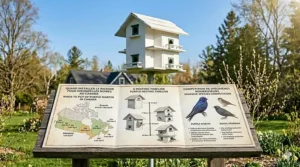
Canadian purple martin arrival dates vary dramatically by region:
Southern Ontario & Quebec: Scout arrival peaks between April 25-May 10. This is the most populated martin breeding range in Canada, with established colonies around Lake Erie, Lake Ontario, and the Ottawa River valley. Put houses up by mid-April, but keep compartments closed until April 20-25.
Alberta: The western prairie populations see scouts arriving May 1-15. Spring weather in Alberta can be highly variable, with freezing temperatures still possible in early May. Northern Sky’s Purple Martin Colony near Wetaskiwin, Alberta, typically opens housing around May 1.
British Columbia: Pacific coast populations follow different patterns due to the western subspecies (P. s. arboricola). Scouts arrive late April along the southern coast. These birds still use natural cavities more than eastern populations but increasingly adopt human-provided housing.
Maritime Provinces: The latest arrival in Canada occurs in New Brunswick, Nova Scotia, and Prince Edward Island, where scouts may not appear until May 15-25. The shorter breeding season means these colonies must be highly efficient.
Scout Arrival Preparation: The 2-Week Setup Window
The period 2-3 weeks before expected scout arrival is when successful martin landlords execute their pre-season setup. This window balances being ready for early scouts while avoiding competitor species claiming your housing.
Pre-Arrival House Prep
Start your physical preparation in early April for most Canadian locations:
Cleaning and Inspection (Early April): Lower your housing and conduct a thorough end-of-winter inspection. Remove all old nesting material — while some species benefit from leaving old nests, purple martins actually prefer starting fresh. Scrub each compartment with a 10:1 water-bleach solution, rinse thoroughly, and let dry completely. Check for winter damage: cracked entrance holes, loose porch rails, rust spots on aluminum houses, and UV degradation on plastic components.
Structural Repairs (Mid-April): This is your opportunity to upgrade entrance holes to starling-resistant designs, replace damaged components, or add protective features like predator guards. Make these changes now, not after scouts arrive. I learned this lesson when I tried to retrofit crescent entrances during the claiming period — the disruption caused my first two pairs to abandon the site.
Pole and Pulley System Checks: Test your raising/lowering mechanism multiple times. Oil pulleys, check cable condition, and ensure the pole remains perfectly vertical. During the scout-arrival period, you’ll be lowering housing daily for nest checks — a seized pulley in early May is a disaster.
Adding Nesting Material: Place a small handful of pine needles or wood shavings in each compartment. This signals “ready for occupancy” to investigating scouts. Don’t overdo it — martins bring most of their own material — but a thin base layer helps.
The Compartment-Closing Strategy
Here’s where timing precision pays off: Keep all compartments closed (using entrance plugs or covers) until approximately 1 week before expected scout arrival in your region. This prevents house sparrows and European starlings from nest-building.
For southern Ontario, that means keeping compartments plugged until approximately April 18-22. Monitor weather forecasts — if a warm front is approaching, it may trigger early scout movement. Check the Purple Martin Conservation Association’s Scout Arrival Map to see real-time arrivals reported by landlords south of your location.
The exact opening day requires judgment. Too early, and you’re battling competitors daily. Too late, and scouts investigating on their first flyover find closed compartments and move on. My rule: Open compartments when the first scouts are reported within 150-200 kilometres south of my location.
Martin House Opening Schedule: Your Week-by-Week Timeline
Let’s walk through the precise timeline for Ontario/Quebec locations (adjust dates by 1-2 weeks for other Canadian regions):
April 1-7: Final Preparation Phase
- Complete all cleaning and repairs
- Install fresh predator guards
- Test pole system multiple times
- Add nesting material to compartments
- Ensure all entrance plugs are ready
April 8-14: Monitoring Phase
- Check Scout Arrival Map daily
- Keep compartments closed but housing raised to full height
- Begin daily skywatch sessions (15 minutes morning, 15 minutes evening)
- Watch for scout reports from Michigan, Ohio, Pennsylvania
April 15-21: Pre-Opening Window
- Increase skywatch frequency
- Look for scouts reported within 200 km
- Weather permitting, open 25% of compartments (2-3 rooms in a 12-room house) around April 18-20
- Continue monitoring for house sparrows and starlings
April 22-28: Peak Scout Arrival
- Open all remaining compartments by April 22 in southern Ontario
- Conduct twice-daily checks for competitor nests (morning and evening)
- Remove any house sparrow or starling nesting material immediately
- Document first scout sightings
- Resist the urge to close compartments if scouts aren’t immediate — they may be investigating other sites first
April 29-May 5: Claiming Period
- First scouts begin claiming specific compartments
- Reduce check frequency to once daily (mid-morning)
- Watch for initial nest material (green leaves indicate claiming)
- Continue competitor management
May 6-12: Subadult Pre-Arrival
- Established pairs settling in
- Egg-laying beginning in earliest-claimed compartments
- Prepare for subadult wave (typically 4-6 weeks after scouts)
Special Considerations for First-Year Colonies
If you’re trying to attract purple martins to a site with no previous colony history, timing strategy changes slightly:
Wait for Subadults: Don’t worry about catching scouts. New colonies are almost always established by young subadult birds looking for their first breeding site. In Ontario, this means opening housing around May 1-5, even if scouts arrived April 25.
Use Attraction Tools: Play purple martin dawn song recordings from a speaker near your housing during morning hours (6:00-9:00 AM). Use decoys — place 2-3 martin decoys on porch railings to create the illusion of an established colony. Subadults investigating potential sites are strongly attracted to locations where other martins already appear settled.
Be Patient: Attracting your first pair may take 2-3 seasons. The timing remains the same each year — open housing in early May for subadults — but colony establishment follows its own timeline independent of when you open compartments.

Purple Martin House Height Requirements: Getting the Elevation Right
When to put up purple martin house is only half the equation — how you put it up matters equally. House height directly influences scout attraction rates and colony success.
The 3.6-6 Metre Sweet Spot
According to research published by the Purple Martin Conservation Association, the ideal height range for purple martin housing is 3.6-6 metres (12-20 feet) from ground to the bottom floor of the house. This isn’t arbitrary — it represents the compromise between multiple factors:
Predator Protection (Minimum Height): Ground-based predators like raccoons, cats, and snakes can devastate martin colonies. Housing below 3.6 metres is easily accessible to climbing predators even with pole guards. One Ontario landlord learned this devastatingly when a raccoon climbed their 2.7-metre pole, bypassed an improperly installed predator guard, and killed an entire colony of nestlings in a single night.
Wind Resistance (Maximum Height): Housing above 6 metres faces significantly increased wind loads. Spring storms with winds of 60-80 km/h are common across Canada during the May-June nesting period. Taller installations require exponentially stronger poles and deeper foundation footings. More critically, maintenance becomes dangerous — lowering housing from 7-8 metres in windy conditions risks injury.
Human Enjoyment Factor: Part of the magic of purple martin landlording is observing your colony up close. At 4.5 metres, you can watch fledglings exercising their wings, observe feeding behaviours, and hear the colony’s constant vocalizations. At 7 metres, martins become distant specks.
The Canadian Context: Adjusting for Open Space
Canadian martin landlords often have the advantage of more open space compared to urban/suburban American sites. If your property provides the 12-18 metre clearance martins prefer in all directions, you can successfully use the lower end of the height range (3.6-4.2 metres). This makes maintenance easier and reduces pole costs.
However, if your site has partial tree encroachment — common in rural Ontario where properties edge woodlots — increasing height to 5.4-6 metres helps martins feel more secure. They prefer aerial approach paths well above tree-canopy level.
Pole Selection and Installation
The pole system you choose interacts directly with timing considerations:
Telescoping Poles: These poles consist of nested sections that slide up and down. They’re the most common choice for houses with 8-16 compartments. During the scout-arrival and claiming period when you’re conducting daily nest checks to remove competitor material, telescoping poles make lowering housing quick and easy. The 3-4 metre extension models are ideal for most Canadian installations. Cost ranges from $180-$280 CAD.
Pulley/Winch Systems: These systems use a cable and winch to raise/lower housing. They’re necessary for larger multi-house installations or gourd racks holding 20+ gourds. The mechanical advantage makes managing heavy systems possible, but they require more maintenance. Pulleys must be oiled before each season, cables inspected for fraying, and winch mechanisms tested. For Canadian winter storage, some landlords remove the entire housing-and-cable assembly to prevent ice damage. Cost ranges from $250-$400 CAD for quality systems.
Foundation Requirements: Canadian frost heave is real. Poles must be set in concrete footings extending below the frost line — typically 1.2 metres deep in southern Ontario, 1.5 metres in Alberta, and up to 1.8 metres in northern regions. The concrete footing should be 45-60 centimetres in diameter. This isn’t optional — insufficient foundations result in poles tilting by season 2-3, and a tilted pole means a tilted house, which martins will abandon.
Starling Resistant Purple Martin House Solutions
European starlings (Sturnus vulgaris) represent the single biggest timing-related failure point for purple martin landlords across Canada. Understanding starling-resistant designs fundamentally changes your opening-window strategy.
The Starling Problem
European starlings are invasive, non-native birds that compete aggressively for cavity nest sites. They arrive back from winter grounds 2-4 weeks before purple martins in most Canadian regions. This timing gap creates disaster: You open your martin housing in mid-April hoping to be ready for late-April scouts, but starlings discover it first. Within days, they’ve built nests in multiple compartments.
Here’s where it gets worse — starlings don’t just occupy compartments. They actively attack purple martins that try to claim nearby cavities. Starlings have been documented killing adult martins, destroying martin eggs, and even killing nestlings. One particularly brutal behaviour: A pair of starlings will trap a martin inside its own compartment and peck it to death. This sounds melodramatic, but I’ve witnessed it. It’s devastating.
Starling Resistant Entrance Holes (SREH)
The solution came from Canadian ingenuity. In the 1980s, Charles McEwen of New Brunswick, Canada, developed the first effective starling-resistant entrance hole design after watching starlings systematically destroy his martin colony. His innovation — the crescent entrance — exploits a simple anatomical difference.
The Physics of Exclusion: Adult purple martins measure approximately 19-20 centimetres in length with relatively streamlined bodies. European starlings are slightly smaller at 19-22 centimetres, but critically, starlings have broader chest structures. A crescent-shaped entrance measuring exactly 3 centimetres tall and 5.4 centimetres wide allows martins to enter by orienting their bodies horizontally, but starlings cannot compress their chest width enough to fit through the restricted height.
The original crescent design — often called the “McEwen crescent” — features a flat bottom and curved top, measuring 1.19 centimetres (1 3/16 inches) in height. Modern variations include:
Crescent SREH: The original design. 100% effective against starlings when properly installed. Martins learn to use them within minutes, though the first few entries may look awkward as birds figure out the optimal angle.
Conley SREH: An oval variation developed later. Some landlords report occasional starling breaches with Conley entrances, particularly smaller/younger starlings.
Excluder Design: Combines crescent shape with additional vertical bars. Extremely effective but requires careful installation to ensure bar spacing prevents starling entry.
The Timing Advantage
Here’s why SREH entrances transform your timing strategy: With traditional 5.7-centimetre round holes, you must keep compartments plugged until scouts arrive, then open them all at once and pray martins claim them before starlings. This creates intense timing pressure — miss your window by 3-4 days and starlings win.
With crescent SREH entrances, you can open housing 2-3 weeks before scout arrival without fear. Starlings will investigate but cannot enter. When scouts arrive, they find accessible, ready housing with no competitor pressure. This extended window eliminates the nail-biting timing game entirely.
Purple Martin House Maintenance Tips Throughout the Season
When to put up purple martin house is just the beginning. Successful landlording requires ongoing maintenance from April through September, with timing-sensitive tasks throughout.
Pre-Season Maintenance (Late March-Early April)
Before raising housing for the season, complete this checklist:
Deep Cleaning Protocol: Remove all old nesting material completely. Some sources suggest leaving old nests, but in humid Canadian climates, old material harbours mold and parasites. Use a water-bleach solution (10 parts water, 1 part bleach), scrub each compartment, rinse thoroughly, and allow 24-48 hours drying time. Never use ammonia-based cleaners — the residual odour can deter martins.
Structural Inspection: Check every entrance hole for cracks or enlargement. Plastic houses can develop UV damage after 5-7 Canadian winters — small cracks around entrances allow them to enlarge, potentially admitting starlings. Aluminum houses develop loose screws and rivets. Tighten all fasteners. Inspect porch rails for damage — these prevent premature fledging by keeping 22-24 day old nestlings from jumping.
Predator Guard Installation: This is non-negotiable. Even if you’ve “never seen raccoons” on your property, they’re present. A conical metal or plastic predator guard should be mounted at least 1.2 metres up the pole from ground level. The cone must face downward and have a diameter of at least 60 centimetres at its widest point.
In-Season Maintenance (May-August)
Once martins arrive and begin nesting, your maintenance schedule becomes timing-critical:
Nest Checks (Weekly During Egg-Laying, Bi-Weekly During Incubation/Nestling Phase): Lower housing mid-morning (10:00 AM-2:00 PM) to inspect each active compartment. Record the number of eggs or age of nestlings. This achieves multiple goals: detecting problems early (dead eggs, dead nestlings, parasites), removing competitor nests, and monitoring colony success.
I can’t overstate this — nest checks don’t disturb martins. Birds become accustomed to the routine within days. I conduct checks while martins sit 3 metres away on power lines, watching. They return to their nests within minutes of housing being raised again.
Parasite Management: By the time nestlings reach 10-14 days old, nest material often becomes infested with blood-feeding parasites — mites, blowfly larvae, and fleas. These parasites can kill nestlings if populations explode. The solution: nest replacement. Remove nestlings temporarily (place in a bucket with towel), discard old nesting material, wipe compartment with damp cloth, add fresh pine needles, and replace nestlings. Studies show 84% fledging success in nests with parasite management versus 44% in untreated nests. Timing matters — perform replacements when nestlings are 10-15 days old.
Competitor Control: Continue monitoring for house sparrow and starling attempts throughout May and June. Even with SREH entrances, house sparrows will try building nests on top of porch rails or in corners. Remove these immediately.
Post-Season Maintenance (September-October)
After martins depart in late August-early September:
Final Cleaning: Conduct another thorough cleaning before closing housing for winter. This prevents mice and other rodents from nesting in compartments over winter. Use the same water-bleach solution. Allow complete drying.
Compartment Closure: Install entrance plugs in every compartment. This prevents winter occupancy by house sparrows, deer mice, and overwintering insects. Some landlords also install temporary panels covering entire floor sections for additional protection.
Structural Repairs: Make any repairs identified during the season. This is when you replace damaged entrance holes, reinforce porch rails, or upgrade to SREH entrances for next season.
Frequently Asked Questions
❓ When should I put up my purple martin house in Ontario?
❓ What is the ideal height for a purple martin house in Canada?
❓ How much does a purple martin house cost in Canada?
❓ Do purple martins return to the same house every year in Canada?
❓ What is the best way to attract purple martins to a new house in Canada?
Conclusion: Your Timing Creates Their Future
Understanding when to put up purple martin house represents more than following a calendar — it’s about recognizing your role in the survival of a species that has become completely dependent on human intervention across eastern Canada. Every April, as temperatures warm and insects begin emerging, purple martins are completing a 10,000-kilometre journey from Brazil. They’re navigating weather systems, predation risks, and dwindling habitat, all with the expectation that the housing they used last year remains available.
Your timing precision during that critical 2-3 week window in late April and early May determines whether returning scouts find ready housing or discover competitor-occupied compartments. It determines whether subadults investigating your site as a potential first breeding location see an active, welcoming colony or an empty, questionable prospect.
The investment you make — researching regional arrival dates, monitoring scout reports, executing pre-season maintenance, and managing competitor species — pays dividends that extend far beyond your own enjoyment. Each pair of purple martins successfully raising 4-5 nestlings represents a small victory against the habitat loss and competition these birds face. Multiply your success across thousands of dedicated Canadian landlords, and the cumulative effect becomes significant.
So mark your calendar for mid-April. Check that Scout Arrival Map starting April 1st. Clean your housing. Test your pole system. And when you open those compartments in late April, do so with the knowledge that you’re not just timing a housing setup — you’re creating the conditions that allow one of nature’s most remarkable migrations to complete its final chapter successfully, season after season. The purple martins are coming. Be ready when they arrive.
Recommended for You
- 7 Best Purple Martin Houses for Beginners Canada 20262
- 7 Best Woodpecker House vs Regular Birdhouse Canada 2026
- 7 Best Downy Woodpecker Nesting Boxes Canada 2026
Disclaimer: This article contains affiliate links to Amazon.ca. If you purchase products through these links, we may earn a small commission at no additional cost to you.
✨ Found this helpful? Share it with your friends! 💬🤗
