
In This Article
The best canary food is a nutritionally balanced daily diet built on a quality base, either formulated pellets or a vitamin-fortified seed blend. It is topped up with fresh greens, vegetables and clean water. Avian veterinarians caution that seed alone is incomplete, so the right choice depends on your bird’s age, moulting cycle and willingness to try pellets.
Canaries are tiny, theatrical and spectacularly picky. The domestic canary descends from wild birds of the Canary Islands and was bred for centuries as a singer. It still runs on a metabolism that burns hot and fast. Feed it badly and the song goes flat long before the bird looks sick.
This guide cuts through the pet-aisle noise for Canadian owners. I compared seven real products, from budget seed mixes to vet-style pellets. I used ingredient panels, manufacturer feeding guidance, Canadian retailer listings and aggregated reviewer sentiment. I haven’t personally tested any of them, and I’ll flag where review data is thin rather than pretend otherwise.
Along the way we’ll compare canary seed brands side by side and look at the canary diet for singing health. We’ll also cover song quality nutrition, feeding through the moulting cycle, setting up cage seed cups, and shopping for canary food Amazon.ca listings without getting burned. All prices are ranges in Canadian dollars, and they shift often, so check the current listing before you buy.
Best Canary Food at a Glance: Quick Comparison
| Product | Format | Pack size checked | Price range (CAD) | Best For |
|---|---|---|---|---|
| Hagen Gourmet Canary Mix | Seed mix with dried fruit and veg | 1 kg (2.2 lb) | C$12–C$15 | Variety on a budget |
| Hagen Canary Staple VME | Fortified staple seed | 1.36 kg (3 lb) | C$12–C$15 | Everyday base, Canadian-made |
| Vitakraft Menu Canary & Finch | Fortified foraging blend | 1.1 kg (2.5 lb) | C$14–C$22 | Fussy eaters who like variety |
| Kaytee Forti-Diet Pro Health Canary & Finch | Seed plus extruded pieces | 0.9 kg (2 lb) | C$12–C$16 | Digestive support |
| Harrison’s Adult Lifetime Fine | Organic pellets | 454 g (1 lb) | C$17–C$25 | Pellet-converted birds |
| Lafeber Premium Daily Diet Canary Pellets | Pellets | 567 g (1.25 lb) | C$16–C$20 | Vet-style complete base |
| Wild Harvest Advanced Nutrition Canary & Finch | Seed and grain mix | 900 g | C$12–C$15 | Tight budgets |
Looking at the table, the two Hagen products and Wild Harvest Advanced Nutrition Canary & Finch cluster at the bottom of the price range. That makes sense, because they’re seed-based and don’t carry the formulation costs of pellets. The two pellet options cost more per bag, but their tiny daily portions narrow the gap more than the sticker suggests. If you only remember one thing, pick by format first and brand second.
💬 Just one click — help others make better buying decisions too!😊
Top 7 Best Canary Food Picks for 2026: Expert Analysis
1. Hagen Gourmet Canary Mix — seed variety with dried fruit and veg
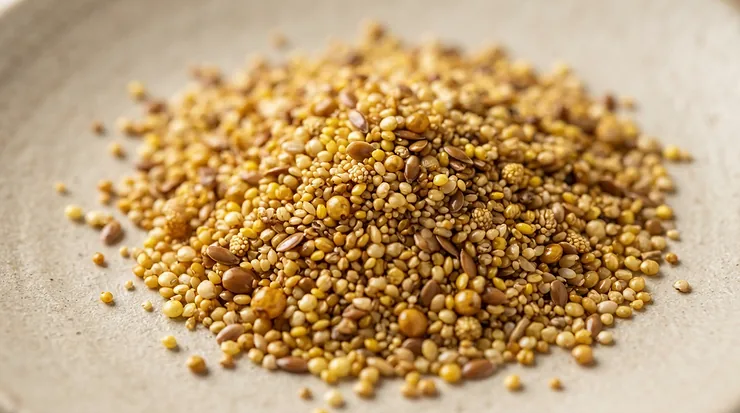
Most budget seed is a beige parade of sameness. This one stirs in dried papaya, pineapple and carrot, which gives a bored canary something to forage for. The Canadian-market recipe leans on canary grass seed, oat groats, flaxseed, canola and white millet, then adds hemp, niger and soybean meal. Hagen says the seed is air-cleaned and polished, and that matters. Less dust means fewer sneezy bowls and less husk blowing across your counter. It ships in a resealable 1 kg (2.2 lb) bag.
Based on the ingredient panel, this is a variety play, not a complete diet. The fruit pieces make bowl time more interesting, but canaries are notorious for picking out favourites, so the nutritional payoff depends on what your bird actually eats. It suits owners who already offer fresh greens and want a livelier base seed. I couldn’t verify a large pool of canary-specific reviews for this exact mix, so treat it as a trusted brand rather than a proven crowd favourite.
Pros:
- ✅ Dried fruit and veg add foraging interest
- ✅ Air-cleaned, polished, low-dust seed
- ✅ Resealable bag helps keep seed fresh
Cons:
- ❌ Birds can cherry-pick favourite pieces
- ❌ Seed-based, so not complete on its own
Expect roughly C$12–C$15 for 1 kg; check the current price. Verdict: good value as a variety base, not as a sole diet.
2. Hagen Canary Staple VME — Canadian-made vitamin-enriched staple
This is boring on purpose: plain, fortified everyday seed without the glitter. The mix is canary grass seed, canola, white millet and niger, sprayed with canola oil. It’s fortified with calcium, zinc, iron and a vitamin pack that includes A, E and niacin. The label says Made in Canada, and the 1.36 kg (3 lb) bag suits single-bird households. The seed is air-cleaned and polished for low dust.
Here’s the catch the spec sheet won’t volunteer. Canaries husk each seed before swallowing, so vitamins applied to the seed surface often end up in the discarded hull. That’s an argument for pairing this staple with greens or a pellet, not for skipping it. Hagen itself suggests a balanced supplement if your bird gets selective. Verified canary-specific reviews were thin in my research, so the case here rests on brand reputation and ingredient logic rather than crowd data.
Pros:
- ✅ Made in Canada and easy to source locally
- ✅ Simple recipe that’s easy to monitor
- ✅ Fortified with vitamins and minerals
Cons:
- ❌ Vitamin coating is lost when seed is husked
- ❌ Monotonous without fresh additions
Plan on about C$12–C$15 for the 1.36 kg bag; a 11 kg (25 lb) bulk bag in the C$75–C$85 range only makes sense for aviaries. Verdict: the sturdy, affordable foundation if you build the rest of the diet around it.
3. Vitakraft Menu Canary & Finch — fortified foraging blend
Vitakraft calls this a foraging blend, which is a polite way of saying the bowl is designed as a treasure hunt. The 2.5 lb (1.1 kg) bag is fortified with vitamins, minerals and what the brand calls a Care Complex. The feeding advice is refreshingly simple: offer it freely, replace it daily, and keep fresh water close.
The practical read is that this is a mid-complexity seed blend for owners who want more variety than staple seed without jumping to pellets. Blends reward selective eaters, though. If the same husks pile up while certain seeds vanish, your bird is editing its own diet. Keep in mind too that “fortified” is a label claim. Avian vets point out that no regulator certifies avian nutrition products, so read the ingredient panel rather than the front of the bag.
Retailer review pools I found were small, and one listing showed a strong average on only a handful of reviews. Sentiment looks positive but statistically thin.
Pros:
- ✅ Variety-packed blend encourages foraging
- ✅ Vitamin and mineral fortification
- ✅ Clear, simple feeding guidance
Cons:
- ❌ Selective eating can waste fortified pieces
- ❌ Limited Canadian review data
Expect the mid-teens to low-C$20s range depending on retailer; comparable US listings sit near US$11, so verify Canadian pricing. Verdict: fair for a variety blend, though not the cheapest per kilo.
4. Kaytee Forti-Diet Pro Health Canary & Finch — gut-health seed blend
Where most seed mixes shrug at digestion, this one adds prebiotics, probiotics and psyllium fibre aimed at gut health. The blend runs on canary grass seed, millet, canola, flax (an omega-3 source) and niger. It also includes extruded pieces, and retailer listings describe it as a seed-and-extruded food. The 2 lb (0.9 kg) bag fits one or two birds. Kaytee’s transition advice is to mix old and new food over seven to ten days.
Those extruded pieces are the quiet hero. They’re uniform nuggets a fussy eater can’t husk away, so the fortification actually gets eaten. For a canary on a seed-heavy diet, this is a sensible upgrade. It still isn’t a substitute for fresh greens or vet guidance.
Aggregated reviews on large retail listings skew strongly positive. Owners describe it as a dependable everyday staple, and the review pools are big enough to trust the overall tone. That makes it the most data-backed seed pick on this list.
Pros:
- ✅ Prebiotics, probiotics and psyllium fibre
- ✅ Extruded pieces limit selective picking
- ✅ Flax adds an omega-3 source
Cons:
- ❌ Still partly seed-based
- ❌ Soybean and corn ingredients won’t suit every preference
Around C$12–C$16 for 2 lb. Verdict: probably the strongest seed-based all-rounder for the money.
5. Harrison’s Adult Lifetime Fine — certified organic pellets
Pellets don’t get more serious than this: certified organic, non-GMO and designed with avian veterinarians and nutritionists in mind. The Fine grind is the small-bird size, with manufacturer feeding guidance of roughly 1–1.75 g a day for canaries and finches. The company advises using an opened bag within eight weeks and storing it in the fridge or freezer to protect freshness. A High Potency Superfine version targets tiny beaks and birds with special needs.
On paper, this is the closest thing here to the pellet-forward diet vet references recommend. VCA notes that birds eating 75–80% of their diet as pellets generally don’t need supplements. The trade-off is conversion. Switching a seed-loving canary can be stressful, so weigh your bird daily during the changeover and loop in your vet.
Chewy shows a strong average across a modest pool of reviews. One owner credits it for finches reaching 16 years old. A March 2026 reviewer, however, says the Fine pellets have grown too large for her bird, which is worth checking if your canary is petite.
Pros:
- ✅ Certified organic, non-GMO formulation
- ✅ Vet-designed and supplement-light
- ✅ Tiny serving sizes stretch a bag
Cons:
- ❌ Premium price per kilo
- ❌ Some reviewers report oversized pellets
Budget C$17–C$25 for a 1 lb bag; Canadian shops sometimes list it as special order, so check delivery windows. Verdict: pricey per kilo, but small daily portions soften the sting.
6. Lafeber Premium Daily Diet Canary Pellets — complete pellet with egg protein
Lafeber’s pitch is blunt: canaries can’t thrive on seed alone, so it built a pellet for them. The canary formula uses ground non-GMO corn and soybean meal, adds whole egg protein and balanced omega-3 and omega-6 fatty acids, and is naturally flavoured and preserved. Lafeber’s vet nutrient table lists at least 13.5% protein and about 3,290 kcal/kg for the finch-canary size. Packs run from 1.25 lb up to 5 lb, and a Tropical Fruit Gourmet variant with real papaya, mango and pineapple and no added sugar can ease fussy birds in.
Pellets are uniform, so there’s no seed-sorting. Every bite carries the same nutrients, which is a real advantage for a bird with a very high metabolic rate. The catch is acceptance: many canaries sulk at first, and a gradual conversion plan is non-negotiable.
Reviewers repeatedly say an avian vet recommended it, and they describe healthy, singing birds. The main complaint I found was a buyer who hadn’t realised it’s pellets, not seed. That’s a label-reading lesson rather than a product flaw.
Pros:
- ✅ Uniform nutrition in every bite
- ✅ Whole egg protein and balanced omega fats
- ✅ Batch testing at an independent lab, per Lafeber
Cons:
- ❌ Some canaries refuse pellets at first
- ❌ Needs a gradual conversion plan
Plan on C$16–C$20 for 1.25 lb. Verdict: strong value when pellets are your base diet.
7. Wild Harvest Advanced Nutrition Canary & Finch — mainstream budget seed-and-grain mix
If your wallet is shouting louder than your canary, this is a widely stocked mainstream option. The 900 g resealable bag is a seed-and-grain mix enriched with vitamins, minerals and omega-3 fatty acids, pitched at skin, feather and foraging benefits. It sits in the same price bracket as the Hagen mixes, with a broad retail footprint across Canada.
It’s a perfectly reasonable base for an owner who adds fresh greens and varies the bowl. Budget blends deserve scrutiny, though. One forum reviewer said some ingredients surprised them, and the broader Wild Harvest range has drawn ingredient-quality debate among bird owners. Read the panel before committing. Wild Harvest bird lines score well at big retailers, but I couldn’t verify a deep canary-specific review pool for this exact product. Lean on the ingredient list, not star averages.
Pros:
- ✅ Widely stocked at mainstream Canadian retailers
- ✅ Resealable bag
- ✅ Added omega-3 and vitamins
Cons:
- ❌ Ingredient quality draws mixed comment
- ❌ Thin canary-specific review data
Expect about C$12–C$15 for 900 g. Verdict: acceptable on a tight budget, paired with fresh food.
Canary Seed Brands: How the Big Names Stack Up
Here’s the hidden structure behind canary seed brands: they fall into three camps. Plain staples such as Hagen Canary Staple VME keep it simple. Variety blends like Hagen Gourmet Canary Mix, Vitakraft Menu Canary & Finch and Wild Harvest Advanced Nutrition Canary & Finch add fruit, extras and foraging interest. Hybrid and pellet formats, led by Kaytee Forti-Diet Pro Health Canary & Finch, Lafeber Premium Daily Diet Canary Pellets and Harrison’s Adult Lifetime Fine, try to fix the selective-eating problem.
| Product | Base | Standout extra | Review signal | Best For |
|---|---|---|---|---|
| Hagen Canary Staple VME | Seed | Vitamin and mineral spray | Limited | Budget base |
| Hagen Gourmet Canary Mix | Seed mix | Dried fruit and veg | Limited | Variety seekers |
| Vitakraft Menu Canary & Finch | Seed blend | Care Complex fortification | Small but positive | Foraging fans |
| Kaytee Forti-Diet Pro Health Canary & Finch | Seed plus extruded | Pre- and probiotics | Large, positive | Gut support |
| Harrison’s Adult Lifetime Fine | Pellet | Certified organic | Modest, positive | Pellet converts |
| Lafeber Premium Daily Diet Canary Pellets | Pellet | Whole egg protein | Positive, vet-cited | Complete diets |
| Wild Harvest Advanced Nutrition Canary & Finch | Seed and grain | Added omega-3 | Limited | Cost-conscious |
The table makes the pattern obvious. Review confidence climbs as formats get more engineered, because the sturdiest data sits behind Kaytee Forti-Diet Pro Health Canary & Finch and the pellets. If you want a seed-first diet with a safety net, that Kaytee product is the logical hinge. If you’re ready to commit to pellets, Lafeber Premium Daily Diet Canary Pellets and Harrison’s Adult Lifetime Fine are the two to short-list.

Canary Diet for Singing Health: What Vets Actually Say
The canary diet for singing health starts with an unglamorous truth. VCA Canada’s canary feeding guidance says seeds are tasty but nutritionally incomplete and should be only a small part of the diet. It recommends a balanced pelleted diet formulated for canaries, with minimal seed and a small portion of fresh greens. Fruits, vegetables and leafy greens should make up roughly 20–25% of the daily intake.
VCA also warns that “molting, song and conditioning” seed mixes are mostly extra fat and aren’t needed. If that sounds like marketing fighting nutrition, that’s because it often is. Nutritionally, a dazzling label doesn’t beat a plain pellet and a handful of greens.
In practice, a singing-friendly plate looks like this:
- A pellet or fortified-seed base, chosen from the picks above.
- Fresh greens daily, rotated so your bird doesn’t get bored.
- Clean water, changed daily.
- Treats and fatty seeds as occasional extras, not staples.
If you’re converting from seed to pellets, VCA stresses weighing your bird daily so weight loss doesn’t sneak up on you. This is also where an avian vet earns their fee. They can tailor ratios if your bird is older, underweight or in breeding condition. The goal is a bird that keeps singing because it’s well, not because you stuffed it with sunflower-adjacent treats.
Song Quality Nutrition: What Moves the Needle (and What Doesn’t)
Let’s be honest about song quality nutrition. No bag of food turns a quiet hen into a Pavarotti. Sex, genetics, age, daylight and season all shape song, and males are the more melodious singers. What food controls is stamina, feather quality and overall condition, which are the foundations a good singer stands on.
Three things matter most:
- Balanced protein and fats. Egg protein, as in Lafeber Premium Daily Diet Canary Pellets, and flax-based omega-3, as in Kaytee Forti-Diet Pro Health Canary & Finch, support condition without relying on fatty seed.
- Consistent intake. Birds that pick favourites at the bowl, which seed mixes encourage, can miss nutrients entirely.
- A healthy weight. Fat-heavy “song foods” risk obesity, and canary care guides note that obesity can bring lipoma lumps and cardiovascular trouble.
For the clinical background on how songbirds’ needs differ from other pet birds, the Merck Veterinary Manual’s passerine nutrition overview is a solid reference to bring to your vet visit.
What doesn’t move the needle? “Song boosters” built mostly on fatty seed and sweet coatings. Treat them as treats. The strongest song quality nutrition plan is dull and consistent: a quality base, fresh produce, and a bird that stays at a steady weight.
Feeding Through the Moulting Cycle: A Practical Plan
Canaries normally sing through fall, winter and spring, then go quiet during the summer moult, according to Lafeber Vet’s canary information sheet. Pet-care sources describe the annual moulting cycle as lasting roughly eight weeks from midsummer. Total feather replacement is tiring, so it helps to adjust food and routines around it. It’s late October as I write this, so many Canadian canaries are finishing recovery and warming up for song season.
July–August (peak moult). Stay on your quality base and keep greens fresh. Some breeders offer soft egg food two to three times weekly during this stretch. Ask your vet first, and offer only small amounts so nothing spoils in a warm room. Keep the room calm. Light misting can help loosen pin feathers.
September–November (recovery). Most birds have finished, though some are still growing feathers. Drop any soft food to about once a week and watch weight.
December–March (song season). A steady base is enough. Avoid piling on conditioning extras.
Supplements for moulting should only be given under a vet’s guidance, as VCA advises. Birds on mostly pelleted diets generally don’t need them. Warning signs such as wings held low, fluffed feathers or persistent lethargy call for a vet visit rather than a new bag of food.
Cage Seed Cups: Setup, Cleaning and Placement
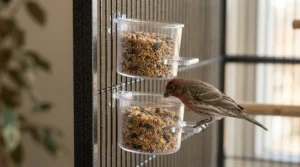
Cage seed cups seem trivial until you see a bowl that looks full but holds nothing edible. Canaries husk their seed, so the cup fills with empty shells while the actual food runs out. Harrison’s advice to feed fresh daily and not “top off” is spot-on for any seed bowl.
A simple setup:
- Use separate cups. One for seed or pellets, one for greens, one for water. Mixing wet greens into seed invites mould.
- Place cups away from perches. Droppings in the bowl are the fastest route to spoiled food. Position cups beside or below perches, not underneath them.
- Clean daily. Hagen’s own instructions say to clean water and seed cups every day and replenish only unsoiled food.
- Blow off husks. Each morning, gently blow or tip the husks off the top and check what’s actually left.
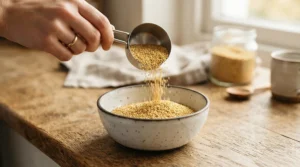
- Portion sensibly. Lafeber suggests about a teaspoon of its fruit pellets as an average canary serving, adjusted so pellets are available all day.
A second small cup is worth buying if you’re mixing seed and pellets during a conversion. It lets you see which food your bird actually chooses. For apartment owners worried about seed scatter, deeper cups with a hooded edge cut the mess.
Real-World Scenarios: Matching the Best Canary Food to Your Situation
Scenario 1: First-time owner, one bird, tight budget. Start with Hagen Canary Staple VME as a base and plan about C$3–C$5 a month for seed. Add fresh greens daily, then ask your vet about moving toward pellets once your bird is settled.
Scenario 2: Apartment dweller with a fussy singing male heading into winter. Try Kaytee Forti-Diet Pro Health Canary & Finch as the main food. Its extruded pieces make selective eating harder, and the gut-health ingredients suit a bird that hasn’t been eating consistently. If you’re ready for pellets, offer Lafeber Premium Daily Diet Canary Pellets in a separate cup alongside the seed.
Scenario 3: Experienced keeper with two or three birds and a vet-guided plan. Build on Harrison’s Adult Lifetime Fine and Lafeber Premium Daily Diet Canary Pellets. Weigh birds during the changeover, and portion Harrison’s Adult Lifetime Fine into small airtight batches in the freezer, since an opened bag should be used within eight weeks.
Scenario 4: Owner who wants a livelier bowl. Use Hagen Gourmet Canary Mix or Vitakraft Menu Canary & Finch as an enrichment layer on top of a nutritionally dense base, not as the entire diet.
Whichever route you pick, the pattern holds: a reliable base, fresh produce, and a vet who knows your bird.

How to Choose the Best Canary Food: 6 Steps
- Pick the format first. Decide between pellets, a fortified seed blend, or a hybrid. Vets lean toward pellets with minimal seed, but your bird’s acceptance matters as much as the theory.
- Read the first five ingredients. Canary grass seed and millet suit a seed base. Be cautious of sugary coatings or heavy fat fillers.
- Check what “fortified” really means. Vitamins on seed surfaces can be lost in the husk, so pellets or extruded pieces deliver fortification more reliably.
- Size the bag to your bird. One canary eats surprisingly little, and stale food loses value. Smaller bags usually beat bulk for a single bird.
- Look for freshness cues. Best-before dates, resealable packaging and low-dust seed all count.
- Plan the transition. Whatever you choose, mix old and new over seven to ten days and keep an eye on weight.
If a decision still feels murky, run a short list through your avian vet. The best canary food on paper means little if your particular bird refuses it, so take their read on your bird’s weight and condition into account.
Canary Food Amazon.ca: How to Shop Smart
Shopping for canary food Amazon.ca listings is convenient, but it rewards a sharper eye. I couldn’t confirm live Amazon.ca stock for every product above. Several are mainly sold through Canadian pet retailers, so availability on Amazon.ca varies by listing and seller.
Practical checks before you click buy:
- Match the exact product and size. Brands list several pack sizes under similar names. Confirm the format (seed, pellet or blend) and the weight.
- Check who sells it. Prefer listings sold by Amazon.ca or the brand itself, and view third-party sellers more cautiously.
- Verify the best-before date on arrival. If a bag is damp, clumped or musty, don’t feed it.
- Compare unit cost, not sticker price. A small bag can cost more per 100 g than it looks.
- Don’t assume a deal. Prices change constantly, and buying through any link doesn’t guarantee a lower price. Check the current listing.
Seed is generally forgiving of Canadian winter shipping, but oils in pellets and fortified blends age faster in heat, so avoid leaving parcels on a hot porch.
✨ Ready to Upgrade Your Canary’s Bowl!
🔍 Take your canary’s daily menu to the next level with these carefully compared options. Click any highlighted product name to check current pricing and availability on Amazon.ca. 🐤 Your bird, and its song, will thank you!
Seed Mix vs Pellets for Canaries: Which Wins?
| Factor | Seed mix | Pellets | Best For |
|---|---|---|---|
| Nutrition consistency | Varies bite to bite | Uniform in every bite | Pellets for consistency |
| Palatability | Eagerly accepted | Often needs conversion | Seed for fussy birds |
| Foraging fun | High | Lower unless hidden | Seed for enrichment |
| Daily portion | Larger | Very small | Pellets for tiny appetites |
| Upfront cost | Lower | Higher | Seed for budgets |
| Vet backing | Supporting role | Preferred base | Pellets for long-term health |
The table shows why many vets lean toward pellets: uniformity solves the selective-eating problem that seed can’t. Seed still wins on appeal and foraging, which is why a sensible hybrid, such as Kaytee Forti-Diet Pro Health Canary & Finch or seed alongside Lafeber Premium Daily Diet Canary Pellets, often works best in practice. For deeper clinical background, the Merck overview linked earlier is a good second read.
Long-Term Cost and Freshness: What a Bag Really Costs per Month
Sticker prices mislead because daily portions differ enormously. Using manufacturer feeding guidance and Canadian price ranges, here’s a rough estimate for a single canary:
| Product | Typical daily amount | Approx. monthly use | Approx. monthly cost (CAD) | Best For |
|---|---|---|---|---|
| Hagen Canary Staple VME | About 10 g (typical seed portion, assumed) | About 300 g | C$3–C$5 | Lowest running cost |
| Hagen Gourmet Canary Mix | About 10 g (retailer guidance) | About 300 g | C$4–C$5 | Variety on a budget |
| Lafeber Premium Daily Diet Canary Pellets | About 3–4 g (assumed from a teaspoon-sized serving) | About 100 g | C$3–C$4 | Complete-diet bases |
| Harrison’s Adult Lifetime Fine | 1–1.75 g (manufacturer guidance) | About 30–55 g | C$1–C$3 | Small appetites |
These are estimates, since real consumption depends on your bird and on waste. Pellets can look cheaper per month, but the freshness window matters. An opened bag of Harrison’s Adult Lifetime Fine is meant to be used within eight weeks, so a 454 g bag outlasts its shelf life for one bird unless you freeze portions. That makes smaller bags or freezer batching essential. Seed, by contrast, wastes money through husks and picking, so buy what you can finish in a couple of months.
FAQ: Best Canary Food Questions Answered
❓ How much food does one canary eat per day?
❓ Is it safe to buy canary food on Amazon.ca?
❓ Can I mix pellets and seed for my canary?
❓ How long does opened canary food stay fresh?
❓ What's the smartest way to buy canary seed brands for one bird?
Conclusion: Choosing the Best Canary Food for Your Bird
If you take one thing from this guide, let it be this: the best canary food is the one your bird eats consistently, in a diet your vet would recognise as balanced. For most owners, that means a pellet or fortified-seed base, fresh greens most days, and treats kept honest.
Here’s the short version. Kaytee Forti-Diet Pro Health Canary & Finch is the most data-backed seed-based all-rounder. Lafeber Premium Daily Diet Canary Pellets and Harrison’s Adult Lifetime Fine are the strongest pellet-forward choices. Hagen Canary Staple VME and Wild Harvest Advanced Nutrition Canary & Finch keep costs low. Hagen Gourmet Canary Mix and Vitakraft Menu Canary & Finch add foraging fun on top of a solid base. Match the pick to your bird’s habits, watch its weight, and adjust through the moulting cycle rather than reaching for flashy “song” labels.
Prices and availability change, so check current listings on Amazon.ca before you order. And if your canary has health concerns, an avian vet will always beat a bag of birdseed.
Recommended for You
- Canary Seed Mix Vs Pellets: 7 Best Foods Ranked (2026)
- Bulk Finch And Canary Food Value Pack: 7 Best Picks (2026)
- Thistle Seed For Finches: 7 Best Picks For Canada (2026)
Disclaimer: This article contains affiliate links. As an Amazon Associate, I earn from qualifying purchases. If you purchase products through these links, we may earn a small commission at no additional cost to you.
✨ Found this helpful? Share it with your friends! 💬🤗
