
In This Article
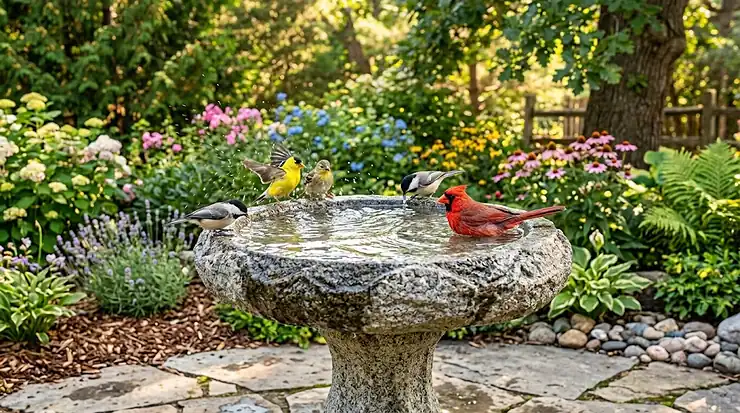
A bird bath for summer heat is simply a shallow water basin, fountain, or solar-powered feature designed to give birds a cool, reliable place to drink and bathe during hot, dry stretches — the kind of weather that’s becoming more common across Canada. 🇨🇦 During a heat wave, a backyard bird bath isn’t just a pretty garden accent; it’s often the closest thing to a lifeline for small songbirds, who lose water fast through panting and have no sweat glands to cool down the way we do.
If you’ve ever stood on your patio during a 32°C (90°F) afternoon in July and wondered why your feeders sat empty, the answer is usually water, not food. Birds will travel out of their way for a clean, shaded bath long before they’ll bother with a feeder in the heat. The trick for Canadian backyards is choosing a bath that holds up to our specific climate swings — intense UV in summer, sudden cold snaps in shoulder seasons, and (for many of us) hard freezes the rest of the year — while staying shallow, easy to clean, and resistant to the algae bloom that hot, still water practically guarantees.
In this guide, we’ll walk through seven real bird baths currently sold on Amazon.ca, how to pick the right one for your yard (balcony, suburban deck, or rural acreage), and the maintenance habits that actually keep birds — not mosquitoes — coming back. We’ll also cover the Canada-specific stuff most U.S.-written buying guides skip entirely: standing-water bylaws, West Nile virus prevention, and what “summer” really means for a bath that has to survive a Prairie cold front by October.
Quick Comparison: Best Bird Baths for Summer Heat at a Glance
| Product | Type | Price Range (CAD) | Best For |
|---|---|---|---|
| AISITIN 2.5W Solar Fountain Pump | Add-on fountain pump | $25–$35 | Adding movement to a bath you already own |
| Mademax Upgraded Solar Fountain Pump | Add-on fountain pump | $20–$30 | Budget buyers, easy filtration |
| Sunnydaze Decor Ceramic Pedestal Bird Bath | Decorative basin (no fountain) | $90–$140 | Classic garden look, simplicity |
| VIVOHOME Bird Bath with Solar Fountain Combo | All-in-one pedestal + fountain | $60–$90 | First-time buyers wanting everything in one box |
| VIVOHOME Deck-Mounted Oval Bird Bath | Railing-clamp bath | $30–$45 | Condos, balconies, small decks |
| Alpine Corporation Pedestal Birdbath with Planter & Solar LEDs | Multi-function pedestal | $70–$110 | Buyers wanting daytime and evening appeal |
| VIVOHOME Solar Bird Bath with Reservoir & Battery System | Premium all-in-one with backup power | $90–$130 | Hands-off owners, longer hot-day coverage |
Looking at the table, the split is really between buying a fountain pump to drop into a bath you already have versus buying a complete bird bath that includes one. If your existing basin is in decent shape, an AISITIN or Mademax pump for well under $35 CAD is the cheapest way to add the sparkle and movement that draws birds in from across the yard. If you’re starting from zero, the VIVOHOME combo sets and the Alpine Corporation pedestal give you a basin, a stand, and a fountain in a single order — at a real cost premium, but with far less guesswork.
💬 Just one click — help others make better buying decisions too! 😊
✨ Don’t Miss These Exclusive Deals!
🔍 Take your backyard bird-watching to the next level with these carefully selected picks. Tap any highlighted product to check current pricing and availability on Amazon.ca — these tools will help you build a backyard oasis your local birds (and your family) will love.
Top 7 Bird Baths for Summer Heat: Expert Picks for Canadian Backyards
1. AISITIN 2.5W Solar Bird Bath Fountain Pump
The AISITIN Solar Bird Bath Fountain Pump is a small floating solar panel-and-pump unit, not a basin — you drop it into water you already have. It runs on a roughly 2.5W monocrystalline panel and ships with six interchangeable nozzles, so you can dial the spray from a gentle bubble up to a taller jet.
What that 2.5W rating actually means in practice: on a bright, sunny Canadian afternoon it starts moving water within about three seconds, but it stalls completely under cloud cover or once the sun dips behind your neighbour’s maple tree — there’s no battery backup, so it’s strictly a “sunny day” gadget, not an all-day solution. For most of southern Ontario, the Prairies, and the BC interior in July, that’s a non-issue; for the coastal fog belt, it’s worth knowing before you buy.
Customer feedback: Buyers on similar AISITIN solar pump listings tend to report quick setup and a noticeable jump in bird visits once moving water is added, with the most common complaint being that the pump needs occasional shaking to clear air bubbles after a refill.
✅ Pros: very affordable; no wiring or electricity bill; works in any existing basin
❌ Cons: no power storage for cloudy days; small panel can get knocked off-centre by larger birds
Price & value verdict: At roughly $25–$35 CAD, this is the lowest-risk way to test whether moving water increases traffic to your yard before committing to a full pedestal-and-fountain set.

2. Mademax Upgraded Solar Fountain Pump with Filtration Box
The Mademax Solar Fountain Pump covers similar ground to the AISITIN unit — a floating solar pump with multiple nozzle styles — but adds a removable filtration box that traps leaves, dust, and debris before they clog the impeller.
In a country where maple seeds, pine needles, and cottonwood fluff drop into outdoor water for a good chunk of the warm season, that filtration box is the detail that matters most. It won’t stop algae from forming (nothing on the pump side does), but it does mean fewer afternoons spent fishing debris out of a jammed pump in late summer.
Customer feedback: Reviews on comparable Mademax solar pump listings frequently mention the filtration add-on extending the time between cleanings, alongside the same caveat as most solar units — performance drops sharply on overcast days.
✅ Pros: filtration box reduces clogging; multiple nozzle styles included; no batteries required
❌ Cons: still fully sun-dependent; smaller spray radius than higher-wattage units
Price & value verdict: Usually in the $20–$30 CAD range, making it one of the cheapest legitimate upgrades for an existing bath — though Canadian buyers near deciduous trees should weigh the filtration benefit heavily.
3. Sunnydaze Decor Ceramic Pedestal Bird Bath
If you want the classic, no-fountain look, the Sunnydaze Decor Ceramic Pedestal Bird Bath is a hand-glazed, two-piece ceramic basin and stand that comes in several finishes. It’s rated UV- and frost-resistant, which is the detail Canadian buyers should actually pay attention to: ceramic that isn’t frost-rated can crack the first winter it’s left outside through a freeze-thaw cycle, even if you don’t use it in cold months.
There’s no pump, so there’s no moving water to discourage algae — this bath earns its keep through capacity and a wide, shallow bowl that holds enough water to resist evaporating dry on the hottest afternoon, but it will need a more disciplined refill-and-scrub routine than a fountain model.
Customer feedback: Buyer feedback on this product line consistently praises the glaze finish and easy twist-lock assembly, with the occasional reviewer noting the ceramic basin’s weight (around 17 kg/38 lbs) makes it stable but awkward to move solo once filled.
✅ Pros: elegant, durable ceramic; frost/UV-rated for Canadian winters in storage; heavy enough to resist tipping in wind
❌ Cons: no fountain — needs manual cleaning more often; ceramic can chip if dropped during winter storage
Price & value verdict: Typically $90–$140 CAD depending on finish — a premium decorative pick rather than a budget option, but one that’s built to last several Canadian seasons if stored properly.
4. VIVOHOME Bird Bath with Solar Fountain Combo Set
The VIVOHOME Bird Bath with Solar Fountain Combo Set bundles a roughly 50–60 cm-wide polyresin bowl, a pedestal base, and a built-in solar fountain pump with multiple nozzle settings in one box — the most practical option for someone with zero existing equipment.
The bowl’s shallow, gently sloped design (around 6 cm/2.4 in deep at the centre) is genuinely bird-friendly: small songbirds can wade in from the rim rather than needing to “jump” into deep water, which matters more in summer when dehydrated birds may be weaker than usual. The polyresin construction also means it won’t crack from a sudden cold snap the way ceramic can, which is a real advantage if you’re the type to forget to bring the bath inside before the first frost.
Customer feedback: Buyers commonly mention the twist-off bowl making water changes fast (no need to disassemble the whole stand), along with a few notes that very windy days can tip the fountain’s spray pattern off-centre.
✅ Pros: complete kit, nothing extra to buy; lightweight polyresin resists cracking; bowl detaches for easy cleaning
❌ Cons: lightweight base may need gravel or stones added for stability in windy areas; fountain still sun-dependent
Price & value verdict: Around $60–$90 CAD, this sits in the sweet spot for first-time buyers — cheaper than premium battery-backed units, more complete than a bare pump.
5. VIVOHOME Deck-Mounted Oval Bird Bath with Solar Fountain
For condo dwellers, apartment renters, and anyone without a real yard, the VIVOHOME Deck-Mounted Oval Bird Bath clamps directly onto a railing up to about 10 cm (3.9 in) thick, with an oval polyresin bowl and a small integrated solar fountain.
This is the product on this list most tailored to urban Canadian life — think a balcony in downtown Toronto or a condo deck in Calgary’s Beltline. The trade-off for that portability is capacity: at roughly 5 litres (1.3 gallons), it evaporates faster on a hot day than a full pedestal bath, so apartment dwellers in particular need to top it up more often during a heat wave rather than assuming it’ll coast for a week.
Customer feedback: Feedback on comparable deck-mount bird bath listings tends to focus on how secure the clamp feels on standard railings, with smaller balcony railings or glass panels sometimes requiring a workaround.
✅ Pros: no yard required; adjustable clamp fits most railings; doubles as a small fountain feature
❌ Cons: small water capacity means faster evaporation in heat; not all balcony railing types are compatible
Price & value verdict: Usually $30–$45 CAD — genuinely the only practical option on this list for renters and condo owners, and reasonably priced for what it solves.
6. Alpine Corporation Pedestal Birdbath with Planter Base and Solar LED Lights
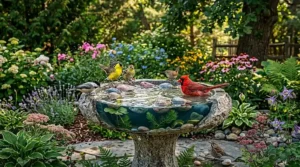
The Alpine Corporation Pedestal Birdbath stands out by combining a roughly 70 cm (29 in) tall pedestal bath with a built-in planter ring at the base and solar-powered LED accent lights.
The planter base is the clever bit: filling it with marigolds, petunias, or another pollinator-friendly annual not only dresses up the piece but gives bees and butterflies something to perch on near the water, while the LEDs mean the bath still earns its spot in the garden after dusk, when songbird activity has died down but you’re still out on the patio. It’s worth noting the solar lights and the (separately sold) fountain pump options draw from different small solar cells, so don’t expect one panel to run everything during a stretch of grey, rainy days — which, depending on the region, parts of a Canadian summer absolutely deliver.
Customer feedback: Reviewers on similar Alpine Corporation pedestal listings generally highlight the dual-purpose planter design, with occasional comments that the LED lights need a full day of direct sun to last through a short summer night.
✅ Pros: doubles as a planter and night feature; tall pedestal keeps water further from ground-level pests; durable resin construction
❌ Cons: LEDs and water feature both sun-dependent; taller stature needs a level, sheltered spot to avoid tipping
Price & value verdict: Typically $70–$110 CAD, positioning it as a mid-to-premium pick for buyers who want a garden centrepiece, not just a water bowl.
7. VIVOHOME Solar Bird Bath with Fountain, Reservoir and Battery System
The VIVOHOME Solar Bird Bath with Reservoir and Battery System is the most hands-off option here: a roughly 50 cm (20 in) bowl paired with a light-sensor solar fountain that switches on at sunrise and off at dusk automatically, backed by a lithium battery that keeps it running for five to six hours even on a cloudy day.
The standout feature for Canadian summers is the built-in pedestal reservoir — about 3 litres (0.8 gal) of extra water that feeds the bowl automatically, so one fill can realistically last three to five days instead of needing a daily top-up. During a genuine heat dome, when evaporation rates spike and refilling daily becomes a real chore, that reservoir is the single feature most likely to keep water available even if you’re away for a long weekend. A low-water sensor also shuts the pump off automatically to prevent it running dry and burning out.
Customer feedback: Buyer feedback on this model line tends to emphasize the multi-day reservoir as the main selling point over cheaper solar baths, alongside reminders to clean the dual filters weekly to keep flow steady.
✅ Pros: battery keeps fountain running through cloudy stretches; multi-day reservoir reduces refill frequency; auto on/off via light sensor
❌ Cons: highest price point on this list; battery performance can dip after extended overcast weather
Price & value verdict: Generally $90–$130 CAD — the premium choice, but arguably the best value-per-hour-of-functioning-fountain if you’re often away from home during the work week.
Detailed Specifications Comparison
| Product | Power Source | Capacity / Coverage | Material | Best Season Fit |
|---|---|---|---|---|
| AISITIN Solar Fountain Pump | Solar (no battery) | N/A (pump only) | Plastic/solar cell | Sunny, consistent summer days |
| Mademax Solar Fountain Pump | Solar (no battery) | N/A (pump only) | Plastic/solar cell, filtration box | Areas with falling leaves/debris |
| Sunnydaze Ceramic Pedestal | None (manual fill) | ~3.8 L (1 gal) bowl | UV/frost-resistant ceramic | All seasons (with winter storage) |
| VIVOHOME Combo Set | Solar (no battery) | ~5.5 L bowl | Polyresin | General-purpose summer use |
| VIVOHOME Deck-Mounted | Solar (no battery) | ~5 L (1.3 gal) | Polyresin, metal clamp | Balconies, condos |
| Alpine Corporation Pedestal | Solar (lights only) | Bowl + planter ring | Resin | Decorative, multi-season |
| VIVOHOME Reservoir + Battery | Solar + lithium battery | ~1.2 gal bowl + 0.8 gal reservoir | ABS plastic | Heat waves, low-maintenance |
The pattern in this table is straightforward once you interpret it: anything without a battery is, in effect, a daytime-only feature that goes quiet the moment the sun does, while the reservoir-and-battery model is the only one engineered specifically to keep working through Canada’s increasingly common multi-day heat events. Capacity matters just as much as power — a 5-litre bowl on a deck-mounted bath simply can’t out-evaporate a heat dome the way a 12-litre pedestal basin can, so renters with smaller units should plan on checking water levels more often, not assume the product is underperforming.
How to Choose a Bird Bath for Summer Heat in Canada
- Match capacity to your climate zone. Buyers in drier, hotter regions (southern Prairies, the Okanagan) should prioritize larger basins or reservoir-backed models that resist evaporating dry mid-day.
- Check frost-resistance before you buy, even for summer use. A bath you only run in July still has to survive storage through a Canadian winter — ceramic and ABS plastic both need a frost/UV rating on the spec sheet.
- Decide if you actually have sun. Solar fountains need several hours of direct, unobstructed sunlight; a shaded backyard in a mature, tree-lined neighbourhood may make a manual or battery-backed option more reliable.
- Prioritize shallow depth and texture. A bowl depth of 2.5–6 cm (1–2.4 in) at the centre, with a sloped or textured surface, lets the widest range of species — and weakened, heat-stressed birds — use it safely.
- Weigh portability against stability. Lightweight polyresin baths are easy to move into shade as the sun shifts but may need gravel in the base on windy sites; heavy ceramic resists tipping but is a two-person job to relocate.
- Factor in cleaning effort, not just looks. A bowl that detaches without disassembling the whole stand will get cleaned more often — and a bath that’s actually cleaned regularly is the single biggest factor in keeping it bird-friendly rather than mosquito-friendly.
- Budget for the whole season, not just the purchase price. Add-on solar pumps are cheap upfront but may need replacing after a season or two of UV exposure; factor that into a “$25 pump now vs. $90 combo set once” decision.
Practical Usage Guide: Setting Up and Running Your Bird Bath in Hot Weather
Getting a new bird bath working well in a Canadian summer takes a bit more than filling it with the garden hose and walking away.
Placement first. Position the bath in partial shade if at all possible — full sun heats shallow water fast and accelerates both evaporation and algae growth, while full shade can mean birds don’t notice it at all. A spot shaded during the hottest part of the afternoon, ideally near (but not directly under) shrubs or a tree, gives birds cover to dart to after bathing while keeping water several degrees cooler.
Cold-water habits matter. Use hose water rather than sun-warmed water from a watering can left outside, and consider dropping in an ice cube or two during the hottest part of the day — it cools the water and slightly slows algae formation as it melts.
First 30 days — common mistakes to avoid. Don’t place a brand-new solar pump in a spot with afternoon shade only and expect all-day operation; test it across a full sunny day before deciding it’s faulty. Don’t overfill a shallow basin to “make it last longer” — depths beyond about 6 cm (2.4 in) actually deter the small songbirds you’re trying to attract. And don’t skip the first deep clean: even a brand-new bath should get a vinegar-and-water scrub before first use to remove manufacturing residue.
Winterizing, even mid-summer. If a heat wave breaks and a sudden cold front rolls through (more common in the Prairies and parts of Ontario than people expect), drain ceramic and concrete baths rather than risk an overnight freeze cracking the basin — it happens even in late spring and early autumn cold snaps.
Real Canadian Backyards: Matching the Right Bird Bath to Your Situation
The downtown Toronto condo dweller, no yard: A deck-mounted oval bath clamped to a balcony railing solves the “no yard” problem outright. Expect to top it up daily during a heat wave given the smaller water volume, and skip the solar fountain option if your balcony faces north with limited direct sun.
The Calgary or Winnipeg suburban family with a fenced yard and kids: A mid-range combo set like the VIVOHOME pedestal-and-fountain bath works well here — lightweight enough to move into shade as the sun shifts through the day, and the moving water tends to hold kids’ attention as much as the birds’.
The rural Manitoba or Okanagan property owner dealing with serious daytime heat: The reservoir-and-battery model earns its higher price here. With less foot traffic to notice and refill a basin daily, the multi-day reservoir and auto on/off light sensor mean the bath keeps functioning even during a multi-day absence or a stretch of 35°C+ days.
How to Keep a Bird Bath Clean in Summer Heat
Heat accelerates everything that makes a bird bath unpleasant — bacterial growth, algae, and mosquito breeding all move faster in warm, still water than in cool spring conditions. The baseline routine that works across almost any bath type: empty and refill with fresh water every one to two days, and do a full scrub with a stiff brush at least once a week, more often if you notice slime forming on the basin walls.
Avoid soap or household cleaners, which can strip natural oils from feathers and irritate skin on contact; a simple mix of water with a small amount of white vinegar, scrubbed and then rinsed thoroughly, is enough for routine cleaning. For baths with a solar pump, pull the unit out during the weekly scrub and rinse any visible grit from the intake — debris buildup is the most common reason a pump that worked fine in June seems to stall by August.
Bird Bath Algae Prevention in Summer
Algae needs three things to take hold: standing water, sunlight, and time — which is exactly what a still bird bath provides on a hot July afternoon. Moving water from even a small solar fountain meaningfully slows algae compared with a static basin, since algae spores struggle to anchor in turbulence the way they do in calm water.
Beyond a fountain, partial shade is the next-biggest lever — water that never gets direct midday sun simply won’t bloom as fast. Frequent refills matter more than any additive: changing the water every couple of days interrupts the algae life cycle before it visibly colours the basin. Some hobbyists drop a clean copper penny into the bowl on the theory that trace copper ions discourage algae, though the effect is modest at best and shouldn’t replace a real cleaning routine.
Mosquito Prevention and Your Bird Bath: What Canadians Should Know
This is the part most bird bath buying guides skip, and it matters more in Canada than people expect. According to the Government of Canada’s guidance on preventing West Nile virus, getting rid of standing water around the home — including in bird baths — is one of the core recommended steps for reducing mosquito breeding sites, since mosquito eggs can develop into biting adults in well under two weeks of still water.
The fix doesn’t mean giving up your bird bath; it means treating water changes as non-negotiable rather than optional. Refreshing the water every one to two days breaks the mosquito life cycle before eggs can mature, and a moving-water fountain makes the basin far less attractive to egg-laying mosquitoes in the first place, since most species strongly prefer still water. Many Canadian municipalities — Toronto and York Region among them — also have standing-water bylaws that specifically reference items like bird baths, so a clean, frequently emptied bath isn’t just bird-friendly, it’s the difference between compliance and a complaint from a neighbour.
Water Change Frequency in Summer: How Often Is Really Enough?
As a baseline, plan to refill a bird bath’s water every one to two days through summer, and increase that to daily during an active heat wave when evaporation is fastest and bacterial growth accelerates most. Larger reservoir-backed baths can stretch slightly longer between full refills thanks to their backup water supply, but the surface water birds actually bathe in should still be freshened at the same one-to-two-day pace regardless of total capacity — a big reservoir delays running dry, it doesn’t delay water going stale.
Bird Bath with Fountain vs Plain Basin: Which Cools Birds Better in Summer?
A basin with a fountain offers two real advantages in hot weather: moving water evaporates and aerates more, which keeps it a degree or two cooler than dead-still water in direct sun, and the visual sparkle of splashing water is documented to draw in more bird species from greater distances than a silent basin. The trade-off is dependence on sun (for solar models) and slightly more upkeep, since a pump is one more part that needs cleaning and occasional replacement.
A plain basin’s advantage is simplicity and resilience — no moving parts to fail, no sun-dependence, and generally a lower price point for the same capacity. For a shaded yard with limited direct light, or for buyers who’d rather do less mechanical upkeep, a quality basin like the Sunnydaze ceramic pedestal, refreshed diligently, performs just as well at the core job of keeping birds hydrated.
Common Mistakes Canadians Make Buying a Bird Bath for Hot Weather
Buying the deepest, biggest basin available, assuming “more water lasts longer,” is a frequent misstep — depth deters the small songbirds most likely to actually use a bath. Skipping the frost-resistance spec because “it’s only for summer” is another: most buyers don’t bring a bath in and back out twice a season, so an unrated ceramic or ABS basin left outside through a shoulder-season frost can crack before next summer even arrives. Choosing a solar fountain for a yard with significant afternoon shade is a third common error — without several consistent hours of direct sun, even a well-reviewed solar pump will underperform regardless of brand. Finally, treating a bird bath as “set and forget” rather than a weekly chore is the mistake most likely to turn a wildlife-friendly feature into the exact standing-water problem Canadian municipalities warn about.
Long-Term Cost and Maintenance in Canada
Budget add-on solar pumps in the $20–$35 CAD range are the cheapest entry point but tend to have the shortest realistic lifespan, often needing replacement after one to two Canadian summers of UV exposure — factor a repeat purchase into the true cost. Mid-range combo sets ($60–$90 CAD) generally hold up two to four seasons with proper winter storage, while a well-made ceramic basin or premium reservoir model ($90–$140 CAD) can last five-plus years if brought indoors or adequately covered through freeze-thaw cycles. Across all tiers, the actual ongoing cost is mostly your time, not money — a brush, white vinegar, and ten minutes a week will extend any bird bath’s working life far more than spending extra upfront on a “premium” finish.
FAQ
❓ How often should I change bird bath water in summer in Canada?
❓ Will a solar bird bath fountain work in a partly shaded Canadian yard?
❓ Does a bird bath attract mosquitoes in Canada?
❓ Can I leave a ceramic bird bath outside through a Canadian winter?
❓ Do bird baths actually help birds survive a heat wave?
Conclusion
A good bird bath for summer heat in Canada isn’t really about finding the fanciest fountain — it’s about matching capacity, sun exposure, and material to your actual yard, then sticking to a simple weekly cleaning habit. Whether that means a $25 solar pump dropped into a basin you already own, a complete combo set for a first-time backyard, or a battery-backed reservoir model for a property where you can’t refill daily, the products covered here span the realistic range of what’s available on Amazon.ca right now. Get the water changed often, keep it shallow and shaded where you can, and the birds — not the mosquitoes — will be the ones showing up.
Recommended for You
- Best Winter Bird Water Source in Canada 2026: 7 Expert-Picked Solutions
- How to Keep Bird Bath from Freezing: 7 Best Heaters in Canada (2026)
- 7 Best Railing Bird Baths for Canadian Decks & Balconies (2026)
Disclaimer: This article contains affiliate links. As an Amazon Associate, I earn from qualifying purchases. If you purchase products through these links, we may earn a small commission at no additional cost to you.
✨ Found this helpful? Share it with your friends! 💬🤗
