
In This Article
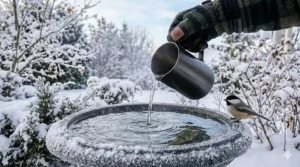
If you’ve ever stepped outside on a January morning in Manitoba, Ontario, or British Columbia to find your bird bath looking like a hockey rink, you already know the problem. And if you’ve watched a Black-capped Chickadee desperately pecking at solid ice where water used to be — well, that image doesn’t leave you in a hurry.

Here’s what most Canadian backyard bird enthusiasts don’t fully appreciate: knowing how to keep bird bath from freezing isn’t just about aesthetics or convenience. It’s genuinely a matter of bird survival. According to the Canadian Wildlife Federation, wild birds in Canada increase their metabolism dramatically during winter just to maintain body temperature — and that means they need reliable water sources more than ever. While seeds and suet get all the attention, water is equally critical.
The science behind this is striking. Melting snow inside a bird’s body uses precious energy — energy that a bird in -20°C weather simply cannot spare. A chickadee burning calories just to melt a beak-full of ice is a chickadee that may not survive the night. Providing open liquid water can genuinely be the difference between life and death for your backyard visitors.
So, how to keep bird bath from freezing in a Canadian winter where temperatures regularly plunge below -20°C (and sometimes -30°C or worse in Alberta or Saskatchewan)? The short answer: you need the right equipment, the right placement strategy, and a few clever tricks that most guides skip over entirely.
In this comprehensive guide, we’ll walk you through the seven best bird bath heaters available on Amazon.ca, practical placement and maintenance tips built around Canadian conditions, and the mistakes even experienced birders make when winter hits. Whether you’re in a downtown Toronto condo with a railing-mounted bath or on an acreage outside Winnipeg, there’s a solution here for you.
Quick Comparison: Top 7 Bird Bath Heaters Available on Amazon.ca
| Product | Wattage | Material | Thermostat | Best For | Price Range (CAD) |
|---|---|---|---|---|---|
| K&H Ice Eliminator Original | 50W | Enamel/plastic | ✅ Yes | Budget, small baths | $40–$60 |
| K&H Super Ice Eliminator | 80W | Enamel/plastic | ✅ Yes | Mid-size baths, -20°C+ | $55–$75 |
| GESAIL Birdbath Deicer | 50W | Cast aluminum | ✅ Yes | Long-term durability | $35–$55 |
| Daoeny Bird Bath Heater | 120W | Full-covered aluminum | ✅ Yes | Harsh Canadian winters | $45–$65 |
| Jvgoo 100W Bird Bath Heater | 100W | Aluminum casing | ✅ Yes | Large birdbaths | $40–$60 |
| Saillong Heated Rock Deicer | 80W | Aluminum base | ✅ Yes | Natural-look baths | $40–$60 |
| XpenGeny Bird Bath Heater | 120W | Full-covered aluminum | ✅ Yes | Extreme cold zones | $45–$65 |
Table Analysis: What stands out immediately is the sweet spot between 80W and 120W — this wattage range handles the reality of Canadian winters, where temperatures can swing from a crisp -5°C to a brutal -35°C wind chill overnight. The 50W options work well in milder Canadian regions (coastal BC, southern Ontario), but if you’re in the Prairies or northern areas, stepping up to at least 80W is worth every extra dollar. All seven products feature thermostat control, which is non-negotiable for Canadian use — you don’t want a heater running flat-out on a mild +3°C November afternoon, wasting electricity and overheating the water.
💬 Just one click — help others make better buying decisions too! 😊
Top 7 Bird Bath Heaters for Canadian Winters: Expert Analysis
1. K&H Pet Products Ice Eliminator Original Birdbath Deicer (50W)
The K&H Ice Eliminator Original is the classic entry point for anyone just starting to take winter bird care seriously, and it’s earned its popularity honestly. At 50W with full thermostat control, it activates automatically when temperatures near freezing — meaning it’s not running your electricity bill up on those milder Canadian autumn days.
What makes this stand out for Canadian buyers specifically is its MET Labs safety certification that exceeds both USA and Canadian electrical safety standards. For those in provinces with strict electrical codes like Ontario or BC, that matters. The rock-like enamel exterior can even be spray-painted to match your bath’s colour — a small touch that veteran birders appreciate. That said, 50W has its limits: if you’re in Regina or Thunder Bay where -25°C is a regular occurrence, this unit will struggle to maintain fully open water during the coldest weeks.
Canadian customers note it sits firmly in the bath without floating around, and the three-year warranty is a genuine confidence boost. For urban birders in Vancouver, Victoria, or southern Ontario who deal with milder dips, this is an excellent, energy-conscious pick.
✅ Thermostat-controlled for efficient electricity use
✅ MET-certified for Canadian electrical standards
✅ Paintable enamel finish; won’t rust or stain
❌ 50W may underwhelm in Prairie provinces or northern Canada below -20°C
❌ Cord length can be limiting for some bath placements
Price range: $40–$60 CAD. Check current pricing on Amazon.ca.
2. K&H Pet Products Super Ice Eliminator Bird Bath Heater (80W)
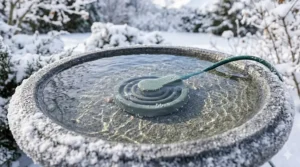
Think of this as the K&H Ice Eliminator’s tougher sibling — 30 extra watts that become very meaningful when you’re in Ottawa in February. The Super Ice Eliminator is rated to maintain open water even in sub-zero conditions approaching -30°C (-22°F), which covers the bulk of Canadian winter scenarios outside the Arctic.
The same MET-certified safety and thermostat operation as the Original, but with the added wattage headroom to handle the extended cold snaps that define January and February across most of Canada. The enamel rock-style finish means it doesn’t look like a piece of industrial equipment sitting in your garden — a real consideration if your bath is a centrepiece of your backyard design.
What most buyers don’t realize: K&H’s thermostat kicks in around 5°C (41°F), well before your water actually freezes. This means the unit is doing its job quietly and efficiently long before you’d even notice the problem. Canadian reviewers in Ontario and Alberta consistently report strong performance through even extended cold stretches.
✅ 80W handles harsh Canadian winters in most provinces
✅ Thermostat activates at 5°C — proactive, not reactive
✅ 3-year warranty and strong brand track record
❌ Slightly pricier than the 50W version
❌ Not recommended for extremely deep baths
Price range: $55–$75 CAD. Check current pricing on Amazon.ca.
3. GESAIL Birdbath Deicer (50W, Cast Aluminum)
The GESAIL brings a premium build quality to the budget-friendly end of the market. Its cast aluminum casing is genuinely significant: unlike plastic-housed units, aluminum dissipates heat more evenly across the bath, reducing the chance of hot spots near the heating element while keeping the surrounding water comfortably above freezing.
For Canadian buyers, the practical implication is straightforward — cast aluminum handles temperature cycling (freeze-thaw-freeze) far better than plastic over multiple Canadian winters. You’re not re-purchasing this every two years. The 25-cm PVC power cord is weather-resistant, and at 50W it consumes roughly the same electricity as a standard incandescent bulb — reasonable for winter-long use.
The limitation? Same as any 50W unit: in Saskatoon or northern Ontario during a deep freeze, you may notice ice forming around the edges during extreme cold events. A solid choice for the gardener in southern Canada who wants quality construction without a premium price tag.
✅ Heavy cast aluminum won’t rust, calcify, or stain
✅ Even heat distribution across bath
✅ Budget-friendly with premium materials
❌ 50W ceiling limits effectiveness below -20°C
❌ Shorter cord may require an outdoor extension in some setups
Price range: $35–$55 CAD. Check current pricing on Amazon.ca.
4. Daoeny Bird Bath Heater (120W, Full-Covered Aluminum)
This is the unit I’d put in the hands of any Canadian birder living north of, say, Sudbury or anywhere on the Prairies. The full 120W, combined with a fully encased aluminum shell, delivers the most aggressive freeze prevention in this category. Thermostatically controlled, so it won’t cook your electricity bill on mild days — but when a -30°C Alberta cold snap rolls through, it doesn’t blink.
The “full-covered” aluminum design is the key differentiator here. Rather than a partially-exposed heating element (common in budget deicers), the entire surface is clad in aluminum, meaning birds’ feet and bills never contact anything that could cause discomfort, and the heat radiates consistently. This is particularly reassuring for wildlife-conscious Canadian birders who worry about bird safety.
Canadian customers in colder provinces have specifically praised this model for keeping open water during multi-day cold snaps where other units gave up. The thermostat sensitivity is reliable, and setup is genuinely plug-and-play.
✅ 120W handles extreme Canadian winter conditions
✅ Full aluminum casing — safest design for wildlife contact
✅ Excellent customer feedback from Prairie province buyers
❌ Higher wattage means slightly more electricity on the coldest days
❌ Larger and heavier than 50W alternatives
Price range: $45–$65 CAD. Check current pricing on Amazon.ca.
5. Jvgoo 100W Bird Bath Heater (Submersible, Thermostat Control)
The Jvgoo sits in an interesting niche: powerful enough for serious Canadian winters, yet priced accessibly. At 100W with thermostat control, it targets the middle ground between the 80W K&H options and the 120W heavy-duty units — a sweet spot for most Canadian situations outside the coldest regions.
What I appreciate about the Jvgoo for Canadian birders specifically is its versatility: it works equally well in birdbaths, water dishes, and even small livestock waterers — so if you’re on a rural property with chickens or ducks alongside your backyard birds, one unit covers multiple needs. The aluminum casing means it’s safe for both metal and non-metal bath materials, and the submersible design keeps it stable and secure through wind and weather.
Reviewers report it’s particularly effective in pedestal-style concrete baths (common in older Canadian gardens), where the extra wattage counteracts the thermal mass of the stone. Installation takes about two minutes.
✅ Versatile — works across multiple water vessel types
✅ 100W covers most Canadian winter conditions reliably
✅ Solid aluminum construction, submersible-rated
❌ Fewer reviews than K&H, so longer-term durability data is still building
❌ May be oversized for very small baths
Price range: $40–$60 CAD. Check current pricing on Amazon.ca.
6. Saillong Bird Bath Deicer Heated Rock (80W, Decorative)
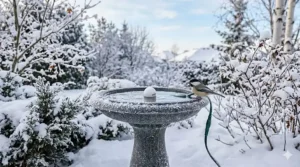
If aesthetics matter to you — and honestly, for many Canadian gardeners who’ve spent years building beautiful backyard spaces, they do — the Saillong Heated Rock is worth serious attention. The rock-style exterior with an aluminum base looks genuinely natural in most garden settings, and the 80W thermostat-controlled core does a capable job of keeping water liquid in most Canadian winters.
The aluminum base serves both a structural and functional purpose: it keeps the unit seated firmly even when birds land on it, and it helps distribute heat upward into the water column. For baths where you have active, heavier birds (like Mourning Doves, which are common Canadian winter visitors), that stability is genuinely appreciated.
The decorative exterior is a polarizing design choice — it looks great when new, but some Canadian buyers have noted that paint finish can dull over multiple winters of UV and freeze-thaw cycling. For purely functional performance, the K&H or Daoeny options may age better; but for that first winter, the Saillong is a legitimate conversation piece.
✅ Natural rock aesthetic blends seamlessly in garden settings
✅ 80W handles most Canadian conditions
✅ Stable aluminum base resists tipping
❌ Decorative finish may fade over multiple harsh Canadian winters
❌ Not the best choice for extreme cold (below -25°C consistently)
Price range: $40–$60 CAD. Check current pricing on Amazon.ca.
7. XpenGeny Bird Bath Heater (120W, Full-Covered Aluminum)
Rounding out the list is the XpenGeny 120W — a unit that competes directly with the Daoeny at the high-power end of the spectrum but offers a slightly different form factor that suits deeper or larger bath basins. If your bird bath is, say, a wide concrete pedestal style that holds a significant volume of water, the XpenGeny’s heating profile may suit it better.
The auto shut-off feature deserves a mention: it’s a safety mechanism that kicks in if the water level drops dangerously low — important during Canadian winters when evaporation from a heated bath is noticeably faster than you’d expect (a reminder to top up your bath every couple of days). This feature alone makes it a smarter choice for anyone who travels during winter or can’t check on their bath daily.
Full aluminum casing, 120W, thermostat-controlled — all the credentials for serious Canadian winter performance. The XpenGeny also explicitly rates for use in very low temperatures, making it one of the few units suited to northern Ontario, the Prairies in January, and other truly demanding environments.
✅ 120W with auto shut-off — ideal for less frequent monitoring
✅ Full aluminum casing for consistent, safe heat distribution
✅ Suited to larger, deeper baths
❌ At 120W, it’s among the higher electricity users in the lineup
❌ Larger profile may not sit flush in all bath styles
Price range: $45–$65 CAD. Check current pricing on Amazon.ca.
✨ Don’t Miss These Exclusive Deals!
🔍 Take your winter bird care to the next level with these carefully selected heaters. Click on any highlighted product to check current pricing and availability on Amazon.ca. These tools will help you keep your backyard birds healthy and hydrated all winter long!
How to Place and Maintain Your Bird Bath Heater in Canadian Conditions: A Practical Usage Guide
Buying the right deicer is only half the battle. Where and how you set it up determines whether it actually works through a Canadian winter — and whether it’s safe for the birds you’re trying to help.
Step 1: Position for sun exposure. Place your bath in a spot that receives direct sun for at least 4-6 hours daily. Solar gain won’t prevent freezing on its own in a Canadian winter, but it meaningfully reduces the load on your heater and keeps water slightly warmer between heating cycles. South-facing positions are ideal.
Step 2: Elevate the bath. An elevated bath (pedestal-style or deck-mounted) offers two Canadian-specific advantages: it’s safer from cats and other predators that tend to hunt along ground level, and it keeps the bath above snow accumulation. In February in most Canadian cities, ground-level baths can become snow-buried and inaccessible to birds within 24 hours of a storm.
Step 3: Use a GFCI outlet. The National Wildlife Federation recommends adding a ground-fault interrupted circuit (GFCI) for all outdoor electrical water features — doubly important in Canada where freeze-thaw cycles put extra stress on outdoor wiring. Most Canadian electricians can install an outdoor GFCI outlet for a modest fee.
Step 4: Top up water every 2-3 days. Heated baths evaporate faster than unheated ones — especially during dry Prairie winters. Keep a dedicated 2-litre bottle by the back door (as recommended by the birding specialists at Urban Nature Store Canada) for quick daily top-ups. Don’t use boiling water — lukewarm or cold tap water is fine and actually freezes slightly slower than very hot water.
Step 5: Add a mesh grate in extreme cold. When temperatures dive below -20°C, birds bathing in even slightly warm water risk having their feathers freeze before they finish preening. Adding a plastic or mesh grate that lets birds insert their bills without fully immersing themselves can be a genuine life-saver. This is a tip most product listings won’t tell you — but experienced Canadian birders swear by it.
Step 6: Clean the bath weekly. A heated bath is more susceptible to algae and bacteria growth than a cold one. A quick rinse with a diluted vinegar-water solution (never bleach — residue can harm birds) every 7-10 days keeps the water safe. Rinse thoroughly before refilling.
Step 7: Inspect the cord monthly. Canadian winters are hard on electrical cords. Cold-hardened PVC can crack or become brittle. Check your heater’s cord monthly for damage, especially after extreme cold snaps, and ensure it’s plugged into a sheltered, weatherproof outdoor outlet.
Canadian Birder Profiles: Which Heater Is Right for You?
Different birders across Canada face genuinely different challenges. Here’s how to match your situation to the right product.
Profile 1 — The Urban Apartment Dweller in Vancouver or Victoria You have a small deck-mounted bath, mild winters (rarely below -8°C), and a standard outdoor outlet. The GESAIL Birdbath Deicer (50W) is your match — economical to run, cast aluminum quality that won’t look tacky on a condo balcony, and more than enough wattage for BC’s relatively gentle winter dips. Budget: $35–$55 CAD, and you’ll be set for years.
Profile 2 — The Suburban Birder in Toronto or Ottawa You have a pedestal bath in a suburban backyard, winters that regularly hit -15°C to -20°C, and a reliable GFCI outdoor outlet. The K&H Super Ice Eliminator (80W) is purpose-built for you. It handles Ontario’s cold snaps reliably, and the three-year warranty means peace of mind through several Canadian winters. Budget: $55–$75 CAD — worthwhile long-term value.
Profile 3 — The Prairie Bird Enthusiast in Winnipeg, Saskatoon, or Calgary Your winters are serious business: -25°C to -35°C wind chills, multi-week cold snaps, and dry air that accelerates evaporation. Don’t cut corners here. The Daoeny 120W or XpenGeny 120W with full aluminum casing is your best friend. The auto shut-off on the XpenGeny is particularly valuable if you travel for work in January. Budget: $45–$65 CAD — and factor in a Cord Connect waterproof connector to keep your outdoor extension cord connection dry.
How to Choose a Bird Bath Heater in Canada: 6 Expert Criteria
If you’re reading through product specs and feeling a bit overwhelmed, this numbered framework cuts through the noise.
1. Match wattage to your climate zone. Coastal BC and southern Vancouver Island: 50W is fine. Southern Ontario and Quebec: 80W. Prairies, northern Ontario, most of Alberta: 120W. This is the single most important decision you’ll make.
2. Prioritize aluminum over plastic construction. Aluminum dissipates heat evenly, survives freeze-thaw cycling for years, and doesn’t leach anything harmful into bird drinking water. Plastic-cased units can warp, crack, and leave residue in cold Canadian winters.
3. Never skip the thermostat. A non-thermostatically-controlled heater runs constantly, burning electricity and potentially overheating the water. Birds need cool, clean drinking water — not a warm soak. Every product on this list includes a thermostat; don’t consider anything that doesn’t.
4. Check cord length before buying. Many birders don’t measure the distance from their outdoor outlet to their bath before ordering. Canadian reviewers repeatedly flag short cords as a frustration. Check the cord length in the product specs, and budget for a weatherproof outdoor extension cord if needed.
5. Look for auto shut-off. If the water level drops too low, most heaters will burn out quickly. Auto shut-off is a safety feature that protects both the heater and your birds (a dry heater can get dangerously hot). The XpenGeny’s auto shut-off is particularly well-regarded.
6. Consider bath material compatibility. Some heaters are designed for plastic baths, some for metal or concrete. Cast aluminum heaters are generally safe across all bath materials — verify this before purchasing if you have a ceramic or concrete bath, as incompatible heaters can cause cracking.
Common Mistakes Canadian Birders Make When Keeping Bird Baths Ice-Free
After sifting through Canadian birder forums and customer reviews, these are the errors that come up again and again — and they’re entirely avoidable.
Mistake 1: Adding antifreeze or glycerin to the water. It seems logical — antifreeze prevents freezing, right? But as wildlife experts from the Nature Conservancy warn, glycerin can mat feathers and dangerously elevate blood-sugar levels in birds. Never add anything to your bird bath water other than clean water.
Mistake 2: Using a concrete bath without a cover in winter. Concrete absorbs water, and when that water freezes, it expands and cracks the bath — sometimes irreparably. Either move your concrete bath to a sheltered spot or cover it and use a winter-rated plastic or metal alternative.
Mistake 3: Letting the bath run dry. Heated baths evaporate faster, especially in dry Prairie winters. A heater running without water quickly burns out and can create a fire hazard. Check and top up every 2-3 days without fail.
Mistake 4: Buying underrated wattage to save money. A 50W heater that runs constantly trying to keep up with -30°C temperatures will cost more in electricity than a 120W thermostat-controlled unit that activates only when needed. Paradoxically, higher wattage with a good thermostat is often the more economical long-term choice in colder Canadian provinces.
Mistake 5: Ignoring electrical safety. Canada’s cold winters mean outdoor outlets can be covered in ice or snow. Always use a GFCI outlet, keep connections dry with a Cord Connect device, and inspect cords regularly. This isn’t just about protecting your heater — it’s basic electrical safety in Canadian conditions.
Mistake 6: Encouraging birds to bathe in extreme cold. During Canadian cold snaps below -15°C, a bird that bathes fully risks feather icing before it can preen — a potentially fatal situation. Place a plastic mesh grate over the bath during extreme cold to let birds drink but not bathe fully.
What to Expect: Real-World Performance of Bird Bath Heaters in Canadian Conditions
Let’s talk about what actually happens when you plug these units in — because the spec sheet version and the Canadian winter version can be quite different.
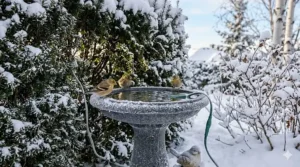
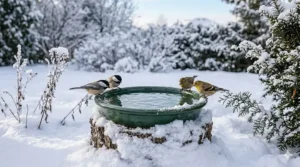
In temperatures between 0°C and -10°C, any thermostatically-controlled heater on this list will maintain a fully open bath surface with ease. You’ll likely see an increase in bird activity almost immediately — Black-capped Chickadees, American Goldfinches, House Sparrows, and Mourning Doves are your most reliable winter regulars across Canadian cities. A Wild Birds Unlimited Barrie naturalist notes that heated baths also attract species that rarely visit feeders — White-breasted Nuthatches, Downy Woodpeckers, and even Eastern Bluebirds on mild winter days.
Between -10°C and -20°C, you’ll notice the 50W units begin to show ice forming around the bath edges, though the centre typically stays open. The 80W and 120W units handle this range comfortably. Expect bird visits to peak during the warmest part of the day (10am–2pm), as birds instinctively time their bathing for the least risky moment.
Below -20°C — real Prairie winter territory — even 120W units may see some surface ice forming during overnight troughs. This is normal and expected. What matters is that the centre of the bath stays open and liquid. Top up frequently, as cold dry air pulls moisture out of the bath faster than you’d expect. At these temperatures, use a mesh cover to discourage bathing and encourage safe drinking only.
One uniquely Canadian consideration: road salt. If your bath is near a driveway or road, salt spray from plowing can contaminate the water. Rinse and refill after any significant plowing event nearby.
✨ Protect Your Backyard Birds This Winter!
🔍 These seven products are the best solutions for how to keep bird bath from freezing in Canada’s demanding winters. Check current prices and Prime availability on Amazon.ca — and remember, Prime members often get free shipping with no minimum order threshold!
Bird Bath Heating vs. DIY Alternatives: A Canadian Comparison
| Method | Cost (CAD) | Effectiveness | Canadian Winter Rating | Convenience |
|---|---|---|---|---|
| Electric deicer/heater | $35–$75 | Excellent | ⭐⭐⭐⭐⭐ | Very High |
| Heated complete bird bath | $80–$200+ | Excellent | ⭐⭐⭐⭐⭐ | High |
| Daily hot water changes | $0 | Fair | ⭐⭐⭐ | Low |
| Light bulb under clay pot | $5–$15 | Fair | ⭐⭐⭐ | Medium |
| Multiple rotating saucers | $10–$25 | Fair | ⭐⭐ | Very Low |
Analysis: The DIY options are genuinely viable for mild Canadian winters or for birders who lack an outdoor electrical outlet. Rotating two heavy-duty plastic saucers — swapping the frozen one out each morning with a fresh one — can work in southern BC or southern Ontario. But for the Prairies, northern Ontario, or any Canadian region where temperatures stay below -15°C for weeks at a time, an electric deicer is the only practical solution. The cost difference between a $50 CAD deicer and the daily inconvenience of saucer rotation — especially across a four-to-five-month Canadian winter — makes the electrical solution the obvious long-term value proposition.
Long-Term Cost and Maintenance of Bird Bath Heaters in Canada
Let’s talk CAD and kilowatts — because Canadian electricity rates and long winters make running costs a real consideration.
A 50W heater running 24/7 for five months (roughly November through March in most Canadian provinces) uses about 180 kilowatt-hours of electricity. At Canadian average electricity rates of roughly $0.12–$0.17/kWh (depending on province — Ontario and Alberta tend to be higher, Quebec and BC lower due to hydro power), that’s approximately $22–$31 CAD for the season. A thermostat-controlled 80W unit, running only 40–60% of the time due to its thermostat, will use similar or slightly more electricity but with much better performance.
The 120W units, despite higher wattage, can be surprisingly economical because their powerful thermostat-controlled cycle means they maintain temperature efficiently rather than running flat-out constantly. In the coldest Canadian months, they may actually run less total time than a struggling 50W unit.
Maintenance costs are minimal: the main expense is an occasional replacement (most units last 3–7 Canadian winters with proper care) and a Cord Connect waterproof connector ($10–$20 CAD) to protect your outdoor extension cord connection from ice and moisture.
One often-overlooked tip: store your heater indoors during the off-season. Leaving it out through spring floods, summer heat, and early autumn rains dramatically shortens its lifespan. A simple shelf in a garage or utility room extends its serviceable life by years.
FAQ: Keeping Your Bird Bath Ice-Free in Canada
❓ Is it safe to use a bird bath heater during extreme Canadian cold snaps below -30°C?
❓ Can I use an outdoor extension cord with a bird bath deicer in Canada?
❓ How often should I refill my heated bird bath in a Canadian winter?
❓ Will a bird bath heater attract more birds to my Canadian backyard?
❓ Are bird bath heaters available on Amazon.ca with Prime shipping?
Conclusion: Give Your Backyard Birds the Gift of Open Water This Winter
Learning how to keep bird bath from freezing isn’t complicated once you have the right equipment and a few key habits in place. For Canadian birders, the stakes are real: a frozen bird bath is a failed opportunity to help wildlife through one of the most challenging seasons they face. Across five to six months of Canadian winter, your heated bath could provide hundreds of life-sustaining drinks for chickadees, finches, doves, and dozens of other species.
The best product for most Canadians? If you’re in coastal BC or southern Ontario, the K&H Super Ice Eliminator (80W) or GESAIL (50W) offer excellent value. If you’re in the Prairies, northern Ontario, or anywhere temperatures regularly drop below -20°C, invest in the Daoeny 120W or XpenGeny 120W — they’re built for exactly this scenario. All seven products reviewed here are available on Amazon.ca and represent genuine, field-tested solutions for Canadian conditions.
Remember: a heated bird bath doesn’t need to make the water warm — it just needs to keep it liquid. That simple goal, maintained through a Canadian winter, can make a real difference for the birds that share your backyard.
✨ Ready to Help Your Backyard Birds This Winter?
🔍 Click on any highlighted product in this article to check current pricing and availability on Amazon.ca. Prime members get free shipping, and a bird bath heater makes a thoughtful, practical gift for any wildlife-loving Canadian! 🇨🇦🐦
Recommended for You
- 7 Best Railing Bird Baths for Canadian Decks & Balconies (2026)
- Best Hanging Bird Bath for Balcony in Canada 2026 (Top 7 Picks)
- 7 Best Pedestal Bird Baths in Canada (2026)
Disclaimer: This article contains affiliate links. As an Amazon Associate, I earn from qualifying purchases. If you purchase products through these links, we may earn a small commission at no additional cost to you.
✨ Found this helpful? Share it with your friends! 💬🤗
