
In This Article
Natural canary food is a seed, grain or pellet diet made without artificial colours, artificial flavours or synthetic preservatives. It is built on recognisable ingredients such as canary grass seed, millet, flax and rapeseed. A good one is sized and balanced for a canary’s tiny beak and fast metabolism, not repackaged from a generic “small bird” mix.
Walk down the bird aisle and you’ll see the problem at once. Every bag shows a cheerful yellow canary, and nearly every bag says “natural” somewhere. The word is cheap, and it means very little on its own. Meanwhile, your canary’s whole diet comes out of a bowl you fill, so it matters what’s in it.
Here’s something that adds a pleasing Canadian twist: the Prairies are a major canary seed growing region, and the Canadian Grain Commission’s overview of canary seed tracks the crop’s acreage and production. Your bird’s staple grain may well have grown within a day’s drive of a Saskatchewan canola field.
This guide covers seven real products, from budget seed blends to certified organic pellets. It also covers what organic canary seed, preservative-free canary food, non-GMO canary seed and dye-free blends actually mean on a label. Everything is based on manufacturer specifications, published veterinary guidance and review sentiment I could verify. Where I couldn’t verify something, I say so. Availability and sellers change on amazon.ca, so confirm the listing before you buy.
Quick Comparison: Natural Canary Food at a Glance
Here is how the seven picks stack up. The “natural claim” column reflects what each manufacturer states on its own materials, not a certification I’ve independently audited. Price ranges are in Canadian dollars and approximate, so check current prices.
| Product | Format | Manufacturer’s natural claim | Price range (CAD) | Best For |
|---|---|---|---|---|
| Dr. Harvey’s Incredible Canary Blend | Whole-food seed, nut and fruit blend | No preservatives, dyes or synthetic ingredients | C$25-C$40 | Owners wanting the cleanest seed-based label |
| Harrison’s High Potency Super Fine | Pellet | Certified organic, non-GMO verified | C$17-C$30 | Organic-first households |
| Lafeber Premium Daily Pellets for Canaries | Pellet | Non-GMO corn and soy, natural preservative, no artificial dyes | C$15-C$25 | Seed-to-pellet converters |
| Higgins Vita Seed Canary Blend | Vitamin-enriched seed mix | No artificial preservatives, flavours or chemical colours | C$12-C$22 | Everyday mid-range feeding |
| Kaytee Supreme Canary & Finch Food | Seed, grain and pellet blend | No artificial colours or flavours, naturally preserved | C$12-C$20 | Easy-to-find staple |
| Hari Gourmet Premium Seed Mix for Canaries | Cleaned, polished seed mix | Vitamin and mineral supplemented, made in Canada | C$12-C$18 | Budget buyers who prefer Canadian-made |
| Wild Harvest Advanced Nutrition Canary & Finch | Seed and grain mix | Omega-3 enriched, resealable bag | C$10-C$16 | Tight budgets and trial bags |
The table shows a clear split. The Harrison’s High Potency Super Fine and the Lafeber Premium Daily Pellets for Canaries are the formulated, nutritionally controlled options. The Dr. Harvey’s Incredible Canary Blend is the label-purist seed pick. Everything else sits in the sensible everyday seed tier.
If your priority is certification rather than ingredient lists, Harrison’s is the only one here that carries organic status on its own packaging. On price alone, the Wild Harvest Advanced Nutrition Canary & Finch undercuts the field, though I could not verify a dye-free claim for it.
💬 Just one click — help others make better buying decisions too!😊
Top 7 Natural Canary Food Picks: Expert Analysis
1. Dr. Harvey’s Incredible Canary Blend — widest variety of whole ingredients
This blend reads like a pantry rather than a seed bag. The listing describes roughly 28 kinds of seeds, nuts, fruits and vegetables, hand blended, and says it contains no preservatives, dyes or synthetic ingredients.
Variety matters because canaries are fussy eaters. Veterinary guidance notes they tend to pick out one or two favourite seeds and leave the rest. A mix with many small components gives you more chances of getting something nutritious into the bird, and also more chances of waste. Based on the ingredient description, this suits an owner who will top up fresh greens and watch what actually gets eaten.
Reviewers on the brand’s own site rate it very highly across several hundred ratings, and retailer reviews mention a fresh smell and good acceptance. Those are brand-hosted and retailer reviews, not independent testing, so treat them as directional.
Pros:
- ✅ Cleanest ingredient story among the seed mixes
- ✅ Whole-food variety encourages natural foraging
- ✅ Hand-blended, small-batch positioning
Cons:
- ❌ Selective eaters may leave much of the mix
- ❌ Not certified organic, despite the natural framing
Expect a premium-seed price in the C$25-C$40 range for the 1.8 kg (4 lb) bag. That buys label purity, though a single canary will take a long time to finish it, so watch freshness.
2. Harrison’s High Potency Super Fine — certified organic, non-GMO verified pellets
This is the veterinary-style pick. Harrison’s describes its foods as certified organic, non-GMO verified diets built from whole grains and legumes with naturally occurring vitamins and minerals. The super fine size is sold for tiny birds, including canaries and finches.
The feeding guide is striking. Product pages list about 1 to 1.75 g per day for a canary. That is a tiny amount, which tells you a pellet diet works on a completely different scale from a bowl of seed. Based on that, a 454 g bag is a very long supply for one bird, but the maker advises using an opened bag within eight weeks and storing it in the fridge or freezer.
Reviews I could verify are positive. The larger Adult Lifetime Fine line shows a strong rating across about 190 retail reviews, and one reviewer reported a canary eating the pellets by choice alongside seed. In Canada, Harrison’s is often a special-order item, so allow lead time.
Pros:
- ✅ Certified organic and non-GMO verified formulation
- ✅ Super fine size suits canary beaks
- ✅ Consistent nutrition in every bite
Cons:
- ❌ Special-order lead times at some Canadian retailers
- ❌ Seed-fed adults may resist switching
Expect roughly C$17-C$30 for 454 g. The price per gram is higher than seed, but waste is minimal. For a certified organic route, it is the strongest value here.
3. Lafeber Premium Daily Pellets for Canaries — pellets sized and balanced for canaries
Lafeber built these as an answer to the problem of seed-only feeding. The company lists ground non-GMO corn, soybean meal, whole egg, added vitamins and amino acids, balanced omega-3 and omega-6, citric acid as a natural preservative, and no artificial food colours.
The guaranteed analysis helps interpret it: a minimum of 13% crude protein, 4.6% fat and a maximum of 3.5% fibre. That sits in the moderate range typically discussed for non-breeding canaries, which means it supports daily maintenance without the fat load of a rich seed mix.
One availability warning is that Lafeber’s own site had paused shipping to Canada at last check, so stock through third-party sellers can be patchy. Verified reviews are also few. I found only a couple on the brand page, both favourable, which is too small a sample to draw conclusions from.
Pros:
- ✅ Nutritionally controlled with a published analysis
- ✅ Naturally preserved with no artificial dyes
- ✅ Useful for converting seed-fed birds
Cons:
- ❌ Patchy availability in Canada
- ❌ Small verified review pool
Expect around C$15-C$25 for the smaller bag. It is excellent value if you can find it fresh.
4. Higgins Vita Seed Canary Blend — vitamin-enriched seed without artificial additives
Higgins positions this as a natural seed blend with added vitamins, minerals and trace nutrients, free from artificial preservatives, flavours and chemical colours. That matches the core of what most owners want from natural canary food.
A caution applies to any vitamin-coated seed: canaries hull their seed, which means much of an outer coating is discarded with the husk. This product still does what a seed mix can, which is provide a familiar, palatable base. Based on the claim set, it is a sensible middle path between plain seed and a formulated pellet.
I found no meaningful verified review data to summarise, so I won’t characterise buyer sentiment. Check recent listings for current feedback.
Pros:
- ✅ Free from artificial preservatives and colours
- ✅ Familiar seed format canaries accept easily
- ✅ Mid-range pricing for a clean label
Cons:
- ❌ Limited verified review information
- ❌ Selective feeding can reduce vitamin intake
Expect around C$12-C$22 depending on bag size. It is a reasonable everyday pick, and a good fit if you want clean claims without premium pricing.
5. Kaytee Supreme Canary & Finch Food — easy-to-find staple with no artificial colours
Kaytee Supreme is built on natural seeds and grains with pellets in the blend, fortified with vitamins and amino acids. The brand states no artificial colours or flavours, and that the food is naturally preserved.
The pellet component is the quiet advantage. Mixed feeding reduces the all-seed problem somewhat, since canaries that crack a pellet get a more uniform nutrient hit. It does not replace a fully formulated diet, but it narrows the gap.
Its retail reviews appear mostly favourable, though I found only small samples, so I’d call the evidence thin. Do not confuse this with Kaytee’s separate Forti-Diet line. One reviewer of that line noted visible colour pieces, which is exactly the kind of difference you check for.
Pros:
- ✅ No artificial colours or flavours stated
- ✅ Includes pellets for added nutrient balance
- ✅ Widely stocked across Canadian retailers
Cons:
- ❌ Seed-heavy, so selective eating remains
- ❌ Less transparent than organic-certified options
Expect around C$12-C$20 for a 907 g bag. It is solid value for a household that wants natural claims without searching.
6. Hari Gourmet Premium Seed Mix for Canaries — Canadian-made and dust-free
Hari is a Hagen brand, and the listing says this blend is made in Canada. Seeds are air cleaned and polished, producing a dust-free mix, then supplemented with vitamins and minerals.
Dust is an underrated problem. Fine husk dust irritates small respiratory systems and hides stale seed. A cleaned, polished blend makes freshness easier to judge by eye, since seed should look glossy and smell neutral. Based on those specs, this is a practical seed base to which you add your own greens.
I could not find verified review counts for it, so I’m leaving sentiment out. It comes in 1 kg and 9.1 kg (20 lb) sizes, and the larger bag is only sensible for several birds or an aviary.
Pros:
- ✅ Made in Canada
- ✅ Air cleaned and polished for low dust
- ✅ Vitamin and mineral supplemented
Cons:
- ❌ No specific dye-free or non-GMO claim noted
- ❌ Large bag goes stale for single-bird homes
Expect around C$12-C$18 for 1 kg. Good value, as long as you check the ingredient panel for the dye-free angle yourself.
7. Wild Harvest Advanced Nutrition Canary & Finch — lowest-cost trial bag
This 900 g blend is described as enriched with vitamins, minerals and omega-3 fatty acids, in a resealable bag. The resealable closure is small but genuinely useful for freshness.
It is the cheapest entry here, and that makes it a sensible trial food. I could not verify a dye-free or preservative-free statement, so it doesn’t meet the strictest reading of natural canary food. The category label I saw was a retailer’s ranking tag, not review evidence, and I found no reliable ratings to summarise.
Treat it as a budget option for owners who read the ingredient panel before committing.
Pros:
- ✅ Lowest price among the seven
- ✅ Resealable bag helps freshness
- ✅ Added omega-3 fatty acids
Cons:
- ❌ Dye-free status unverified
- ❌ No verified review data to lean on
Expect around C$10-C$16 for 900 g. It’s good value for testing a bird’s interest, less convincing as a long-term clean-label choice.
Switching to Natural Canary Food: A 30-Day Transition Guide
Changing a canary’s diet is not a weekend project. Amazon listings never mention this, yet it decides whether a good food actually gets eaten. Veterinary guidance recommends weighing the bird daily when converting a seed-fed canary toward pellets, because a stubborn bird can lose weight while avoiding unfamiliar food.
Days 1-7: Keep the old mix as 90% of the bowl and add 10% new natural canary food. Weigh the bird each morning on a kitchen scale accurate to 0.1 g.
Days 8-14: Move to roughly 75/25. Offer the new food first thing, when hunger is highest, and hold the old seed until later.
Days 15-21: Move to 50/50. If you are converting to pellets, crush a few over some familiar seed so the smell and texture overlap.
Days 22-30: Move to 25/75 and then to the full new diet. Stop and consult an avian vet if weight drops steadily.
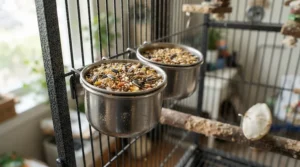
The most common mistake in the first 30 days is topping up an apparently empty bowl. Canaries hull seed and leave empty husks on top, so tip the bowl, blow off the husks, and check the real level beneath before refilling.
Real-World Scenarios: Matching a Bird to the Right Food
Scenario one: the apartment single-bird owner. One canary, a small kitchen, and a freezer. A 454 g bag of Harrison’s High Potency Super Fine will outlast the eight-week opened-bag window by a wide margin, so portion it into small containers and freeze most of it. Budget: modest monthly, high upfront.
Scenario two: the new owner on a tight budget. A first canary and no idea what it likes. Start with Wild Harvest Advanced Nutrition Canary & Finch or Kaytee Supreme Canary & Finch Food in a small bag, watch what gets eaten, and upgrade later.
Scenario three: the small breeder or multi-bird household. Several birds, one feeding routine, and a need for volume. The larger Hari Gourmet Premium Seed Mix for Canaries bag makes sense here because it will be used quickly, supplemented with fresh greens and, ideally, a pellet component recommended by your vet. Daily use means freshness is not a problem.
Problem and Solution: Fixing Common Natural Canary Food Headaches
“My canary only eats the sunflower-sized bits.” This is selective feeding. Offer a smaller portion so the bird must eat more variety, a tip echoed in veterinary guidance. A mix such as the Dr. Harvey’s Incredible Canary Blend rewards that approach.
“The food smells musty.” Without synthetic preservatives, a bag can turn faster. Discard it, and buy smaller quantities next time.
“My bird refuses pellets.” Mix in tiny amounts, crush a few pellets, and be patient. Mature seed-fed canaries can be hard to convert, as veterinary sources acknowledge.
“Droppings changed after the switch.” Minor changes are normal for a few days, but persistent changes or a puffed, lethargic bird warrant a vet visit.
How to Choose Natural Canary Food: 6 Steps
- Read the ingredient panel, not the front of the bag. Canary grass seed, millet, flax and rapeseed should lead the list. Colours or unexplained “flavours” should not appear.
- Decide your format. Seed mixes are familiar and palatable, while pellets give uniform nutrition. VCA’s canary feeding guidance states that an all-seed diet is not nutritionally complete.
- Check the preservation method. Look for natural preservatives such as citric acid or tocopherols, and a best-before date.
- Match the formula to life stage. Breeding and moulting birds often need richer food than a sedentary pet.
- Size the bag to the bird. One canary eats very little. Smaller bags stay fresher.
- Verify claims. Look for actual certification when a label says organic or non-GMO.
Organic Canary Seed: What the Label Really Means
Organic canary seed comes from crops grown without most synthetic pesticides and fertilisers, under a certification scheme. The word matters because “natural” is unregulated marketing language, while “organic” is a controlled claim.
In practice, certified organic seed is rarer and pricier, and Harrison’s is the clearest example here since it is certified organic in pellet form. Beware vague phrases such as “made with organic ingredients”, which may mean only a portion of the formula. Ask for the certifying body’s logo on the bag.
Does organic make a bird healthier? I found no strong independent evidence that it does. The benefit is chiefly reduced pesticide exposure and a stricter paper trail, which is reasonable if it fits your budget.
Preservative-Free Canary Food: Freshness Without Chemistry
Preservative-free canary food is attractive, but it has a trade-off: shorter shelf life. Be careful with the phrase itself. “No artificial preservatives” is not identical to “preservative-free,” because many brands use natural options such as citric acid or tocopherols.
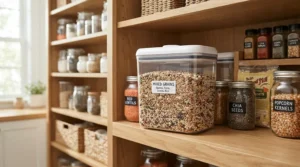
The practical rule is simple. Buy small, check the best-before date, seal the bag tightly, and store in a cool, dry spot. For pellets, Harrison’s guidance is to use an opened bag within eight weeks and chill or freeze the rest. Seed mixes without preservatives should be sniffed on arrival. A sharp, stale or oily smell means return it.
Non-GMO Canary Seed: Separating Fact from Marketing
Non-GMO canary seed is something of a marketing curiosity, because the seed itself is not a widely genetically modified crop. The claim has more bite for formulated foods that use corn and soybean meal.
That is where Lafeber Premium Daily Pellets for Canaries is useful, since it states non-GMO corn and soy. For plain seed blends, non-GMO labelling is mostly reassurance rather than a differentiator. Don’t pay a large premium for it on seed alone. Do look for a recognised verification mark when you pay extra for a formulated diet.
Dye-Free Blends: Why Colour Is a Choice, Not a Need
Dye-free blends deserve a hard look because artificial colour has no nutritional job. Brightly coloured pellets or fruit pieces are for the human buyer, since your canary is not choosing food by dye shade.
The labels to watch for are “artificial colours,” “colour added,” or numbered dyes in the ingredient panel. Compare the Kaytee Supreme Canary & Finch Food, which states no artificial colours, with a coloured specialty mix. One Kaytee Forti-Diet reviewer noticed visible colour pieces. Not every added colour is harmful, since “natural colours” such as beta-carotene appear in several foods. Still, if dye-free blends are your rule, scan the full list rather than trusting the front.
Seed Mix vs Pellets: Which Natural Canary Food Format Wins?
Veterinary references are fairly consistent here. The Merck Veterinary Manual’s passerine nutrition entry says commercial seed mixtures are often deficient in several vitamins and amino acids, and notes pellets as a nutritionally consistent alternative. VCA adds that pellets ideally make up a large share of the diet, around 75-80%.
| Feature | Natural seed mix | Pellets | Hybrid |
|---|---|---|---|
| Nutritional consistency | Variable | High | Moderate |
| Palatability | High | Variable | High |
| Waste | Higher | Lower | Moderate |
| Best For | Dr. Harvey’s Incredible Canary Blend, Hari Gourmet Premium Seed Mix for Canaries | Harrison’s High Potency Super Fine, Lafeber Premium Daily Pellets for Canaries | Kaytee Supreme Canary & Finch Food |
Seed wins on appeal, pellets win on balance, and hybrids split the difference. The best answer for most owners is a pellet base with seed, greens and the occasional treat as variety, discussed with an avian vet.
✨ Ready to Upgrade Your Canary’s Bowl?
🔍 Take your canary’s diet to the next level with these carefully selected products. Click any highlighted product to check current pricing and availability on amazon.ca. A cleaner label, a calmer bird, and a brighter song are well worth a look!
Long-Term Cost and Waste: What Natural Canary Food Really Costs
Sticker price misleads here. A canary eats such small amounts that the cost question is mostly about waste and freshness, not grams per dollar.
| Product | Typical bag | Freshness note | Value verdict | Best For |
|---|---|---|---|---|
| Harrison’s High Potency Super Fine | 454 g | Use within eight weeks once opened; freeze the rest | Best long-term if portioned | Organic households |
| Lafeber Premium Daily Pellets for Canaries | Small and large bags | Naturally preserved | Strong, if stocked | Converters |
| Dr. Harvey’s Incredible Canary Blend | 1.8 kg (4 lb) | Preservative-free, so store carefully | Premium for one bird | Multi-bird homes |
| Kaytee Supreme Canary & Finch Food | 907 g and larger | Naturally preserved | Good everyday value | New owners |
For a single bird, a premium bag that goes stale is a worse deal than a cheaper small bag eaten fresh. Buy to the bird’s appetite, and the cleaner, more expensive options often turn out cheaper per healthy meal than they look on paper.
Safety, Labels and Regulations: What Canadian Buyers Should Know
Here is an uncomfortable truth: nutritional claims on bird food are lightly policed. VCA notes that no regulatory body certifies avian nutrition products, so “complete nutrition” on a bag is not a guarantee. Natural, organic and non-GMO claims follow their own rules, which is why certification marks matter more than adjectives.
Seed quality is also less standardised than you might expect. The Canadian Grain Commission’s published report on canary seed notes that canary seed has not been among the grains officially regulated under the Canada Grain Act, and that a proposal to change this had been developed. Check the current status, but the point stands: official grading is not a safety net for you.
Practical safety steps are simple. Buy sealed bags with a best-before date, discard anything damp or musty, never feed expired food, and keep cuttlebone and clean water available. Discuss supplements with an avian vet before adding any.
FAQ
❓ Is natural canary food really better than a regular seed mix?
❓ How much natural canary food should my canary eat each day?
❓ Does organic canary seed make a real difference to my bird?
❓ How long does preservative-free canary food stay fresh once opened?
❓ Can I buy natural canary food on amazon.ca?
Conclusion: Choosing Natural Canary Food With Confidence
Natural canary food is less about a magic ingredient and more about careful reading. A clean label, a format that supports balanced nutrition, and a bag fresh enough to smell right all matter more than a flattering photo of a yellow bird.
If you want certified organic, Harrison’s High Potency Super Fine is the clearest choice. If you want a formulated pellet with natural preservation, the Lafeber Premium Daily Pellets for Canaries is worth tracking down. For a seed-based clean label, the Dr. Harvey’s Incredible Canary Blend leads, while the Higgins Vita Seed Canary Blend, Kaytee Supreme Canary & Finch Food and Hari Gourmet Premium Seed Mix for Canaries cover everyday feeding sensibly. The Wild Harvest Advanced Nutrition Canary & Finch is a low-risk way to test a bird’s interest.
Whichever you pick, change foods gradually, weigh your bird, buy small, and keep an avian vet in the loop. A well-fed canary shows it in bright eyes, tidy feathers and a lot of song.
Recommended for You
- Canary Food For Molting: 7 Best Picks For Canada (2026)
- Egg Food For Canaries: 7 Ultimate Picks In Canada (2026)
- Finch Food For Breeding Season: 7 Proven Picks For 2026
Disclaimer: This article contains affiliate links. As an Amazon Associate, I earn from qualifying purchases. If you purchase products through these links, we may earn a small commission at no additional cost to you.
✨ Found this helpful? Share it with your friends! 💬🤗
