
In This Article
A conure pellet diet is a formulated bird food, pressed or extruded into uniform pieces, designed to deliver complete daily nutrition in every bite rather than letting a bird pick favourite (and often fattier) seeds out of a mix. For conure owners across Canada, the switch from a seed-heavy bowl to a proper conure pellet diet is probably the single biggest lever you can pull for your bird’s long-term health — and yet it’s also the decision most owners quietly agonize over at 11 p.m. while scrolling ingredient panels on their phone.
Here’s the thing nobody tells you at the pet store: not all pellets are created equal, and “premium” on a bag doesn’t always mean premium in the feeder. Some formulas lean on corn and soy fillers dressed up with fruity dye. Others go certified organic and cold-pressed, at a price that makes your wallet wince. Somewhere in the middle sits the sweet spot most conures actually thrive on, and finding it depends on your bird’s species, activity level, and — let’s be honest — how stubborn they are about trying anything new.
This guide breaks down seven real, currently available pellet diets sold through amazon.ca, compares them head-to-head on protein, fat, fibre, and ingredient philosophy, and layers in the practical stuff — conversion tactics, cage enrichment ideas, and the true long-term cost of feeding a conure well. We’ll also dig into how sun conure food needs differ from a green cheek conure diet, why seed hulling mess drives so many owners to pellets in the first place, and how conure activity levels should actually shape your feeding plan. None of this is guesswork dressed up as authority — it’s built from manufacturer spec sheets, aggregated customer-review themes, and guidance from avian nutrition researchers, because your conure deserves better than a rewritten product label.
Quick Comparison: Top Conure Pellet Diets at a Glance
Before we get into the weeds, here’s the 30,000-foot view. This table exists so you can shortlist two or three options before committing to the deeper dive below.
| Pellet Diet | Crude Protein | Best For | Price Range (CAD) |
|---|---|---|---|
| ZuPreem FruitBlend | 14% min | Budget-friendly seed-to-pellet conversion | Under C$25 |
| Roudybush Daily Maintenance | 11% min | Low-dust, gentle steam-pelleted texture | C$20-C$30 range |
| Kaytee Exact Rainbow | 15% min | Probiotic-supported all-rounder | C$25-C$30 range |
| Lafeber Premium Daily Diet | 14-16% min | Reluctant seed-junkies (molasses flavour) | Mid-C$30s |
| ZuPreem True Harvest | 14% min | Dye-free daily formula with real veggies | C$25-C$30 range |
| Harrison’s Adult Lifetime | 14% min | Certified organic, vet-favoured premium | C$30-C$45 range |
| TOP’s Organic Small Pellets | 12-13.6% min | Corn, soy and wheat-free specialty diet | C$20-C$25 range |
A quick read of this table already tells a story: protein percentages cluster tightly between 11% and 16%, which tracks with what avian nutrition researchers have found about companion parrot maintenance requirements — conures don’t need the sky-high protein of a breeding or growth diet, they need consistency. Where these seven products actually diverge is ingredient philosophy: whole-food organic grain blends at one end, corn-and-dye convenience formulas at the other. Roudybush Daily Maintenance sits lowest on protein because it’s genuinely built as a maintenance (not conversion or breeding) formula, while TOP’s Organic Small Pellets trades a chunk of protein for markedly higher fibre and zero corn, soy, or wheat. Neither is “wrong” — they’re solving different problems, which is exactly why the product breakdown below matters more than the raw numbers.
💬 Just one click — help others make better buying decisions too!😊
Top 7 Conure Pellet Diets: Expert Analysis
We researched real products currently listed on amazon.ca, verified their guaranteed analysis panels against manufacturer data, and cross-referenced aggregated customer-review themes from major retail platforms. Prices are shown as ranges only, since Amazon pricing shifts constantly — always check current price before buying.
1. ZuPreem FruitBlend — best budget pick for fussy eaters
The fruit-forward flavour is the whole point here: ZuPreem FruitBlend was built specifically to coax seed-loving birds into accepting pellets without a three-week standoff. Every pellet in the bag is the same shape, size, and nutrient profile, which matters because it removes the “I’ll just eat around the boring bits” option that seed mixes hand your conure on a platter.
On the spec sheet, ZuPreem FruitBlend guarantees a minimum 14% crude protein, 4% fat, and a maximum 3.5% fibre — solid maintenance-level numbers that line up with what most adult conures need day to day. What the label doesn’t spell out in plain English is that this is an extruded (not cold-pressed) formula flavoured with real fruit pieces like orange, apple, grape, and banana, which is exactly why finicky birds tend to convert faster on it than on plainer pellets.
Based on the spec comparison, this is the pick for owners doing their first-ever pellet conversion, or anyone managing a multi-bird household on a tight budget. Reviewers consistently note that even stubborn seed-only conures will investigate ZuPreem FruitBlend out of curiosity within the first week, which isn’t something every brand can claim.
Aggregated customer sentiment across major retailers skews positive on palatability specifically — the recurring theme is “finally got my bird to try pellets” rather than complaints about the food itself. A smaller but consistent thread of feedback flags the artificial colouring (Yellow 5, Red 40, Blue 1) as a downside for owners who’d prefer a cleaner ingredient panel, and a few note that droppings can pick up a slight colour tint from the dyes, which is cosmetic but worth knowing about in advance.
Pros:
- ✅ Reformulated fruit flavour speeds up seed-to-pellet conversion
- ✅ Widely stocked, so restocking is rarely a scramble
- ✅ Consistent pellet shape prevents selective picking
Cons:
- ❌ Contains artificial colours some owners prefer to avoid
- ❌ Corn and soybean meal sit high on the ingredient list
Priced generally under C$25 for a mid-size bag, ZuPreem FruitBlend delivers strong value as an entry point — just don’t be surprised if you eventually graduate your bird to a cleaner formula once the conversion sticks.
2. Roudybush Daily Maintenance — gentlest steam-pelleted texture, low dust
Roudybush Daily Maintenance takes a different manufacturing route than most of this list: it’s genuinely steam-pelleted rather than extruded, a gentler process that avoids the high heat and pressure extrusion requires. In practice, that means less nutrient degradation during processing and a noticeably less dusty pellet in the bowl — a detail that matters more than it sounds like for owners whose conures perch near open windows or shared living spaces.
The guaranteed analysis lands at 11% minimum protein, 6% fat, and 3.5% max fibre — the lowest protein figure on this list, and that’s deliberate. Roudybush markets this specific line as a true maintenance diet for adult, non-breeding birds, not a conversion or growth formula, so the lower protein is a feature for a sedentary indoor conure rather than a shortfall.
Here’s what most buyers overlook about this brand: Roudybush has been formulating avian diets since 1985 and built its reputation almost entirely on word-of-mouth from breeders and avian vets rather than flashy retail marketing, which explains why it shows up so often in vet-recommended brand lists despite a relatively plain-looking bag.
Reviewers, including several identifying as long-term green cheek conure owners, consistently report that Roudybush Daily Maintenance produces firmer, less messy droppings compared to fruitier extruded diets, and that birds maintain steady weight on it over years of feeding — though a handful of owners note their birds needed a slower, more patient conversion period since the pellets lack the fruit-flavour hook some competitors use.
Pros:
- ✅ Steam-pelleting process reduces nutrient loss and dust
- ✅ Trusted by breeders and avian vets since the 1980s
- ✅ Firmer, more consistent droppings reported by long-term feeders
Cons:
- ❌ Lower crude protein than most competing formulas
- ❌ Plainer flavour can slow initial pellet conversion
Expect to pay in the C$20-C$30 range depending on bag size, which makes this one of the more cost-efficient premium-adjacent options on the market.
3. Kaytee Exact Rainbow — probiotic-boosted all-rounder for conures
Kaytee Exact Rainbow has been a fixture in the parrot-and-conure aisle for more than two decades, and the formula backs that longevity up with a fairly aggressive nutrient profile: 15% minimum crude protein, 6% fat, and added prebiotics plus a guaranteed minimum count of beneficial Bacillus species for gut support.
The spec sheet interpretation here matters: that probiotic inclusion isn’t just marketing filler. Digestive support additives are relatively uncommon at this price tier, and for conures prone to loose droppings during stress or environmental changes (a common complaint in this species), a diet with built-in gut-flora support can meaningfully smooth things out.
What most buyers overlook about Exact Rainbow is that it’s explicitly designed to be a sole diet when fed as directed, with the brand recommending fresh produce make up no more than 20% of total intake on top of it — a stricter ratio than some competitors suggest, and worth knowing if your feeding philosophy leans toward a higher fresh-food percentage.
Aggregated review sentiment is broadly favourable on acceptance rates, with many owners describing successful conversions from seed within two to three weeks. A recurring critique, similar to FruitBlend, involves the artificial colouring used to create the “rainbow” branding — some reviewers specifically sought out duller, dye-free alternatives after noticing their bird’s droppings taking on colour.
Pros:
- ✅ Added probiotics and prebiotics support gut health
- ✅ Backed by over two decades of formulation history
- ✅ Strong acceptance rates reported during conversion
Cons:
- ❌ Uses artificial colouring (FD&C dyes) in the pellet mix
- ❌ Slightly pricier than baseline extruded competitors
At roughly C$25-C$30 for a standard bag, Kaytee Exact Rainbow sits comfortably in the mid-range tier — a reasonable middle ground between FruitBlend’s budget simplicity and the organic premium options further down this list.
4. Lafeber Premium Daily Diet — whole-egg protein seed-convert favourite
What sets Lafeber Premium Daily Diet apart on paper is the inclusion of dried whole egg as a protein source — one of the most digestible protein forms available in a commercial diet, according to Lafeber’s own published nutrition materials. Combined with ground non-GMO corn and oat groats, the recipe reads more like a farmhouse grain blend than a lab-formulated nugget.
Depending on the specific line (parrot vs. cockatiel-sized pellets), crude protein runs 14-16% minimum with 5% fat and a notably low 3% max fibre — tighter fibre control than most competitors on this list, which can translate to slightly richer stool consistency if you’re not also supplementing fresh greens.
Here’s what the spec sheet won’t tell you outright: Lafeber genuinely pellets (rather than extrudes) this line, using lower processing temperatures around 165°F compared to the 250-275°F typical of extrusion. The company argues this preserves more heat-sensitive nutrients naturally, meaning less reliance on synthetic vitamin fortification to make up the difference — a manufacturing detail that matters more to nutrition-focused owners than casual shoppers realize.
The molasses-based natural flavouring is specifically engineered to appeal to “seed junkies,” and aggregated review sentiment backs this up — Lafeber shows up repeatedly in avian-vet recommendation lists alongside Harrison’s and Roudybush as a trusted conversion option for stubborn birds. A minority of reviews flag the inclusion of soy and wheat as a drawback for owners managing suspected allergen sensitivities in their flock.
Pros:
- ✅ Whole-egg protein is highly digestible for daily maintenance
- ✅ Gentler pelleting process retains more natural nutrients
- ✅ Molasses flavour helps convert stubborn seed-only birds
Cons:
- ❌ Contains soy and wheat, a concern for allergen-sensitive owners
- ❌ Runs pricier per pound than extruded competitors
Sitting in the mid-C$30s for a mid-size bag, Lafeber commands a modest premium over Kaytee and ZuPreem — a price most owners consider justified given its vet-favoured reputation.
5. ZuPreem True Harvest — dye-free natural daily formula
If the artificial colouring in FruitBlend and Exact Rainbow gives you pause, ZuPreem True Harvest is essentially ZuPreem’s answer to that exact concern. Same manufacturer, same core nutritional philosophy, but reformulated without artificial colours, flavours, or preservatives, and built around real vegetable inclusions like carrot, celery, parsley, and beet alongside ground flaxseed.
The guaranteed analysis holds steady at 14% minimum protein, 4% fat, and 5% max fibre — nearly identical to standard FruitBlend on the macro numbers, which confirms this is genuinely a reformulation rather than a nutritionally different product wearing a “natural” label for marketing purposes.
What most buyers overlook here is the ground flaxseed inclusion, a genuine plant-based omega-3 source that most competing corn-forward formulas simply don’t include. On paper, that’s a small but real nutritional edge for feather and skin condition over a straight FruitBlend feeding plan.
Reviewers converting from FruitBlend to True Harvest — a fairly common path, based on aggregated feedback — consistently report smooth transitions since the pellet size, shape, and general palatability stay close to the original line. The most frequently cited motivator for making the switch is exactly what you’d expect: owners noticing dye-tinted droppings on the original formula and wanting to eliminate that variable entirely.
Pros:
- ✅ No artificial colours, flavours, or preservatives
- ✅ Includes real vegetables and flaxseed omega-3s
- ✅ Smooth transition path for existing FruitBlend feeders
Cons:
- ❌ Corn remains a primary ingredient despite the “natural” branding
- ❌ Narrower size range available than the original FruitBlend line
Typically priced in the C$25-C$30 range, ZuPreem True Harvest asks for only a small premium over standard FruitBlend in exchange for a meaningfully cleaner label.
6. Harrison’s Adult Lifetime — certified organic, vet-trusted premium
Harrison’s Adult Lifetime sits at the top of this list on ingredient pedigree. Every asterisked ingredient on the label — whole corn, hull-less barley, toasted soybeans, peas, lentils, peanut kernels, chia — is certified organic, and the formula skips artificial preservatives, colours, and flavours entirely, relying instead on mixed tocopherols (natural vitamin E) for shelf stability.
Nutritionally, it lands at 14% minimum crude protein, 6% fat, and 4.5% max fibre, which reads similar to several mid-range competitors on paper. The real differentiator isn’t the macro numbers, it’s sourcing and processing philosophy: Harrison’s has built two decades of credibility specifically by avian veterinarians recommending it as a conversion and maintenance diet, a reputation that shows up repeatedly across independent buying guides rather than just brand marketing.
Based on the spec comparison, Harrison’s makes the most sense for owners actively managing a health issue, working alongside an avian vet on a supervised diet transition, or simply prioritizing organic sourcing above all else. It’s worth noting the “Coarse” grind is formulated for medium-to-large parrots; most conure owners should look specifically for Harrison’s Fine or Super Fine pellet size rather than the Coarse variant referenced in wider product listings.
Aggregated review sentiment is strongly favourable on feather quality and overall condition improvements after switching, with reviewers frequently describing it as “worth the extra cost” despite acknowledging it’s the priciest option they’ve tried. The most consistent critique isn’t about the food itself but the feeding discipline it requires — Harrison’s explicitly recommends against “topping off” old food and instead calls for fresh daily portions, which is a bigger behavioural shift for owners used to free-feeding a bowl.
Pros:
- ✅ Fully certified organic with zero artificial additives
- ✅ Strong track record among avian veterinarians
- ✅ Reviewers report visible feather-condition improvements
Cons:
- ❌ Most expensive option on this list per pound
- ❌ Requires strict daily fresh-feeding, not casual free-feeding
At a C$30-C$45 range depending on bag size and grind, Harrison’s is a genuine investment — but for owners chasing the cleanest possible ingredient panel, it’s hard to beat.
7. TOP’s Organic Small Pellets — corn, soy and wheat-free specialty diet
TOP’s Organic Small Pellets takes the most unconventional formulation approach of all seven products here. There’s no corn, no soy, no wheat, and no peanuts anywhere in the ingredient list — a deliberate choice the company frames around avoiding common allergens and what it considers lower-quality filler grains. Instead, the base is organic alfalfa, hulled millet, barley, and rice, cold-pressed rather than heat-extruded to preserve nutrient integrity.
The trade-off shows up clearly on the spec sheet: crude protein sits at 12-13.6% minimum, noticeably lower than the extruded competitors on this list, while max fibre runs considerably higher at 8-10.5%. What that means in practice is a bulkier, more fibre-forward pellet that behaves more like a whole-grain diet than a nutrient-dense nugget — genuinely good for digestive regularity, but potentially insufficient as a truly sole diet for a high-activity bird without some fresh-food supplementation.
What most buyers overlook about TOP’s is the naturally-preserved ingredient list: rosemary, rose hips, lemon and orange peel do the preservation work that synthetic BHA, BHT, or ethoxyquin handle in cheaper formulas. For owners specifically trying to eliminate synthetic preservatives from their bird’s diet, that’s a meaningful point in TOP’s favour that even Harrison’s doesn’t fully match.
Reviewer sentiment skews positive but smaller in volume than the bigger brands on this list, reflecting TOP’s more niche market position. A recurring theme, including from owners specifically mentioning sun conures, is that conversion takes noticeably longer than with flavoured formulas — but that birds who do convert tend to stick with it long-term, with several long-time feeders describing it as their permanent maintenance diet.
Pros:
- ✅ Free of corn, soy, wheat, and peanut allergens
- ✅ Cold-pressed processing preserves nutrient integrity
- ✅ Naturally preserved with rosemary, rose hips, and citrus peel
Cons:
- ❌ Lower protein and higher fibre than extruded competitors
- ❌ Smaller brand footprint means less availability and slower shipping
Priced in the C$20-C$25 range for a small-pellet bag, TOP’s punches well above its price point for owners managing allergen concerns — just budget extra patience for the conversion period.
Practical Pellet Conversion, Feeding & Enrichment Guide
Buying the right bag is half the job. The other half is getting your conure to actually eat it, and this is where most well-intentioned owners stumble.
The First 30 Days: Conversion Without a Fight
Cold-turkey pellet switches are a well-documented recipe for a bird that simply stops eating, which is dangerous within days given a conure’s fast metabolism. Instead, gradually mix increasing ratios of pellets into the existing seed bowl over one to two weeks, moistening pellets slightly at first to soften the texture and release more aroma. Watch droppings closely during this window — colour and consistency changes are the clearest early signal that pellets are actually being consumed rather than just picked at and discarded.
Maintenance Schedule
Once converted, discard uneaten pellets daily rather than topping off a partially full bowl — stale, oil-oxidized pellets lose palatability and nutrient value fast, especially in the fattier extruded formulas. A clean, dry storage container away from humidity extends shelf life meaningfully; several manufacturers, including Harrison’s, specifically recommend squeezing excess air out of the bag before resealing.
Cage Enrichment: Turning Pellet Time Into Playtime
Cage enrichment and pellet feeding aren’t separate tasks — they can be the same activity if you’re willing to get a little creative. Scatter-feeding pellets inside a foraging toy, wrapping a small portion in paper for your conure to shred open, or hiding pellets inside cardboard tubes all convert a passive meal into an active problem-solving session, which matters enormously for a species this intelligent and this prone to boredom-driven feather plucking. A conure that has to work for part of its ration tends to show calmer, more settled behaviour than one eating from an open dish with nothing else to occupy its day.
Common First-Month Mistakes
The most common early misstep is removing all seed too abruptly, triggering a hunger strike from a bird that genuinely doesn’t recognize pellets as food yet. The second is judging success too quickly — some conures convert within days, others take a full month of patient exposure, and giving up at week two is the single biggest reason conversion attempts fail.
✨ Don’t Miss These Exclusive Deals!
🔍 Take your conure’s diet to the next level with these carefully selected picks. Click on any highlighted item to check current pricing and availability. These pellets can help you build the healthy, colourful, engaged bird your family will love!
Real-World Scenarios: Matching a Pellet Diet to Your Conure’s Life
Scenario 1 — The first-time pellet convert. Say you’ve got a two-year-old conure that’s only ever known a seed mix, and you’re nervous about the switch. This is squarely ZuPreem FruitBlend or Kaytee Exact Rainbow territory: both lean on flavour and colour to ease that first bite, and both are budget-friendly enough that a slow, patient conversion doesn’t feel like an expensive gamble.
Scenario 2 — The multi-bird household on a budget. If you’re feeding three or four conures out of the same bag every week, cost per pound starts mattering as much as ingredient purity. Roudybush Daily Maintenance offers strong long-term value here, with its steam-pelleted process and lower per-bag pricing making frequent restocking less painful on the wallet.
Scenario 3 — The health-conscious owner working with an avian vet. If your conure has had digestive issues, feather-condition concerns, or you’re simply committed to the cleanest possible ingredient panel regardless of cost, Harrison’s Adult Lifetime or TOP’s Organic Small Pellets are where that priority is best served — both skip synthetic preservatives and dyes entirely, at a price premium many owners in this camp consider non-negotiable.
Buyer’s Decision Framework: Which Conure Pellet Diet Fits You
Use this simple priority checklist to narrow your shortlist fast:
- If your bird is a stubborn seed-only eater, choose a flavoured formula like ZuPreem FruitBlend or Lafeber Premium Daily Diet, because flavour acceptance matters more than ingredient purity at the conversion stage.
- If your top priority is avoiding artificial dyes, choose ZuPreem True Harvest or Harrison’s Adult Lifetime, because both explicitly exclude synthetic colouring.
- If you’re managing suspected allergen sensitivities, choose TOP’s Organic Small Pellets, because it’s the only formula here free of corn, soy, and wheat simultaneously.
- If you’re feeding multiple birds on a tight budget, choose Roudybush Daily Maintenance, because its steam-pelleted process and pricing balance quality against cost efficiency.
- If your avian vet has flagged a specific health concern, choose Harrison’s Adult Lifetime, because its certified-organic sourcing and vet-favoured track record make it the safest default for supervised diets.
How to Choose a Conure Pellet Diet
What is a conure pellet diet? A conure pellet diet is a nutritionally complete, uniformly formulated bird food — either extruded under heat and pressure or gently steam/cold-pressed — designed to replace or supplement seed mixes with consistent daily nutrition in every piece, eliminating the selective eating that leads to nutritional gaps.
Choosing between seven credible options can feel paralyzing, so here’s a simplified, expert-reasoned checklist:
- Check the guaranteed analysis first. Look for crude protein between roughly 11-16% and fat between 4-6% for an adult maintenance diet — anything dramatically outside that range is likely formulated for breeding, growth, or a different life stage.
- Read the first three ingredients. If corn or wheat dominates the top of the list on a formula you’re paying a premium for, you may not be getting the ingredient quality the price tag implies.
- Decide your stance on artificial colouring. Dyes don’t harm most birds directly, but they’re a legitimate personal preference — decide early so you’re not second-guessing your purchase later.
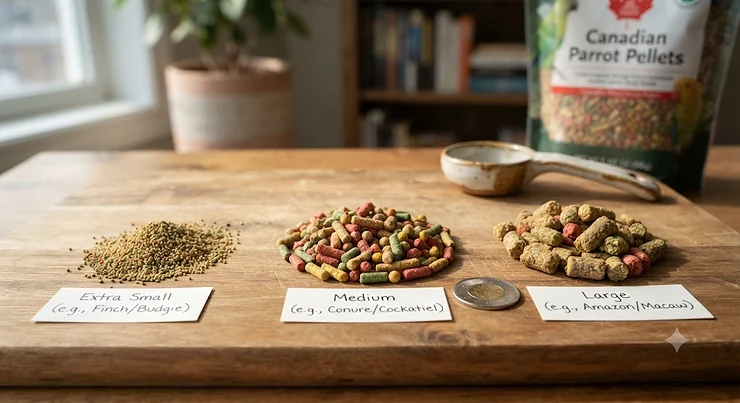
- Match pellet size to your bird. Conures generally do best with small-to-medium pellet sizes; oversized pellets marketed for larger parrots can be genuinely difficult for a conure’s smaller beak to manage efficiently.
- Factor in your bird’s conversion history. A bird that’s already resisted pellets once may need a flavoured formula on the second attempt, even if a plainer option would otherwise be your first choice.
- Budget for the long haul, not just the first bag. A cheaper bag that gets rejected and wasted costs more in practice than a slightly pricier formula your bird actually eats consistently.
- Loop in your avian vet for anything beyond routine maintenance. Health conditions, egg-laying history, or age-related concerns can shift which formula makes sense far more than brand reputation alone.
Features that actually matter here are protein-fat balance, ingredient sourcing, and pellet size — features that don’t matter nearly as much as marketing suggests include rainbow colouring (purely cosmetic) and “gourmet” branding language, which rarely correlates with measurably different nutrition on the guaranteed analysis panel.
Conure Pellet Diet vs Seed Diet: Ending the Seed Hulling Mess
Anyone who’s vacuumed a seed-hull halo off the floor around a birdcage knows exactly why pellets have become the default vet recommendation. Seed hulling mess isn’t just an annoyance — it’s a genuine indicator of nutritional selectivity, since a conure picking through a seed mix is choosing the fattiest, most palatable pieces first and leaving the more balanced (but less tasty) seeds behind, dramatically skewing actual intake away from what the bag’s nutrition label promises.
| Factor | Pellet Diet | Traditional Seed Mix |
|---|---|---|
| Nutritional consistency | Every piece nutritionally complete | Highly variable; birds self-select |
| Mess & cleanup | Minimal; no hulls to sweep | Seed hulling mess accumulates daily |
| Fat content risk | Controlled, formula-specific | Often excessive from sunflower/safflower selection |
| Best For | Harrison’s Adult Lifetime, TOP’s Organic Small Pellets | Occasional treat/enrichment supplement only |
The analysis here is straightforward: a seed mix that looks balanced on the bag’s overall nutrition panel rarely reflects what a bird actually eats once selective picking enters the equation, while a pelleted diet removes that variable entirely by making every bite nutritionally identical. That said, seeds aren’t villainized entirely — most avian nutrition guidance still supports offering a small daily seed or nut portion (generally under 20% of total intake) for enrichment and natural foraging behaviour, provided pellets form the true dietary foundation. Reviewers switching from seed-only to pelleted diets almost universally cite reduced daily cleanup and firmer, less oily droppings as the most immediately noticeable change.
Conure Pellet Diet for Sun Conures and Green Cheek Conures
Not every conure is nutritionally identical, and lumping “sun conure food” and “green cheek conure diet” under one generic recommendation misses some genuinely useful distinctions.
Sun conures run larger and noticeably louder-metabolism than green cheek conures, and their feather colouring — that vivid orange-yellow plumage — depends partly on carotenoid intake from diet. Owners prioritizing sun conure food specifically often gravitate toward formulas with real fruit or vegetable inclusions, like ZuPreem FruitBlend or ZuPreem True Harvest, since natural carotenoid sources can support feather vibrancy more meaningfully than a plain grain-based pellet, though genetics remains the primary driver of colour intensity.
Green cheek conures, by contrast, are smaller-bodied and generally lower-energy than sun conures, which shows up in aggregated review sentiment too — multiple reviewers of Roudybush Daily Maintenance specifically identify as long-term green cheek owners, and the lower 11% protein maintenance formula suits a smaller, calmer bird’s caloric needs reasonably well without over-supplying energy it won’t burn off.
Here’s what the spec sheet won’t tell you but breeders consistently note: green cheeks tend to convert to pellets slightly faster than sun conures on average, possibly because they’re marginally less food-selective as a personality trait, though individual variation swamps any species-level pattern fairly quickly. Whichever species you’re feeding, pellet size matters more than species-specific marketing — both sun and green cheek conures do best with small-to-medium pellet diameters rather than pellets sized for larger macaws or cockatoos.
Conure Activity Levels and Energy Needs: Matching Diet to Lifestyle
Conure activity levels vary enormously between individual birds, and diet should flex accordingly rather than following a single generic feeding chart. A conure that spends hours daily flying supervised laps around a bird-proofed room burns meaningfully more energy than one confined to a single cage with limited out-of-cage time, and fat content should scale with that reality.
For high-activity conures — frequent fliers, birds with large aviary access, or younger energetic individuals — a moderate-to-higher fat formula like Kaytee Exact Rainbow (6% min fat) or Roudybush Daily Maintenance (6% min fat) provides the caloric buffer those energy demands require. For lower-activity, primarily caged conures, a leaner formula like ZuPreem True Harvest or Lafeber Premium Daily Diet, both sitting at 4-5% fat, reduces the risk of the fatty liver disease and obesity that sedentary pet birds are genuinely prone to.
What most buyers overlook about activity-based feeding is that it should be reassessed periodically, not set once and forgotten — an older conure slowing down, or a bird recovering from injury with restricted movement, both warrant a fat-content review even if you’re not changing brands entirely. Watching keel-bone condition (the breastbone should feel padded, not sharply protruding) remains one of the simplest at-home indicators that intake and activity are reasonably matched.
Common Mistakes When Buying Conure Pellet Diet
The single most common mistake is buying based on packaging appeal rather than the guaranteed analysis panel — a colourful bag with cartoon birds tells you nothing about actual nutrient content, and the least flashy bag on the shelf is sometimes the better formulation.
A close second is switching formulas too frequently in search of the “perfect” pellet. Conures generally do better on dietary consistency than on constant novelty, and frequent switching can actually slow conversion progress since the bird never fully settles into recognizing any single pellet as reliably safe food.
A third recurring error is ignoring pellet size relative to bird size, buying whatever’s cheapest per pound regardless of whether it’s actually formulated for conure-scale beaks. And finally, many owners underestimate how gradual a proper conversion needs to be, expecting results within days when several weeks is genuinely normal — abandoning a formula after 72 hours rarely reflects the food’s quality so much as an unrealistic conversion timeline.
Long-Term Cost & Maintenance
Sticker price per bag tells an incomplete story. A cheaper bag consumed in larger daily quantities, or wasted through rejection and spoilage, frequently ends up costing more per month than a pricier formula fed efficiently.
| Diet Tier | Approx. Monthly Cost (CAD, single conure) | Best For |
|---|---|---|
| Budget (ZuPreem FruitBlend, Roudybush) | Roughly C$10-C$15 | Cost-conscious, multi-bird households |
| Mid-range (Kaytee Exact, Lafeber, True Harvest) | Roughly C$15-C$20 | Balanced quality-to-cost owners |
| Premium (Harrison’s, TOP’s) | Roughly C$20-C$30 | Health-focused, supervised diets |
These figures are rough estimates based on typical single-conure daily intake and current bag pricing at the time of research — actual cost varies with bird size, waste, and local pricing, so treat this as a planning tool rather than a guarantee. The real long-term cost consideration isn’t the pellets themselves, though; it’s the downstream veterinary cost of nutritional deficiency. A seed-only diet is strongly linked in avian veterinary literature to fatty liver disease, vitamin A deficiency, and obesity-related complications, all of which carry vet bills that dwarf the price difference between a budget and premium pellet bag many times over. Viewed through that lens, even the priciest option on this list represents genuine preventive-care value rather than an indulgence.
Safety, Regulations & Compliance Guide for Canadian Bird Owners
Unlike livestock feed, Canada does not currently mandate specific nutritional standards for pet bird food, though most reputable manufacturers voluntarily align with Association of American Feed Control Officials guidelines to support their “complete and balanced” labelling claims. The Canadian Food Inspection Agency oversees import and export compliance for pet foods, while labelling accuracy and marketing claims fall under the Competition Bureau of Canada’s jurisdiction rather than CFIA nutritional review.
Practically speaking, this means the onus sits more heavily on you as the buyer to interpret guaranteed analysis panels critically rather than assume regulatory oversight has already vetted every nutritional claim. According to the Pet Food Association of Canada, member manufacturers do commit to specific labelling and safety standards, which is a reasonable factor to weigh when choosing between a well-established brand and a newer, smaller manufacturer with less regulatory track record.
Storage safety matters just as much as formula selection. Pellets stored in humid environments are genuinely susceptible to mould growth, and several manufacturers explicitly recommend airtight, cool, dry storage with air squeezed out of resealable bags before each closure. Discard any pellets showing discolouration, clumping, or an off smell immediately rather than risking exposure — avian digestive systems are considerably less forgiving of spoiled food than most mammals.
Frequently Asked Questions
❓ How long does it take to convert a conure to a pellet diet?
❓ What percentage of a conure's diet should be pellets?
❓ Are coloured pellets bad for conures?
❓ Can conures eat only pellets with no seeds at all?
❓ Why won't my conure eat pellets?
Conclusion
Picking the right conure pellet diet ultimately comes down to matching formula philosophy to your specific bird — its species tendencies, its activity level, its conversion history, and your own priorities around ingredient sourcing. ZuPreem FruitBlend and Kaytee Exact Rainbow make the conversion process easier for stubborn seed-only birds through flavour and familiarity. Roudybush Daily Maintenance offers a genuinely gentler steam-pelleted process at a wallet-friendly price for multi-bird households. Lafeber Premium Daily Diet and ZuPreem True Harvest sit comfortably in the middle, balancing palatability with cleaner formulation choices. And for owners chasing the most rigorous ingredient standards, Harrison’s Adult Lifetime and TOP’s Organic Small Pellets deliver certified-organic, allergen-conscious options worth the added cost.
There’s no single “best” pellet that outranks the rest universally — there’s only the best match for the conure actually sitting on your shoulder right now. Whichever direction you go, prioritize a slow, patient conversion, keep an eye on your bird’s droppings and weight during the transition, and don’t hesitate to loop in an avian vet if anything about the process feels off. A well-fed conure is a calmer, healthier, longer-lived companion, and that’s worth getting right.
Recommended for You
- Macaw Pellet Size Guide: 7 Trusted Picks for 2026
- 7 Best African Grey Parrot Food Picks for 2026 (Vet-Backed)
- Parrot Food for Large Parrots: 7 Best Picks for
Disclaimer: This article contains affiliate links. As an Amazon Associate, I earn from qualifying purchases. If you purchase products through these links, we may earn a small commission at no additional cost to you.
✨ Found this helpful? Share it with your friends! 💬🤗
