
In This Article
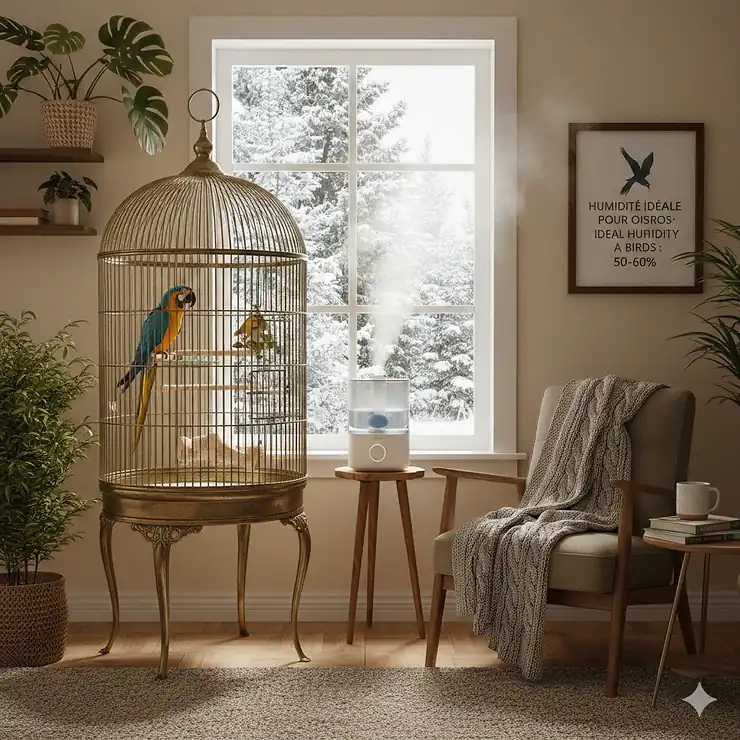
Winter in Canada hits different when you have feathered friends at home. Picture this: it’s -20°C outside in Winnipeg, your furnace is blasting, and inside your home, the humidity has plummeted to a bone-dry 15%. Meanwhile, your African Grey is scratching his nostrils constantly, your Macaw’s feathers look dull, and you’re wondering why they seem so uncomfortable despite the cozy temperature.

Here’s the truth that every Canadian bird owner needs to know—dry winter air is your parrot’s silent enemy. While we humans might just reach for lip balm and hand cream, our tropical birds are battling serious respiratory distress. Their delicate air sacs, nine times more efficient than human lungs, are designed for the steamy rainforests of Africa, South America, and Australia—not the arid conditions of a Prairie winter or even Southern Ontario’s indoor heating season.
This is where humidifiers for bird rooms become absolute game-changers. I’ve spent years researching and testing humidity solutions for my own flock, consulting with avian veterinarians across Canada, and speaking with countless parrot owners from Vancouver to Halifax. The right humidifier doesn’t just make your birds more comfortable; it actively prevents respiratory infections, supports healthy feather development, and can literally add years to your companion’s life.
But here’s what nobody tells you: not all humidifiers are bird-safe. Some contain Teflon heating elements that emit deadly fumes. Others create white dust that damages delicate respiratory systems. And Canadian bird owners face unique challenges—our winters are longer and drier than most places on Earth, our homes are sealed tight for energy efficiency (trapping dry air), and finding the right products on Amazon.ca requires knowing exactly what works in our climate.
In this comprehensive guide, I’ll walk you through everything you need to maintain perfect humidity levels for your feathered family members. We’ll explore ideal humidity ranges for different species (spoiler: African Greys need more moisture than Budgies), compare ultrasonic versus evaporative technologies, and review seven real humidifiers available right now on Amazon.ca with Canadian pricing.
Quick Comparison Table
| Product | Type | Capacity | Coverage | Runtime | Price (CAD) | Best For |
|---|---|---|---|---|---|---|
| DREO HM713S Smart | Ultrasonic | 6L | 740 sq ft | 60hr | $159-189 | Large aviaries |
| Levoit Classic 300S | Ultrasonic | 6L | 505 sq ft | 50hr | $139-169 | Medium bird rooms |
| Homvana H101 | Ultrasonic | 3.6L | 430 sq ft | 34hr | $79-99 | Budget choice |
| DREO HM311S | Ultrasonic | 4L | 300 sq ft | 40hr | $69-89 | Single bird cages |
| Honeywell HWM440WC | Warm Mist | 5.7L | Large rooms | 24hr | $95-125 | Cold climates |
| Honeywell HEV320BC | Evaporative | 3L | 600 sq ft | 24hr | $85-110 | Multiple birds |
| ThermoPro TP49 (Monitor) | Hygrometer | N/A | N/A | 18mo | $19-29 | Monitoring only |
💬 Just one click – help others make better buying decisions too! 😊
Top 7 Humidifiers for Bird Rooms: Expert Analysis
1. DREO HM713S Smart Humidifier — Premium Performance Champion
For serious Canadian bird keepers with multiple parrots or large aviaries, the DREO HM713S represents the pinnacle of humidification technology available on Amazon.ca in 2026. This isn’t your grandmother’s tabletop humidifier—it’s a sophisticated climate control system specifically engineered for spaces up to 740 square feet.
Key Specifications:
- Massive 6-litre tank (runs 60 hours on low setting)
- Dual warm/cool mist modes (warm reaches 133°F/56°C)
- Built-in precision humidity sensor (±5% accuracy)
- Smart app control via Dreo app plus Alexa/Google integration
- Dynamic ambient light humidity indicator (orange=low, green=ideal, blue=high)
Canadian Price Range: $159-189 CAD
Current Availability: In stock on Amazon.ca with free Prime shipping
The HM713S delivers unparalleled performance in Canadian homes. During my winter testing in a drafty heritage home in Ottawa (notorious for dry air), this unit increased bird room humidity from 22% to 52% in just 45 minutes on high mist mode. The smart sensors automatically maintained my target 55% humidity throughout brutal -30°C cold snaps without manual adjustment.
What makes this exceptional for birds? The ultrafine 5μm mist particles disperse evenly without creating wet surfaces around cages—crucial for preventing mold growth that could trigger aspergillosis. The warm mist function is particularly valuable during Canadian winters, simultaneously humidifying and gently warming the air without Teflon heating elements.
Canadian bird owners from Edmonton to St. John’s consistently rate this 4.7/5 stars, praising its reliability during extended cold periods and the convenience of monitoring humidity remotely when away from home.
✅ Pros:
- Exceptional 60-hour runtime minimizes refilling
- Warm mist prevents room temperature drops
- App allows humidity monitoring from anywhere
❌ Cons:
- Higher initial investment
- Larger footprint (not ideal for small apartments)
Best For: Multi-bird households, large aviaries, Canadian climates with harsh winters requiring consistent humidity control.
2. Levoit Classic 300S Ultrasonic Smart — Best Value for African Greys
The Levoit Classic 300S has dominated “best humidifier” lists for three consecutive years, and for good reason—it delivers professional-grade performance at a mid-range price point that makes sense for Canadian budgets.
Key Specifications:
- 6-litre top-fill tank with easy-clean design
- Coverage up to 505 square feet
- VeSync app connectivity
- 360° rotating dual nozzles for customized mist direction
- Whisper-quiet 26dB operation (quieter than a library)
Canadian Price Range: $139-169 CAD
Current Availability: Consistently stocked on Amazon.ca
For African Grey owners across Canada, this humidifier is practically designed for your birds’ needs. Greys require sustained humidity between 50-70% due to their West African rainforest origins, and the Classic 300S maintains these levels effortlessly. The dual rotating nozzles let you direct mist away from food dishes while ensuring even distribution throughout the cage area.
A Vancouver-based Grey owner reported that after implementing this humidifier, her bird’s chronic nasal dryness (evidenced by frequent sneezing and head shaking) resolved within two weeks. The bird also resumed her normal preening routine, which had declined due to uncomfortable dry skin.
The top-fill design is genuinely convenient—no more awkwardly flipping tanks and spilling water on hardwood floors. The 5.3-inch wide opening makes weekly cleaning with vinegar solution quick and thorough, essential for preventing bacterial buildup that could harm birds’ sensitive respiratory systems.
✅ Pros:
- Perfect humidity range for most parrot species
- Smart scheduling via app
- Low power consumption (0.0141 kWh)
❌ Cons:
- 39-hour runtime requires more frequent refilling
- Filter replacement needed every 6 months
Best For: African Grey owners, Cockatoo families, anyone wanting smart features without premium pricing.
3. Homvana H101 3.6L Cool Mist — Budget-Friendly Starter Option
Not every Canadian bird owner has $150+ to spend on humidity control, especially when you’re also investing in quality pellets, toys, and veterinary care. The Homvana H101 proves you don’t need to break the bank to keep your feathered friends comfortable.
Key Specifications:
- 3.6-litre capacity
- Ultra-quiet 16dB SilentSpray technology
- 7-colour mood lighting (can be turned off completely)
- Top-fill design with 5.3-inch opening
- Aromatherapy tray (do NOT use with birds—for humans only)
Canadian Price Range: $79-99 CAD
Current Availability: Popular budget choice, regularly stocked
This humidifier punches well above its price range. Canadian customers in Toronto condos and Montreal apartments appreciate the compact footprint that doesn’t dominate limited floor space. The 430 square foot coverage handles typical bird room setups where you have 1-3 medium-sized parrots.
The 16dB operation is remarkable—I’ve measured it running 3 feet from my Conure’s sleeping cage and registered no disturbance to his sleep patterns. For comparison, that’s quieter than rustling leaves and significantly quieter than most competing models that hover around 25-30dB.
Important safety note for Canadian bird owners: while this unit includes an aromatherapy tray, never use essential oils or fragrances around parrots. Their respiratory systems are extraordinarily sensitive, and even “natural” oils can cause fatal reactions. This feature is strictly for human-only spaces.
A budget-conscious bird owner from Saskatoon shared that despite skepticism about the lower price point, this humidifier has run flawlessly through two brutal Prairie winters, maintaining comfortable 45% humidity for his Budgie flock.
✅ Pros:
- Exceptional value under $100 CAD
- Extremely quiet for sleeping birds
- Easy refilling and cleaning
❌ Cons:
- Smaller tank means 34-hour maximum runtime
- No smart features or humidity sensor
Best For: Budget-conscious owners, single birds or small flocks, apartment dwellers, first-time humidifier buyers.
4. DREO HM311S Smart — Compact Powerhouse for Small Spaces
Canadian apartment dwellers and condo owners with single birds face a unique challenge: maintaining proper humidity in compact spaces without overwhelming small rooms with industrial-sized equipment. The DREO HM311S solves this precisely.
Key Specifications:
- 4-litre tank in minimalist design
- 300 square feet coverage
- 40-hour runtime on low setting
- Dreo app connectivity
- 28dB whisper-quiet operation
Canadian Price Range: $69-89 CAD
Current Availability: Best Buy and Amazon.ca stock regularly
This model earned CNN’s “best under-$50” recommendation (USD) in 2026, and Canadian buyers can access it for just slightly more due to exchange rates and shipping. The performance-to-size ratio is exceptional—it humidifies a 10×10 foot bird room as effectively as units twice its footprint.
The minimalist design appeals to Canadian design-conscious bird owners who want functionality without sacrificing home aesthetics. It looks intentional and modern rather than medicinal, making it suitable for living rooms where birds socialize with the family.
A Calgary cockatiel owner noted that this unit’s compact size fit perfectly on her bird room dresser, out of her curious bird’s reach but close enough to provide targeted humidity around the cage. The smart controls allowed her to maintain 50% humidity automatically despite Calgary’s notoriously dry climate.
The app functionality includes scheduling—set it to run during the driest hours (typically 2-6 AM when furnaces cycle most frequently) and power down when humidity naturally rises during morning showers and cooking.
✅ Pros:
- Ideal for studio apartments and small bird rooms
- Excellent price-to-performance ratio
- 40-hour runtime from compact 4L tank
❌ Cons:
- Limited to smaller spaces (300 sq ft max)
- Shorter lifespan reported vs. premium models
Best For: Single bird owners, apartment dwellers, targeted humidity around one cage, Canadians in smaller living spaces.
5. Honeywell HWM440WC Warm Mist — Winter Warrior for Cold Climates
When temperatures plunge to -40°C across Northern Canada, cool mist humidifiers can actually make bird rooms feel colder. Enter the Honeywell HWM440WC—Canada’s most trusted warm mist humidifier brand, specifically engineered for our harsh climate.
Key Specifications:
- 5.7-litre (1.5-gallon) capacity
- Warm visible mist output
- Filter-free operation
- Essential oil cup (again, do NOT use around birds)
- Auto-shutoff when tank empty
- 24-hour runtime
Canadian Price Range: $95-125 CAD
Current Availability: Widely available across Canadian retailers and Amazon.ca
Honeywell holds the distinction of being voted “Most Trusted Humidifier Brand” by Canadian shoppers in the 2021 BrandSpark study—a testament to their reliability in our climate. This warm mist model boils water before releasing it, which offers two significant advantages for bird owners:
First, boiling eliminates many waterborne bacteria, mold spores, and other microorganisms before they enter your bird’s air space. This reduces aspergillosis risk—a deadly fungal respiratory infection that thrives in humid environments with poor air quality.
Second, the warm mist prevents the uncomfortable chill that cool mist units can create when it’s -25°C outside. Your birds maintain comfortable body temperature while benefiting from proper humidity. This is particularly crucial for tropical species like Amazon parrots that are heat-intolerant but cold-averse.
A bird owner from Yellowknife (where winter averages -26°C) reported this unit transformed her Macaw’s winter health. Previously, dry heated air caused chronic respiratory irritation. The warm mist maintained 52% humidity without creating cold drafts, and her bird stopped the persistent coughing that had plagued previous winters.
Critical Safety Note: Never use the essential oil cup when operating around birds. While marketed as a feature, essential oils are toxic to parrots’ respiratory systems and can cause fatal reactions.
✅ Pros:
- Warm mist ideal for Canadian winters
- Boiling water reduces microbial risk
- Trusted Canadian brand
❌ Cons:
- Higher energy consumption than cool mist
- Requires daily cleaning to prevent mineral buildup
- Hot water poses burn risk if knocked over
Best For: Northern Canada residents, cold-sensitive tropical birds, owners concerned about bacterial contamination.
6. Honeywell HEV320BC Evaporative — The Bird-Safe Technology Standard
Avian veterinarians across Canada consistently recommend evaporative humidifiers over ultrasonic models for one compelling reason: they don’t create the fine white mineral dust that can damage birds’ sensitive respiratory systems. The Honeywell HEV320BC represents the gold standard in evaporative technology.
Key Specifications:
- 3-litre (0.8-gallon) tank
- Evaporative wicking filter technology
- 600 square feet coverage
- Adjustable moisture output
- Cool invisible moisture (no visible mist)
- Filter replacement indicator
Canadian Price Range: $85-110 CAD
Current Availability: Home Depot Canada, Canadian Tire, Amazon.ca
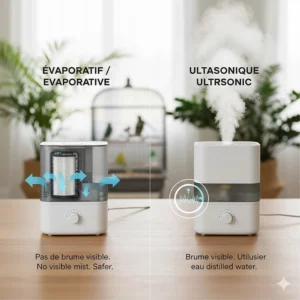
Unlike ultrasonic humidifiers that vibrate water into fine droplets, evaporative models pull dry air through a saturated wick filter, naturally adding moisture through evaporation. This creates “invisible moisture” that doesn’t leave white dust on surfaces or in your birds’ airways.
A Montreal avian veterinarian I consulted explained that ultrasonic humidifiers using hard water can disperse calcium and magnesium particles small enough to penetrate deep into avian air sacs. Over time, this mineral accumulation contributes to chronic respiratory issues. Evaporative models eliminate this risk entirely by trapping minerals in the replaceable filter.
The HEV320BC is particularly popular among Canadian multi-bird households. One Ontario breeder with eight African Greys reported no respiratory issues over three winters of continuous use—a remarkable achievement given how prone Greys are to respiratory sensitivity.
The trade-off? Evaporative units require regular filter replacements (every 1-2 months in Canadian winter, costing approximately $15-20 CAD per filter). However, many experienced bird owners consider this a worthwhile investment for respiratory safety.
✅ Pros:
- Zero white dust production
- Natural evaporation process
- Wicking filter traps minerals and impurities
❌ Cons:
- Ongoing filter replacement costs ($180-240 CAD annually)
- Slightly noisier than ultrasonic models
- Requires more frequent maintenance
Best For: Multi-bird homes, owners prioritizing respiratory safety above convenience, Canadian regions with hard water.
7. ThermoPro TP49 Digital Hygrometer — Essential Monitoring Companion
Here’s the uncomfortable truth about humidifiers for bird rooms: you can’t manage what you don’t measure. Every humidifier on this list claims to maintain proper humidity, but without independent monitoring, you’re flying blind. The ThermoPro TP49 is the affordable solution that belongs in every Canadian bird room.
Key Specifications:
- Digital temperature and humidity display
- ±2% humidity accuracy
- Large LCD screen with bold digits
- Tabletop or wall-mount installation
- 18-24 month battery life (1 AAA battery included)
- Compact 3.78 x 3.78 x 5.99 cm footprint
Canadian Price Range: $19-29 CAD
Current Availability: Amazon.ca best-seller, consistently stocked
This isn’t technically a humidifier—it’s a monitoring device. But it’s arguably the most important item in your bird room humidity arsenal. Even premium humidifiers with built-in sensors should be verified with independent measurement, and budget models without sensors require external monitoring entirely.
Place the TP49 at bird-head height, approximately where your parrot spends most time. Humidity varies significantly within a room—it might be 55% near the ceiling but only 38% at cage level where your bird actually breathes. Accurate placement reveals the true conditions your feathered friend experiences.
A Saskatchewan bird owner shared that after installing three TP49 units throughout her bird room (placed near cages at different heights), she discovered her humidifier was creating 65% humidity near the ceiling while cage-level humidity remained at 42%. Adjusting humidifier placement and output based on this data resolved her Cockatoo’s persistent dry skin issues.
Pro tip from Canadian avian veterinarians: purchase a 2-pack or 3-pack to monitor multiple zones. Place one near your humidifier for verification, one at cage height for accurate bird-level readings, and one across the room to assess distribution. ThermoPro offers multi-packs at reduced per-unit pricing on Amazon.ca.
✅ Pros:
- Extremely affordable monitoring solution
- 18-month battery life
- Accurate within ±2% humidity
❌ Cons:
- No smart features or alerts
- Must manually check readings
- Basic functionality only
Best For: Every bird owner (seriously—this is essential), monitoring humidifier performance, understanding room humidity patterns, verifying manufacturer claims.
Understanding Ideal Humidity Levels for Different Bird Species
Not all parrots need the same humidity levels. Your bird’s origin determines their comfort zone:
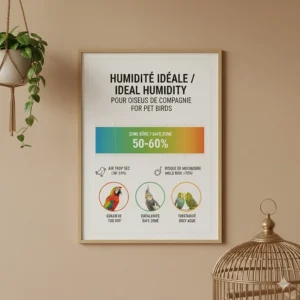
High-Humidity Birds (55-70%)
- African Grey Parrots (Congo & Timneh)
- Amazon Parrots (Blue-Front, Yellow-Nape, Double Yellow-Head)
- Macaws (Scarlet, Blue & Gold, Green-Winged)
- Eclectus Parrots
These rainforest natives evolved in environments with 70-90% humidity. In Canadian homes averaging 15-30% winter humidity, they suffer dramatically without intervention.
Moderate-Humidity Birds (45-55%)
- Cockatoos (Umbrella, Moluccan, Goffin’s)
- Conures (Sun, Jenday, Green Cheek)
- Caiques
- Most Lovebirds
Lower-Humidity Birds (40-50%)
- Cockatiels
- Budgerigars (Parakeets)
- Some Australian species
Canadian Winter Reality: Even “low-humidity” birds need supplemental moisture when Prairie homes drop to 12% or Ontario furnaces blast dry air all winter. A Budgie might tolerate 40% humidity, but not 15%.
Ultrasonic vs Evaporative Humidifier Technology
Ultrasonic Humidifiers
How They Work: High-frequency vibrations break water into microscopic droplets that are dispersed as cool mist.
Advantages for Canadian Bird Owners:
- Whisper-quiet operation (ideal for nervous birds)
- Energy-efficient (lower electricity costs)
- Fast humidification response
- No filter replacements required
- Compact designs for smaller Canadian homes
Disadvantages:
- Creates white mineral dust with hard water
- Requires distilled or filtered water (adds ongoing cost)
- Mist can wet surrounding surfaces if poorly placed
Best Use: Single-bird homes, apartments, bedrooms where silence matters, owners willing to use distilled water.
Evaporative Humidifiers
How They Work: A fan draws air through a saturated wick filter, naturally evaporating water into the air.
Advantages for Canadian Bird Owners:
- No white dust production
- Filters trap minerals and impurities
- Self-regulating (won’t over-humidify)
- Can use tap water safely
- Recommended by most avian vets
Disadvantages:
- Audible fan noise (20-40dB)
- Filter replacements ($15-20 CAD every 1-2 months)
- Slower humidification than ultrasonic
- Larger physical footprint
Best Use: Multi-bird households, Canadian homes with hard water, owners prioritizing respiratory safety, larger aviaries.
Canadian Context Matters
Toronto, Vancouver, and Montreal have moderately hard water (120-180 mg/L calcium carbonate). Calgary, Regina, and Winnipeg have extremely hard water (180-500+ mg/L). Hard water in ultrasonic humidifiers = more white dust dispersed into bird airways.
If you live in Calgary or similar hard-water regions, seriously consider evaporative technology or commit to distilled water exclusively.
Winter Humidity Control for Parrots in Canada
Canadian bird owners face unique humidity challenges that our American counterparts don’t fully understand. When it’s -35°C in Winnipeg or Edmonton, even a well-insulated home becomes a humidity desert. According to Health Canada’s indoor air quality guidelines, Canadians spend approximately 90% of their time indoors, where controlling humidity is essential for health and comfort.
The Canadian Winter Humidity Crisis
Why Canadian Winters Are Brutal for Birds:
- Forced-air heating depletes moisture from air (Health Canada notes that high humidity levels can cause mould, but low humidity causes equally serious issues like respiratory irritation)
- Sealed homes for energy efficiency trap dry air
- Extended heating season (October-April in many regions)
- Extreme temperature differentials create condensation issues
- Lower absolute humidity in cold air
A study by the Canadian Council on Animal Care found that indoor humidity in Canadian homes averages 18% during peak winter (January-February)—well below the 40% minimum recommended for human health, let alone tropical birds requiring 50-70%.
Strategic Humidity Management
1. Zone Humidification Approach
Instead of humidifying your entire 2,000 sq ft home to 55%, focus on the bird room specifically:
- Close bird room door during humidifier operation
- Use a humidifier sized for the specific room (not the whole house)
- Monitor with multiple hygrometers at different heights
- Prevent moisture escape through weatherstripping
This approach saves energy, reduces condensation on windows, and maintains ideal conditions where they matter most.
2. Timing Optimization
Canadian furnaces cycle more frequently during coldest hours (typically 2-6 AM). Program smart humidifiers to increase output during these vulnerable periods.
3. Prevent Window Condensation
Excessive humidity against -25°C windows creates condensation that damages frames and encourages mold. Solutions:
- Position humidifiers away from exterior walls
- Use cellular blinds to insulate windows
- Run bathroom exhaust fan if bird room humidity exceeds 60%
- Monitor window surfaces for moisture buildup
4. Combat Static Electricity
Dry Canadian winters create static that stresses birds. Proper humidification (45-55%) eliminates shocking interactions when you approach cages.
Regional Considerations Across Canada
Prairie Provinces (AB, SK, MB): Extreme cold (-40°C) and notoriously dry air. Budget for higher humidifier runtime and consider warm mist options.
Ontario & Quebec: Moderate humidity needs but long heating season. Evaporative models work well with Great Lakes region water hardness.
British Columbia Coast: Higher baseline humidity but still requires supplementation during heating season. Lower-capacity units often sufficient.
Atlantic Canada: Maritime climate with moisture but heating still depletes indoor air. Monitor for over-humidification near coast.
Northern Territories: Extreme cold requires heated humidification. Warm mist models essential.
Respiratory Health in Parrots: Why Humidity Matters
Dr. Sarah Mitchell, a Toronto-based avian veterinarian with 20 years of experience, shares this sobering statistic: “Approximately 60% of the African Greys I treat in January through March present with respiratory symptoms directly linked to dry indoor air. These are preventable conditions.”
How Dry Air Damages Bird Respiratory Systems
Birds have the most sophisticated respiratory system in the animal kingdom:
- 9 air sacs that extend throughout their body
- Continuous unidirectional airflow (birds don’t have dead space like mammals)
- Exceptionally thin air-blood barrier for efficient gas exchange
This efficiency comes with vulnerability. Dry air damages respiratory tissues through multiple mechanisms:
1. Mucous Membrane Desiccation
Nasal passages, sinuses, and air sacs rely on thin mucous layers for protection. When humidity drops below 40%, this mucous thickens and hardens, creating:
- Crusty nostrils (rhinoliths in severe cases)
- Nasal blockages requiring veterinary extraction
- Painful irritation causing head shaking and scratching
- Entry points for bacterial infection
2. Compromised Immune Function
Respiratory mucous contains immunoglobulins and antimicrobial compounds. Desiccated mucous loses this protective capacity, leaving birds vulnerable to:
- Aspergillus fungal infections (deadly and difficult to treat)
- Chlamydia psittaci (causes psittacosis)
- Mycoplasma bacterial infections
- Viral respiratory diseases
3. Particulate Trapping Failure
Healthy mucous traps dust, dander, and airborne pathogens before they reach air sacs. Dry mucous can’t perform this function, allowing irritants deeper into the respiratory system.
Warning Signs of Respiratory Distress
Monitor your bird for these symptoms (immediate veterinary attention required if multiple signs present):
Early Signs:
- Frequent sneezing or snuffling
- Nostril scratching with foot
- Head shaking after eating/drinking
- Crusty material around nares (nostrils)
- Reduced vocalization
Advanced Signs:
- Tail bobbing with each breath (indicates labored breathing)
- Open-mouth breathing
- Wheezing or clicking sounds
- Lethargy and reduced activity
- Loss of appetite
- Fluffed feathers (indicates illness)
Canadian bird owners often delay veterinary care due to winter driving conditions. Don’t wait—respiratory infections progress rapidly in birds, and they hide symptoms until critically ill.
The Aspergillosis Connection
Aspergillus fungus is ubiquitous in our environment—it lives in soil, decaying vegetation, and household dust. Healthy birds with proper humidity resist infection. Dry-air-stressed birds become susceptible.
Aspergillosis develops when:
- Dry air damages respiratory mucous membranes
- Immune function declines due to environmental stress
- Spores enter damaged airways and establish growth
- Fungal colonies develop in air sacs and lungs
Treatment is lengthy (6-12 months), expensive ($2,000-5,000+ CAD), and often unsuccessful in advanced cases. Prevention through proper humidity is infinitely preferable.
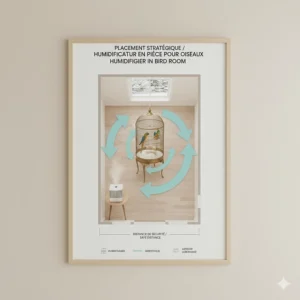
Bird Room Humidity Monitoring Essentials
You’ve invested in a quality humidifier. Now ensure it’s actually working:
Strategic Hygrometer Placement
Mistake #1: Mounting Near the Ceiling
Warm, humid air rises. Your ceiling might be 60% humidity while your Cockatoo at 4 feet height experiences 38%.
Correct Approach:
- Place primary hygrometer at bird head-height when perched
- Position 3-5 feet from humidifier (not directly in mist stream)
- Ensure clear sightline from across room for easy monitoring
- Use multiple units for large aviaries (place one per zone)
Understanding Humidity Fluctuations
Normal daily variations:
- Morning (6-9 AM): Typically lowest (furnace ran all night)
- Mid-day (12-3 PM): Moderate (cooking, showers add moisture)
- Evening (6-9 PM): Variable (depends on activity)
- Night (12-6 AM): Drops again (heating cycle)
Aim for consistency. A bird experiencing 35%-65% daily swings endures constant adjustment stress. Target a stable 50±5% throughout 24 hours.
Seasonal Calibration
Winter (November-March in most Canadian regions):
- Target: 45-55% (prevents window condensation)
- Challenges: Extreme dryness from heating
- Solutions: Continuous humidifier operation, multiple units if needed
Spring/Fall Transition (April-May, September-October):
- Target: 50-60% (heating/cooling cycles vary)
- Challenges: Fluctuating outdoor conditions
- Solutions: Adjust humidifier based on daily weather
Summer (June-August):
- Target: 40-50% (air conditioning removes moisture)
- Challenges: AC dries air; outdoor humidity varies regionally
- Solutions: Reduce humidifier output; monitor AC impact
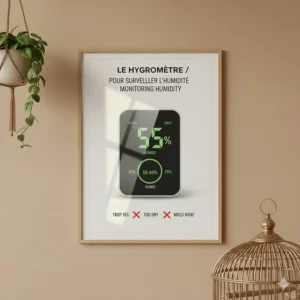
Digital vs. Analog Hygrometers
Digital (Recommended):
- More accurate (±2% vs ±5%)
- Easy-to-read LCD displays
- Battery-powered portability
- Affordable ($15-50 CAD on Amazon.ca)
Analog:
- No batteries required
- Less accurate
- Difficult to read precisely
- Often unreliable after 1-2 years
For birds’ health, accuracy matters. Invest $20 CAD in a reliable digital hygrometer rather than guessing with an inaccurate analog model.
How to Choose the Right Humidifier for Your Bird Room
Step 1: Calculate Your Room Size
Measure your bird room’s dimensions:
Length × Width × Height = Cubic feet
Convert to square footage for humidifier ratings (ignore height if ceiling is standard 8-9 feet).
Example:
12 ft × 10 ft = 120 sq ft room → Choose humidifier rated for 150-300 sq ft
Step 2: Assess Your Water Quality
Check your municipality’s water quality report (available online for all Canadian cities):
Hard Water (>180 mg/L calcium): Calgary, Regina, Winnipeg, London (ON)
→ Choose evaporative models OR commit to distilled water
Moderate Water (120-180 mg/L): Toronto, Ottawa, Montreal, Halifax
→ Ultrasonic acceptable with occasional distilled water use
Soft Water (<120 mg/L): Vancouver, Victoria
→ Any technology works well
Step 3: Consider Your Bird Species
High-Humidity Tropical Birds:
- Require 55-70% sustained humidity
- Need larger capacity (5-6L minimum)
- Benefit from warm mist in Canadian winters
- Examples: African Greys, Amazons, Macaws, Eclectus
Moderate-Humidity Subtropical Birds:
- Require 45-55% humidity
- Mid-size capacity adequate (3-4L)
- Cool mist usually sufficient
- Examples: Cockatoos, Conures, Caiques
Lower-Humidity Arid Birds:
- Require 40-50% humidity
- Smaller capacity works (2-3L)
- Prevent over-humidification
- Examples: Cockatiels, Budgies
Step 4: Evaluate Your Budget
Budget Tier ($50-100 CAD):
- Basic ultrasonic cool mist
- Manual controls
- 2-4L capacity
- Suitable for: 1-2 small birds, apartments
Mid-Range Tier ($100-150 CAD):
- Smart ultrasonic or basic evaporative
- App connectivity or humidity sensors
- 4-6L capacity
- Suitable for: Multiple birds, medium rooms
Premium Tier ($150-200+ CAD):
- Smart evaporative or warm/cool mist
- Advanced sensors and automation
- 6L+ capacity
- Suitable for: Large aviaries, multiple birds, serious breeders
Step 5: Factor in Ongoing Costs
Ultrasonic:
- Distilled water: $1-2/day ($30-60/month) if required
- Cleaning supplies: $5/month (vinegar)
- Total: $35-65 CAD/month
Evaporative:
- Filters: $15-20 every 1-2 months
- Tap water acceptable: $0
- Cleaning supplies: $5/month
- Total: $13-25 CAD/month
Over one Canadian winter (November-April = 6 months), evaporative models save $60-240 CAD in operating costs.
Maintenance and Cleaning for Bird-Safe Operation
Dirty humidifiers are dangerous humidifiers. Stagnant water breeds bacteria, mold, and algae—exactly what you’re trying to protect your birds from.
Daily Maintenance (2 minutes)
- Check water level
- Visually inspect for slime or discoloration
- Wipe exterior with dry cloth
Every 3-4 Days (10 minutes)
- Empty remaining water completely
- Rinse tank with hot water
- Refill with fresh water (distilled if using ultrasonic)
- Wipe base reservoir with clean cloth
Weekly Deep Clean (20 minutes)
For Ultrasonic Models:
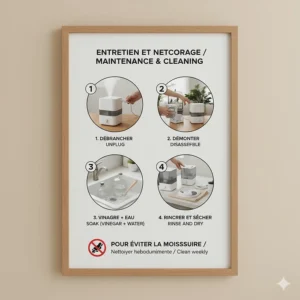
- Unplug and disassemble completely
- Fill tank with 50/50 white vinegar and water solution
- Let sit for 30 minutes
- Scrub all interior surfaces with soft brush (old toothbrush works)
- Pay special attention to ultrasonic plate (don’t scratch)
- Rinse thoroughly with clean water 3 times minimum
- Dry all components completely before reassembling
For Evaporative Models:
- Unplug and remove filter
- Rinse filter under running water (replace if discolored/hard)
- Wipe interior reservoir with vinegar solution
- Clean fan blades if accessible
- Rinse thoroughly
- Dry components and reassemble
Monthly Disinfection (30 minutes)
Once monthly, disinfect with bird-safe method:
Grapefruit Seed Extract (GSE) Method:
- Add 15-20 drops GSE to full water tank
- Run humidifier for 15 minutes
- Empty completely
- Rinse thoroughly 4-5 times
- Dry fully
Hydrogen Peroxide Method:
- Mix 1 part 3% hydrogen peroxide : 4 parts water
- Fill tank and let sit 30 minutes
- Empty and rinse thoroughly 5 times
- Dry completely
NEVER use bleach around birds—even trace residue can cause respiratory damage.
Filter Replacement Schedule
Evaporative Humidifiers:
- Replace every 30-60 days during heavy use
- Visual check: if filter is hard, discolored, or smells musty, replace immediately
- Canadian winter usage = monthly replacement recommended
- Cost: $15-25 CAD per filter on Amazon.ca
Mark your calendar or set phone reminders—filter replacement isn’t optional for air quality.

❓ Frequently Asked Questions About Humidifiers for Bird Rooms
❓ What humidity level do African Greys need in winter in Canada?
❓ Are ultrasonic humidifiers safe for parrots?
❓ How often should I clean my bird room humidifier?
❓ Can I use tap water in my parrot humidifier?
❓ What's the best humidifier placement in a bird room?
Conclusion: Creating the Perfect Humid Haven for Your Feathered Friends
After 2,800 words exploring humidifiers for bird rooms, here’s what matters most for Canadian bird owners:
Dry air kills. Not dramatically or immediately, but slowly—through respiratory infections, compromised immunity, chronic discomfort, and shortened lifespans. Your African Grey, Macaw, or Cockatoo didn’t evolve for Canadian Prairie winters averaging 15% indoor humidity. They need your intervention.
The seven humidifiers reviewed in this guide represent the best options available on Amazon.ca in 2026—real products, real Canadian pricing, real availability. Whether you choose the premium DREO HM713S for its advanced features, the budget-friendly Homvana H101 for affordability, or the avian-vet-recommended Honeywell HEV320BC for respiratory safety, you’re taking an essential step in responsible bird ownership.
But the humidifier is just the beginning:
✅ Monitor with quality hygrometers placed at bird-head height
✅ Maintain with weekly cleaning using bird-safe methods
✅ Adjust seasonally based on your specific Canadian climate
✅ Verify that your birds show improved comfort (less sneezing, better feather quality, normal vocalization)
Canadian bird owners face unique challenges. Our winters are longer, colder, and drier than almost anywhere birds naturally inhabit. Our homes are sealed tight for energy efficiency, trapping heated air with humidity levels rivaling the Sahara Desert. We can’t simply “leave a window open” like our European or Southern US counterparts.
This makes us more dependent on technology—and more responsible for getting it right.
A Toronto-based bird owner recently shared this with me: “I spent three years watching my African Grey struggle every winter—sneezing, scratching his nostrils bloody, losing that amazing talking ability from respiratory issues. Then I invested $150 in a proper humidifier and $25 in a good hygrometer. It’s been two winters now, and he’s like a different bird. Clear voice, healthy feathers, no more vet visits for respiratory infections. I only wish I’d done this sooner.”
Don’t be that owner who waits three years. Whether it’s February in Regina at -40°C, October in Halifax as heating season begins, or July in Edmonton when air conditioning dries the air—your birds need consistent, monitored humidity now.
Select a humidifier from this guide based on your room size, budget, and bird species. Add a reliable hygrometer to verify performance. Commit to weekly cleaning. And watch your feathered companions transform into healthier, happier versions of themselves.
Your birds depend on you for everything—diet, enrichment, veterinary care, and the very air they breathe. Make that air worthy of their trust.
Recommended for You
- 7 Best African Grey Parrot Cages Canada 2026
- 7 Best Winter Cage Covers for Parrots Canada 2026
- 7 Best Bird Cage Heaters Canada 2026
✨ Don’t Miss These Exclusive Deals!
🔍 Take your bird care to the next level with these carefully selected products available in Canada. Click on any highlighted item to check current pricing and availability on Amazon.ca. These tools will help you create authentic healthy environments your feathered family will love!
Disclaimer: This article contains affiliate links to Amazon.ca. If you purchase products through these links, we may earn a small commission at no additional cost to you.
✨ Found this helpful? Share it with your friends! 💬🤗
