
In This Article
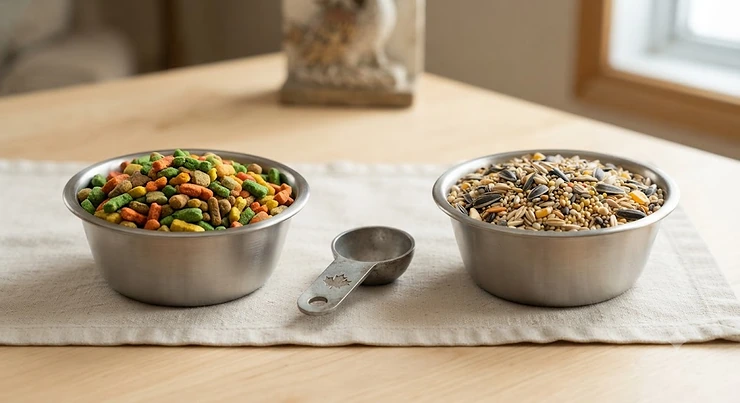
Open any parrot forum at 2 a.m. and you’ll find the same argument on repeat: pellets or seeds, and which one is actually going to shorten your bird’s life. It’s not a small question. parrot pellets vs seed mix is one of the few debates in companion bird care where the science is genuinely lopsided, even though the pet store shelf still stocks both like they’re equally reasonable choices. Here’s the 45-word version: pellets are extruded or cold-pressed formulas engineered to be nutritionally complete on their own, while seed mixes are loose blends of whole seeds that birds can selectively pick through — meaning your parrot chooses the fatty, nutrient-poor bits and leaves the fortified ones in the bowl.

That selective-eating problem is the whole story, and it’s why every major avian veterinary body has been saying the same thing for three decades. But “just switch to pellets” isn’t quite as simple as it sounds either — some birds hunger-strike rather than touch a pellet, and not every pellet brand is created equal. This guide pulls apart the real nutritional gap between the two feeding styles, walks through seven genuine products currently sold in Canada across budget, mid-range, and premium tiers, and gives you an honest, source-backed framework for making the switch without starving your bird or your wallet in the process. According to the Hagen Avicultural Research Institute, a Quebec-based facility that has spent nearly 40 years studying captive parrot nutrition, formulated diets remain the foundation vets recommend building a bird’s bowl around — and the reasoning behind that recommendation is worth understanding before you buy anything.
Quick Comparison Table
| Feeding Style | Nutritional Completeness | Selective Eating Risk | Typical Price Range (CAD) | Best For |
|---|---|---|---|---|
| Formulated Pellets | High — engineered per bite | Low | C$25-C$70 per bag (2-4.5 lb) | Owners prioritizing long-term health outcomes |
| Seed Mix (plain) | Low — fat-heavy, vitamin-poor | Very high | C$15-C$35 per bag (2-5 lb) | Occasional enrichment, not a sole diet |
| Fortified Seed/Pellet Blend | Medium — improves if bird eats the pellet portion | Moderate | C$20-C$40 per bag (2-4 lb) | Transitioning birds, picky eaters |
Reading this table straight, the completeness column is really the whole argument in miniature — a pellet is nutritionally whole in every single piece, so a bird can’t cherry-pick its way into a deficiency the way it can with a bowl of loose seed. Fortified blends sit in an awkward middle ground: they look like a compromise, but if your bird just eats around the pellet crumbles the way it eats around vitamin-dusted seed, you’re back to the same selective-eating problem in a slightly prettier bag. Price alone shouldn’t decide this one, either — the cheapest seed mix looks like a bargain until you tally avian vet visits down the road, which is a cost comparison we’ll come back to later in this guide.
💬 Just one click — help others make better buying decisions too!😊
Top 7 Parrot Pellets and Seed Mixes: Expert Analysis
Seven real, currently available products, spanning budget, mid-range, and premium tiers, plus a genuine seed mix so the comparison isn’t stacked in advance. Coverage spans pure pellets, an organic option, a Canadian-made fortified diet, a traditional seed blend, and a foraging-style fortified treat.
1. Harrison’s Adult Lifetime Fine — the vet-recommended benchmark
Harrison’s Adult Lifetime Fine built its reputation on being the pellet avian vets reach for first when a bird’s health can’t afford compromise. It’s a certified organic, cold-pressed formula made without synthetic preservatives, dyes, or flavourings, using ground nuts and seeds as a whole-food base rather than corn-and-soy filler. In practice, that formulation matters because cold-pressing at lower temperatures preserves more of the natural nutrient content than high-heat extrusion, and the absence of added sugar means it doesn’t reward the same taste preferences that make birds reluctant to give up sunflower seed. Based on the spec comparison across the category, this is the diet with the fewest asterisks — it’s formulated for birds with existing liver, kidney, or reproductive issues as much as it is for healthy adults, which is why exotic vets default to it. Reviewers consistently report that the biggest hurdle isn’t the bird’s health, it’s the bird’s palate: Harrison’s has a muted, savoury flavour rather than a fruity one, and conversion from seed or dyed pellets often takes patience. Harrison’s is best for owners who want the highest nutritional ceiling and are willing to work through a slower transition.
Pros:
- ✅ Certified organic with no synthetic preservatives or dyes
- ✅ Cold-pressed formulation preserves more natural nutrients
- ✅ Frequently the first recommendation from exotic-animal vets
Cons:
- ❌ Smaller bag sizes push the per-kilogram cost up
- ❌ Muted flavour makes conversion from seed slower for picky birds
Pricing generally sits around C$25-C$40 for a small bag, climbing toward C$70-C$90 for larger sizes at the time of research; given the certification and clinical trust behind it, Harrison’s earns its premium price tag rather than just charging one.
2. Roudybush Daily Maintenance Mini — the everyday consistency pick
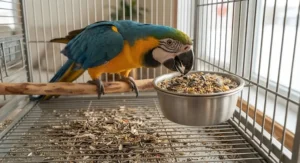
Roudybush Daily Maintenance Mini comes out of decades of avian nutrition research at UC Davis, and the recipe has barely changed since the brand launched in 1985 — which, depending how you look at it, is either proof of a formula that already works or a company that hasn’t bothered to modernize. Either way, the guaranteed analysis runs leaner than most competitors, at roughly 11% protein and 6% fat, which matches what a non-breeding, sedentary companion bird actually needs rather than what a breeding or working bird would require. What most buyers overlook about this brand is that it uses ground rice, not corn or wheat, as its primary carbohydrate base — Tom Roudybush’s own reasoning was that rice reduces the skin and food-sensitivity reactions some birds show on corn-heavy formulas. Reviewers across parrot-owner communities describe it as one of the easier pellets to convert a bird onto, often faster than Harrison’s, likely because of a milder processing profile. Roudybush is best for owners who want a scientifically grounded, no-frills daily diet without premium-tier pricing.
Pros:
- ✅ Lower protein/fat ratio matches sedentary companion-bird needs
- ✅ Rice-based formula linked to fewer skin sensitivities
- ✅ Owner reports suggest an easier seed-to-pellet transition
Cons:
- ❌ Not certified organic or human-grade
- ❌ Fewer size and flavour variants than larger competitors
Expect to pay somewhere in the C$20-C$35 range for a small bag, with 25 lb bulk bags running considerably higher — a smart move if you’ve already confirmed your bird will eat it, since Roudybush‘s cost-per-kilogram drops sharply at scale.
3. ZuPreem Natural — the widely available budget option
ZuPreem Natural is probably the pellet most Canadian bird owners encounter first, simply because it’s stocked at nearly every big-box pet retailer rather than requiring a specialty order. It skips the artificial dyes used in ZuPreem’s colourful FruitBlend line — a distinction that matters, since some sensitive birds have shown behavioural changes linked to dyed pellets in owner-reported cases. On paper this means you’re getting a fortified, vitamin-and-mineral-complete diet without the dye controversy, at a genuinely accessible price point. Here’s what to weigh, though: the protein levels here run lower than Harrison’s or Roudybush, and it isn’t certified organic, so it reads as a solid entry-level pellet rather than a top-tier one. Reviewers frequently mention that ZuPreem is one of the higher-acceptance pellets for picky eaters, though a recurring complaint is its slightly higher sugar content compared to more clinical formulas. ZuPreem Natural is best for owners transitioning a stubborn bird off seed without blowing the food budget in month one.
Pros:
- ✅ Widely stocked, so restocking is rarely a hassle
- ✅ No artificial colouring in the Natural line
- ✅ High acceptance rate among reluctant, seed-loving birds
Cons:
- ❌ Higher sugar content than premium organic competitors
- ❌ Lower protein levels than Harrison’s or Roudybush
At around C$20-C$30 for a 3.5 lb bag at the time of research, ZuPreem Natural is the pick for owners who want “good enough and easy to find” over “clinically optimal.”
4. TOP’s Totally Organic Pellets — the cleanest-label organic pick
TOP’s (Totally Organic Pellets) positions itself as the strictest formula on the market: USDA certified organic, non-GMO, no soy, no peanuts, no wheat, and notably no spirulina — an ingredient some formulas lean on for colour that TOP’s owners argue adds little real nutritional value. The ingredient philosophy here leans hard into “closer to whole food,” and the cold-pressing process is built to retain more of that whole-food nutrient profile than heat-extruded competitors. Based on the spec comparison, this is arguably the closest rival to Harrison’s on paper, though TOP’s markets itself more explicitly around allergen exclusion, which matters for birds with known soy or wheat sensitivities. Reviewers note that texture and shape vary noticeably by batch compared to more industrially standardized pellets, which some owners read as evidence of less processing and others find inconsistent. TOP’s is best for owners managing a bird with a specific food sensitivity who also want organic certification.
Pros:
- ✅ USDA organic, non-GMO, and free of common allergens
- ✅ Cold-pressed to help preserve whole-food nutrient content
- ✅ Strong reputation among owners managing food sensitivities
Cons:
- ❌ Among the priciest pellets in this roundup
- ❌ Batch-to-batch texture consistency draws mixed owner feedback
Pricing runs roughly C$35-C$50 for a 4 lb bag at the time of research, positioning TOP’s firmly in premium territory alongside Harrison’s rather than competing on cost.
5. Hagen Tropican Lifetime Granules — the Canadian-made fortified formula
Hagen Tropican Lifetime Granules is manufactured under the direction of the Hagen Avicultural Research Institute in Rigaud, Quebec, which gives it a distinction none of the American brands on this list can claim: it’s formulated, tested, and produced in Canada, with every batch fed to HARI’s own resident breeding flock before release. The Lifetime formula is built for fledged juvenile through adult parrots living a typical companion lifestyle, with multiple protein sources aimed at feather quality and a calcium-to-phosphorus ratio designed around a less active, non-breeding bird. What most buyers overlook about this brand is that its research pedigree isn’t marketing copy — HARI genuinely runs ongoing feeding studies on its own colony of several hundred breeding pairs, which is a level of in-house verification most competitors outsource or skip entirely. Reviewers frequently cite strong palatability and easier transitions compared to more clinical-tasting American formulas, likely due to Tropican’s slightly richer flavour profile. Tropican is best for Canadian owners who want a domestically produced, research-backed pellet without importing from the U.S.
Pros:
- ✅ Formulated and manufactured in Canada, reducing import friction
- ✅ Backed by an in-house research aviary of hundreds of breeding pairs
- ✅ Reviewers describe strong palatability for a formulated diet
Cons:
- ❌ Fewer third-party independent reviews than the major U.S. brands
- ❌ Selection at big-box retailers is thinner than ZuPreem’s
Expect a price range of roughly C$20-C$35 for a mid-size bag at the time of research, making Tropican one of the more competitively priced pellets on this list once cross-border shipping is factored out.
6. Volkman Avian Science Super Parrot — the traditional seed mix
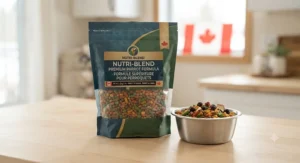
Volkman Avian Science Super Parrot is the honest seed-mix entry in this roundup, and it deserves a place here precisely because most owners still have a bag of something like it in the cupboard. It’s a blend of safflower, corn, sunflower, wheat, peanuts, and pumpkin seed, built around palatability and foraging texture rather than nutritional completeness — the ingredient list reads like what a bird would forage for opportunistically, not what it needs as a daily staple. The spec sheet won’t tell you this, but the nutritional gap here is exactly the one avian vets warn about: a bird given free choice over this mix will selectively eat the high-fat sunflower and peanut pieces first, leaving the more balanced grains in the bowl, which defeats any fortification the mix might otherwise offer. That’s not a knock on Volkman specifically — it’s true of essentially every loose seed mix on the market, and it’s precisely why the industry’s own vitamin-and-mineral fortification claims rarely translate into real intake. Volkman is best used as a supplementary foraging component alongside a pelleted base, not as a sole diet.
Pros:
- ✅ High palatability makes it useful for foraging enrichment
- ✅ Long shelf-stable ingredient base, easy to store
- ✅ Genuine variety of seed types and textures
Cons:
- ❌ Selective eating undermines any fortification in the bag
- ❌ Not nutritionally complete as a standalone daily diet
At roughly C$15-C$30 for a 4 lb bag, Volkman is inexpensive up front, but as we’ll cover in the cost-and-maintenance section below, the true cost of a seed-only diet shows up later, not at checkout.
7. Lafeber Classic Nutri-Berries — the fortified foraging bridge food
Lafeber Classic Nutri-Berries occupies a genuinely useful niche: it’s a fortified pellet base rolled up with whole grains and seeds into a berry-shaped clump, engineered so a bird can’t selectively pick out just the tasty bits, because the tasty bits and the fortified pellet core are bound together. That single design choice solves the core problem with loose seed mixes without asking a stubborn seed-lover to accept a diet that looks nothing like what it’s used to. Based on the spec comparison, Nutri-Berries land in a middle nutritional tier — better than plain seed, not quite as complete per-bite as a pure pellet like Harrison’s — but their real value is behavioural, not just nutritional, since the foraging shape encourages natural manipulation behaviour that flat pellets don’t. Reviewers frequently describe Nutri-Berries as an effective stepping stone for birds that have flatly refused pellets in every other format, and several transition guides recommend mixing them in during the early stages of a pellet switch. Nutri-Berries is best as a transition tool or enrichment supplement, not a full replacement for a completely formulated diet.
Pros:
- ✅ Fortified core prevents purely selective eating
- ✅ Foraging shape adds behavioural enrichment value
- ✅ Effective bridge food for stubborn seed-only birds
Cons:
- ❌ Less nutritionally complete than a pure pellet formula
- ❌ Higher price per kilogram than a plain pellet bag
Pricing generally runs around C$18-C$28 for a smaller bag at the time of research, and given its role as a transition and enrichment tool rather than a full diet, Lafeber earns its keep as a supporting player rather than the main event.
Parrot Pellets vs Seed Mix: The Core Nutritional Differences
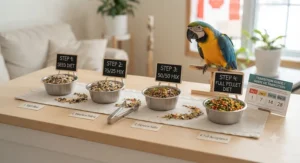
The parrot pellets vs seed mix debate really comes down to one mechanism: choice. A pellet is nutritionally identical from piece to piece, so there’s no way for a bird to selectively eat around the vitamin content. A seed mix is a buffet, and birds are excellent at optimizing for taste and fat content over long-term health, exactly as you’d expect from an animal whose wild ancestors needed calorie-dense food during scarce seasons. According to the Merck Veterinary Manual, even mixed diets of roughly half seed and half pellets are frequently deficient in vitamin A if portions aren’t carefully controlled, which tells you how persistent the selective-eating problem really is. Fat content is the other headline gap: sunflower and peanut-heavy mixes run consistently high in fat relative to what a mostly sedentary companion bird burns off, while formulated pellets are engineered around a leaner, maintenance-level energy profile. Calcium-to-phosphorus ratio is a third, quieter difference — seeds are naturally phosphorus-heavy and calcium-poor, a ratio that can contribute to metabolic bone issues over years of exposure, whereas pellets are balanced specifically to correct that imbalance.
None of this means seed is inherently evil or that pellets are a magic bullet — a completely stressed-out bird that refuses to eat anything is worse off than one eating an imperfect diet it will actually consume. But when the two are compared apples to apples, on paper the completeness argument for pellets is not close, which is exactly why the shift toward formulated diets has become the dominant recommendation across avian veterinary medicine over the last three decades.
Seed-Based Parrot Diet Risks: What the Research Actually Shows
Seed-based parrot diet risks aren’t theoretical — they show up in exam rooms with predictable regularity, and the pattern has been documented for decades. Research summarized by the University of Illinois College of Veterinary Medicine identifies vitamin A deficiency as one of the most frequently diagnosed nutritional disorders in pet birds, disproportionately affecting seed-fed parrots, with clinical signs ranging from blunted choanal papillae to chronic sinus and respiratory infections. Reviewers of avian veterinary literature consistently flag the same secondary cluster of problems: poor feather quality, reduced immune function, and reproductive disease, all tracing back to the same nutritional gap.
Calcium deficiency follows a similar pattern, particularly in African grey parrots and cockatiels, where seed’s poor calcium-to-phosphorus ratio combines with limited sunlight exposure indoors to produce vitamin D3 shortfalls as well — a combination that, in young or breeding birds, can present as bone deformity or hypocalcemic seizures. Iodine deficiency is the less-discussed third risk: an all-seed diet lacking iodine can enlarge a bird’s thyroid gland enough to press on the trachea, producing wheezing or voice changes that owners often mistake for a respiratory infection rather than a dietary one. What the spec sheet won’t tell you is that these conditions rarely appear as a single dramatic event — they build slowly over months or years, which is exactly why an owner watching daily can miss them until a vet catches it on an exam.
Obesity in Captive Parrots: Why Seed Mixes Are a Hidden Driver
Obesity in captive parrots gets less attention than vitamin deficiencies, but it’s arguably the more common outcome of a seed-heavy diet, particularly in species like Amazon parrots, cockatoos, and budgerigars. The mechanism is straightforward: a captive bird burns dramatically fewer calories than a wild counterpart flying for food, foraging, and evading predators, yet a seed-forward diet still delivers wild-level fat density. Clinically, obesity in birds is generally defined as roughly 20% over ideal body weight, and it’s linked to downstream problems including hepatic lipidosis — fatty liver disease — along with pododermatitis from extra pressure on the feet and reduced respiratory capacity from abdominal fat pressing on the air sacs.
Here’s what most owners overlook: a fat, glossy-looking parrot is often read as a healthy one, when a heavy keel score is actually one of the more reliable red flags an avian vet checks for. Reviewers of clinical case data note that sunflower seed and peanut-heavy mixes are repeat offenders, since both are exceptionally calorie-dense relative to their size and endlessly palatable to birds. The fix isn’t just “feed less” — it’s shifting the baseline diet toward something that isn’t stacked with the ingredients a bird will overeat given the chance, which circles right back to why formulated pellets dominate the veterinary recommendation. Portion control matters regardless of diet type, but it’s a far easier conversation to have with a pellet-based bowl than one where a bird can dig straight to the fattiest pieces every single time.
Curious which of the seven products above fits your bird’s situation best? Keep reading for the transition guide and decision framework further down.
Fortified Diets Explained: What “Fortified” Really Means
Fortified diets get thrown around as a marketing term almost as often as “natural,” so it’s worth being precise about what fortification actually does. A fortified product — whether it’s a pellet like ZuPreem Natural or a foraging blend like Lafeber Classic Nutri-Berries — has vitamins, minerals, and amino acids added during manufacturing to compensate for gaps in the base ingredients. On paper this sounds like it should solve the seed-mix problem entirely, and for genuinely uniform pellets, it mostly does, because every bite carries the same fortification. The catch is that fortification only helps if the bird actually eats the fortified portion, and loose fortified seed mixes run into exactly the selective-eating issue described earlier — a bird can pick out the plain sunflower seed and ignore the vitamin-coated pieces entirely, meaning the fortification listed on the bag never actually reaches the bird’s stomach.
This is precisely why format matters as much as ingredient list. A fortified pellet like Roudybush Daily Maintenance Mini delivers its fortification uniformly because there’s nothing to pick around; a fortified clump food like Nutri-Berries binds the fortified core to the tasty parts so a bird can’t separate them; but a loose fortified seed mix, no matter how impressive its label reads, is only as good as a bird’s willingness to eat every component evenly, which in practice, it rarely does. Reviewers and avian nutritionists alike tend to treat “fortified seed mix” as a marketing improvement over plain seed rather than a genuine substitute for a properly formulated pelleted diet.
How to Choose Between Pellets and Seed Mix: A 7-Step Framework
- Start with your bird’s current diet. A bird already eating mostly seed needs a gradual, monitored transition plan, not an overnight swap — cold-turkey switches carry a real starvation risk if a bird refuses the new food outright.
- Check for existing health conditions. Birds with liver, kidney, or reproductive issues benefit most from a clinically formulated option like Harrison’s Adult Lifetime Fine, ideally under a vet’s guidance.
- Weigh your bird regularly during any change. A consistent daily or weekly weigh-in on a gram scale catches a failing transition long before visible symptoms would.
- Match the format to your bird’s personality. Stubborn or nervous eaters often do better starting with a foraging-format fortified food like Lafeber Classic Nutri-Berries rather than a plain pellet dropped straight into the bowl.
- Factor in your budget honestly. Premium organic options like TOP’s Totally Organic Pellets cost more per bag, but a mid-tier pellet like Roudybush or a Canadian-made option like Hagen Tropican Lifetime Granules delivers most of the same completeness for less.
- Keep a small amount of variety, not a free-for-all. Fresh vegetables and a controlled seed portion alongside a pelleted base is different from letting seed be the majority of the diet — variety and selective eating aren’t the same problem.
- Reassess every few months. A diet plan isn’t static — body condition, activity level, and even seasonal appetite changes mean the right daily portion shifts over a bird’s life.
Transitioning Your Parrot to Pellets: The Practical Usage Guide
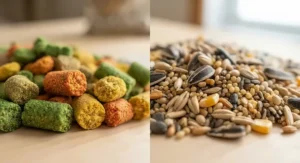
Transitioning a parrot to pellets is where most well-intentioned owners stumble, usually by moving too fast and panicking when the bird stops eating for a day. The safest approach mixes a small percentage of the new pellet into the existing seed bowl — roughly 25% new to 75% old for the first several days — while watching droppings and body weight daily, since a genuinely hungry bird’s droppings will noticeably decrease in volume before weight loss becomes visible. From there, gradually shift the ratio toward 50/50, then 75/25, over one to two weeks, adjusting the pace based on how consistently the bird is actually eating rather than a fixed calendar.
A few tricks make a real difference during the first 30 days: offering pellets in the morning when hunger is highest, moving the food bowl to a more visible or social location, and introducing fresh chopped vegetables alongside the new pellets to keep the bowl interesting without reintroducing the fatty seed that undermines the whole effort. The most common mistake in this window is removing seed entirely on day one out of enthusiasm — that’s the scenario that actually risks starvation in a genuinely stubborn bird, since some parrots will hold out for days rather than try an unfamiliar food. If a bird goes more than 24-48 hours with a clearly empty crop and no interest in the new food, that’s the point to fall back to a slower ratio or loop in an avian vet rather than push through alone.
Real-World Scenarios: Matching the Right Diet to Your Bird’s Life
Picture three different owners, three different birds, three different right answers. First, a university student with a budgerigar in a shared apartment, tight on both time and money — for that setup, ZuPreem Natural paired with a modest, controlled seed portion for foraging enrichment covers the nutritional bases without requiring a specialty order or a big grocery bill. Second, a retiree with an older African grey that’s been on straight seed for over a decade and has some early signs of feather picking — that’s a case for a slower, vet-supervised transition onto Harrison’s Adult Lifetime Fine, using Lafeber Classic Nutri-Berries as a bridge food during the early weeks, since older, entrenched seed-eaters are typically the most stubborn converts.
Third, a Canadian family with a young, healthy Quaker parrot and a preference for supporting domestic products where possible — Hagen Tropican Lifetime Granules fits that use case well, offering research-backed formulation without cross-border shipping costs or availability headaches. None of these are the only correct choice for their situation, but they illustrate the core point: the right pellet or feeding plan depends on the bird’s age, health history, and how entrenched its current eating habits already are, not just on which bag has the best marketing.
Problem → Solution: Common Feeding Struggles, Solved
Problem: My bird won’t touch pellets at all. Try a foraging-format fortified food like Lafeber Classic Nutri-Berries first, since the shape and texture read as more familiar to a seed-conditioned bird than a flat, uniform pellet does.
Problem: My bird is losing weight during the transition. Slow down immediately — drop back to a lower percentage of new food, reintroduce more of the familiar seed temporarily, and consult an avian vet if the weight loss continues past a few days, since crop stasis in a stubborn non-eater can become dangerous quickly.
Problem: I can’t find a specific pellet brand locally. A Canadian-formulated option like Hagen Tropican Lifetime Granules tends to have more consistent domestic stock than U.S. imports like Harrison’s, which can face shipping delays or higher landed costs.
Problem: My bird seems bored and messier on pellets than it was on seed. Add foraging enrichment separately — scatter feeding, foraging toys, or a rotating small portion of Volkman Avian Science Super Parrot used specifically as an enrichment activity rather than a dietary staple.
Problem: I’m not sure my bird is eating enough of the fortified portion in a mixed bowl. Switch to a format where fortification can’t be separated from the tasty parts, such as Lafeber Classic Nutri-Berries, rather than relying on a loose fortified seed blend.
Buyer’s Decision Framework: If This, Choose That
If your bird has an existing liver, kidney, or reproductive health issue, choose a clinically formulated organic option like Harrison’s Adult Lifetime Fine, because the ingredient purity and vet-trusted formulation matter more than price at that point. If your budget is the primary constraint and your bird is otherwise healthy, choose ZuPreem Natural or Hagen Tropican Lifetime Granules, because both deliver solid nutritional completeness without premium-tier pricing. If your bird has flatly refused every pellet you’ve tried, choose a foraging-format bridge food like Lafeber Classic Nutri-Berries before giving up on the switch entirely. If you’re simply supplementing an already-solid pelleted diet with enrichment, a controlled portion of a traditional seed mix like Volkman Avian Science Super Parrot is reasonable — the key word being controlled, not free-choice.
Common Mistakes When Buying Parrot Food
The single most common mistake is buying based on a colourful bag rather than a guaranteed analysis panel — brightly dyed pellets and fruit-shaped seed mixes are frequently designed to appeal to the owner’s eye more than the bird’s actual nutritional needs, and some dyes have been associated with behavioural sensitivity in individual birds. A close second is assuming a “gourmet” or “premium” seed blend solves the selective-eating problem simply because it’s fortified — as covered above, fortification only works if every piece gets eaten, and a loose mix rarely achieves that regardless of price. Owners also frequently buy in bulk before confirming their bird will actually eat a new product, ending up with a half-used 20 lb bag going stale in a closet; a small bag first, even at a worse per-kilogram price, is the smarter move for any first-time brand switch. Finally, a subtler mistake is ignoring species-specific formulation — a pellet sized and balanced for a budgerigar isn’t optimized for a macaw’s larger beak or different caloric needs, and matching pellet size to species reduces both waste and choking risk.
Long-Term Cost & Maintenance: Pellets vs Seed Mix
Sticker price alone makes seed mix look like the obvious budget winner, but that comparison ignores the total cost of ownership. A seed-only diet’s downstream veterinary costs — bloodwork, imaging, and treatment for conditions like hypovitaminosis A, hepatic lipidosis, or nutritional secondary hyperparathyroidism — can easily dwarf the price difference between a bag of seed and a bag of pellets over a bird’s multi-decade lifespan. On the pellet side, a mid-tier option like Roudybush Daily Maintenance Mini becomes noticeably cheaper per kilogram when purchased in bulk, which matters given how long most parrot species live and how consistently they need to eat the same daily staple.
Maintenance costs matter too: pellets generally produce less mess and food waste than loose seed, since there’s no hull debris scattered around the cage, which modestly reduces cleaning time and bedding costs over the long run. The clearest way to think about it is cost-per-decade, not cost-per-bag — a bird eating Harrison’s Adult Lifetime Fine for 20 years at a premium price point may still come out ahead of one that develops a preventable nutritional disease from a cheaper seed-only diet somewhere along the way.
Safety, Regulations & Labelling for Canadian Bird Owners
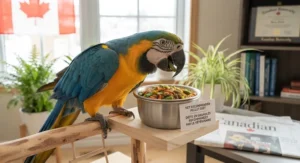
Pet food regulation in Canada doesn’t work quite the way many owners assume. There’s no single dedicated pet food law the way there is for livestock feed — instead, oversight is split across several federal frameworks, with the Canadian Food Inspection Agency handling import controls and animal health safeguards for products containing certain animal-derived ingredients, while labelling accuracy and marketing claims fall under the Consumer Packaging and Labelling Act and the Competition Act. According to the Canadian Food Inspection Agency’s feed registration guidance, products intended purely as companion animal food are generally treated differently from registered livestock feed, which explains why Canada has no mandatory nutrient standard specifically for pet bird food the way some might expect.
In practice, that means most reputable pellet brands voluntarily align with guidelines from the Association of American Feed Control Officials to support “complete and balanced” claims, even though following AAFCO isn’t a legal requirement north of the border. For Canadian owners, the practical safety takeaway is to check the guaranteed analysis panel yourself rather than relying purely on marketing language, confirm bilingual labelling and a legitimate manufacturer address as basic authenticity signals, and treat any product making specific medical claims with a healthy dose of skepticism, since Health Canada restricts unsubstantiated health claims on pet food labelling but enforcement is complaint-driven rather than proactive.
Frequently Asked Questions
❓ Can I mix pellets and seeds together permanently?
❓ How long does it take to fully transition a parrot to pellets?
❓ Are fortified seed mixes as good as pellets?
❓ What's the biggest sign my parrot needs a diet change?
❓ Is it safe to switch an older parrot's diet after years of seed?
Conclusion
Weighed side by side, parrot pellets vs seed mix isn’t really a close contest on nutritional merit — pellets deliver consistent, complete nutrition in every bite, while seed mixes hand a bird the ability to select its way into a deficiency it doesn’t even know it has. That doesn’t mean seed disappears from a healthy bird’s life entirely; a controlled portion still has a place as enrichment and foraging material. What matters is which ingredient is doing the heavy lifting in the daily bowl. Among the seven products covered here, Harrison’s Adult Lifetime Fine and TOP’s Totally Organic Pellets sit at the clinical, premium end; Roudybush Daily Maintenance Mini, ZuPreem Natural, and Hagen Tropican Lifetime Granules offer strong everyday value across different budgets; and Lafeber Classic Nutri-Berries earns its place as a transition tool for the birds that flatly refuse to cooperate. Volkman Avian Science Super Parrot remains a reasonable supplementary product, but the research is consistent that it shouldn’t anchor a bird’s daily diet on its own.
Whichever direction you go, the transition itself matters as much as the product choice — slow, monitored, and adjusted to your specific bird’s stubbornness rather than rushed to match a calendar. 🦜
✨ Don’t Miss These Exclusive Deals!
🔍 Take your parrot’s diet to the next level with these carefully selected products. Click on any highlighted item to check current pricing and availability. These tools will help you build a genuinely healthier daily routine your bird will thank you for!
Recommended for You
- Bulk Parrot Food Value Pack: 7 Best Large Bags for 2026
- Affordable Parrot Bird Food: 7 Budget Picks Vets Approve (2026)
- Bird Nuts Canada Bulk: 7 Top Picks That Save Money in 2026
Disclaimer: This article contains affiliate links. As an Amazon Associate, I earn from qualifying purchases. If you purchase products through these links, we may earn a small commission at no additional cost to you.
✨ Found this helpful? Share it with your friends! 💬🤗
