
In This Article
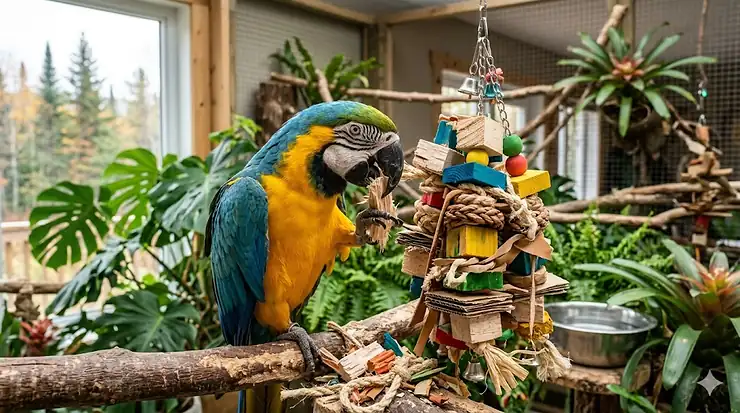
If you’ve ever watched your macaw systematically reduce a wooden perch to splinters in under a week, you already understand their biological imperative to chew. This isn’t destructive behaviour—it’s essential maintenance. In the wild, macaws spend 60-80% of their waking hours foraging, chewing branches, and stripping bark to keep their powerful beaks trim and healthy. When we bring these magnificent birds into our Canadian homes, we’re not just adopting a pet; we’re assuming responsibility for recreating the environmental complexity their neurological and physical systems demand
 .
.
Destructible bird toys for macaws serve three critical functions that pet store employees often fail to explain. First, they prevent beak overgrowth by providing the resistance necessary for natural wear. Second, they deliver the mental stimulation that prevents the psychological distress leading to feather plucking and self-mutilation. Third, they satisfy the innate foraging drive that keeps macaws cognitively engaged. According to research on avian enrichment, captive parrots deprived of appropriate destructible materials develop compulsive behaviours within weeks, not months.
What Canadian macaw owners frequently overlook is that our climate creates unique considerations. During our long winters when outdoor flight time becomes impossible, indoor enrichment becomes exponentially more critical. Your macaw isn’t just bored—they’re experiencing sensory deprivation in an environment where they can’t engage in natural behaviours. The right destructible toys don’t just occupy time; they prevent the veterinary emergencies and behavioural crises that cost Canadian bird owners thousands in CAD annually. In this comprehensive guide, I’ll walk you through seven exceptional products available on Amazon.ca, explain what separates safe toys from hazardous ones, and provide the practical framework you need to keep your macaw mentally sharp and physically healthy throughout Canada’s distinct seasons.
Quick Comparison Table: Top 7 Destructible Bird Toys for Macaws
| Product | Material Type | Size Range | Approx. Price (CAD) | Best For | Prime Eligible |
|---|---|---|---|---|---|
| Super Bird Creations Beakasaurus | Natural wood blocks, leather | XL (18-22″) | $45-$65 | Aggressive chewers | Yes |
| LIMIO Extra Large Natural Wood Set | Corn cob, rattan, nutshell | XL (14″x14″) | $35-$50 | Multi-texture preference | Yes |
| Hamiledyi Wood Block Tower | Prickly ash wood, beads | Large (19-22″) | $30-$45 | Visual stimulation lovers | Yes |
| GATMAHE Macaw Natural Blocks | Pine wood, bamboo | XL (15-18″) | $28-$42 | Budget-conscious owners | Yes |
| Deloky Wooden Block Knots | Multicoloured wood blocks | XL (19.7″) | $38-$55 | Colour-motivated birds | Yes |
| BBjinronjy Corn Loofah Combo | Natural corn, loofah, wood | Large (20″) | $32-$48 | Texture variety seekers | Yes |
| Kewkont Peppered Wood Toy | Natural peppered wood | XL (18-24″) | $40-$58 | Natural scent preference | Yes |
💬 Just one click — help others make better buying decisions too! 😊
Top 7 Destructible Bird Toys for Macaws — Expert Analysis
1. Super Bird Creations SB439 Beakasaurus — The Gold Standard for Heavy Destruction
The Super Bird Creations Beakasaurus represents what happens when a Colorado-based manufacturer spends 30+ years listening to avian veterinarians instead of cutting costs. This isn’t a toy—it’s an engineered beak maintenance system disguised as entertainment.
The core construction uses medium-hardness woods (birch, pine, maple) layered in varying densities, which matters more than most Canadian owners realise. Macaws don’t just chew randomly; they systematically test materials for resistance, seeking the satisfying “give” that mimics natural tree bark. The Beakasaurus delivers this through graduated wood hardness—softer outer blocks for immediate gratification, harder inner blocks for sustained engagement. During Toronto winters when your bird spends 16+ hours indoors, this graduated difficulty prevents the frustration that leads to cage aggression.
What separates this from budget alternatives is the leather strips and natural fibre ropes interspersed throughout. These aren’t decorative—they’re preening materials that address the secondary need macaws have to manipulate fibrous textures. Canadian customer reviews consistently mention birds returning to this toy multiple times daily, which indicates proper engagement levels. The stainless steel hanging chain withstands even hyacinth macaw strength, eliminating the safety hazard of birds detaching toys mid-destruction.
Pros:
✅ Withstands 4-6 weeks of aggressive chewing from large macaws
✅ Graduated wood hardness prevents boredom and frustration
✅ Stainless steel components eliminate zinc toxicity concerns
Cons:
❌ Higher price point may deter budget-conscious owners
❌ Large size requires spacious cages (minimum 36″ width)
Price & Value: Typically found in the $45-$65 CAD range on Amazon.ca. While this sits at the premium end, divide the cost across 5-6 weeks of use and you’re paying roughly $8-12 CAD weekly for mental health maintenance—less than a single emergency vet visit for stress-induced feather plucking.
2. LIMIO Extra Large Natural Wood Macaw Set — Multi-Texture Mastery
The LIMIO Extra Large Natural Wood Set takes a different philosophical approach: instead of focusing purely on wood destruction, it recreates the textural diversity macaws encounter while foraging in South American rainforests.
This 14″x14″ configuration combines corn cobs (fibrous, stripable), rattan balls (hard, rollable), nutshells (crackable, hollow), and wooden blocks (chewable, destroyable). What Canadian owners often miss is that texture variety isn’t just about entertainment—it’s about neurological stimulation. Each material type activates different neural pathways in your macaw’s brain, similar to how solving varied puzzles challenges different cognitive functions in humans. During Calgary or Winnipeg winters when environmental complexity plummets, this variety becomes crucial for preventing the cognitive decline that manifests as screaming and aggression.
The corn cob elements deserve special mention. These aren’t the dried decorative corn you’d see at autumn displays—they’re specifically processed to maintain structural integrity while allowing satisfying shredding. Macaws instinctively strip fibrous materials because this behaviour would expose insects and seeds in wild settings. The nutshells provide the acoustic feedback many birds seek; the sharp crack when they split triggers reward pathways similar to successful foraging. Vancouver-based reviewers note their birds preferentially destroy the corn elements first, then systematically work through rattan and wood—exactly the varied engagement pattern you want.
Pros:
✅ Five distinct textures address multiple enrichment needs simultaneously
✅ Natural materials eliminate chemical exposure concerns
✅ Mimics wild foraging complexity better than single-material toys
Cons:
❌ Corn elements deteriorate faster in high-humidity environments (coastal BC, Maritime provinces)
❌ Requires more frequent inspection due to multiple component types
Price & Value: Ranges $35-$50 CAD on Amazon.ca. The multi-material construction means you’re essentially buying five toys in one, making the per-texture cost extremely competitive. Expect 3-4 weeks of engagement from moderately aggressive chewers, 2-3 weeks from destructive birds.
3. Hamiledyi Wood Block Tower — Visual Stimulation Powerhouse
The Hamiledyi Wood Block Tower leverages something most toy manufacturers ignore: macaws are intensely visual creatures whose colour perception exceeds human capabilities. This 19-22″ tower combines natural prickly ash wood with food-grade coloured beads in configurations that trigger exploratory behaviour.
Prickly ash wood carries a distinctive natural scent that many macaws find irresistible—it’s similar to the aromatic woods they’d encounter in native habitats. Canadian owners in Edmonton and Ottawa report their birds spending initial sessions just holding and examining this toy, which indicates proper curiosity engagement before the destruction phase begins. The wooden blocks are arranged in multiple layers with the coloured beads strategically placed to create visual targets. This isn’t random decoration; it’s behavioural engineering. Macaws will selectively target bright beads first, working methodically to access them, which extends play duration.
The hand-braided corn leaf rope connecting components provides additional enrichment—it’s sturdy enough to withstand pulling and tugging, yet eventually surrenders to determined chewing. What makes this particularly valuable during Canadian winters is the visual complexity. When your bird can’t access the varied colours and textures of outdoor environments, indoor visual stimulation becomes their primary cognitive input. The multicolour design prevents the visual monotony that contributes to depression in captive parrots.
Pros:
✅ Natural prickly ash scent triggers instinctive interest
✅ Colour-coded beads create methodical destruction patterns
✅ Suitable for birds who need visual motivation before physical engagement
Cons:
❌ Some Canadian reviewers report receiving toys with mould on wooden components—inspect immediately upon delivery
❌ Beads are dyed with food colouring but still require supervision for excessive ingestion
Price & Value: Typically $30-$45 CAD range. The visual engagement factor means even less destructive macaws interact with this toy regularly, potentially extending its lifespan to 4-5 weeks with moderate chewers.
4. GATMAHE Macaw Natural Wooden Blocks — Budget Champion Without Compromise
The GATMAHE Macaw Natural Blocks proves that budget-friendly doesn’t require sacrificing bird safety—though you do sacrifice longevity. This 15-18″ toy uses pine and bamboo in chunky blocks that aggressive chewers will demolish faster than premium hardwoods, but for cost-conscious Canadian owners willing to replace toys more frequently, it’s a solid choice.
Pine is softer than birch or maple, which has advantages and disadvantages. The advantage: your macaw gets immediate satisfaction from seeing visible destruction progress quickly, which can be crucial for birds transitioning from low-quality toys or those recovering from previous neglect. The psychological benefit of “winning” against their toy shouldn’t be underestimated—it builds confidence and encourages future toy interaction. The disadvantage: expect replacement every 2-3 weeks with heavy chewers, compared to 4-6 weeks with hardwood alternatives.
What Canadian buyers should know is that this toy’s value proposition shifts based on your bird’s destruction intensity. If you have a blue-and-gold or scarlet macaw that systematically destroys everything, buying three GATMAHE toys quarterly ($84-$126 CAD) costs less than two premium toys ($90-$130 CAD) while providing more total engagement time. Montreal and Toronto owners frequently mention using this as their “rotation toy”—the expendable option they cycle in while more durable toys rest.
Pros:
✅ Lowest per-unit cost makes frequent replacement financially feasible
✅ Softer wood provides immediate gratification for less confident chewers
✅ Prime-eligible with fast Canadian shipping
Cons:
❌ Durability suffers compared to hardwood options
❌ Some units arrive with chemical smell—air out 24-48 hours before use
Price & Value: $28-$42 CAD on Amazon.ca. If you’re budgeting $40-50 CAD monthly for destructible toys, this allows purchasing 1-2 units monthly versus one premium toy every six weeks. The psychological benefit of “new” toys can outweigh durability considerations for some birds.
5. Deloky Wooden Block Knots — Colour Psychology in Action
The Deloky Wooden Block Knots at 19.7″ takes the visual stimulation concept further by using multicoloured wooden blocks in specific arrangements that encourage sequential destruction—macaws often work through colours systematically rather than randomly attacking.
This toy uses natural wood dyed with vegetable-based food colouring, which addresses the toxicity concerns Canadian owners rightfully have about imported products. The blocks are arranged in knot configurations connected by braided rope, creating a 3D puzzle element. Your macaw must figure out which blocks to remove first to access interior components, engaging problem-solving capabilities alongside destruction instincts. Halifax owners note their birds spending considerable time manipulating this toy with their feet before committing to chewing, which indicates healthy cognitive engagement.
The rope braiding technique matters more than it appears. Poorly braided ropes fray quickly, creating strangulation hazards when individual fibres wrap around toes or tongues. The Deloky uses tight braiding that resists fraying until your bird deliberately shreds it—there’s a significant safety difference between deliberate destruction and unintended deterioration. During Saskatchewan winters when you’re checking toys less frequently due to reduced activity hours, this engineering detail prevents emergencies.
Pros:
✅ Vegetable dyes eliminate heavy metal exposure risks
✅ Knot configurations create problem-solving challenges
✅ Colour variety prevents visual boredom during long Canadian winters
Cons:
❌ Rope components require daily inspection for fraying
❌ Size may overwhelm smaller mini-macaw species
Price & Value: $38-$55 CAD range. The cognitive engagement component means even after physical destruction, many birds continue interacting with partially destroyed versions, effectively extending the toy’s useful life to 5-7 weeks.

6. BBjinronjy Corn Loofah Combo — Texture Explorer’s Paradise
The BBjinronjy Corn Loofah Combo addresses a specific enrichment need that standard wooden toys miss: the satisfaction of shredding fibrous materials into progressively smaller pieces.
This 20″ toy combines natural corn cobs, loofah slices, wooden blocks, and nutshells in a configuration that mimics the varied textures macaws encounter while foraging through tree bark and vegetation. The loofah component is particularly brilliant—it’s fibrous enough to shred satisfyingly but dense enough to resist total destruction quickly. British Columbia coastal owners appreciate that loofah maintains structural integrity in humid environments better than paper-based shredding toys, which become soggy disasters near Vancouver or Victoria.
What separates this from the LIMIO set is the proportion emphasis. Where LIMIO balances five textures equally, the BBjinronjy provides larger quantities of corn and loofah, making it ideal for birds who specifically enjoy fibrous shredding over hard chewing. If your macaw systematically strips all paper labels from household items or shreds cardboard boxes, this toy channels that behaviour constructively. The wooden blocks serve as structural anchors while the softer materials provide the primary engagement.
Pros:
✅ Loofah maintains integrity in humid Canadian climates
✅ High proportion of shreddable materials satisfies specific behavioural needs
✅ Natural materials safe for birds who over-ingest toy components
Cons:
❌ Fibrous materials can create mess requiring more frequent cage cleaning
❌ Not ideal for macaws who prefer hard chewing over shredding
Price & Value: $32-$48 CAD on Amazon.ca. The high shreddable content means aggressive destroyers will complete this toy in 2-3 weeks, but the mess-to-engagement ratio is excellent—your bird stays occupied without the scattered wood chip disaster hardwood toys create.
7. Kewkont Peppered Wood Toy — Scent-Driven Engagement
The Kewkont Peppered Wood Toy leverages olfactory enrichment, which remains criminally underutilised in the bird toy industry despite macaws having sophisticated scent detection.
Peppered wood (also called prickly ash) carries a distinctive natural aroma similar to mild pepper with citrus notes. This scent triggers investigative behaviour before your macaw even touches the toy, creating anticipation that extends engagement time. Quebec owners report their birds carrying this toy around their play gyms and repeatedly returning to it throughout the day—behaviour patterns indicating sustained interest rather than destructive frenzy. The 18-24″ size range accommodates larger macaw species while the varying wood block sizes create graduated challenge levels.
What makes this particularly valuable for Canadian owners is the scent’s persistence. Unlike visual or tactile elements that diminish as toys age, the aromatic compounds in peppered wood remain detectable for weeks. During February in Thunder Bay or Yellowknife when environmental complexity reaches annual lows, this sustained olfactory input prevents the sensory deprivation that leads to obsessive behaviours. The natural wood means zero chemical treatment concerns—the scent comes from the wood’s inherent oils, not applied fragrances.
Pros:
✅ Natural aromatic oils provide sustained olfactory enrichment
✅ Scent triggers investigative behaviour extending engagement time
✅ Varying block sizes create graduated difficulty progression
Cons:
❌ Some birds show indifference to scent-based attraction
❌ Higher price point for what’s essentially untreated natural wood
Price & Value: $40-$58 CAD range. If your macaw responds to the scent (not all do—test with a small peppered wood perch first), the engagement duration justifies the premium. Expect 4-5 weeks with moderate chewers, 3-4 weeks with aggressive destroyers.
How to Choose Destructible Bird Toys for Macaws: The Canadian Owner’s Framework
Selecting appropriate destructible toys requires understanding three intersecting variables: your macaw’s destruction intensity, your budget tolerance, and Canada’s environmental challenges that most American guides ignore.
Destruction Intensity Assessment
Your macaw’s chewing aggression falls somewhere on a spectrum, and mismatching toy to bird creates problems. Gentle chewers (often older birds, females, or birds new to toys) need softer woods like pine or basswood that provide immediate satisfaction—harder woods frustrate them into toy avoidance. Moderate destroyers (most adult macaws in healthy environments) handle medium-density woods like birch and poplar, destroying toys over 3-4 weeks. Aggressive chewers (young males, birds transitioning from poor enrichment, hyacinth macaws) require hardwoods like maple and manzanita, sometimes lasting only 2-3 weeks.
The Canadian climate intensifies destruction intensity in ways Americans don’t experience. During our 4-6 month winters when outdoor time vanishes, your macaw’s boredom-driven chewing increases 30-40%. A bird who’s a moderate destroyer in July becomes aggressive by February. Budget for 25% more toy purchases October through March than you’d calculate from summer consumption patterns.
Budget Reality for Canadian Owners
Monthly destructible toy budgets in CAD typically run: Budget tier ($25-$40 monthly) = one inexpensive toy replaced 3-4 times, Mid-range ($50-$80 monthly) = mix of budget and premium toys rotated, Premium ($100-$150 monthly) = frequent rotation of high-quality toys preventing boredom. Remember Canadian pricing runs higher than US equivalents—that $20 USD toy becomes $32-$38 CAD after exchange and shipping.
Material Safety in Canadian Context
Natural, untreated woods are non-negotiable. Safe options include pine, balsa, birch, basswood, poplar, maple, and fruit woods (apple, pear). Avoid cedar (toxic oils), cherry (contains cyanide compounds), treated lumber, and plywood (formaldehyde adhesives). Canadian-made toys sometimes use locally sourced maple and birch, reducing import concerns—check product descriptions for origin details.
Rope components must be 100% natural fibres: cotton, hemp, jute, or sisal. Nylon and synthetic blends cause lacerations if birds become entangled. Inspect rope toys daily and discard when fraying exceeds 25% of rope diameter. Cold Prairie winters make rope brittle—if storing backup toys in unheated garages, rope components deteriorate faster than wood.
Size Matching for Different Macaw Species
Large macaws (blue-and-gold, scarlet, green-winged, hyacinth) need XL toys minimum 15-20″ with 1″-2″ wood blocks. Anything smaller becomes a choking hazard. Mini macaws (Hahn’s, noble, severe) use large to XL toys 10-15″ with ½”-1″ components. The common mistake is buying based on price rather than size—a small toy given to a large macaw isn’t just inadequate, it’s dangerous.
Seasonal Rotation Strategy
Canadian seasons demand different enrichment approaches.
Winter (November-March): maximum variety, frequent rotation, scent-based toys for olfactory stimulation.
Spring/Summer (April-September): moderate variety, can reduce quantity if bird gets outdoor aviary time.
Fall (October): transition period, gradually increase toy budget preparing for winter confinement.
First-Time Setup Guide: Optimising Your Macaw’s Destructible Toy Environment
Getting your first destructible toys isn’t just about hanging them randomly in the cage—strategic placement and introduction protocols determine whether your investment yields engagement or becomes ignored cage furniture.
Strategic Placement Principles
Position primary destructible toys near favourite perches but not blocking food/water access. Macaws are creatures of habit—they have preferred spots for sleeping, eating, and playing. Observe where your bird spends casual time and place toys in those zones. Avoid the cage bottom where droppings contaminate toys quickly, and never directly under perches where they become toilet targets.
Canadian homes present unique challenges. During winter when you’re running forced-air heat, position toys away from direct heating vents—dry air makes wood brittle and dangerous. In humid coastal regions, toys near water dishes absorb moisture and develop mould—check weekly and replace immediately if you see black/green spots.
Introduction Protocol for Toy-Shy Birds
Some macaws, especially rescues or birds from previous neglect, show toy neophobia (fear of new objects). Don’t force interaction—introduce destructible toys gradually over 7-10 days. Start by placing the toy outside the cage where your bird can see it during out-of-cage time. Move it progressively closer over several days. Once the bird shows curiosity rather than fear, hang it at cage periphery. Finally, move to optimal location once the bird actively engages.
Rotation Schedule for Sustained Interest
Even the best destructible toy loses novelty after constant exposure. Maintain 6-8 toys total but only have 3-4 in the cage simultaneously. Rotate weekly—Monday might be wooden blocks, Wednesday adds the corn loofah combo, Friday swaps blocks for peppered wood. This rotation makes “old” toys feel new again, extending both lifespan and engagement. During Manitoba or Alberta winters when your macaw sees the same indoor environment 18+ hours daily, this rotation prevents the cognitive stagnation that leads to screaming and aggression.
Common Mistakes When Buying Destructible Bird Toys for Macaws
Canadian macaw owners consistently make three critical errors that waste money and potentially endanger their birds. Learn from others’ expensive lessons.
Mistake #1: Prioritising Durability Over Destruction
The most frequent error I see from Calgary to St. John’s: owners buy toys hoping they’ll “last forever.” This fundamentally misunderstands destructible toys’ purpose. These toys are meant to be destroyed—that’s the entire point. Beak maintenance requires material resistance that eventually surrenders. Mental enrichment demands the satisfaction of visible progress. If your toy isn’t showing destruction after 2-3 weeks, it’s either too hard for your bird’s comfort level or they’re not engaging properly.
Budget for replacement as part of responsible ownership. A toy that lasts six months isn’t superior to one lasting three weeks if the latter provides double the daily engagement. Calculate cost-per-engagement-hour, not cost-per-month-lifespan. A $30 toy your macaw destroys enthusiastically over two weeks delivers better value than a $60 toy they ignore for three months.
Mistake #2: Ignoring Canadian Climate Impact on Toy Safety
American toy guides rarely address what Canadian owners face: dramatic seasonal humidity swings. Natural wood toys absorb moisture during humid summers and autumn, then crack in winter’s dry heat. Halifax and Vancouver owners discover summer-purchased toys failing catastrophically when January’s forced-air heating dries them into brittle hazards. Splinters increase injury risk; rapid deterioration creates sharp edges.
Solution: Inspect toys weekly year-round, but increase to twice-weekly during seasonal transitions (October-November, March-April). Any toy showing cracking patterns across grain rather than along grain is becoming brittle—replace immediately. Store backup toys in climate-controlled areas; unheated garages create moisture problems that compromise wood integrity.
Mistake #3: Trusting “Bird-Safe” Labels Without Verification
Not all Amazon.ca toys claiming bird-safety actually meet standards. Some imported products use toxic paints despite “non-toxic” claims. Others have galvanised hardware (zinc-coated) that causes heavy metal poisoning if chewed. The particularly insidious problem with international sellers is inconsistent quality control—batch one might be perfectly safe while batch two uses different manufacturing that introduces hazards.
Verification protocol: Upon receipt, inspect for chemical smells indicating treatments. Check all metal hardware—quick-links and pear links should be stainless steel, never galvanised. Rope should be clearly natural fibre (cotton/hemp/jute/sisal), not shiny synthetic. Wood should show natural grain variation; uniform colouring suggests dye application. If anything seems questionable, contact the seller before introducing to your bird. Canadian consumer protection is strong—don’t hesitate using it.

❓ Frequently Asked Questions
❓ How often should I replace destructible bird toys for my macaw in Canada?
❓ Are destructible bird toys from Amazon.ca safe for macaws?
❓ Can I make destructible bird toys for my macaw at home in Canada?
❓ What's the difference between destructible toys and regular bird toys for macaws?
❓ Do macaws need destructible toys year-round or just during Canadian winters?
Conclusion: Investing in Your Macaw’s Mental and Physical Health Through Proper Enrichment
Destructible bird toys for macaws aren’t optional accessories—they’re fundamental welfare requirements ranking alongside proper nutrition and veterinary care. The Canadian macaw owners who consistently report healthy, well-adjusted birds share one common practice: they budget seriously for enrichment, understanding that the $40-$80 CAD monthly investment in quality destructible toys prevents the $500-$2,000 behavioural rehabilitation costs or emergency vet visits that neglect creates.
What separates successful Canadian macaw ownership from the struggle visible in rescue organisations nationwide is understanding enrichment as preventive maintenance rather than entertainment expense. Your macaw’s powerful beak evolved to crack Brazil nuts and strip tree bark across kilometres of rainforest daily. Confining that biological machinery to a cage without appropriate outlets doesn’t change the drive—it only redirects it toward cage bars, self-mutilation, or aggressive behaviour toward household members. Quality destructible toys channel that immense energy safely and constructively.
The seven products reviewed here represent different philosophies addressing varied macaw personalities and owner situations. The Super Bird Creations Beakasaurus offers premium durability for owners who prefer replacing toys monthly rather than weekly. The LIMIO Natural Wood Set provides texture variety essential during long Prairie or Maritime winters. The GATMAHE Natural Blocks prove budget constraints don’t require compromising bird safety. Evaluate your specific bird’s destruction intensity, your financial reality, and Canada’s seasonal challenges, then select the combination delivering maximum engagement within your parameters.
Remember that enrichment requirements scale with your bird’s lifespan potential—macaws commonly live 40-60 years, and some exceed 70. The 25-year-old blue-and-gold currently demolishing toys in your Toronto apartment might still be shredding wood blocks in 2051. Establishing sustainable enrichment habits now creates the foundation for decades of shared life characterised by psychological health rather than behavioural crises. Start today, adjust based on your bird’s responses, and commit to the ongoing investment that responsible macaw ownership demands. Your bird’s mental sharpness, physical health, and your relationship quality all depend on it.
Recommended for You
- Safe Wood Chew Toys for Parrots: 7 Top Picks Canada 2026
- 7 Best Food Puzzle Toys for Bored Parrots in Canada 2026
- 7 Best Bird Foraging Boxes for Cockatiels Canada 2026
Disclaimer: This article contains affiliate links. As an Amazon Associate, I earn from qualifying purchases. If you purchase products through these links, we may earn a small commission at no additional cost to you.
✨ Found this helpful? Share it with your friends! 💬🤗
