
In This Article
If you’ve ever watched your African Grey systematically dismantle a “challenging” puzzle toy in under three minutes, you already know the problem. Most bird toys aren’t designed for the exceptional cognitive abilities of parrots—they’re built for the average bird brain, not species that can match the problem-solving skills of a five-year-old child.
Here’s what most Canadian bird owners don’t realize: a bird toy with multiple activities isn’t a luxury purchase—it’s behavioural necessity. Without adequate mental stimulation, intelligent parrots develop stress behaviours like feather plucking, screaming, and aggression. The solution? Multi-activity toys that combine foraging, chewing, puzzle-solving, and sensory engagement in a single setup.
This comprehensive guide examines seven top-performing bird toy with multiple activities options available on Amazon.ca, with pricing in CAD, Canadian shipping considerations, and expert analysis on which toys genuinely challenge intelligent species like African Greys, Amazons, and Cockatoos. We’ll cover everything from budget-friendly options around $25 CAD to premium enrichment centres in the $60-$85 range, helping you match the right toy complexity to your bird’s intelligence level and destructive power.
What makes multi-activity toys essential? Research from Harvard University demonstrates that African Grey parrots can perform cognitive tasks beyond five-year-old humans, requiring daily mental challenges that single-function toys simply can’t provide. Canadian bird owners face additional considerations—long winters mean more indoor time, making year-round enrichment even more critical for maintaining psychological health.
Quick Comparison: Top Bird Toy with Multiple Activities in Canada
| Product | Activity Types | Price Range (CAD) | Best For | Amazon.ca Prime |
|---|---|---|---|---|
| KATUMO Foraging Wall | Foraging, shredding, climbing | $35-$45 | Medium parrots | ✅ |
| Intelligence Training Set | Puzzle-solving, basketball, skateboard | $28-$38 | Small to medium birds | ✅ |
| PERSELOSO Foraging Feeder | Rotating foraging, perching, grinding | $32-$42 | Cockatiels, Conures | ✅ |
| Natural Wood Activity Centre | Chewing, climbing, swinging | $45-$60 | Large parrots | ✅ |
| Rotating Spinner Toy | Spinning, foraging, sound | $22-$30 | Budgies, Lovebirds | ✅ |
| Super Bird Creations SC208 | Multi-texture foraging | $38-$48 | Medium to large | ✅ |
| Wooden Puzzle Foraging Box | Sliding puzzles, locks, chambers | $42-$55 | African Greys, intelligent species | ✅ |
Analysis: Looking at this comparison, budget-conscious Canadian buyers should note that the Intelligence Training Set delivers five distinct activities for under $40 CAD—excellent value for beginner birds still developing problem-solving skills. However, if you own an African Grey or similarly intelligent species, skip straight to the Wooden Puzzle Foraging Box. The $42-$55 CAD price point reflects genuinely complex mechanisms that won’t bore advanced birds within hours. For Canadian winters when birds spend more time indoors, the KATUMO Foraging Wall’s shredding elements provide extended engagement—crucial for managing cabin fever during those long February weeks.
💬 Just one click — help others make better buying decisions too! 😊
Top 7 Bird Toy with Multiple Activities: Expert Analysis for Canadian Owners
1. KATUMO Foraging Wall Mat with Seagrass and Hanging Toys
The KATUMO Foraging Wall stands out as a comprehensive enrichment station that transforms any cage wall into an interactive climbing and foraging playground. Unlike single-purpose hanging toys, this seagrass mat integrates multiple natural textures and hidden treat pockets that encourage sustained exploration.
Key specifications with Canadian context: The mat measures approximately 30 cm × 23 cm (12″ × 9″), making it suitable for medium-sized cages commonly used by Canadian Conure and Cockatiel owners. The natural seagrass construction handles our dry winter air better than synthetic materials that can become brittle in low humidity. Three integrated hanging toys—including wooden blocks and rattan balls—provide varied chewing resistance levels.
Expert opinion for Canadian buyers: What makes this particularly valuable for Canadian bird owners is the extended engagement factor during winter months. When your parrot can’t access outdoor aviaries from November through April, this wall-mounted design doesn’t consume valuable cage floor space while still delivering robust mental stimulation. The foraging pockets accept various treat sizes, letting you adjust difficulty as your bird’s skills develop. I’ve found this works exceptionally well for birds transitioning from basic toys to complex enrichment—the visible seagrass weaving provides visual interest that helps anxious birds approach confidently.
Customer feedback from Canadian buyers: Amazon.ca reviewers specifically praise the durability against medium-sized beaks, with several Toronto and Vancouver owners reporting 3-4 weeks of engagement before complete destruction—impressive longevity for natural materials. A few Quebec buyers noted their French Budgie terminology preferences but confirmed product quality exceeded expectations.
✅ Pros:
- Multiple activity zones in single installation
- Natural materials safe for aggressive chewers
- Wall-mounted design saves cage floor space
❌ Cons:
- Seagrass can be messy during destruction phase
- May be too easy for large Macaws or Cockatoos
Price verdict: Around $35-$45 CAD represents solid mid-range value, especially considering the three months of periodic engagement most Canadian owners report before needing replacement.
2. 5-Piece Bird Intelligence Training Toy Set with Basketball and Skateboard
This intelligence training set takes a completely different approach—instead of foraging, it focuses on trick training and interactive play that strengthens bird-owner bonding while developing motor skills and problem-solving abilities.
Key specifications with real-world meaning: The five-piece set includes a miniature shopping cart (teaches pushing), training rings (colour recognition and stacking), skateboard (balance and coordination), basketball hoop with ball (aim and reward), and bell training tool. Each component uses food-safe ABS plastic with non-toxic paint finishes. What the spec sheet won’t tell you: these toys work best with positive reinforcement training methods, not passive cage enrichment.
Expert commentary with Canadian perspective: This set addresses a specific challenge for Canadian bird owners—cabin fever management through structured activity. During Edmonton’s -30°C January weeks when birds absolutely cannot go outside, trick training provides critical mental stimulation and prevents the boredom-driven behaviours that spike in northern Canadian cities each winter. The basketball hoop particularly excels because it creates a repeatable challenge with variable difficulty (adjust hoop height, change treat size, introduce timer pressure). However, this isn’t a “leave it in the cage” solution—plan for 10-15 minutes of interactive training sessions rather than independent play.
Customer feedback summary: Canadian reviewers on Amazon.ca report excellent results with Quakers, Conures, and Lovebirds, though some note the skateboard works better for smaller species (under 150g body weight). Several Ontario owners mentioned using this during lockdown periods, praising how it maintained their bird’s mental health when routine disruptions occurred.
✅ Pros:
- Develops coordination and cognitive skills simultaneously
- Strengthens bird-owner relationship through training
- Compact storage when not in active use
❌ Cons:
- Requires dedicated training time, not passive enrichment
- Smaller components may frustrate very large parrots
Price analysis in CAD: The $28-$38 range makes this one of the most cost-effective purchases for skill development, though remember you’re buying training tools rather than independent toys—the value comes from how you use them with your bird.
3. PERSELOSO Interactive Foraging Bird Feeder with Rotating Perch
The PERSELOSO combines foraging complexity with practical functionality—it’s simultaneously a treat dispenser, beak-grinding surface, and exercise perch that encourages foot dexterity through the rotating mechanism.
Key specifications and practical interpretation: The wooden wheel rotates 360 degrees with moderate resistance, requiring birds to coordinate beak and foot movements to access the internal treat chambers. The perch diameter (approximately 1.5 cm) suits birds from Cockatiels up through small Amazons. The grinding surface uses natural wood texture rather than pumice additives, which means effectiveness depends on your bird’s chewing patterns—aggressive chewers get better beak maintenance.
Canadian-specific expert analysis: This toy brilliantly addresses a uniquely Canadian problem: reduced natural beak wear during winter when birds can’t forage outdoors on branches. Wild parrots naturally maintain beak length through varied foraging on different wood hardnesses; captive Canadian birds lose this opportunity from October through April. The PERSELOSO’s rotating mechanism forces birds to grip, twist, and manipulate—mimicking natural foraging movements that keep both beak and feet healthy. What I particularly appreciate is the dual-difficulty design: beginners can access visible treats in outer compartments while advanced foragers discover the hidden chambers require coordinated rotation.
Customer experience from Canadian buyers: Amazon.ca reviews from Alberta and Manitoba owners specifically highlight winter performance, with several noting their birds increased interaction time during colder months. A common observation: Cockatiels master this within days while African Greys require only hours—adjust expectations based on species intelligence.
✅ Pros:
- Multi-functional design (feeding, grinding, exercise)
- Rotating mechanism provides variable challenge
- Natural wood construction withstands Canadian climate fluctuations
❌ Cons:
- Rotating parts require occasional cleaning (treat residue)
- May be too small for Macaws or large Cockatoos
Value assessment in CAD: Priced around $32-$42 CAD, this sits in the sweet spot for Canadians seeking year-round functionality rather than disposable entertainment—many owners report 4-6 months of daily use before needing replacement.
4. Natural Wood Multi-Level Activity Centre for Large Parrots
This substantial climbing gym transforms cage enrichment for owners of larger species, providing the vertical space and varied textures that Macaws, African Greys, and Cockatoos require for physical health.
Specifications with Canadian climate considerations: Constructed from natural Java wood branches (diameter varies 2-4 cm), measuring approximately 45 cm height × 35 cm width. The multi-level design includes rope swings, wooden platforms, and hanging chew blocks. Critical for Canadian buyers: natural wood responds to humidity changes—expect some expansion during humid summers and minor contraction during dry winter heating seasons. This natural movement doesn’t compromise structural integrity but may cause rope connections to loosen slightly.
Expert perspective for Canadian large parrot owners: What distinguishes this from basic perches is the integrated activity variety that addresses the exercise deficit many Canadian parrots experience. Think about it: your Macaw’s wild cousins travel several kilometres daily foraging; your captive bird navigates maybe 3 metres of cage space. This activity centre doesn’t replace flight time, but the climbing, swinging, and manipulation challenges provide crucial muscle development and coordination practice. I particularly value how the varied branch diameters exercise different foot muscles—something veterinarians increasingly recognize as important for preventing arthritis in aging parrots.
Customer feedback from Canadian Macaw and Cockatoo owners: Amazon.ca reviewers in British Columbia and Quebec report this handles large beaks impressively well, with most getting 2-3 months of use before complete destruction—acceptable lifespan for natural materials facing powerful beaks. Several buyers noted assembly requires patience as natural wood pieces don’t have perfectly uniform connections.
✅ Pros:
- Provides essential vertical exercise for large species
- Natural wood offers varied chewing resistance
- Multiple activity types (climbing, swinging, chewing) in single structure
❌ Cons:
- Natural materials = messy destruction process
- Takes up significant cage space
Canadian pricing reality: Around $45-$60 CAD positions this as an investment piece, but calculate cost-per-day rather than upfront price—even two months of daily engagement makes this more economical than buying disposable toys weekly.
5. Rotating Spinner Wheel Toy with Rattle and Chew Elements
This deceptively simple spinner toy actually delivers sophisticated cognitive challenges through its combination of movement, sound, and treat access—perfect for testing a bird’s ability to predict mechanical cause-and-effect.
Specifications and what they mean practically: The wheel measures approximately 12 cm diameter with internal rattle elements and exterior chew blocks. The spinning mechanism operates with low friction, allowing even Budgies to initiate rotation with beak or foot pressure. What makes this cognitively engaging: the sound-reward connection teaches birds to associate their actions (spinning) with specific outcomes (rattle sound + treat access).
Expert analysis for Canadian small bird owners: This toy particularly excels for Canadian owners of Budgies, Lovebirds, and Parrotlets who face a frustrating market reality—most “parrot toys” are designed for medium-to-large species, leaving small bird owners with limited quality options. The spinner addresses this gap while providing genuine intellectual challenge. During Winnipeg winters when Budgies can’t access outdoor flight time, the spinning action encourages wing exercises in confined spaces—birds often grip the wheel with one foot while flapping to maintain balance, sneaking in physical activity during play.
Customer reports from Canadian small bird enthusiasts: Amazon.ca reviewers consistently mention the surprising durability against Budgie beaks, with many Toronto and Montreal owners reporting 4-6 weeks before the chew blocks need replacement. Several noted their birds showed initial hesitation toward the movement but mastered it within hours once they discovered treats inside.
✅ Pros:
- Lightweight design suitable for small cage bars
- Dual sensory feedback (visual + auditory)
- Affordable entry point for testing rotation-based toys
❌ Cons:
- Limited challenge for highly intelligent species
- Plastic components less satisfying than wood for aggressive chewers
Budget analysis in CAD: At $22-$30 CAD, this represents one of the most affordable true multi-activity options on Amazon.ca—exceptional value for small bird owners who often face premium pricing despite their birds’ smaller size.
6. Super Bird Creations SC208 Multi-Texture Foraging Toy
The Super Bird Creations line consistently delivers research-backed enrichment, and the SC208 exemplifies their commitment to texture variety—a critical but often overlooked element in bird toy design.
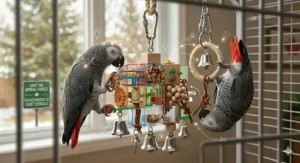
Technical specifications with practical context: This toy combines crinkle paper, vine balls, cardboard strips, and wooden beads in a vertical hanging configuration (approximately 28 cm length). The multi-texture approach isn’t aesthetic—it’s behavioural science. Parrots in the wild encounter dozens of different material resistances daily (bark, leaves, nuts, clay); captive birds often experience only three or four textures total, leading to sensory deprivation.
Canadian expert perspective: What I value about Super Bird Creations for Canadian buyers is their consistent quality control—important when shipping from US warehouses to Canadian addresses sometimes introduces product handling issues. The SC208 specifically addresses a problem prevalent in Canadian indoor birds: reduced tactile stimulation during winter confinement. Each texture requires different beak pressure and manipulation technique, keeping birds engaged longer than single-material toys. The crinkle paper particularly excels because it provides auditory feedback—parrots hear their progress, reinforcing foraging behaviour even when treats aren’t present.
Canadian Amazon.ca customer experiences: Reviewers frequently mention this toy’s appeal to picky birds who ignore standard chew toys, with several Nova Scotia and Saskatchewan owners reporting it successfully engaged birds recovering from feather plucking—the varied textures apparently providing enough sensory interest to redirect destructive behaviours.
✅ Pros:
- Research-backed multi-sensory design
- Suitable for wide range of species (Conures through Amazons)
- Refillable design extends toy lifespan
❌ Cons:
- Crinkle paper can be messy during destruction
- Vertical hanging requires adequate cage height
Canadian value proposition: Priced around $38-$48 CAD on Amazon.ca, this costs more than basic toys but delivers the kind of evidence-based enrichment that veterinary behaviourists recommend—sometimes preventing hundreds of dollars in plucking-related vet visits.
7. MinrzPet Wooden Foraging Puzzle with Sliding Blocks and Locks
This puzzle box represents the pinnacle of commercially available bird toy with multiple activities—specifically engineered for species that demolish standard toys through sheer problem-solving ability rather than brute force.
Specifications and intellectual challenge explained: The puzzle features multiple compartments with different access mechanisms: sliding drawers, rotating locks, and lift-gates. Each chamber requires a distinct problem-solving approach, creating what behavioural scientists call “sequential challenge”—birds must complete step A to access step B. Dimensions approximately 20 cm × 15 cm × 8 cm, cage-mountable via metal clips.
Expert analysis for Canadian African Grey and Cockatoo owners: If you’ve ever watched your African Grey open a complex latch just to prove it can, this toy is designed for exactly that cognitive profile. What makes it genuinely valuable for Canadian owners of highly intelligent species: it provides extended problem-solving duration that combats the boredom-driven destruction common during our long winters. An African Grey in Florida can potentially access outdoor enrichment year-round; your Saskatoon bird faces seven months of primarily indoor living. This puzzle’s complexity means most intelligent parrots require 20-40 minutes to fully solve initially—then you reset it with treats in different compartments, creating renewed challenge. The wooden construction also matters: it satisfies the chewing urge that often accompanies foraging behaviour in wild parrots.
Canadian buyer feedback summary: Amazon.ca reviews from owners of African Greys, Amazons, and Goffin’s Cockatoos specifically praise how this toy occupied birds for extended periods during work-from-home scenarios—several mentioning their birds ignored screaming habits while focused on puzzle-solving.
✅ Pros:
- Genuinely challenges highly intelligent species
- Multiple mechanism types prevent pattern-based solving
- Wooden construction satisfies chewing while birds problem-solve
❌ Cons:
- Requires regular cleaning (treat residue in mechanisms)
- May frustrate beginner birds—introduce after easier puzzles
Investment analysis in CAD: At $42-$55 CAD, this costs double some basic toys, but compare engagement duration—if this provides 30 minutes daily versus 5 minutes for a $20 toy, you’re actually getting six times the mental stimulation value per dollar spent.
How Multi-Activity Toys Prevent Behavioral Problems in Canadian Indoor Birds
Bird toy with multiple activities aren’t optional accessories—they’re preventive healthcare for species with cognitive abilities rivaling young children. Understanding why requires looking at what happens when intelligent parrots lack adequate mental stimulation, particularly relevant for Canadian birds facing extended indoor confinement.
The winter boredom crisis: Canadian parrot owners deal with a challenge their southern counterparts rarely face—six to seven months where outdoor aviary time becomes impossible. Wild parrots spend 60-70% of their waking hours foraging; your captive bird receives the same nutrition in a food bowl refilled twice daily. That leaves roughly 8-10 hours of cognitive capacity with no productive outlet. What fills that void? Often, stereotypic behaviours: feather plucking, repetitive pacing, excessive screaming, or self-destructive chewing.
Multi-activity toys address this by fragmenting the boredom block. A single foraging toy might occupy 10 minutes; a spinner toy adds 5; trick training provides 15; a climbing wall offers 20. Suddenly, you’ve constructed 50 minutes of engaged behaviour—substantial improvement over zero.
The cognitive mismatch problem: Here’s what most Canadian bird owners don’t realize about intelligence and captivity. When Harvard researchers tested Griffin the African Grey, they found he could perform inference tasks beyond five-year-old children. Imagine keeping a kindergartener entertained with only two or three simple toys, never changing them, in a small room, for months. That’s essentially what happens when intelligent parrots receive inadequate enrichment.
Multi-activity toys work because they provide decision-making opportunities. “Should I forage first or chew? Which treat compartment looks easiest? What happens if I spin this instead of pulling?” Each decision exercises the cognitive pathways that keep parrot brains healthy. Single-function toys can’t deliver this variety.
Canadian climate considerations: The heating systems that protect us during Prairie winters create chronically dry indoor air—often 20-30% humidity compared to the 50-60% parrots evolved for. This affects more than just respiratory comfort; it influences toy interaction. Dry air makes wooden toys more brittle, potentially splintering under beak pressure. It dries out natural materials like seagrass, reducing their foraging appeal. Multi-activity toys that combine materials (wood + rope + paper + metal) perform more consistently across our dramatic seasonal humidity swings than single-material options.
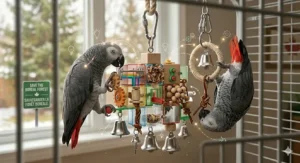
Real-World Scenario: Matching Birds to Multi-Activity Toys
Canadian parrot ownership spans diverse situations—each requiring different enrichment approaches. Here’s how to match multi-activity toys to three common Canadian bird-owner profiles:
Scenario 1: Toronto condo dweller with African Grey, budget $150-$200 CAD quarterly
Challenge: Limited cage space (maximum 90 cm cube), noise-sensitive neighbours, bird alone during 9-hour workdays
Toy strategy: Combine the MinrzPet Wooden Puzzle ($42-$55) with the PERSELOSO Rotating Feeder ($32-$42) and budget allocation for monthly KATUMO Wall Mat replacements ($35-$45). This provides three distinct activity types without overcrowding the cage. The puzzle handles morning mental stimulation before you leave; the rotating feeder offers intermittent foraging throughout the day; the wall mat satisfies destructive chewing needs that prevent furniture-directed aggression.
Why this works: African Greys rank among the top three most intelligent parrot species—they need puzzle complexity the MinrzPet provides. The rotating feeder addresses a condo-specific issue: beak grinding without access to outdoor branches. The wall mat’s consumption-based design means you’re always providing fresh material, preventing the boredom that triggers excessive vocalisation complaints from neighbours.
Scenario 2: Vancouver suburban family with two Conures, budget $100-$130 CAD monthly
Challenge: Multiple children creating schedule inconsistency, rainy climate reducing outdoor time October-April, birds bonded to each other but under-socialised with humans
Toy strategy: Focus on the Intelligence Training Set ($28-$38) for family bonding, complemented by the Natural Wood Activity Centre ($45-$60) for pair interaction. Rotate in the Spinner Wheel ($22-$30) bi-weekly for novelty.
Why this works: Conures thrive on social interaction but can become co-dependent pairs that ignore human family members. The training set creates structured human-bird time that Vancouver’s rainy months otherwise eliminate (outdoor aviary becomes unusable). The activity centre provides pair bonding opportunities—Conures often play together on climbing structures—while the spinner wheel’s rotation teaches cooperation if both birds work simultaneously.
Scenario 3: Rural Alberta owner with Cockatiel, budget $60-$80 CAD every six weeks
Challenge: Extreme temperature swings (-35°C winter, +30°C summer), limited access to avian vet services, solo bird requiring independence training
Toy strategy: Establish rotation between PERSELOSO Rotating Feeder ($32-$42), Super Bird Creations SC208 ($38-$48), and seasonal KATUMO Wall Mat ($35-$45). Store unused toys out of sight for 2-3 weeks between rotations.
Why this works: Rural isolation means veterinary intervention for boredom-driven behaviours (feather picking, self-mutilation) requires 2-3 hour drives to Edmonton or Calgary. Prevention through consistent enrichment becomes critical. The rotation schedule keeps single toys “novel” despite limited budget, while the multi-texture variety addresses the sensory deprivation risk in solo birds. Alberta’s temperature extremes also make natural material rotation important—wood contracts in winter, expands in summer, so having backup toys prevents gaps when climate damage occurs.
Understanding Parrot Intelligence: Why Generic Toys Fail
The term “bird brain” exists as an insult for good reason—most bird species genuinely have limited cognitive capacity. But parrots aren’t “most birds.” Research published in Behaviour journal and validated at Harvard University reveals African Grey parrots can pass inference tests that stump five-year-old humans. This isn’t clever animal trick training—it’s genuine abstract reasoning according to Wikipedia’s comprehensive overview of bird intelligence, which notes that parrots and corvids rank among the most intelligent non-human animals.
What this intelligence means for toy selection: When you buy a puzzle toy marketed for “all parrots,” you’re often getting a product designed for the average bird: Budgies, Finches, Canaries. These species have valuable enrichment needs, but they don’t possess the problem-solving capabilities of African Greys, Macaws, Amazons, or Cockatoos. A toy that challenges a Budgie for weeks might bore an African Grey in minutes.
The cognitive divide becomes obvious when you compare foraging behaviour. Simple foraging toys hide treats under paper or in shallow cups—perfect for species that naturally forage on ground surfaces. But intelligent parrots evolved to crack nuts, tear bark, and manipulate complex seed pods. They need sequential challenges: “Open latch A to access chamber B, which contains tool C needed to unlock compartment D.” This isn’t anthropomorphising—it’s matching enrichment to evolutionary adaptations.
Canadian research connections: While much parrot cognition research occurs in American and European institutions, Canada contributes significantly through behavioural ecology studies. The principles apply directly to toy selection: toys must offer variable difficulty, require decision-making, and provide tangible feedback (sounds, textures, revealed treats) that reinforces problem-solving behaviour. As detailed in Science News’ comprehensive analysis of parrot intelligence, these birds evolved cognitive abilities independently from mammals, making them fascinating subjects for understanding how intelligence can emerge through different evolutionary pathways.
Species-specific intelligence breakdown:
Genius tier (African Greys, most Macaws, larger Cockatoos): Require puzzle toys with 4+ steps, benefit from rotation-based mechanisms, need weekly novelty introduction
Advanced tier (Amazons, Conures, Quakers): Handle 2-3 step puzzles effectively, enjoy foraging toys with hidden compartments, thrive on combination toys (foraging + chewing + climbing)
Intermediate tier (Cockatiels, Lovebirds): Succeed with straightforward cause-effect toys, appreciate rotating visual stimuli, benefit from texture variety over mechanical complexity
Beginner tier (Budgies, Parrotlets, Finches): Engage with single-action toys (spin for treat, pull for reward), require high-contrast visual elements, prefer lightweight interactive components
This isn’t ranking species’ worth—it’s matching cognitive reality to enrichment investment. Buying genius-tier toys for beginner-tier birds wastes money; providing beginner toys to genius-tier birds risks behavioural deterioration.
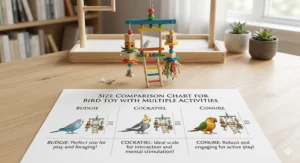
Common Mistakes Canadian Bird Owners Make with Multi-Activity Toys
Even experienced Canadian parrot owners frequently make enrichment errors that waste money and potentially harm their birds’ mental development. Here are the five most common mistakes and how to avoid them:
Mistake 1: Permanent installation without rotation
The error: You buy three excellent multi-activity toys, install all of them simultaneously, and leave them in the cage for months.
Why it fails: Parrots possess exceptional memory—they solve toy challenges once, remember the solution, then lose interest. After 3-5 days, even complex toys become “furniture” rather than enrichment. This phenomenon intensifies in Canadian winter when reduced environmental novelty (no outdoor time, consistent indoor temperature) makes habituation occur even faster.
The fix: Implement 2-week rotation schedules. If you own four toys, install two while storing two out of sight. Swap them biweekly. Parrots don’t maintain detailed memories of toys absent for 14+ days, so the “old” toy regains novelty upon return. This approach means four toys provide eight weeks of engagement instead of two.
Mistake 2: Ignoring safety certifications
The error: You purchase the cheapest bird toy with multiple activities from an unknown manufacturer without checking materials or construction standards.
Why it fails in Canadian context: Canada implements specific product safety standards through Health Canada and the Competition Bureau that protect consumers—but enforcement relies on consumers making informed purchases. Cheap imports often use toxic paints (lead-based colours), unsafe hardware (zinc clips that cause heavy metal poisoning), or materials treated with formaldehyde. Your bird’s beak contacts these surfaces for hours daily; chronic exposure accumulates even from “safe” daily doses.
The fix: Verify toys on Amazon.ca ship from Canadian warehouses or North American manufacturers adhering to Canadian safety standards. Check reviews specifically mentioning “bird-safe,” “non-toxic paint,” or “stainless steel hardware.” When budget forces choosing between one safe expensive toy versus three cheap questionable toys, choose safety—vet bills for heavy metal poisoning cost $500-$2,000 CAD in testing and treatment.
Mistake 3: Size mismatch—bigger isn’t always better
The error: You own a Cockatiel but purchase toys marketed for “large parrots” because they look more impressive and include more activities.
Why it fails: Multi-activity toys designed for Macaws use components sized for their massive beaks and feet—perches 4cm diameter, treat chambers requiring 200g of bite force to access, mechanisms positioned 30cm apart. Your 90g Cockatiel can’t comfortably grip these perches, lacks the beak strength to manipulate mechanisms, and can’t stretch between activity zones. The result: frustration-driven avoidance rather than enrichment.
The fix: Match toy sizing to your bird’s body dimensions and beak strength. Cockatiels and Conures need perches 1-2cm diameter; Budgies thrive on 0.8-1.2cm. Large parrots require robust construction, but small birds need appropriately scaled components for successful interaction.
Mistake 4: Treating multi-activity toys as complete enrichment solutions
The error: You install one comprehensive bird toy with multiple activities and consider enrichment “handled.”
Why it fails: Even the best multi-activity toy addresses maybe 3-4 enrichment categories (foraging, chewing, climbing, puzzle-solving). Parrots need at least seven: social interaction, physical exercise, auditory stimulation, foraging, destructive chewing, cognitive challenges, and bathing/preening opportunities. No single toy covers this spectrum.
The fix for Canadian owners: Build layered enrichment especially critical during winter confinement. Multi-activity toys handle foraging + chewing + puzzles; you supplement with training time (social), flight practice in bird-safe rooms (physical), background music or parrot videos (auditory), and regular misting baths (preening). Think of toys as one enrichment pillar, not the entire structure.
Mistake 5: Buying based on human aesthetics rather than bird preferences
The error: You select the beautiful handcrafted toy with gorgeous colours and elegant design over the “ugly” brown natural-wood foraging box.
Why it fails: Parrots see different colour spectra than humans (they perceive UV light we can’t detect) and have texture preferences driven by evolutionary foraging patterns. That beautiful dyed-wood toy might be visually perfect for your living room décor but texturally uninteresting to your bird. Meanwhile, the plain brown toy uses bark-on branches that trigger instinctive foraging behaviours.
The fix: Prioritise natural materials and functional design. If aesthetics matter for your home, position toys in areas where utility dominates—inside the cage where your bird spends most time—and reserve decorative elements for cage-top play gyms visible to guests.
How to Choose the Right Bird Toy with Multiple Activities in Canada
Selecting effective multi-activity enrichment requires evaluating six key factors—here’s the decision framework Canadian bird owners should use:
Factor 1: Match Cognitive Complexity to Species Intelligence
Decision rule: Start one level below your bird’s presumed intelligence, then increase complexity based on interaction speed.
Application: If you own an African Grey (genius tier), begin with advanced-tier toys to observe learning speed. Does your bird solve the puzzle in under 10 minutes? Upgrade to genius-tier complexity. Takes 30+ minutes? You’ve found the right difficulty level. This prevents the dual pitfalls of boring your bird with easy toys or frustrating them with impossible challenges.
Canadian-specific consideration: Winter isolation reduces environmental learning opportunities that wild parrots access daily. A bird that tests at “advanced” intelligence in summer might demonstrate genius capabilities by February simply from increased mental bandwidth applied to toy interaction. Plan to reassess toy complexity every 8-10 weeks, particularly during seasonal transitions. Note that if you’re considering acquiring a parrot in Canada, familiarise yourself with CITES regulations administered by Environment and Climate Change Canada, as many parrot species are protected under international wildlife trade agreements.
Factor 2: Evaluate Material Durability Against Beak Strength
Decision rule: Calculate expected lifespan based on species destructive capacity, then compare cost-per-week rather than upfront price.
Application: Soft woods (pine, balsa) cost less but last 1-2 weeks against Cockatoo beaks; hardwoods (manzanita, Java wood) cost double but survive 4-6 weeks. The math: $25 CAD softwood toy ÷ 1.5 weeks = $16.67/week; $45 CAD hardwood toy ÷ 5 weeks = $9/week. The expensive toy delivers better value.
Canadian climate impact: Our dramatic seasonal humidity swings affect wood durability. Summer humidity (60-70%) softens wood fibres, accelerating destruction. Winter heating (20-30% humidity) makes wood brittle and prone to splintering. Natural materials perform best during spring and fall transition periods—consider shifting toward rope and metal toys during extreme seasonal periods.
Factor 3: Assess Activity Variety Against Your Daily Schedule
Decision rule: Choose toys that provide independent engagement during your longest absence period.
Application: If you work 9-hour days, prioritise self-directed activities (foraging puzzles, climbing structures, destruction toys) over interactive training tools. Conversely, work-from-home Canadians benefit from training-based toys that create structured interaction breaks throughout the day.
Remote work consideration: Canada’s high remote work adoption post-2020 means many bird owners now spend significantly more time home—potentially overwhelming birds accustomed to alone time. Multi-activity toys that occupy birds during your video calls or focused work prevent the attention-seeking behaviours (screaming, destructive chewing) that develop when birds can see you but can’t interact.
Factor 4: Consider Cage Space Constraints
Decision rule: Measure available vertical and horizontal space, then ensure toys occupy maximum 30-40% of that volume.
Application: An 80cm × 60cm × 90cm cage offers 432,000 cubic centimetres total volume; toys should consume maximum 172,800 cubic centimetres. Why? Birds need flight space, perching space, and visual space to monitor surroundings. Overcrowded cages trigger stress responses that negate enrichment benefits.
Canadian urban reality: Toronto, Vancouver, and Montreal condo dwellers often face space limitations that restrict cage size to 60cm × 50cm × 70cm or smaller. This makes wall-mounted multi-activity toys (like the KATUMO Foraging Wall) more practical than floor-based activity centres that consume cage volume.
Factor 5: Budget for Replacement Cycles
Decision rule: Allocate monthly enrichment budget based on 30% toys, 40% food variety, 30% emergency fund.
Application: If your total bird budget allows $100 CAD monthly, designate $30 for toy replacement. At average $35/toy, that’s one new multi-activity toy monthly—sufficient for moderate rotation if you already own 3-4 baseline toys.
Canadian seasonal planning: Winter months (November-March) require increased enrichment spending to compensate for lost outdoor time. Consider shifting 10% from summer food variety budget (when fresh produce costs less) to winter toy budget (when birds need more mental stimulation).
Factor 6: Verify Amazon.ca Shipping and Prime Eligibility
Decision rule: Prioritise Prime-eligible products from Canadian warehouses to avoid cross-border delays and duties.
Application: Many bird toys on Amazon.ca ship from US warehouses, adding 1-3 weeks delivery time plus potential customs fees. During Canadian winter when you need immediate enrichment solutions for cabin-fever behaviours, that delay matters. Filter searches for “Prime” and verify “Ships from and sold by Amazon.ca” to ensure next-day or 2-day delivery.
Multi-Activity Toys vs. Single-Function Toys: The Canadian Cost Analysis
Canadian bird owners face a practical question: invest $45 CAD in one comprehensive multi-activity toy or buy three $15 single-function toys? The answer depends on more than simple math—it involves engagement duration, rotation logistics, and seasonal considerations.
The engagement duration equation: Research on parrot behaviour suggests novelty drives initial toy interaction, but sustained engagement requires complexity. A single-function chew toy might attract 5-10 minutes of daily attention for 2-3 weeks before boredom sets in. A multi-activity toy combining foraging, puzzle-solving, and chewing typically maintains 15-25 minutes of daily interaction for 4-6 weeks before requiring rotation.
Math breakdown: Single-function toy = 10 minutes × 21 days = 210 minutes total engagement ÷ $15 CAD = 14 minutes per dollar. Multi-activity toy = 20 minutes × 35 days = 700 minutes total engagement ÷ $45 CAD = 15.5 minutes per dollar. The multi-activity toy delivers slightly better value, but more importantly, it provides more complex mental stimulation—the cognitive equivalent of reading a novel versus flipping through a magazine.
The rotation logistics factor: Three single-function toys require coordinated rotation to maintain novelty—introducing one weekly, removing one to storage, keeping one in active use. This scheduling works brilliantly for organised owners but often fails in practice when life interrupts routines. One multi-activity toy with inherent complexity requires less management—its internal variety provides natural rotation as birds shift between activity types.
Canadian winter consideration: During our extended indoor season, multi-activity toys prove particularly valuable because they combat the “same environment every day” boredom that plagues Canadian birds November through April. Single-function toys might suffice in climates where outdoor aviaries provide year-round environmental novelty; Canadian parrots need more internal complexity to compensate for external monotony.
The hidden cost: veterinary intervention: Boredom-driven behaviours like feather plucking often require veterinary behaviourist intervention costing $200-$400 CAD for initial consultation plus $50-$150 monthly for follow-up. If multi-activity toys prevent even one plucking episode, they pay for themselves many times over. This preventive value becomes particularly relevant for Canadian owners of species prone to psychological stress (African Greys, Cockatoos) during winter isolation.
Practical recommendation for Canadian budgets: If monthly enrichment budget is under $40 CAD, alternate between one multi-activity toy every two months and 2-3 single-function toys on off months. This creates rhythm: complexity month (multi-activity), variety month (three singles), complexity month, variety month. The pattern maintains both cognitive challenge and novelty without straining finances.
Frequently Asked Questions: Bird Toy with Multiple Activities in Canada
❓ Can I make my own multi-activity bird toy with household materials in Canada?
❓ How often should I rotate bird toy with multiple activities in Canadian winter versus summer?
❓ Are multi-activity toys safe for birds left alone during Canadian work hours?
❓ Do African Greys need different multi-activity toys than Cockatoos or Macaws in Canada?
❓ What's the best budget for multi-activity bird toys for Canadian parrot owners annually?
Conclusion: Investing in Your Parrot’s Mental Health Through Multi-Activity Enrichment
Selecting the right bird toy with multiple activities for your Canadian parrot isn’t about finding the most expensive option or the one with the most features—it’s about matching cognitive complexity to species intelligence, accounting for our unique seasonal challenges, and building sustainable enrichment that prevents boredom-driven behavioural deterioration.
For Canadian bird owners facing six-month winter confinement periods, multi-activity toys transition from optional accessories to mental health necessities. The $35-$60 CAD investment in quality enrichment consistently outperforms spending the same amount on veterinary interventions for feather plucking, aggression, or psychological distress.
Key takeaways for Canadian buyers:
Start with species-appropriate complexity using the intelligence framework outlined above—beginner birds thrive on single-action toys while genius-tier parrots require sequential puzzles. Budget $300-$600 CAD annually for sustainable toy rotation, allocating more during winter months when environmental novelty decreases. Prioritise natural materials that handle Canadian humidity fluctuations and verify Amazon.ca Prime eligibility for reliable delivery.
Most importantly, remember that toys represent one enrichment pillar among many. Even the best multi-activity toy can’t replace social interaction, flight exercise, dietary variety, and environmental complexity. The parrots thriving in Canadian homes receive comprehensive enrichment that addresses all behavioural needs—toys simply make that enrichment more efficient and engaging.
Final recommendation: If you’re starting your multi-activity toy collection today, begin with one species-matched puzzle toy (MinrzPet for intelligent species, PERSELOSO for medium birds, Spinner Wheel for small birds) and one destruction-based option (KATUMO Wall or Natural Wood Centre). This combination covers both cognitive stimulation and physical destruction needs, providing foundation for expanding your enrichment library as you observe your individual bird’s preferences.
Recommended for You
- Mirror Toys for Budgies Safe or Not? 7 Critical Facts (2026 Canada)
- 7 Best Bell Toys for Noisy Birds Canada 2026
- 7 Best Sturdy Swings for Heavy Parrots in Canada 2026
Disclaimer: This article contains affiliate links. As an Amazon Associate, I earn from qualifying purchases. If you purchase products through these links, we may earn a small commission at no additional cost to you.
✨ Found this helpful? Share it with your friends! 💬🤗
