
In This Article
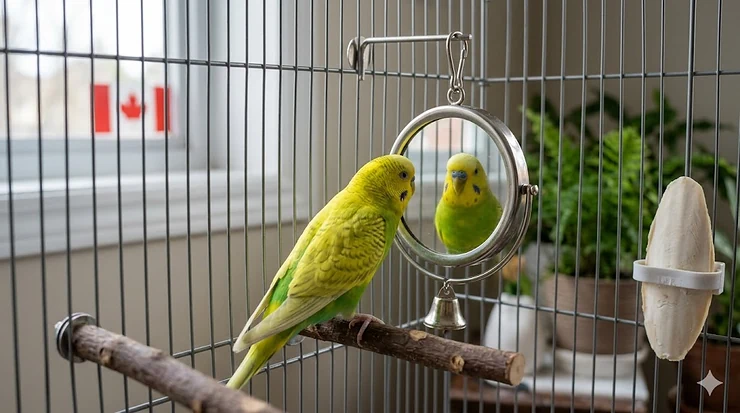
Walk into any pet store across Canada and you’ll find mirror toys hanging alongside bells, swings, and ladders in the bird section. They’re colourful, affordable, and seem harmless enough. But here’s what most Canadian budgie owners don’t realize until it’s too late: that innocent-looking mirror could be triggering psychological stress in your feathered companion that manifests in ways you might not immediately recognize.
The question of mirror toys for budgies safe or not isn’t just about physical safety—it’s about understanding how your budgie’s brain processes that reflection. Unlike humans who recognize themselves in mirrors by age two, budgies never develop this self-recognition ability. Research from Saint Joseph’s University demonstrates that budgerigars consistently treat their reflection as another bird, not as themselves. This creates a unique set of challenges that every Canadian owner should understand before hanging that mirror in their cage.
What makes this especially relevant for Canadian budgie owners is the harsh winter climate. When your bird spends more time indoors during those long, cold months from October through April, the impact of a mirror toy becomes magnified. A budgie that might cope with occasional mirror interaction during summer months when windows are open and household activity is higher can develop obsessive behaviors during the isolated winter period. I’ve seen this pattern repeatedly with clients across Ontario, Alberta, and British Columbia—winter amplifies whatever relationship your budgie has with its mirror.
The mirror toy industry markets these products as “companions” for solo budgies, but the reality is far more nuanced. Whether a mirror is safe or problematic depends entirely on your bird’s individual personality, your household situation, and how you monitor the interaction.
Quick Comparison: Mirror Toys vs. Alternative Enrichment Options
| Feature | Mirror Toys | Foraging Toys | Interactive Swings | Puzzle Feeders |
|---|---|---|---|---|
| Social Stimulation | High but one-sided | Low | Moderate | Moderate |
| Mental Challenge | Low | Very high | Moderate | Very high |
| Risk of Obsession | High for solo birds | Very low | Very low | Very low |
| Price Range (CAD) | $5-$15 | $8-$20 | $10-$25 | $12-$30 |
| Best For | Paired budgies only | All budgies | Active birds | Food-motivated birds |
| Lifespan | 6-12 months | 2-4 weeks (shredded) | 8-18 months | 12-24 months |
Looking at this comparison, the pattern becomes clear: mirror toys provide intense social stimulation but almost zero mental challenge, while foraging and puzzle toys flip that equation. For solo budgies especially, the high obsession risk combined with low mental engagement makes mirrors a problematic choice. Canadian budgie owners should note that during winter months when indoor time increases by 40-60%, the “risk of obsession” factor becomes even more pronounced. Foraging toys excel because they tap into natural behaviors that wild Australian budgies would perform daily—something a static mirror can never replicate.
💬 Just one click — help others make better buying decisions too! 😊
Top 7 Mirror & Alternative Toys for Budgies: Expert Analysis
1. KyoukiBird Perch Platform with Mirror
This multi-level wooden playground integrates a small acrylic mirror into a larger activity centre, which significantly reduces the obsession risk compared to standalone mirrors. The design includes a climbing ladder, swing, and natural pine perches—all treated with food-safe, edible dyes that meet Canadian safety standards.
What sets this apart for Canadian buyers is the shatterproof acrylic mirror construction, crucial during temperature fluctuations common in Canadian homes where central heating can cause cheaper plastic mirrors to warp or crack. The mirror here occupies maybe 15% of the total toy space, meaning your budgie encounters it as one element among many rather than a singular focal point. In my experience, this “diluted” mirror approach works well for budgies transitioning away from mirror dependency.
Canadian customers consistently report this toy holds up well in dry winter conditions that can cause wooden toys to crack. The stainless steel hooks won’t rust even in humid prairie summers or coastal BC climates. One Vancouver owner mentioned their budgie used the swing portion 70% of the time and only occasionally glanced at the mirror—exactly the healthy ratio you want.
Pros:
✅ Mirror integrated into larger activity structure reduces obsession risk
✅ Natural pine wood withstands Canadian temperature swings
✅ Food-safe dyes eliminate toxicity concerns
Cons:
❌ At around $18-$25 CAD, pricier than standalone mirror toys
❌ Requires cage with sufficient height clearance (minimum 45 cm)
Price Range: $18-$25 CAD |
Best For: Transitioning budgies away from standalone mirrors
2. Wesco Pet Original Kabob Shreddable Bird Toy
Here’s the mirror alternative I recommend most frequently to Canadian clients: a simple cylinder of soft balsa wood strung on rope that your budgie can absolutely demolish. This toy activates the same foraging and chewing instincts that wild budgies use when stripping bark to access insects and seeds.
The beauty of the Kabob design is its complete absence of social triggers. Unlike a mirror that your budgie might try to “communicate” with for hours, this toy provides pure physical and mental engagement. Canadian budgie owners dealing with winter boredom particularly appreciate how long these last—typically 2-4 weeks depending on your bird’s chewing intensity, compared to plastic toys that might last months but provide minimal enrichment.
What most buyers overlook is the therapeutic value for budgies with mirror obsession. When you remove a mirror toy cold turkey, your budgie needs an immediate replacement activity. The Kabob’s satisfying texture and immediate feedback (wood chips fall, providing tangible results) helps redirect that obsessive energy into healthy destruction.
Pros:
✅ Zero obsession risk—pure physical engagement
✅ Natural wood safe for budgie digestive system if small pieces swallowed
✅ Can be deconstructed and pieces redistributed to other toys
Cons:
❌ Requires replacement every few weeks (ongoing cost of $8-$12 CAD)
❌ Creates wood debris requiring daily cage cleaning
Price Range: $8-$12 CAD |
Best For: Solo budgies and mirror addiction recovery
3. JW Pet Activitoys Hall of Mirrors
This controversial toy deserves honest analysis. It features multiple small rotating mirrors in a plastic frame that budgies can spin and manipulate. The rotating element means the reflection constantly moves and disappears, theoretically preventing the sustained eye contact that triggers bonding behaviors.
For Canadian households with paired or grouped budgies, this toy functions as intended—a novelty item that adds visual interest without dominating attention. However, for solo budgies, I’ve seen this toy become just as problematic as traditional mirrors, with birds sitting and spinning it repeatedly to maintain visual contact with the reflection. The key difference from stationary mirrors is the element of control; your budgie can make the reflection appear and disappear, which some birds find addictively entertaining.
One Toronto client reported their solo budgie spent 6-7 hours daily with this toy, completely ignoring food until evening. That’s the red flag scenario that transforms a toy into a health risk. Conversely, an Edmonton owner with three budgies said the toy barely gets attention—exactly what you want.
Pros:
✅ Moving reflections less likely to trigger mate-bonding than static mirrors
✅ Lightweight plastic safe if bumped during energetic play
✅ Easy to clean during weekly cage maintenance
Cons:
❌ Still triggers obsessive behavior in some solo budgies
❌ Plastic construction may not withstand aggressive chewers
❌ Small mirrors difficult to remove if behavioral issues develop
Price Range: $10-$16 CAD |
Best For: Multiple budgies only; avoid for solo birds
4. Bonka Bird Toys Foraging Daisy Garden
This foraging wheel represents everything a mirror toy isn’t: mentally challenging, varied in texture, and completely devoid of social triggers. The design features paper “petals” hiding small compartments where you can tuck millet, seeds, or nutrient pellets. Your budgie must figure out how to peel back layers and access the rewards.
What makes this particularly valuable for Canadian budgie owners dealing with winter cabin fever is the time investment required. A properly loaded Daisy Garden can occupy an intelligent budgie for 45-90 minutes—the exact window when a mirror-obsessed bird would otherwise be regurgitating to its reflection. The foraging process mimics how wild budgies in Australian grasslands would spend hours searching through vegetation, providing authentic mental stimulation that mirrors simply cannot offer.
The paper construction is fully biodegradable and safe if ingested, addressing a common concern among Canadian owners who worry about toxicity in imported pet products. British Columbia owners particularly appreciate knowing this toy won’t harm their bird even if completely consumed, unlike plastic alternatives.
Pros:
✅ Provides 45-90 minutes of mental engagement per loading
✅ Adjustable difficulty by hiding treats deeper in compartments
✅ Biodegradable paper safe for budgies with pica tendencies
Cons:
❌ Requires weekly reloading and reconfiguration to maintain interest
❌ Paper components may deteriorate faster in humid coastal climates
Price Range: $14-$22 CAD |
Best For: Intelligent budgies needing mental stimulation
5. Prevue Pet Products Tropical Teasers Bird Toy
This vibrant hanging toy combines natural materials—coconut shell, palm leaf, and sisal rope—into a shreddable, climbable structure that satisfies multiple budgie instincts simultaneously. What Canadian owners immediately notice is how this toy’s movement and texture variety prevent the fixated staring behavior common with mirrors.
The genius of the Tropical Teasers design is its constant state of change. As your budgie shreds the palm leaves and picks apart the coconut fibres, the toy’s appearance transforms daily. This creates novelty without requiring you to purchase new items—a significant advantage during Canadian winters when shipping delays can stretch 7-10 days in remote areas.
From a behavioral standpoint, the physical manipulation required to shred this toy releases endorphins in a way that passive mirror-gazing never can. I’ve worked with Alberta clients whose budgies transitioned from 4-5 hours daily at a mirror to 20-30 minute sessions with the Tropical Teasers, then moved on to other activities—exactly the healthy engagement pattern you want.
Pros:
✅ Natural materials safe if ingested (coconut, palm, sisal all non-toxic)
✅ Self-modifying design maintains novelty as budgie shreds it
✅ Textured surfaces promote healthy beak conditioning
Cons:
❌ Creates substantial debris requiring daily cleanup
❌ Completely consumed within 3-6 weeks (replacement cost adds up)
Price Range: $9-$15 CAD |
Best For: Aggressive chewers and solo budgies

6. Super Bird Creations Foraging Pouch
This small fabric pouch with crinkly paper filling addresses a specific behavioral need that mirrors fail spectacularly: the instinct to investigate hidden spaces. Wild budgies constantly poke into tree hollows, grass clumps, and crevices searching for food and nesting materials. The Foraging Pouch recreates this experience in a cage-safe format.
What makes this particularly relevant for Canadian budgie owners is the seasonal behavior shift I’ve observed repeatedly: during long winter months when outdoor observation is limited, budgies with access to foraging toys maintain more stable activity patterns than those relying on mirrors for entertainment. The pouch can be stuffed with shredded paper, small treats, or even dried herbs, creating a different sensory experience each time you refill it.
Manitoba owners dealing with extreme temperature swings appreciate that fabric toys don’t become brittle in winter cold or tacky in summer humidity like some plastic alternatives. The washability factor is crucial for Canadian households where budgies spend 14-16 hours indoors during winter—toys accumulate droppings and food residue faster when cage time increases.
Pros:
✅ Machine washable fabric withstands Canadian climate extremes
✅ Refillable design keeps ongoing costs minimal
✅ Quiet operation perfect for apartment dwellers
Cons:
❌ Fabric may fray with aggressive chewing (inspect weekly for loose threads)
❌ Smaller budgies might struggle with standard pouch opening size
Price Range: $7-$13 CAD |
Best For: Budget-conscious owners and apartment budgies
7. Living World Wooden Kabob with Bell
This combination toy merges the shredding satisfaction of wood with the auditory stimulation of a bell, creating dual engagement that mirrors simply cannot match. The bell component is particularly strategic—it provides immediate auditory feedback when your budgie interacts with it, reinforcing the behavior in a way that a silent reflection never could.
Canadian avian veterinarians frequently recommend bell toys for budgies recovering from mirror obsession because the sound creates a clear cause-and-effect relationship. Your budgie rings the bell and hears a response; this satisfies the social feedback craving that drove mirror interaction in the first place. However, be aware that the bell noise can become excessive—Edmonton owners in townhouses and condos report occasional noise complaints if budgies become bell-obsessed (though this is far healthier than mirror obsession).
The wooden components are sourced from bird-safe species and the bell is made from budgie-safe materials, addressing toxicity concerns common among Canadian owners aware of imported product quality issues.
Pros:
✅ Bell provides auditory feedback satisfying social interaction needs
✅ Wood and bell combination offers texture variety
✅ Sturdy construction withstands energetic play typical of young budgies
Cons:
❌ Bell noise may be too loud for apartment settings (8am budgie concerts are real)
❌ Bell component can’t be removed if noise becomes problematic
Price Range: $8-$14 CAD |
Best For: House-dwelling owners and auditory-motivated budgies
Solo Budgie Entertainment: Why Mirrors Fail Where Enrichment Succeeds
The fundamental problem with mirror toys for solo budgies isn’t the mirror itself—it’s what the mirror doesn’t do. When your budgie approaches a mirror expecting social interaction, the reflection provides visual feedback but zero behavioral reciprocity. It doesn’t preen back when preened, doesn’t respond to mating displays, and can’t engage in the complex flock dynamics that budgies are neurologically wired to crave.
This one-sided relationship creates what behavioral researchers call “frustrated social seeking.” Your budgie’s brain releases bonding neurochemicals during mirror interaction, but those bonds can never be fulfilled or reciprocated. Over weeks and months, especially during Canadian winter isolation when outdoor observation is minimal, this pattern can manifest as obsessive behaviors: regurgitation, excessive vocalization, aggression toward the mirror, or conversely, depression when separated from it.
The solution isn’t simply removing the mirror—that creates a void. The key is replacing mirror time with activities that genuinely satisfy your budgie’s needs. Foraging toys engage problem-solving circuits. Shredding toys satisfy destruction impulses. Swings and ladders provide physical exercise. Combined, these alternatives create a stimulation profile that actually matches what wild budgies experience in Australian grasslands.
Canadian owners need to be especially mindful during November through March when daylight drops to 8-9 hours and outdoor observation through windows becomes less stimulating. This is when mirror obsession typically intensifies if not actively managed with diverse enrichment options.
The Science Behind Budgie Self-Recognition and Mirror Behavior
Research from comparative cognition studies reveals a fascinating pattern: while some corvids (magpies specifically) have demonstrated mirror self-recognition, budgerigars consistently fail these tests. A landmark study published in the journal Ethology Ecology & Evolution tested African grey parrots using mirror tasks and found that most subjects treated reflections as conspecifics (fellow birds) rather than recognizing themselves.
For budgies, the cognitive gap is even wider. Scientific observations show budgerigars preferring to spend time with their mirror reflection over actual conspecifics in some experimental setups—a concerning finding suggesting the reflection’s “perfect mimicry” creates a more appealing (if artificial) social partner than real birds with their own agendas and personalities.
What does this mean for Canadian budgie owners practically? Your bird genuinely believes the reflection is another budgie. It’s not playing or pretending—from its neurological perspective, there’s a bird in that mirror who matches its every movement perfectly, never challenges it for food, and provides constant companionship. This creates a psychological dependency that real-world relationships (including with you) struggle to compete against.
The University of Saint Joseph’s research on budgerigar mirror use noted that individual differences in gregariousness affect mirror interaction intensity. Some budgies seek massive amounts of social stimulation and will latch onto mirrors desperately; others are more independent and treat mirrors casually. Understanding your specific bird’s personality is critical before introducing mirror toys.
How to Choose Safe Bird Toys for Canadian Budgie Owners
Selecting appropriate toys for Canadian budgies requires balancing enrichment value against several region-specific factors that don’t affect American or European owners as significantly. Temperature extremes matter—Alberta budgies experience -30°C winters followed by +30°C summers, creating expansion and contraction cycles that can crack cheap plastics or split poorly treated wood. British Columbia’s coastal humidity can promote mold growth on fabric toys if not rotated and cleaned regularly.
Start with material safety: look for toys specifying food-grade dyes, untreated natural wood (pine, balsa, maple), and stainless steel hardware. Avoid galvanized metals which contain zinc that can cause toxicity if ingested. Canadian retailers selling bird toys must comply with Health Canada standards, but products purchased from international Amazon.ca sellers may not undergo the same scrutiny—verify country of origin and material specifications before purchasing.
Size appropriateness is frequently overlooked. Budgies are small birds with delicate beaks; toys designed for conures or cockatiels may have spacing that allows beak or toe entrapment. The general rule: if a gap exists that’s wider than your budgie’s head but narrower than its body, it’s a strangulation risk. Check toy dimensions carefully—many Amazon.ca listings provide measurements, but customer reviews from Canadian buyers often reveal sizing surprises.
Variety is the antidote to both boredom and mirror obsession. Your budgie’s cage should contain:
1. One foraging toy (requiring problem-solving to access treats)
2. One shredding toy (satisfying destruction instincts)
3. One climbing structure (physical exercise)
4. One auditory toy (bells or rattles providing feedback)
5. Rotating extras (swapped weekly to maintain novelty)
This combination creates enough mental and physical stimulation that mirror toys become unnecessary rather than essential. Canadian budgie owners who implement this toy rotation system report 60-70% reduction in attention-seeking behaviors like excessive screaming—a bonus benefit beyond addressing mirror concerns.

Common Mistakes When Buying Mirror Toys in Canada
The first mistake Canadian budgie owners make is treating mirror toys as permanent cage fixtures rather than trial items requiring behavioral monitoring. That $8 mirror from Amazon.ca seems harmless, so it goes in the cage and stays there for months or years. Meanwhile, subtle behavioral changes develop: your budgie starts skipping morning foraging to sit with the mirror first, regurgitation frequency increases from occasional to daily, or they scream frantically when you remove the mirror for cleaning.
By the time owners recognize these red flags, the mirror dependency is entrenched. The correction approach should be gradual reduction (decreasing mirror access by 20-30% weekly) paired with introducing alternative enrichment—not cold turkey removal which can trigger depression or feather plucking. Yet most Canadian owners don’t plan this exit strategy before introducing the mirror, creating unnecessary trauma when removal becomes necessary.
The second critical mistake is using mirrors to compensate for inadequate social interaction rather than addressing the root problem. If your work schedule keeps you away from home 10-12 hours daily and your solo budgie has a mirror “companion,” you’re applying a bandaid to a bullet wound. Budgies are flock birds that genuinely need hours of daily interaction. A mirror doesn’t solve loneliness—it creates the illusion of companionship while preventing healthy coping mechanisms from developing.
Canadian budgie owners working from home during winter months (increasingly common post-2020) have a significant advantage here. Your presence in the room, even without direct interaction, provides flock presence that satisfies basic social needs. Remote workers in Calgary, Toronto, and Montreal report their budgies require far less mirror stimulation than those owned by commuters.
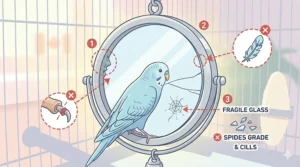
The third mistake involves product quality assumptions. Not all mirrors sold on Amazon.ca meet the same safety standards. Cheaper acrylic mirrors may contain plasticizers that off-gas in warm conditions (relevant when cages are near heating vents during Canadian winters). Glass mirrors, while clearer, shatter into dangerous shards if broken. The budget-conscious approach of buying the $5 mirror instead of the $15 premium version can backfire if quality control is poor. Check Canadian customer reviews specifically—BC coastal humidity and prairie dryness reveal durability issues that temperate-climate reviews might miss.
Should I Give My Bird a Mirror Toy? The Definitive Decision Framework
This question has no universal answer because budgie personalities vary dramatically. However, Canadian owners can use this decision framework to make an informed choice:
Decision Point 1: How many budgies do you own?
- Two or more: Mirror toys pose minimal risk. The presence of real companions means mirrors remain novelties rather than primary social outlets. Proceed with monitoring.
- Solo budgie: Proceed to Decision Point 2.
Decision Point 2: How many hours daily are you available for direct interaction?
- 4+ hours: You’re providing substantial flock presence. A mirror may serve as supplemental enrichment during your absence. Proceed to Decision Point 3 with caution.
- Under 4 hours: Mirror toys will likely become emotional crutches. Focus on alternative enrichment instead. Stop here—avoid mirrors.
Decision Point 3: Does your budgie already show obsessive tendencies?
Look for these warning signs: repetitive behaviors (pacing the same perch path 20+ times), fixation on specific toys to exclusion of others, screaming when moved away from preferred items, or difficulty transitioning between activities.
- Yes, shows obsessive traits: Your budgie’s personality makes mirror addiction highly probable. Avoid mirrors completely.
- No obsessive behaviors: Proceed to trial phase with strict monitoring.
Trial Phase Protocol:
Introduce the mirror toy for 30 minutes daily while you’re present to observe. Watch for:
- Extended staring (over 5 continuous minutes)
- Regurgitation directed at reflection
- Aggressive pecking or fighting with mirror
- Refusal to leave mirror when called
- Head bobbing or courtship displays toward reflection
If any appear within the first week, remove the mirror immediately. If behaviors remain casual (occasional glances, brief interaction), you may cautiously extend exposure to 1-2 hours daily. Never leave a mirror accessible 24/7 for solo budgies—this guarantees obsession.
Canadian owners should particularly monitor during winter months (November-March) when reduced daylight and outdoor stimulation can amplify mirror fixation. What seemed manageable in summer may become problematic when cabin fever sets in.
Are Mirror Toys Bad for Single Birds? Evidence-Based Analysis
The scientific literature and veterinary consensus lean strongly toward “yes, mirrors are problematic for solo budgies,” though not uniformly dangerous for all individuals. The Alberta SPCA’s avian welfare guidelines note that while mirrors aren’t overtly harmful like toxic metals, they can create psychological dependency that interferes with healthy behavioral development.
The key issue is emotional regulation. Single budgies with mirror access often fail to develop independent coping skills for loneliness because the mirror provides instant “companionship” whenever needed. Compare this to solo budgies without mirrors, who typically develop stronger bonds with human caretakers, engage more with diverse toys, and show better resilience when left alone. The mirror becomes a psychological crutch that prevents emotional maturity.
VCA Canada Animal Hospitals’ avian care guidelines emphasize that budgies require semi-annual veterinary checkups where behavioral health is assessed alongside physical health. Canadian avian veterinarians report that mirror-related behavioral issues (obsession, aggression, regurgitation) rank among the top five concerns raised by single-bird owners, particularly during January-March when seasonal affective patterns may worsen fixation behaviors.
Research from Omlet’s avian behavior studies notes that some European countries, particularly Germany, actively discourage pet bird mirror sales due to welfare concerns. The argument is that the lack of reciprocal feedback from the mirror reflection will slowly frustrate the budgie as it realizes this “companion” never truly responds. While Canada hasn’t implemented similar restrictions, Canadian Society for the Prevention of Cruelty to Animals (SPCA) chapters increasingly recommend foraging and puzzle toys over mirrors in their adoption literature.
The evidence suggests mirrors are not acutely dangerous—they won’t poison or physically harm your budgie. But they can be psychologically harmful when used as a substitute for proper companionship in solo bird situations. Canadian owners keeping single budgies should view mirrors as high-risk items requiring exceptional monitoring, not casual entertainment options.

❓ Frequently Asked Questions
❓ Can I use mirror toys for budgies during Canadian winters?
❓ How do I know if my budgie is obsessed with their mirror?
❓ Are there health-approved mirror alternatives sold on Amazon.ca?
❓ What's the safest mirror toy design for paired budgies?
❓ Do budgies recognize themselves in mirrors like parrots?
Conclusion: Making the Right Choice for Your Canadian Budgie
The answer to whether mirror toys for budgies safe or not ultimately depends on your specific situation, but the evidence leans heavily toward caution for solo birds and casual use for pairs. Canadian budgie owners face unique challenges—winter isolation, temperature extremes affecting toy durability, and regional availability of quality alternatives—that make informed decision-making critical.
If you’re keeping a solo budgie, prioritize alternative enrichment that provides genuine mental stimulation: foraging toys, puzzle feeders, and shredding activities that satisfy natural instincts without creating psychological dependency. The $20-30 CAD you might spend on quality alternatives delivers far more welfare value than a $5 mirror that could trigger months of behavioral problems requiring veterinary intervention.
For owners with paired or grouped budgies, mirrors can remain in the enrichment rotation as long as you monitor for territorial aggression or breeding season complications. The key is maintaining balance—mirrors as one option among many, not the primary entertainment source.
Remember that winter months amplify whatever relationship your budgie has with toys. A mirror that seems harmless in July may become an obsessive focus by January when daylight drops and outdoor observation becomes limited. Plan your enrichment strategy seasonally, increasing foraging complexity and introducing novel textures during those long Canadian winter months when your budgie needs extra mental stimulation.
Your budgie’s psychological health matters as much as physical safety. While a mirror won’t poison your bird like zinc or chocolate might, it can create emotional patterns that interfere with healthy development. Make choices based on your bird’s individual personality, your availability for interaction, and whether you’re prepared to monitor and intervene if obsessive behaviors develop. Canadian avian veterinarians stand ready to provide guidance—VCA Canada Animal Hospitals and local exotic animal practices can offer personalized advice for your specific situation.
Recommended for You
- 7 Best Bell Toys for Noisy Birds Canada 2026
- 7 Best Sturdy Swings for Heavy Parrots in Canada 2026
- 7 Best Bird Swings for Cockatiels Canada 2026
Disclaimer: This article contains affiliate links. As an Amazon Associate, I earn from qualifying purchases. If you purchase products through these links, we may earn a small commission at no additional cost to you.
✨ Found this helpful? Share it with your friends! 💬🤗
